

In true crime documentary series, evil is an anomaly. Detectives blunder, but keep investigating. Judges waver, but decide. Journalists question and ultimately discover. The truth, though hidden, can always be attained by reason. This narrative faith is also a political faith: the State exists, works, breathes.
Shows like Making a Murderer (2015), The Jinx (2015), or Mindhunter (2017-19) embody this paradigm: even as they denounce the system’s shortcomings, they do so from the assumption that it can be fixed. The audience is encouraged to piece the case back together and make judgments: to partake in the illusion of closure. Crimes are real, but they are solvable.
That illusion is not an accident: it is the result of a serialized structure designed for entertainment, a form of play. It usually opens with a hook (the crime as opening scene), recreates the preceding world (the victim as character, a stable reality on the verge of breaking), and establishes a line of inquiry, which it then turns into a ladder: testimonies, archives, expert reports. Each episode works as an act: it offers up a discovery or a suspect, shifts the blame, sows doubts, and ends with a cliffhanger—a call, a new piece of evidence, a line that reframes everything. The next episode seems inevitable. Throughout the season, they all march in lockstep: from chaos to order, from haze to transparency, from not knowing to knowing. Even if at the end there’s some ambiguity left, the overarching pattern has been fulfilled: evil has been organized, made legible, turned into a story.
This faith in closure, in the possibility of a return to order, has its urban equivalent: gentrification. They’re both fictions of hygiene. True crime purifies crime through narrative structure; gentrification purifies the urban landscape through aesthetics. In one case, justice appears at the end of the series; in the other, renovation appears at the end of the neighborhood.
Both promise the same thing: that chaos can be given shape, that evil can be made profitable.
True crime emerges in societies that believe crime is a crack in normality, an exception that proves the rule. Its narrative structure works like a manual on moral urban planning: there’s a crime (a temporary fissure), an investigation (the crew that patches the crack), and a resolution. The flawless façade has been restored. The system breathes. So does the story.
It promises truth through inquiry. Truth is not found in a victim’s suffering, but in method: the accumulation of evidence, logical reasoning, trust in institutions. The adjective “true” does not refer to moral truth; it refers to procedural truth. What’s true is that which can be proven, archived, closed. The naive illusion is that reason has no limits and can even solve the enigma of death.
However, in Latin America, the pavement is not merely cracked; it is the crack. Violence does not interrupt order; it founds it. Crime is not a splotch of paint; it is the background color. Justice does not sanitize; it manages squalor. Institutions don’t just organize the landscape. They negotiate it, distribute it, and charge for the privilege.
Closing an unsolved case is a fundamental demand of true crime. The genre needs an ending because its moral tension hinges on the possibility of reparation. There’s no catharsis without closure.
When that expectation is imported into Latin America—exceptions notwithstanding—it fails. Stories rarely end: they bleed out, mutate, and transform.
Criminals don’t appear as isolated geniuses or unfathomable monsters: they are products of the system. Evil does not shelter inside Gothic castles or psychotic minds: it operates from offices, distributes quotas, signs contracts, collects bribes. Villains don’t necessarily live in the margins. Often, they are the managers at the center of things.
In Latin America, the border between good and evil is rarely well-defined. There is no foundational social contract, no narrative where evil is framed as a deviation from order. Colonization, fragile republics, dictatorships, narcostates. A succession of broken compacts.
True crime emerges in societies that believe crime is a crack in normality, an exception that proves the rule. Its narrative structure works like a manual on moral urban planning: there’s a crime (a temporary fissure), an investigation (the crew that patches the crack), and a resolution.
I like to call this strain of documentary filmmaking—one that centers not on a mystery nor a perpetrator, but on an ever-widening wound—“documentary of loss”. It is the product of structural violence that cannot be foreclosed by verdict or narrative gesture. It forces us to contemplate harm as an almost inevitable condition rather than as an exception.
True crime demands a clear moral framework: someone acted wrongly, and someone else investigates. It works because of its trust in institutions. Even as it criticizes them, it recognizes them as boundaries.
Documentary of loss emerges wherever that clarity is not possible. Not because of a lack of violence, but due to its ubiquity. It grows wherever the state has melded with the apparatus of evil, abandoning its role as guarantor of the social contract.
In the first case, the spectator plays the role of judge. In the second, that of an uncomfortable witness. True crime soothes; documentary of loss unsettles.
In one, a detective finds an enlightening clue in a well-lit library. In the other, a mother finds a shoe in the middle of the desert.
Documentary of loss seeks permanence in place of resolution. Instead of structuring the story around the crime, it focuses on the pain of its aftermath. It seeks corporeal truth rather than procedural truth. It doesn’t ask whodunit, but how it hurts.
It is a genre of absence in lieu of intrigue. In place of the detective who reasons, the mother who searches; in place of the prosecutor, the unmarked grave; in place of the trial, an improvised altar or a wake blaring with brass.
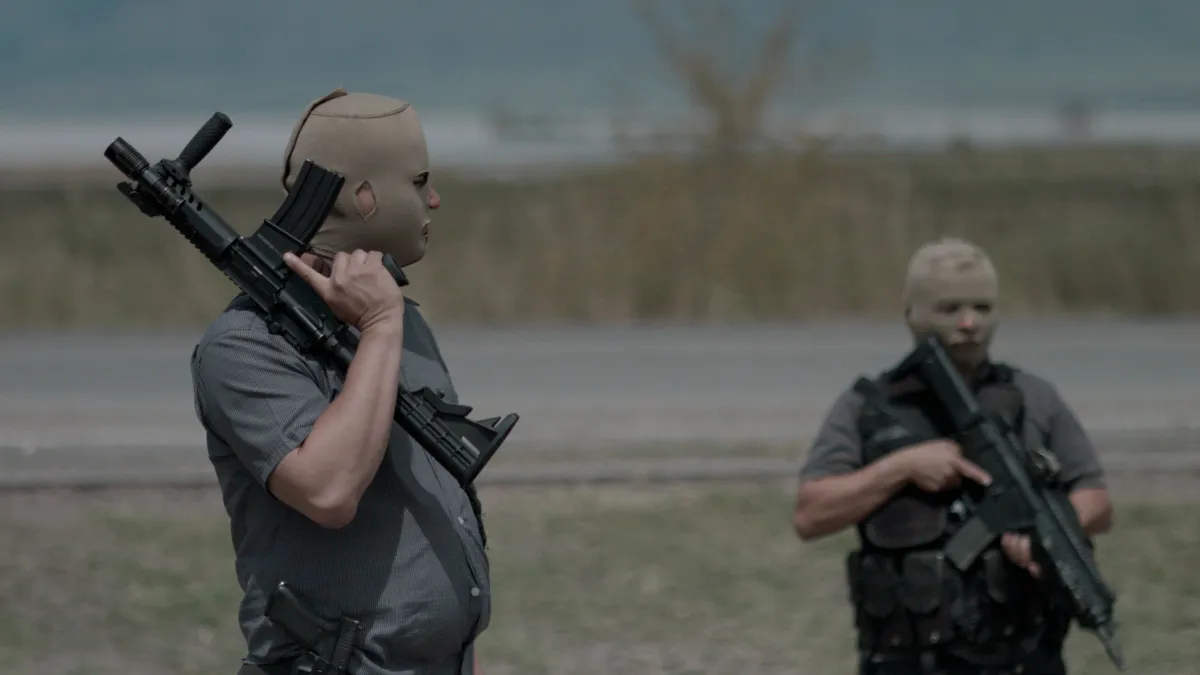
Documentaries like Tempestad (dir. Tatiana Huezo, 2016), Devil’s Freedom (La libertad del diablo, dir. Everardo González, 2017), or Armed to the Teeth (Hasta los dientes, dir. Alberto Arnaut, 2018) promise no relief, no closure. They are structured like memory: a spiral of repetitions and silences. They don’t foreclose, because the story they’re telling is still unfolding. A cinema punctuated not by clues, but by breaths.
The gentrification of memory works the same way as that of the city. It erases the uncomfortable to make it sellable. It wipes away crime to make it livable. It turns an open file into a series and absence into an ornament.
Documentary of loss rejects the refurbishing of pain. It knows there are bones hidden under the tiles, and that there’s humidity behind the fresh coat of paint. Unlike the stories that promise justice, it barely manages to name absence.
It is not a genre: it is an ethics of narrative. It doesn’t seek to explain or punish, but to attend. It doesn’t promise justice—barely memory. Its fragmentary, circular nature resists closure and the gentrification of meaning.
To tell a story without solving it gestures towards the truth.
While true crime turns atrocity into entertainment, documentary of loss turns memory into an act of resistance.
Because here, monsters are not exceptions: they are institutions. And to name the wound without embellishing it is the closest we can get to justice.
Editor’s Note: This piece was originally published as “El asesinato ameno” in Dromómanos and is here translated and reprinted for Documentary magazine.
Translated from the Spanish by Cristóbal Riego