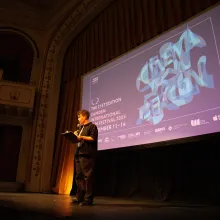

Tallinn Black Nights will be celebrating its first documentary competition, Doc@PÖFF, featuring 11 titles—all of them international or world premieres. Ahead of the festival, running this year from November 8-24, I spoke to Marianna Kaat, curator of this brand-new section. Kaat is a prominent documentary director and producer in Estonia and founded her own firm, Baltic Film Production, in 1998. Alongside filmmaking and programming, she wears many other hats, including that of documentary lecturer at Tallinn University’s Baltic Film and Media School. In this interview, Kaat unpacks the line-up of this year’s competition, its raison d’être, and the work she has carried out with her fellow programmers.
Online Feature
As a great-grandchild of Armenian genocide survivors uprooted from their indigenous lands, director Sareen Hairabedian carries a deeply personal
I first encountered the work of Milo Rau back in 2020, when his reimagining of the story of Jesus, The New Gospel, premiered in Venice. Set in the
After spending her early career making documentaries for British television, primarily for the public service broadcaster Channel 4, Victoria
In 1975, an unusual would-be presidential assassin emerged. Sara Jane Moore, a middle-aged five-time divorcee and mother of four, a suburbanite turned
In Jessica Chaney’s I Am, five Black women directly address the audience to discuss their personal struggles with mental health—a therapist and a holistic life coach are both also on hand to help contextualize their stories, to demonstrate that no one need truly be alone in their personal journeys in anxiety, depression, and more. The film seeks to break down barriers in communication around how Black women specifically suffer these issues in this country. In collaboration with the 2022 Indie Memphis Film Festival, IDA presented a work-in-progress DocuClub screening of I Am.
On March 15, 1990, French author and ethnologist Jacques Kerchache published a manifesto in Libération signed by 150 artists, scholars, and
In 1979, filmmaker Werner Herzog flies to the jungles of the Amazon to shoot a film about a turn-of-the-century rubber baron, Brian Sweeney Fitzgerald, who strives to bring Caruso’s operas to the Peruvian city of Iquitos. As Herzog is adamant the film—Fitzcarraldo (finally released in 1982)—should not rely on special effects, the baron and the filmmaker have the same titanic task ahead of them: to transport a 320-tonne steamship over a hill and gain access to a neighboring river system. Another filmmaker, the American Les Blank, has been recruited to capture the tribulations surrounding and informing this technical feat. Blank’s 1982 documentary Burden of Dreams, newly restored and re-released by Janus Films, does much more than merely observe the resurrection of Sisyphus in the modern day. It also charts, and subsequently punctures, a man’s attempts to swaddle himself in the ill-fitting garments of that myth, to ennoble his self-inflicted suffering to the history books and pave over crime with punishment.
Before A-Doc (Asian American Documentary Network) formed its roots at IDA’s 2016 Getting Real conference, there was a decades-long history of Asian
Cullen Hoback has developed something of a specialty in chasing elusive cultural figures. In his 2021 HBO miniseries Q: Into the Storm, he examined