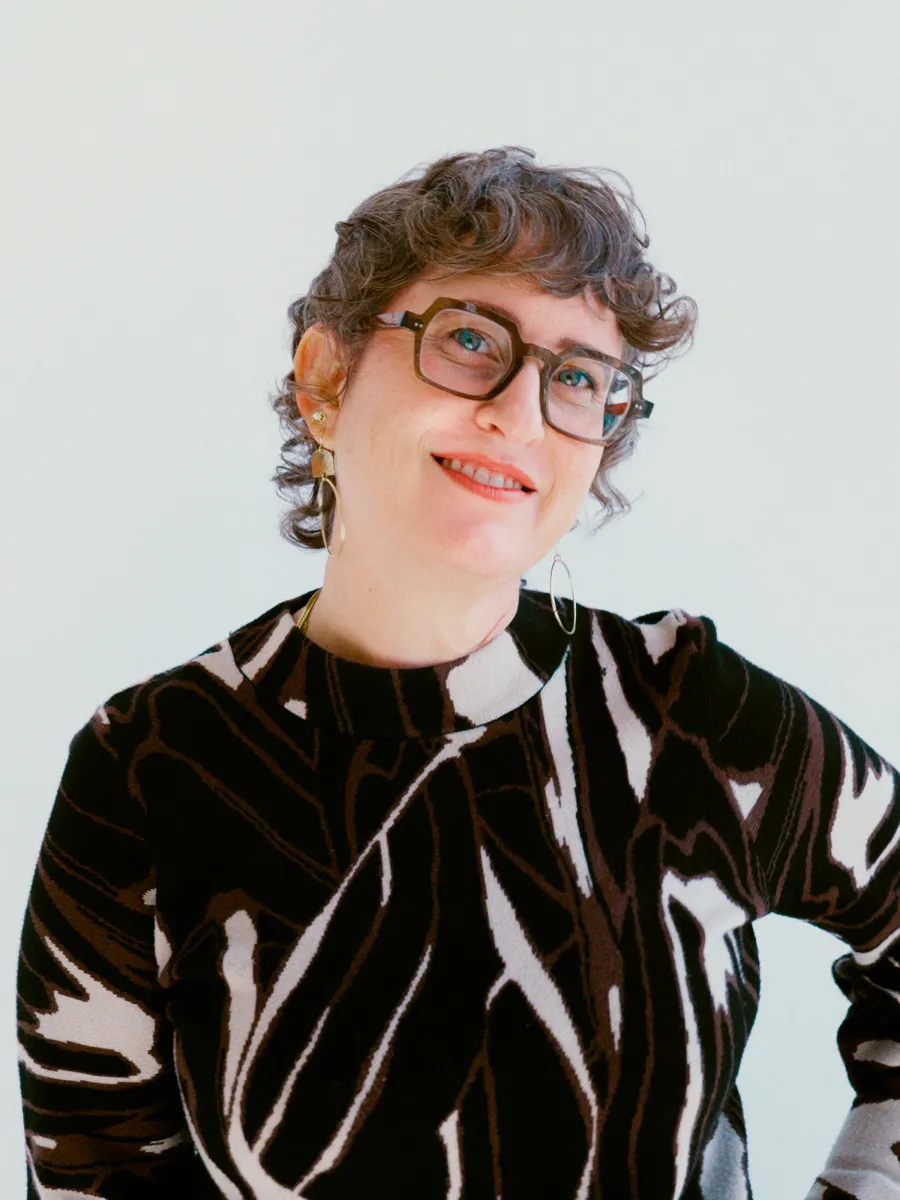
Alysa Nahmias
Alysa Nahmias is an Emmy-winning filmmaker and founder of the Los Angeles-based production company AJNA. Alysa’s directing credits include Cookie Queens, which recently premiered at the 2026 Sundance Film Festival and won the SXSW Festival Favorite Audience Award; the 2022 Emmy-winning Art & Krimes by Krimes (2021) for MTV Docs/Paramount+; and Unfinished Spaces (2011) which won a 2012 Film Independent Spirit Award, was distributed by Netflix and PBS, and is in the permanent collocation at MoMA New York. Her producing and executive producing credits include Wildcat (2022); Homegrown (2025), Unrest (2017); I Didn’t See You There (2021); No Light and No Light Anywhere (2016), among others. Nahmias is a 2026 Film Independent Changemaker Award recipient and a 2019 Sundance Momentum Fellow. She is a frequent advisor for Sundance Catalyst, Film Independent Labs, and Global Media Makers and is a member of the Academy of Motion Picture Arts & Sciences, the Television Academy, and a co-founder of FWD-Doc. She lives in Los Angeles with her partner, two kids, and one kitten.
IDA: Could you share a bit about your background and the experiences that shaped who you are as a storyteller?
ALYSA NAHMIAS: I grew up in Tucson, Arizona, in a multi-cultural family that valued creativity, storytelling, and a diversity of perspectives. I loved painting and drawing, and I loved watching movies. I knew I was an artist from a young age, but I didn’t aspire to be a professional artist or filmmaker. In college, I took studio art classes in addition to my academic courses because it took me a while to realize that being an artist could be more than a hobby for me.
IDA: You studied art and architecture. How did that background lead you to documentary?
AN: My interest in architecture arose concurrently with becoming a filmmaker. The initial spark happened on a research trip to Cuba in 2001. I was studying architecture in Havana when I met an architect who asked me to help him tell his story in a documentary. That film became my debut feature, Unfinished Spaces, a story about Cuba’s National Art School, which I co-directed with Benjamin Murray. While making that film, I fell in love with both architecture and cinema. I decided to pursue a master’s degree in architecture, which I did while shooting in Cuba during the summers. When I finished the film ten years later, the feeling of sharing it with audiences was exhilarating, and I decided to quit my job in architecture to continue making films. I felt entirely in my element with visual storytelling, especially with my foundation in art and design.
IDA: Unfinished Spaces took roughly a decade to make and went on to win an Independent Spirit Award and a place in MoMA’s permanent collection. Looking back, what did that long, uncertain process teach you that shaped how you’ve approached every project since?
AN: I would never have started my first film if I had known how long it would take and how much it would require of me. But I’m glad I didn’t know enough to stop, because I wouldn’t take back any of that journey now. I would do it again in a heartbeat. I enjoy the uncertainty of the documentary creative process. When we start, we don’t know how the story might end. At the same time, I always feel unshakable clarity about why I’m telling a story. That’s like a North Star to follow along the way. The North Star for making Unfinished Spaces was a question about whether utopia is worth pursuing, even though it’s impossible, or perhaps because it’s impossible. I wanted to explore that question, no matter where the journey took me. I wanted to go on this adventure with the people I collaborated with. Seeing how Unfinished Spaces has lived in the world and made an impact over the past fifteen years since its premiere, it’s clear that finding and following that North Star can make for a lasting work of art that transcends trends.
IDA: You move between directing your own films and producing for other directors, including Jennifer Brea on Unrest (2017) and Reid Davenport on I Didn’t See You There (2022). Whether you’re directing your own film or producing someone else’s, is there something in your approach that stays constant regardless of the role you’re playing?
AN: Whether I’m directing or producing, I like to keep in mind that it’s a joy and honor to be a storyteller. I wake up most days wanting to do the work I get to do, and that work is helping to connect and inspire others. I also like to remind myself that the best idea can — and often does— come from anyone in the room—and often from somewhere I might least expect it. Whether I’m directing or producing, I’m tuning in to make sure I don’t miss that. It might come from my own mind. It might come from anyone else on my team or even someone they meet. So it’s about being receptive, open, and inclusive regardless of the role I’m playing on a team. I try to respect everyone on the team, be true to myself, and share my ideas freely.
IDA: Your new film, Cookie Queens, premiered at Sundance and opens in theaters this August. What drew you to Girl Scout cookie season as a subject, and what did you find in that world that surprised you?
AN: When my last film Art & Krimes by Krimes premiered, my kids watched even though it’s not aimed toward young audiences. They said they liked it, and then asked me to please make my next one a movie that they’d really want to share with their friends. It felt like a compelling challenge for me, both as a director and as a parent!
Soon afterward, I heard a story about a precocious young top seller of Girl Scout Cookies. I was immediately struck by the idea that this could be an entertaining, highly visual world and an exploration of the intersection of girlhood and capitalism. I became interested in how Girl Scouts are not simply rehearsing for participation in the economy; they generate $800 million in annual cookie sales. I decided to observe how young Girl Scouts learn the rules of the economic “game” and come to understand their value within it.
I’ve been really surprised by how many women have been Girl Scouts. I wasn’t a Girl Scout, but one in three American women has been, including my mom. It’s not something people talk about all the time, but since I’ve been making Cookie Queens, of course, friends have told me their Girl Scouting stories. Whether they got kicked out of their troop for some ridiculous reason or it was the most meaningful and safe space they experienced as a child, it seems to be memorable for everyone. I’ve also been impressed by many of the troop leaders I’ve met. These people are mostly women (and some men) who volunteer an incredible amount of time and put deep care into creating real community for the young people in their lives. And this is something that young people can experience not only through Girl Scouting but sports, music, or other activities – which makes the story of Cookie Queens resonate more widely since most of the film isn’t focused on the sales but rather the coming of age stories of each girl in the context of their family and community.
IDA: What has been the Cookie Queens reception? Does it resonate with the impact you hoped the film would inspire?
AN: The impact has been amazing in a lot of different ways already since the world premiere at Sundance in January. Women and girls are seeing ourselves represented on screen as multifaceted, complex characters. Men—and not just fathers—are really appreciating the special glimpse into girlhood that they see on screen in Cookie Queens. Men in the audience say it helps them understand some of the challenges girls face in childhood, as well as the specific hard work Girl Scouts do to sell the cookies people love to eat. My brother even heard the film talked about on a Fantasy Football podcast! This actually makes sense, as cookie season is not unlike a sports season for these girls, who train hard to succeed.
It’s been exciting for me to see how many young people are coming to theaters to watch this nonfiction movie. I don’t think I saw my first documentary in a theater until I was in college. It feels impactful that Cookie Queens is bringing multigenerational audiences to movie theaters at festivals and, soon, to hundreds of theaters around the country. I enjoy hearing the kids laugh or turn to their parent to whisper something in a theater. I love it when kids ask me at Q&A’s if the kids in this film are real. I’ve had some great conversations with kids after watching this film about truth, nonfiction, and media literacy through programs like the SFFILM Festival’s education screenings and at the Girl Scout National Convention, where I previewed Cookie Queens this past week. The film is also sparking important conversations about labor rights and how Girl Scouts could be getting more money per cookie box that they sell. I’m looking forward to more of these conversations when the film is in wider release.
IDA: For our members who are eager to watch Cookie Queens and stay connected with your work, what’s the best way to see the film and follow your upcoming projects?
AN: Cookie Queens opens in about 500 theaters nationwide on August 7. It’s a wide release for any indie film, and especially a documentary. I hope people will want to watch it with their family and friends. Ticketing info is at cookiequeensfilm.com and on Instagram @cookiequeensfilm. My production company AJNA Films is at ajnafilms.com and on Instagram @ajna.films.
IDA: Looking ahead, what’s next for you? Are there any upcoming projects you’re able to share with us?
AN: I don’t like doing the same thing twice. However, I do enjoy collaborating with good people again. I have a new directing project in active development with a wonderful team that I’ll be excited to share before long. Several of the new producing projects on my slate at AJNA Films are in collaboration with directors and producers I’ve worked with on past films. I’m producing a new feature documentary with the team I collaborated with on Wildcat and fellow producer Mridu Chandra, which is currently shooting in India. Another feature doc I’m producing alongside director Todd Chandler and producers Keith Wilson, Nora Wilkinson, and Heidi Fleisher, whom I met while working on Reid Davenport’s I Didn’t See You There and Jennifer Brea’s Unrest. I’m also developing an immersive film project for planetaria with artist Janani Balasubramanian and theater producer Alyssa Simmons. I do a fair amount of executive producing and consulting work for other filmmakers around storytelling and strategy, including the recent Tribeca premiere Kids Like Me, directed by Cynthia Lowen and Jon Cohrs alongside my friend and fellow FWD-Doc co-founder Jim LeBrecht.