In December 2023, as part of the series Making a Production, Documentary profiled Meerkat Media, the New York-based cooperatively owned production company and media arts collective. As a radical experiment in shared authorship and ownership, Meerkat built a sustainable framework for making the kind of films they cared about, while still providing steady paychecks, health insurance, and medical leave to their members. Since the publication of their profile, the group has faced industry-wide challenges, including tightening budgets and shrinking opportunities. At the same time, they’ve experienced major creative high points. Over Zoom, Documentary caught up with Sterrenberg to talk about Meerkat’s recent creative highs, the challenges of balancing freelance work with collective production, and how Emergent City, which opens at DCTV tomorrow and will be broadcast on POV later this year, took shape within the group.
Latest Posts
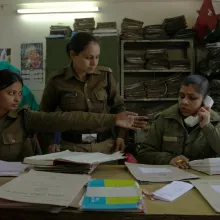
A cramped room inside which most of Marriage Cops takes place becomes an effective metaphor for not only the stifling sensation of being trapped in an unhappy marriage but also the limited scope within which the police can work. The Hot Docs-premiering documentary follows sub-inspectors Sandhya Rani and Krishna Jayara, who run the Women’s Helpline in Dehradun, India, listening to sparring couples and attempting to work through their marital issues along with a psychologist, a lawyer, and a volunteer. Behind them lie voluminous bags of paperwork and cobwebbed files. What unfolds is a bleak

Marking its 20th anniversary this edition (March 27–30, 2025), Berwick Film & Media Arts Festival has established itself as one of the UK’s most boundary-defying festivals for the moving image. This commitment to dismantling hierarchies extends to the festival’s structure. Many of the featured works explore the body’s mnemonic capacities—how gesture, movement, and touch might commune with history, or reimagine how to engage with the unknowable: Underground, Black & Arab Encounters on Screen, Bounded Intimacy, an Eri Makihara program, and Nightshift.
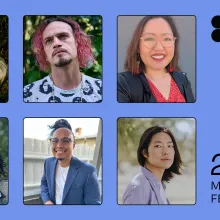
Today, BAVC Media announces the 2025 cohort of its longstanding MediaMaker Fellowship, which is known for betting on emerging artists and early projects as a “first-in” supporter. Selected filmmakers will receive US$10,000 in unrestricted funding, mentorship, industry access, feedback sessions, and workshops over the next 9 months. The Fellowship kicks off with an in-person intensive convening in San Francisco in April before continuing at select film festivals across the U.S.
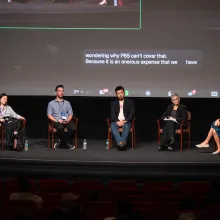
Over the past several years, when discussing the audience exodus to large platform streamers, I’ve encountered exhaustion from filmmakers, arts workers, funders, broadcasters, distributors, and exhibitors. Everyone wants to help fix the problem, but no one knows where to start. That’s because there are real issues that stack the deck against documentary filmmakers and our audiences. They can be classified into three main categories: funding, discoverability, and unequal market power.

This month, we have the great opportunity to highlight three rising stars and Northwestern University Documentary Media program graduate students: Blake Knecht, Gríma Eir Geirs Irmudóttir, and Shawn Antoine II. The Northwestern University Documentary Media Program is a member of IDA’s educational membership program , an essential program for higher education institutions that want to provide their students, faculty, and staff with access to the documentary industry. If you are interested in joining our educational membership program, please reach out to Anisa Hosseinnezhad, IDA Membership
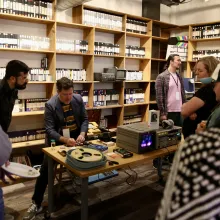
Access to archival media is often the result of the invisible work of teams of archivists and technicians who preserve content on fragile media and provide it to the public. Accessing archival media can be a financial challenge for documentary filmmakers because preservation of media is as time consuming and expensive (sometimes more) as shooting new footage. Logistically, making this material available is time consuming, expensive, and requires skilled team members to coordinate. Our upcoming research study, Mapping the Magnetic Media Landscape, a project of BAVC Media, examines U.S. collection holders’ needs and how we might support them. Because of our decades of work with and for filmmakers, we can put it bluntly: All of these costs are ultimately passed on to the filmmaker.
Sora, a new generative AI video tool from Open AI, is named after the Japanese word for sky. Is the sky the limit? Last year, the company gave early access to 300 artists, some of whom later denounced the company’s product release as artwashing. OpenAI responded with a series of exclusive promotional screenings of artist-made films for industry executives in New York, Los Angeles, and Tokyo. What might this all mean for the documentary field? We decided to run our own experiment. To test the limits of Sora, we prompted it with the taglines from the six most recent Oscar-winning documentaries. We showed the resulting 15-second silent clips to a panel of seven documentary luminaries over Zoom.
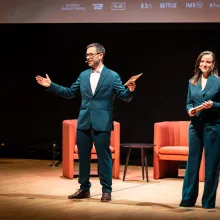
The 23rd edition of CPH:DOX wrapped last month, with record-breaking attendance and satisfied delegates at the festival’s market, but individual events at the industry conference revealed ruptures in the front of documentary unity against political threats. Filmmaker Omar Shargawi issued one of the most visible criticisms, reading a statement contrasting the festival’s support of Ukrainian filmmakers to a lack of “solidarity with the Palestinians” at an industry talk. At the closing ceremony, Artistic Director Niklas Engstrøm and Executive Director Katrine Kilgaard said their aim was “pluralism” and “to make room for a multitude of opinions and ideas, including those that challenge our own perspective as a festival.” Documentary reached out to Engstrøm for further comment via email after the festival ended.
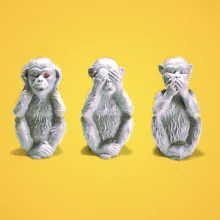
When it comes to AI and documentary, all bets are off in 2025. So, we scrapped our column line-up for The Synthesis and hit reset. To recap, it’s been a dizzying year so far: in Europe, the February Paris AI Policy Action summit failed to usher in much meaningful regulation, and in the U.S., under the new Presidential administration, a March directive from the National Institute of Standards and Technology eliminates the mention of “AI safety” and “AI fairness.” To reboot in this context, we checked in with a few documentarians, artists, and human rights advocates. We asked them this question: In this unregulated and dysregulated landscape, what are the immediate and new concerns of AI shaping the future of documentary filmmaking in 2025?