As a documentary filmmaker with one project in distribution, one in post and one in development, it felt like a perfect moment to attend IDA’s Getting Real 2018. Having more than one project to lean on, I was able to seek out industry wisdom from a variety of angles thanks to a professional development grant from the Regional Arts and Culture Council in Portland, OR, where I’ve lived since 2010. I’ve been to film festivals before and admit that I enjoy looking at massive schedules, circling too many films, and trying to get to them all. What I always forget is that ideally one does this while
Latest Posts
Screen Time is your curated weekly guide to excellent documentaries and nonfiction programs that you can watch at home. The announcement last week that WarnerMedia would shut down FilmStruck at the end of November has sent shock waves of dismay throughout the community of cinephiles. In its all-too-brief existence--it was launched in November 2016-- FilmStruck has hosted both The Criterion Channel and TCM, the former of which is a treasure trove of some of the greatest docs of all time-- Chronicle of a Summer, Dont Look Back, Harlan County USA, and so many more! So, while we’re confident that
Reenactments have been a part of documentary since the very beginning of the form: Robert Flaherty's seminal 1922 film Nanook of the North, arguably the first feature documentary, was largely staged. Since then, directors including Errol Morris, Shirley Clarke, Werner Herzog, Sarah Polley and Joshua Oppenheimer have utilized documentary reenactments to great effect. While traditional, literal-minded reenactments are often dismissed as uninspired, inauthentic and generally in poor taste—"the bane and the curse of the modern documentary film," in the words of New Yorker critic Richard Brody—more
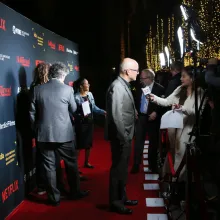
IDA has unveiled the nominees for the 2018 IDA Documentary Awards. The annual event is the world's most prestigious event dedicated to the documentary genre. Winners of the 34th edition will be announced at the ceremony on Saturday, December 8, 2018 at Paramount Studios, Los Angeles.
Screen Time is your curated weekly guide to excellent documentaries and nonfiction programs that you can watch at home. In 2014, 276 Nigerian school girls were kidnapped from a school in Chibok, Northern Nigeria and hidden in the vast Sambisa Forest for three years by Boko Haram, a violent Islamic insurgent movement. A year ago, 82 were released. Gemma Atwal's Stolen Daughters: Kidnapped by Boko Haram, which premieres October 22 on HBO and streams on HBO Go and HBO Now through October, tells the story of the girls’ time in captivity and follows their lives over the past year. Native America, a
Essential Doc Reads is a weekly feature in which the IDA staff recommends recent pieces about the documentary form and its processes. Here we feature think pieces and important news items from around the Internet, and articles from the Documentary magazine archive. We hope you enjoy! The Guardian's Steve Rose assesses the plethora of Trump docs as the midterm elections loom. Rather than a test for Trump’s presidency, this could turn out to be a testing time for documentary itself. The intention for these films to sway hearts, minds and voting intentions. But let’s also admit that Trump sells
Alain Resnais said about Night and Fog, "I want to address the viewer in a critical state…to create a space for contemplation." In the Getting Real session entitled "Creative Courage in Nonfiction Storytelling," filmmakers Yance Ford, Jenni Olson and Jennie Livingston showed us how to do just that. Taken together, their personal essay films—Ford's Strong Island, Olson's The Royal Road and Livingston's work-in-progress, Earth Camp One—reflect many of the formal choices that distinguish Renais' film. He insisted on concentration camp inmate and poet Jean Cayrol as the author of the narration
Alexandria Bombach's On Her Shoulders opens with a scrum of photographers. Everyone is trying to get the shot. Many are going for selfies. They want to share the frame with a notable person. For the first few moments, we cannot see who the center of attention is. A young woman emerges from the crowd. This is our first glimpse of 2018 Nobel Peace Prize Laureate Nadia Murad Basee Taha. We see her next in a quiet moment, writing in a notebook. We learn that Nadia is a Yazidi survivor of ISIS genocide and sexual slavery. This juxtaposition—the mass of media demanding access set against the young
Getting Real 2018 used complementary sessions to examine documentaries as tools for public knowledge and action as well as the policies, best practices and standards that enable documentary-making and distribution. In her "mini-keynote" that she delivered the day before "The Role of Documentary in the Public Sphere," ITVS CEO Sally Jo Fifer called on the field to project the standards and values of independent documentary in an increasingly commercialized, dynamic and blended marketplace by holding true to the long-held commitment to diversity, equity and inclusion. "Our purpose stays clear
Part home movie, part activist doc, Rudy Valdez's The Sentence is that rare film that can bring even the most jaded filmgoer (yes, that would be me) to tears. Indie cinematographer Valdez spent nearly a decade shooting hundreds of hours of footage to create a portrait of his own close-knit family in the aftermath of his sister Cindy Shank's incarceration—the consequence of what's colloquially referred to as "the girlfriend problem." Shank, who'd never before been in trouble with the law, was sentenced to 15 years—the mandatory minimum—on conspiracy charges after her boyfriend, a drug dealer