

Editor’s Note: On July 21, 2026, Sarvnik Kaur led a workshop at IDA’s Getting Real conference in Los Angeles titled “Who Do You See? Casting as Recognition.” Moderated by Brigid O’Shea, the workshop drew on Kaur’s experience finding subjects for her documentary projects, guided by an open curiosity and a quest for freedom.
This text has been edited for publication in Documentary.
I want to begin with my grandmother.
She raised four children in Delhi in the late 1950s, in real poverty—the kind that comes after Partition, after displacement, after losing everything your family had built across generations on the other side of a border that didn’t exist until it suddenly did. There was very little money. There was no comfort to speak of.
But once a month, on a Sunday, she would take her children on a picnic. She’d tell them they were going to a foreign country and that they would be taking an airplane.
She would walk them to the RBI building—the tallest building in Delhi at that time—and she would put them into the elevator, which was the airplane, and they would ride that rickety lift up to the twelfth floor to “Singapore,” where she would buy them a ten-paisa thali—subsidized meals—as their picnic lunch in a foreign land.
It wasn’t true. None of it was true. And yet.
My father grew up to be one of the most joyful people I have ever known. He complained constantly about his parents—lovingly, warmly, with the particular intimacy of someone who felt genuinely held by the people he was complaining about. Something in him was formed by magic. By the insistence that even inside misery, the imagination could travel.
My mother was raised differently. Strict. Disciplined. Dutiful. She worked with a kind of soldierly determination that brought our whole family to a materially better life than either of my parents had known. I am genuinely in awe of what she built. But she was anxious. She disconnected from her own family the moment she married. She never complained about her childhood—she idealized it. But something essential had been trained out of her. The capacity, maybe, to ride a rickety elevator to Singapore.
I tell you this because I think it is the first film I ever watched, and why I make the films I make.
I also tell you this because I am my mother and my father simultaneously. I dream of owning a house. I also dream of Singapore. And I have never fully resolved which dream is more embarrassing to admit.
I’ve spent a long time understanding why I’m drawn to the people I make films about. And the most honest answer I can give you is this: I am looking for freedom.
Not political freedom. Not freedom as ideology or argument or manifesto. But elemental freedom—the kind that lives in a person’s body, in how they move through the world, in what they are simply not afraid of. The kind my grandmother somehow managed to pass through a rickety elevator to her children.
When I find someone who carries that kind of freedom, something in me recognizes it immediately. I feel drawn toward them the way you move toward warmth. I can’t always name it at first. But I feel it.
I’ve come to understand that this recognition—that pull—is the beginning of every film I’ve made.
I’ve spent a long time understanding why I’m drawn to the people I make films about. And the most honest answer I can give you is this: I am looking for freedom.
—Sarvnik Kaur
When people ask me about how I find my characters, I want to be honest with you about something. I don’t think of it as casting at all. Casting implies that you arrive with a role, and you find the person who fits it. You have a story, and you need a protagonist. You have a theme, and you need a face.
That is not what I do. And I would gently suggest it is not the most interesting way to work in documentary.
What I do is closer to recognition. I am looking for a specific quality in a person. And when I find them, something in me—the part formed by my grandmother’s stories, by my father’s warmth, by every moment I’ve spent with people who carry abundance where the world expects lack—knows.
***
The quality I am looking for is this: someone whose inner life runs on a different operating system from the world around them. Not someone who is rebelling against that world—not an activist, not a protestor, not someone with an argument to make. But someone who is simply, quietly, stubbornly living by a different logic and a different understanding of what a good life is. And crucially, someone the world around them has misread—or is punishing, or simply cannot understand.
The first person I found like this was Rakesh. He is a Koli fisherman in Mumbai. The Kolis are the indigenous fishing community of Bombay—they were there before the city, before the reclamation, before any of it. Rakesh fishes in shallow water the way his father fished, the way his grandfather fished. Small catches. A small boat. A small income.
When I first met him, he said something to me that I didn’t know what to do with. He said, “A Koli man will never go hungry. All he has to do is step into the sea to feed his family.” I was flummoxed. Here was a man with no toilet in his house. And he was speaking to me with the calm confidence of someone who has never once doubted his place in the world.
I thought it was posturing. I thought—and I’m embarrassed to admit this now—that it was the bravado of someone who hadn’t yet accepted his own precarity. I was reading him through the logic of the modern world, which told me that a man with no toilet and a small catch is a man in trouble.
I was wrong.
What I eventually understood—and it took time, it took staying, it took watching—was that Rakesh was operating from something the modern world had largely forgotten, a knowledge of abundance that has nothing to do with accumulation. A faith in the sea, in the universe, in the community that had always held him. He wasn’t performing confidence. He was simply free from the fear of scarcity. He was, I realized, my grandmother’s child. Not literally. But essentially.
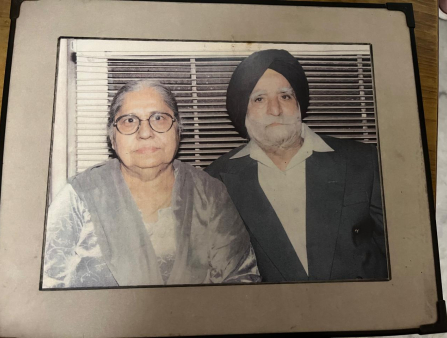
Sarvnik Kaur’s grandparents, Anand Kaur and Saranjit Singh. Courtesy of Sarvnik Kaur
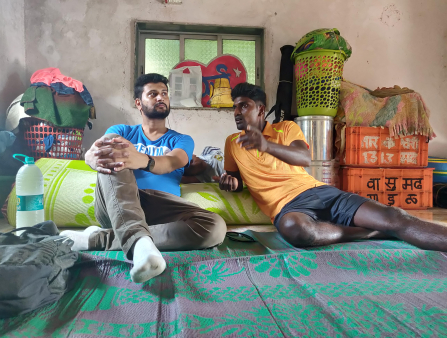
Protagonists Ganesh and Rakesh at Rakesh’s house. Photo credit: Sarvnik Kaur.
And then I looked at his closest friend, Ganesh. Ganesh, who had gone to university in Scotland and had come back with big boats and advanced technology and a vision for modernizing the entire Koli fishing community. Ganesh, who was by every measurable standard more successful, was terrified.
Not because his business was failing—though it was. But because he had been educated away from the knowledge Rakesh still carried. He had learned to measure himself against his father-in-law’s success, against the market, against the yield from his last expedition. He had learned scarcity. And once you’ve learned it, it is very hard to unlearn.
That gap between Rakesh’s abundance and Ganesh’s fear became the film Against the Tide (2023).
The single moment that made everything worth it. Not the awards, not the distribution deals, not the thirty-six festival prizes (all of which I remember less clearly than the five times we didn’t win). It was watching Rakesh’s truth shine inside Ganesh’s logic. Despite the impossibility of it. That’s what I was there to film. Not the crisis, but the survival of something inside the crisis that the crisis could not touch.
***
There is a story I keep returning to.
A wise man lived in a jungle with his parrot. He loved the parrot deeply and feared that one day a birdcatcher would come and trap it. So he taught the parrot to sing a warning every day, in every tree:
“The birdcatcher will arrive with his trap. He will put bait in the net. But don’t fall for the bait. Remember: it’s a trap.”
And then one day, a birdcatcher arrived in the jungle. He heard the parrot singing its warning and thought, This bird is too smart for my net. I’ll never catch it. And with despair in his heart, thinking of his hungry children at home, he cast the net anyway.
And the parrot—hopping from branch to branch, singing about the trap, completely aware, fluent in the language of resistance—hopped right in.
I am the parrot. You are the parrot. We are all the parrot.
We know about the net. We can describe it in detail. We teach workshops about it. We write grant applications that name it, theorize it, and propose to make films about it. And then we hop right in, singing.
This is not a counsel of despair. The parrot’s singing was not wasted. The awareness was not useless. It’s just that awareness alone is not immunity. And pretending otherwise—performing a kind of enlightened exemption from the system while also depending entirely on the system—is its own kind of trap.
The only honest position, I have come to believe, is to be in on the joke. To know you’re the parrot. To sing anyway. To hop into the net sometimes and out of it other times, and to stop pretending you have a formula for which is which.
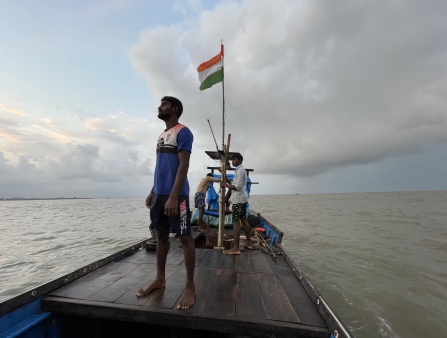
Rakesh on his boat at the his fishing spot near his village. Photo credit: Sarvnik Kaur.
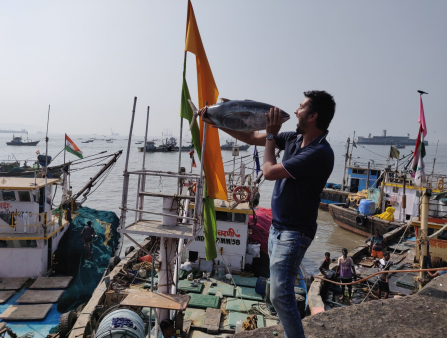
Ganesh holding a tuna at Sassoon dock Mumbai. Photo credit: Sarvnik Kaur.
I was at an awards ceremony some years ago. A filmmaker—Asian, successful, genuinely talented—won a significant prize. And in his speech, through real tears, he said he hoped his mother was finally proud of him.
And I looked around that room full of documentary filmmakers, and I thought, We are all, every single one of us, unloved children. Not literally. Not always. But in some essential way—the way that chooses this particular path, this economically irrational, institutionally punishing, personally exhausting way of moving through the world—we are people who are trying to be loved by the largest possible audience because somewhere smaller that love felt insufficient or conditional or simply hard to trust.
And I say this not to pathologize us. I say it because I think it’s the most useful thing I can tell you.
Because if that’s true—and I believe it is, at least partially, at least for me—then the films we make are not just about our subjects. They are also always about us—our search, our wound, our version of the elevator to Singapore.
And the characters we choose are not just people with good stories. They are people who carry something we are looking for ourselves; some form of freedom we have not yet found; some way of being in the world that doesn’t require external validation to feel real.
We make films to find that. And sometimes—not always, but sometimes—we find it. And in that moment, it doesn’t matter how many awards you won or didn’t win. It doesn’t matter what the sales agent said. It doesn’t even matter whether your mother is proud.
It matters that Rakesh’s truth shone inside Ganesh’s logic. Despite the impossibility of it.
That was enough. That was the whole thing.
I am looking for the person who is living without fear in a world organized around fear. The person who carries an older knowledge—ecological, ancestral, intuitive, relational—in a world that has declared that knowledge obsolete. The person whose life takes me from facts to the attitudes those facts engender. The person who shows me not what is happening but what it feels like to be a particular kind of human being inside what is happening.
I walk the path of least resistance. I don’t convince people to be in my films. The right person is already moving toward being seen. My job is to create the conditions in which they can finally be seen as they actually are.
And my first read is always wrong, always contaminated by the very logic the film is trying to question. The dissonance—the person who confuses you, who seems to have less and feel like more—is not a warning sign. It is the signal.
When someone breaks your categories, stay.
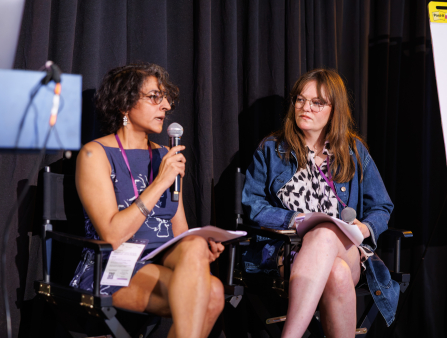
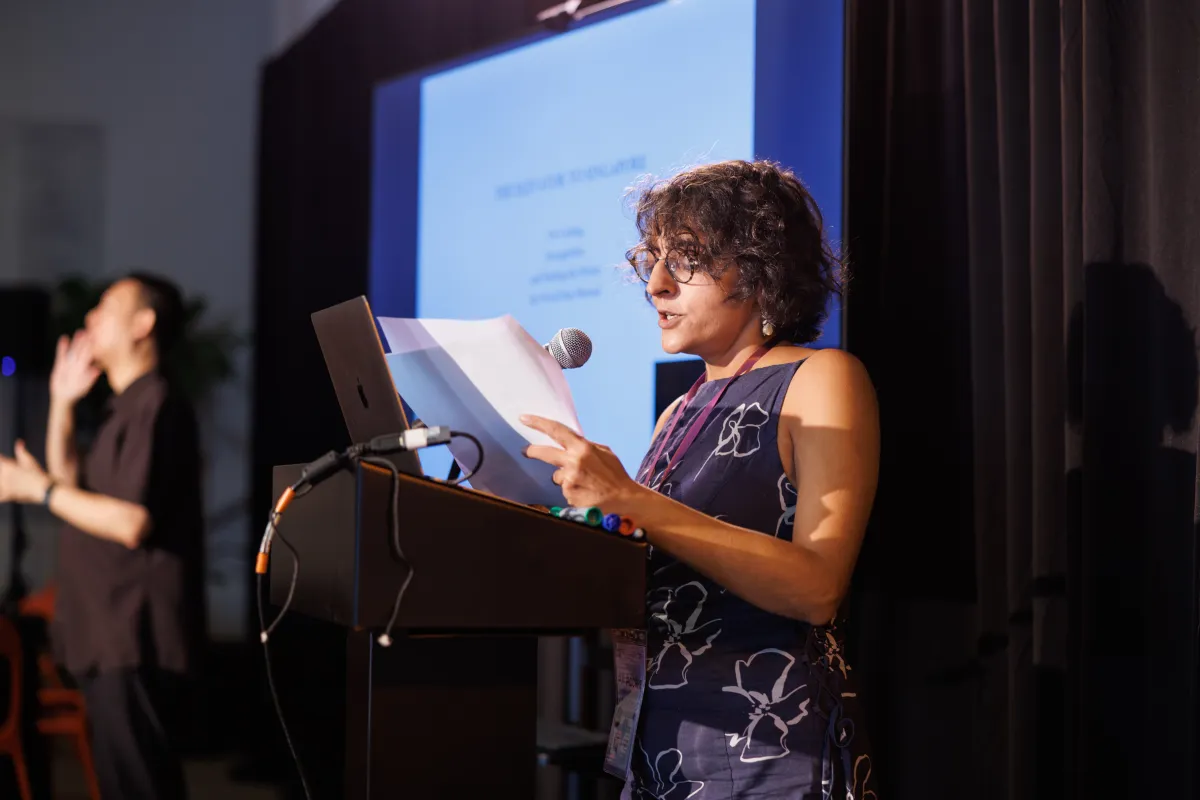
Sarvnik Kaur and Brigid O’Shea at Getting Real ’26 in Los Angeles, CA, July 2026. Photo credit: Urbanite LA.
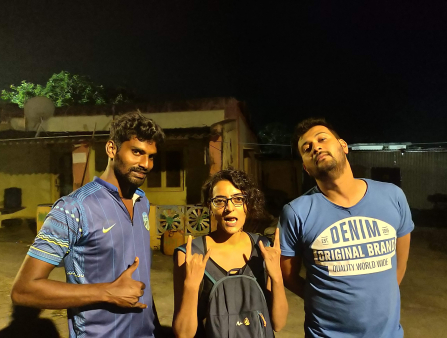
(L to R) Protagonists Ganesh and Rakesh pose with director Sarvnik Kaur. Photo credit: Moinak Bose.
But I want to end with something more concrete than technique. I want to end with what I wish someone had said to me: “It’s messy. There are no templates. Anyone who tells you otherwise is either lying or hasn’t made enough films yet.” The funding is uncertain. The process is grueling. The system is designed to make you conform—to know your ending, to have your budget, to deliver your impact outcomes, to make yourself legible to people who need you to be one thing when you are always, necessarily, at least two.
You will be the parrot sometimes. You will hop into the net while singing about the net. You will apply for grants from institutions whose values you privately question. You will make compromises you didn’t plan to make, and some of them will be fine, and some of them will cost you something real.
You will win awards and remember the five you didn’t. You will have friends who call this an “expensive hobby.” You will wake up some mornings, reach for your phone, and feel, before anything else, dread.
And it is still worth doing. Not because it changes policy. Not because it shifts the needle on measurable outcomes. Not because it wins at Sundance (though winning at Sundance is genuinely wonderful and I am not going to pretend otherwise).
It is worth doing because the search for Rakesh is also a search for the Rakesh in yourself. Because making films about people who refuse to let the dominant logic be the only logic is also a way of refusing to let the dominant logic be the only logic. Because the craft of observing life so deeply that you begin to find reflections of it everywhere—in your subjects, in yourself, in the room you’re sitting in right now—is not just a filmmaking skill. It is a way of staying human in a world that is working very hard to make that difficult.
We are all mirrors of each other. Rakesh is Ganesh is me is you. The freedom we find in our subjects is also the freedom we are practicing in ourselves. The mess we forgive in them is also the mess we are learning to forgive in ourselves.
That’s not a methodology. There is no box for it on the grant application. But it is, I believe, the only reason any of us are actually here. My grandmother knew that. She pressed the button on a rickety elevator in Delhi and sent her children to Singapore.
I’m still riding that elevator. I hope you are too.