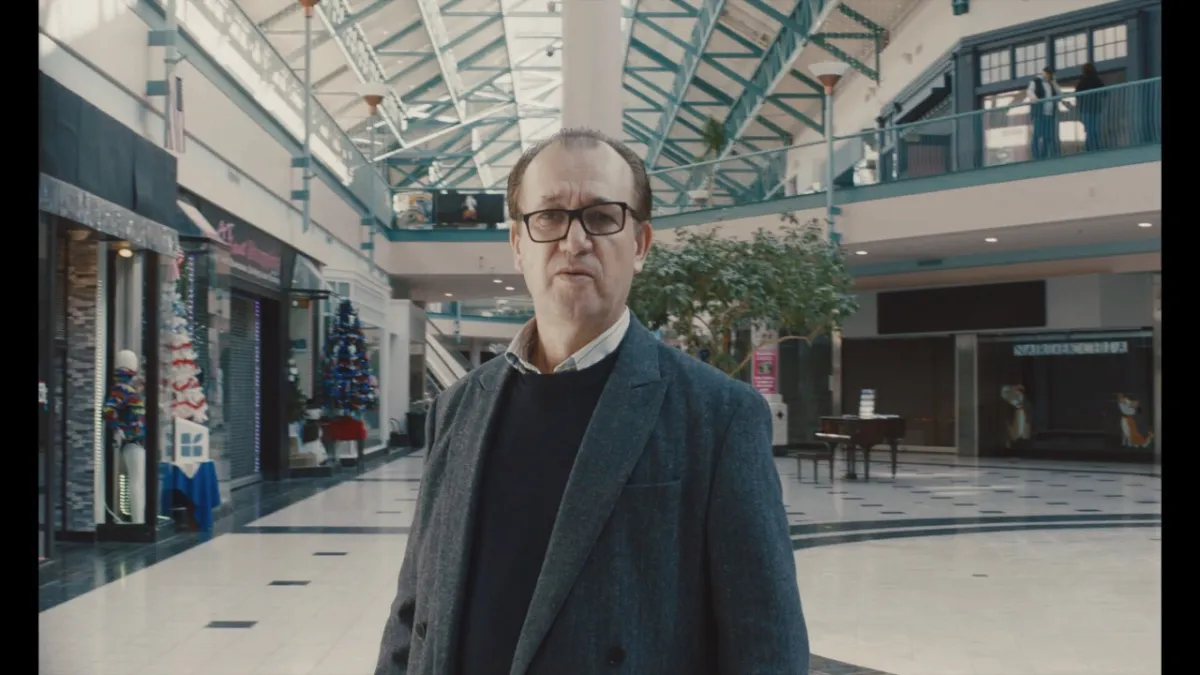


When Albanian immigrant Leo Karruli bid to purchase the Johnstown Galleria in an online auction, he didn’t actually expect to win. After thriving when it opened in 1992, the two-story facility in rural Pennsylvania had fallen into the “dead mall” zone—low on tenants and visitors, visibly decaying, with no working escalators and seemingly no path to bring the space back to life.
Mall Country, Brian Becker’s first feature as a solo director, follows Karruli over the course of 2024 as he strives to bring vendors and customers back. When we first meet him, he’s bustling with optimism, showing the space to a potential renter and eagerly pointing out the scant quantity of mall walkers as evidence of high foot-traffic potential. He’s an almost impossibly benevolent landlord, throwing his back into every aspect of the mall, repairing its malfunctioning HVAC system and Muzak machine and even briefly functioning as the chef for The Italian Oven, a mall-redux Olive Garden, when its longtime owner retires and sells him the business.
Scored by soft-rock staples including When in Rome’s “The Promise” and Orchestral Manoeuvres in the Dark’s “Souvenir,” Mall Country frames its vérité portrait of a year in the life of a mall with archival context. That includes not just footage of malls in their ’80s heyday but the story of Victor Gruen, an Austrian immigrant who first conceived of the shopping mall as a potential suburban analogy to the Viennese town square he grew up in, and who grew to loathe and reject his legacy’s consumerist corruption. As with Becker’s first feature, Time Bomb Y2K (co-directed with Marley Macdonald, 2023), an all-archival history of the race to solve the Y2K problem, Mall Country is aware of the inherent comedy of dated fashions without exploiting them for easy laughs.
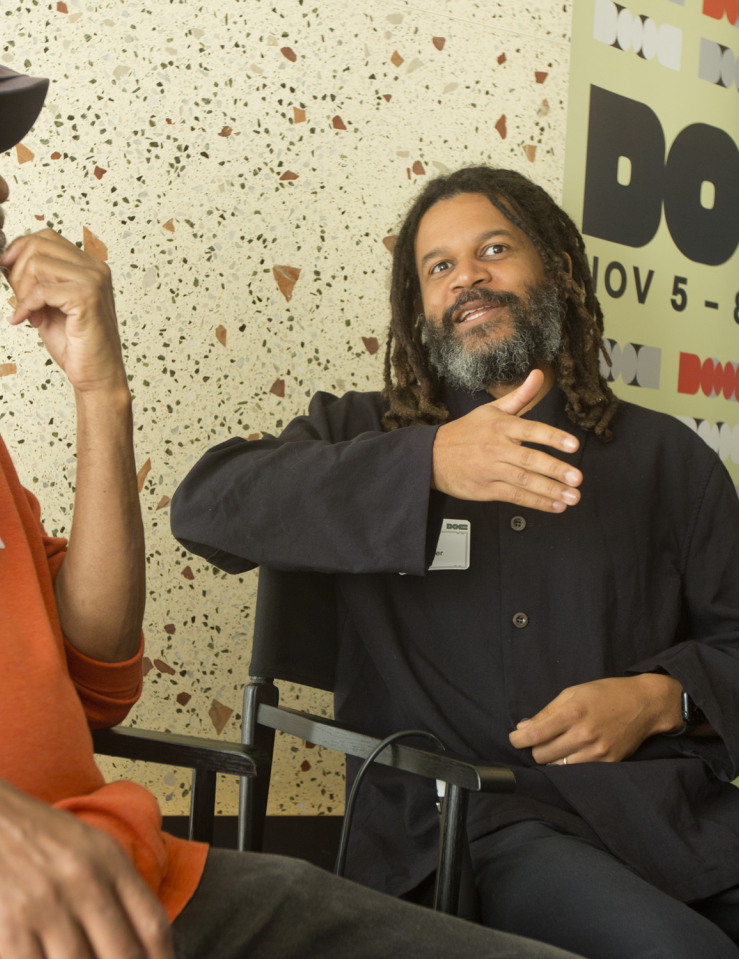
Prior to the film’s world premiere at DOC NYC, I spoke to Becker while in Austin—itself once mall country, now watching a similar die-off of those spaces. The following interview has been edited for length and clarity.
DOCUMENTARY: Did you know that you wanted to make a dead mall movie and then find one, or did you find the dead mall and then figure out what a movie about that could be?
BRIAN BECKER: I wasn’t interested in making a film about dead malls. I did a bunch of archival digging and wanted to find a present-day story to tie some of the archival together—a mall that wasn’t completely dead and abandoned, or a total consumerist success, but that existed somewhere between those two poles. So, I set a Google alert for the word “mall” and watched for three-and-a-half years as the nation’s mall news trickled into my inbox every day. One day there was an article about Leo and the Johnstown Galleria—this guy bought this mall somewhat accidentally, in an online auction he didn’t expect to win, ended up as the owner, and thought that by taking a new, more community-focused tack, he could save it from dying. I instantly knew after one Zoom call with him that this was the story I wanted to follow for a year. Then, after a day of filming with him at the Johnstown Galleria, I realized this would be a much more vérité film than I’d initially conceived.
DM: What happened on that first day?
BB: There’s quite a bit of footage from that first day, especially in the first act. Leo gives this tour to a guy, and midway through, a mall walker walks by, and you see him in this total—I don’t want to say “hustler mode,” but he was actively trying to fill the mall around the clock, bouncing around and taking care of all these tasks. At one point, he went to go fix an elevator himself. People in Johnstown talked about Leo as more than just a mall owner, sort of like a mayoral figure for the Galleria ecosystem—a lot of malls are owned by massive real estate holding companies.
Leo is rare in that he owns the Galleria outright and could give us full permission to film there. There were not eight levels of bureaucracy. This guy was willing to let us observe everything.
—Brian Becker
DM: Simon is the one I know down here. They’ve got a mall where there was a shooting a few years ago.
BB: This is a sad truth of America: where people tend to gather in groups, you get shootings, so when I set the Google alert, there were quite a number of shootings, and also mundane business dealings. Leo is rare in that he owns the Galleria outright and could give us full permission to film there. There were not eight levels of bureaucracy. This guy was willing to let us observe everything, whether it was him in his office, giving tenants tours, or fixing an HVAC unit. That access was apparent from the start, when he literally gave us the key to the mall and told us to come and go whenever we pleased. That was a huge factor, and his ability to conjure real belief from those around him in his mission to save this place showed we were dealing with a legitimate character, someone who could actually achieve some success. He had already been bringing business back to the mall, taking this anything-goes approach where there were really no rules about what could happen there. There’s not a bunch of chain stores; there’s a roller rink, a bunch of mom-and-pops. As a dork about architecture and civic space, I thought he was embodying some of the most forward-thinking ideals about communities determining spaces, but he wasn’t some MIT professor. He just has an open-minded view towards the people around him and what the space could be.
DM: Another archival dimension is the larger story of malls in America and Victor Gruen. How much of that were you aware of when you started thinking about this project?
BB: I start my projects with a real deep research phase, and the research for this project began back in 2020.
DM: So this is, in a way, a pandemic project.
BB: Pandemic project number two after Time Bomb Y2K. I have a drive of archival projects I was working on while cooped up in my apartment during the pandemic. One of those was Time Bomb Y2K; there was this project, and there’s probably four or five others. The history of malls was much more fraught and surprising than anticipated, especially the case of Victor Gruen, a socialist who fled the rise of Hitler and designed malls inspired by the town square in Vienna, from which he was forced to flee. I kept bumping into these strange idiosyncrasies in the history of the mall, but also realized that a survey of mall history wasn’t necessarily the most exciting project to pursue. I was more interested in how malls were initially conceived as a place for individuals to come together, and also in ways in the present that, in being forced to redefine themselves, they’re kind of coming back around to the ideas that Gruen initially had. A lot of malls are being turned into housing, parking lots, parkland.
We were most interested in tracing through archival sources the lived, on-the-ground experiences of people, especially young people, going to malls over time.
—Brian Becker
DM: I want to ask about the one chunk of archival that conspicuously is not in the film, which is any kind of montage of mall representation on screen. I’m sure you thought about it. Did you attempt cutting something together like that,or did you just take it off the table conceptually to begin with?
BB: Dawn of the Dead [dir. George Romero, 1978] and the Monroeville mall, which is an hour-and-20-minute drive west of the Galleria, loomed large in our heads. I think we cut something together at one point and ultimately discarded it. We were most interested in tracing through archival sources the lived, on-the-ground experiences of people, especially young people, going to malls over time. The mountain of archival material we were able to pull provided a real taste of what it was like to go to the mall from the ’60s up until the present.
DM: Tell me about finding that mountain of archival.
BB: The Galleria itself was tricky to find footage of. Johnstown still has a handful of local affiliates, some of which have maintained archives, so there is some footage of the Galleria which we licensed from the local network. I received a travel grant to go to Victor Gruen’s archive, which is held at the University of Wyoming’s American History Center, so I spent an incredible three days in Laramie going through his archive. I also traveled to his daughter’s house in Western Massachusetts and spent a day in her basement picking out Super 8 reels to transfer based on Victor Gruen’s hand-scrawled notes.
Similar to Time Bomb Y2K, I was blessed by the international lens on a particularly American phenomenon. There’s quite a bit of footage from a film called Mall Time [dir. George Haggerty, 1988]; I worked directly with the living members of that team to source the material. There’s this incredible 1982 CBS TV special, After the Dream Comes True, that operates at the level of a documentary. They filmed in a mall in Overland Park, Kansas, at the height of the mall boom. We sourced all the outtakes from that, which were held in CBS’s archive in Metropark, New Jersey—20 minutes from where I grew up, walking around malls often—so that felt like a very personal and fitting find. There’s footage of the first mall in Southdale, Minnesota, which Victor Gruen designed, sourced from a combination of material we got from the Minnesota Historical Society, Gruen’s daughter Peggy, and the corporate archive of Gruen Associates, the architecture firm, which is still extant and operating in Los Angeles.
The style that we shot in mirrors the experience of drifting through a mall where you stop and linger in certain places, then bounce around in circles from one place to another.
—Brian Becker
DM: How many years did you shoot, and how often did you go back?
BB: I shot for a year throughout 2024. We went once or twice a month for a few nights, and I would orient the shoots around an event, whether it be July 4th fireworks or trick-or-treating inside the mall, then bracket a couple of days just sticking with characters and filming them without a specific event. During December, [my cinematographer] Melissa [Langer] and I essentially moved to a town right next to Johnstown and filmed in a more concerted manner, with less specific plans regarding events or narrative moments. I think we got some of our most special footage just from being there so consistently throughout that month. Largely, Melissa shot it. When she was booked on other projects, I worked most frequently with Nellie Kluz and Nick Ramey, who are both great DPs in their own right.
DM: The visual language is a little bit locked off, and you tend to keep it that way if you can. What kind of conversations and reference points did you have to establish when the camera moves, when the camera doesn’t move, and how it does or doesn’t do both of those things?
BB: I was really intrigued by Melissa’s body of work, because she’s both a director in her own right, making more formally controlled and locked-off work—she recently made a film called In Excess [2025] that I liked a lot—but she also was a DP on a Netflix series, Cheer [2020]. I was interested in landing in a middle zone between some of her more formal work and these really sensitive, handheld shots that she got on Cheer. Visually, when we were locked off, we tried to lean upon the architecture of the Galleria to help frame our shots. We were blessed with a mall that really hasn’t changed in appearance since it was built in 1992: the columns are still seafoam, the floor is still checkered, the Muzak machine is still largely functioning.
Leo was constantly running around the mall, fixing one problem or another, cooking in the Italian Oven, taking a meeting. We filmed a bit more handheld, often tilting the camera up slightly to give Leo this King of the Mall appearance, but also being very attentive to detail when he had to go run and take care of an HVAC unit. Ditto for teens moving through the mall. Yes, they would sit down in the food court, but they’d also run around and go roller skating in the rink. I think the style that we shot in mirrors the experience of drifting through a mall where you stop and linger in certain places, then bounce around in circles from one place to another.
Early on, I spoke a bit with the DP of Mallrats [dir. Kevin Smith, 1995], David Klein. We were shooting on these Super Speed lenses, and I was like, “I bet Mallrats was shot on these Zeisses.” After a shoot, I was really curious if I got it right, so I wrote him, and he confirmed it was shot on Super Speeds. My inner New Jerseyan felt very validated. When I was a teen, we either walked in circles around the baseball field or, if it was cold or raining, walked in circles around the shopping mall, and it wasn’t because I’m a shopaholic. It was because there was nowhere else to go and do nothing. The means by which teens can take a space designed for capital and turn it into a hangout was interesting to me.
I don’t want to fall too hard into the nostalgic zone, but the canon of mall films certainly loomed in my head while making choices about score.
—Brian Becker
DM: Time Bomb is about a problem that actually existed, which required cooperation and a high degree of technocratic coordination in order to solve. The implicit message of the movie is that this will never happen again because we’re in a huge mess and nobody knows how to do that anymore. I don’t know that this film is optimistic, but it’s like this project that crystallized as an emblem of dead-eyed Reaganite America has become, in the absence of other options, a public forum for non-corporate businesses.
BB: For a long time I was studying the intersection of the built environment and mosquito ecology, and I was very interested in the ways in which the built environment civically functions. There are articles all the time about how Gen Z is bringing malls back—they’re really interesting spaces that could have all this potential other than just being empty and depressing if mall owners took a more open-minded approach to how they could function. This is maybe a bad analogy, but I grew up skateboarding. You see ledges, and you’re like Oh, I could do this trick—at this point in my life, I can’t do this trick anymore, but if we could look at civic spaces and think of ways in which to utilize them in a manner for which they were not intended but that better serves people, I think that’s an interesting lens through which to see these hulking masses of concrete and glass.
D: Let’s close by talking about nostalgia both texturally and musically. How do you calibrate making the footage work on its own terms without sinking into the pit of, like, “Big hair in the ’80s!” I’m also interested in how the songs work as synecdoches for the ’80s.
BB: On day one, there was a literal Muzak machine playing music over the PA system. I think of Muzak as a genre, but Muzak is a corporation. There’s this zone of ’80s soft sax music that feels fitting for this film, and I wanted to use some of these films, like Mallrats or Clueless [dir. Amy Heckerling, 1995] or John Hughes films, as a stylistic jumping-off point that could inform this much stranger and idiosyncratic story. I don’t want to fall too hard into the nostalgic zone, but the canon of mall films certainly loomed in my head while making choices about score. I also wanted to find songs that felt as if they could play throughout the Galleria through the Muzak subscription. Occasionally, one song would pop up in the mall, and it was like, “Oh yeah, gotta add that to the playlist.”