



In recent years, films from Cinema-ye Azad (“Free Cinema”), an underground Iranian filmmaking movement active between 1969 and 1979, have gradually re-emerged after decades of obscurity. Produced on 8mm and Super 8 in cities, villages, and peripheral regions throughout Iran, these works survived in scattered, fragile condition following the dissolution of the movement around the 1979 Revolution. Many remain lost, damaged, or inaccessible, while others are only now being rediscovered and digitized through ongoing independent archival efforts in Iran by Hadi Alipanah. Recent programs at London’s Institute of Contemporary Arts and Bristol’s Cube Cinema have introduced some of these works to UK audiences for the first time, while an expanded selection is being presented at the UCLA Film & Television Archive, bringing this largely unseen body of films into wider international circulation.
Founded by Basir Nasibi in 1969, Cinema-ye Azad grew from a small initiative in Tehran into a nationwide network of more than twenty offices stretching across Iran. During its decade of activity, the movement produced over 1,000 short films and several feature-length works by roughly 300 filmmakers. Many participants were students, amateurs, or self-taught artists who shared equipment, technical knowledge, and resources, creating an alternative filmmaking infrastructure that operated largely outside both commercial cinema and state institutions. More than just a filmmaking movement, Cinema-ye Azad functioned as a cultural network, organizing cine-clubs, workshops, festivals, publications, and eventually international exchanges that connected young Iranian filmmakers to broader currents of amateur and experimental cinema.
The movement was profoundly shaped by the ideas of Nasibi, who was himself deeply influenced by filmmaker and poet Fereydoun Rahnema. Rahnema understood documentary cinema not simply as a means of recording reality, but as a way of entering into contact with one’s surroundings. His influence, alongside the experimental filmmaking of Nasib Nasibi (Basir’s brother) and the interdisciplinary milieu surrounding poetry and theatre groups, helped shape Cinema-ye Azad’s understanding of cinema as an exploratory practice. Younger filmmakers were frequently encouraged to begin with documentary filmmaking, not because it was considered easier, but because it taught them how to look: how to approach unfamiliar environments, establish relationships with people, and discover narratives emerging from the world itself.
The 8mm camera itself became central to this relationship. Unlike larger 16mm or 35mm setups, which required crews, lighting, preparation, and considerable intrusion into a filming environment, the lightweight 8mm camera allowed filmmakers to move through villages, homes, ceremonies, streets, and workplaces with minimal disruption. Scarcity was not simply a limitation to be overcome but one of the conditions that shaped the movement itself. Working with minimal resources forced filmmakers to invent new solutions, embrace technical imperfections, and develop forms adapted to the possibilities of the format. Their camera behaved less like an instrument of registration than a curious presence searching, wandering, and attempting to understand.
This intimacy shaped the formal character of many Cinema-ye Azad documentaries. Behnam Jafari’s Wandering in Tehran (1969), made when he was seventeen, records the city not through the lens of modernization or official urban transformation, but through the subjective perspective of an adolescent drifting through Tehran’s streets. Naser Gholamrezai’s Winter is Coming (1972) follows villagers in Lorestan preparing for the harsh winter ahead, while Bahaa Taheri’s Dolce Dooz (1973) documents a craftsman whose traditional labor has been rendered increasingly obsolete by industrial products. These are not films that position themselves above their subjects. Their relation to reality is horizontal rather than hierarchical.
Scarcity was not simply a limitation to be overcome but one of the conditions that shaped the movement itself. Working with minimal resources forced filmmakers to invent new solutions, embrace technical imperfections, and develop forms adapted to the possibilities of the format.
This is further evident in the way Asghar Javid, in The Day After the Rain (1975), takes his camera into the flooded alleyways of his hometown of Ardabil, capturing a raw portrait of everyday life unfolding around the temporary streams and pools of water filling the streets and alleys. Ardeshir Shalileh in Until Evening (1974) creates a Sisyphean narrative out of a single day in the hard life and labor of a young blacksmith, while Amir Zargan in Felt (1976) shows less interest in documenting the actual process of felt-making than in the physicality of the felt-makers’ bodies and the texture of their everyday lives.
What distinguishes many Cinema-ye Azad documentaries from institutional documentaries produced by Iranian National Television or the Ministry of Culture and Arts at the time is not merely their choice of subjects but the mode of attention they bring to them. Official documentaries often approached villages, labor, rituals, or regional traditions through the frameworks of modernization, folklore, or state representation. Cinema-ye Azad films, by contrast, dwell within the everyday realities of communities that remained largely absent from official images of the country, revealing people, places, and ways of life that were often overlooked or considered peripheral. Many Cinema-ye Azad documentaries were made in regions left behind by Iran’s rapid and uneven modernization, where older communal structures and rhythms persisted alongside abandonment, migration, and historical rupture. In these spaces, the separation between different spheres of existence—labor and ritual, daily survival and metaphysical belief, communal memory and material reality—often appears less compartmentalized than within modern urban life. The films formally reproduce this instability. Documentary observation gradually drifts toward poetry, abstraction, or myth because reality itself appears layered, haunted, and internally unstable.
This exploratory tendency becomes especially evident in films produced outside Tehran during Iran’s rapid, uneven industrialization in the 1970s. While some films centered on young people confronting migration, labor, or economic precarity, others focused on elderly people, laborers, women, children, and communities living through the transformations reshaping provincial life. Across these works, modernization appears less as triumphant progress than as a process producing dislocation, abandonment, and historical suspension.
Another Season.
Dokhtarbas Didn’t Want to Be Alone 2.
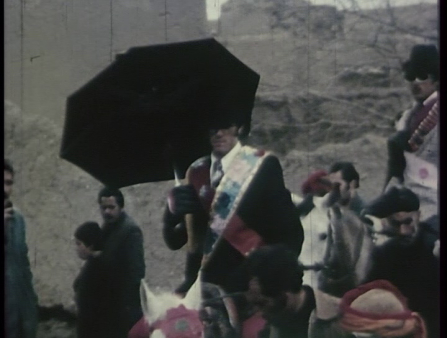
Tazieh.
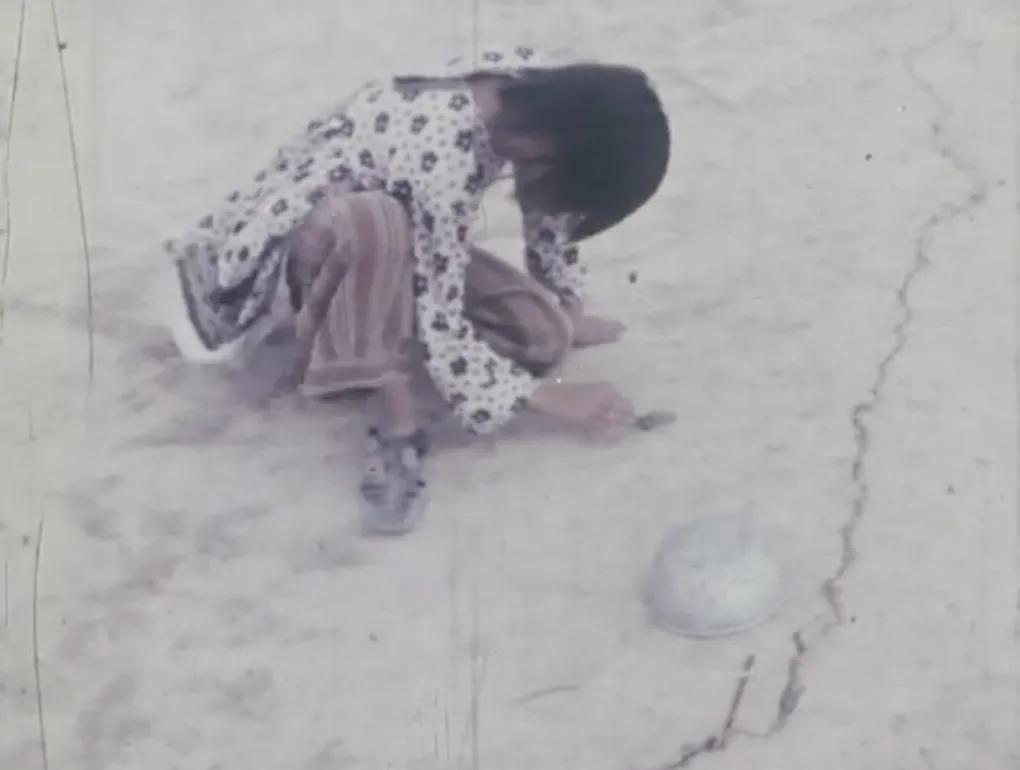
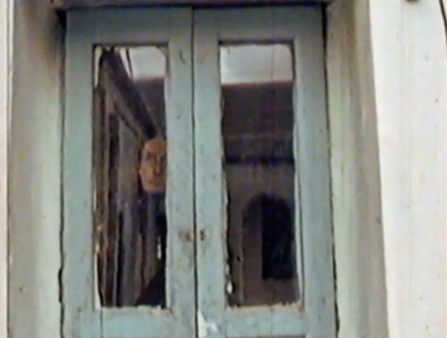
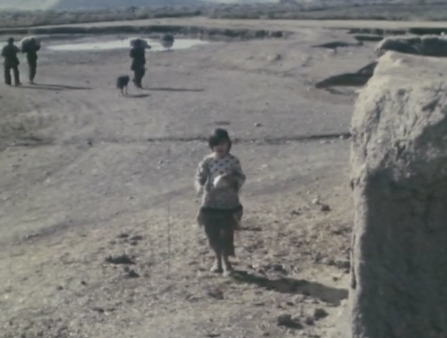
This historical condition gives many of the films their distinct atmosphere. In Another Season (dir. Zaven Ghokasian, 1975), an elderly woman drifts through empty spaces haunted by the absence of her dead son. In Dokhtarbas Didn’t Want to Be Alone (dir. Naser Gholamrezai, 1974), the narrative premise—a young girl searching for a frog believed capable of healing her father’s wound—functions less as a dramatic structure than as a pretext for observation. The film oscillates constantly between documentary and fiction, following gestures, movement, windows, landscapes, and solitary existence without imposing psychological explanation upon them.
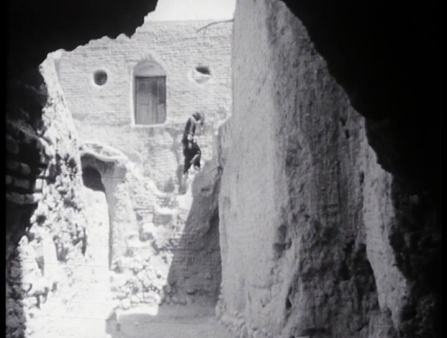
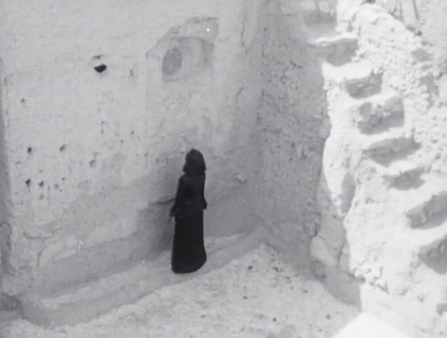
Although not officially part of Cinema-ye Azad, Nasib Nasibi’s From Isfahan to Abarkooh (1970) crystallizes many of the tensions that would later recur throughout the movement. The film begins within a largely documentary register, observing caravanserais, desert landscapes, ruined architecture, and everyday life in remote regions of Iran. Yet gradually it moves elsewhere. A little boy wanders through abandoned spaces while the voiceover evokes forgotten myths and buried histories. Dark wells, arches, cracks, and openings recur throughout the film like thresholds between visible reality and mythic memory.
A materialist approach to ritual appears in Tahmasb Solhjou’s Tazieh (1976), which documents the Shiite passion play less as a sacred spectacle than as a communal performance. Through restless handheld camerawork and rapid editing, the ceremony often feels more like a carnival than a moment of spiritual transcendence. Participants wearing sunglasses, top hats, or carrying umbrellas while reenacting historical figures are repeatedly foregrounded, emphasizing the ritual’s strange anachronisms and collective improvisations. Rather than imbuing the event with mystical reverence, the film situates it within the rhythms of ordinary communal life. Images of the surrounding landscape and open sky continually interrupt the ceremony, grounding ritual within material existence rather than transcendent spirituality.
This tendency reaches extraordinary intensity in I Behold the Sleepers Upon the Dusty Tapestry of the Earth (Kianoush Ayyari, 1979), filmed in the aftermath of a devastating earthquake. Bodies are unearthed from rubble while survivors wander through landscapes marked by devastation and mourning. The stench of death appears almost palpable through the screen itself. Yet the film continually interrupts these scenes with images of flowers, gardens, birds, and children’s playgrounds. A corpse wrapped in white cloth is carried across the frame before a graphic match cut transforms the image into white pelicans gliding through water. The result is less a journalistic record of catastrophe than a meditation on mourning, disappearance, and the thin boundary separating life from death.
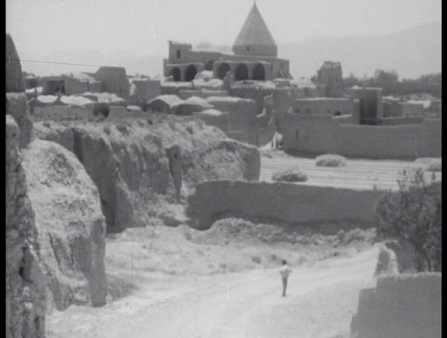
From Isfahan to Abarkooh.
The same conditions that enabled filmmakers to move through neglected spaces and produce intimate records of everyday life also contributed to the fragility of the films’ survival after the movement’s dissolution. Without institutional preservation structures, many films became scattered across private collections or disappeared altogether. Today, the ongoing recovery and presentation of Cinema-ye Azad mirrors the ethos of the movement itself: improvised, collective, and sustained largely through independent labor. Over the past decade, Alipanah has tracked down surviving filmmakers and their families across Iran and abroad, locating prints, documents, photographs, and other materials preserved in private homes and personal collections. Gradually, these fragments have been digitized and reassembled into a history that never benefited from systematic preservation.
The films survive not in a centralized archive but across dispersed, often precarious collections. Efforts to preserve them continue to face significant obstacles, including limited access to professional 8mm film-scanning equipment, scarce financial resources, and the broader constraints facing archival work in Iran. Yet much remains lost, inaccessible, or undiscovered. Through the growing circulation of these works, we hope not only to reintroduce them to contemporary audiences but also to contribute to their long-term preservation and eventual restoration. What survives today are fragments of another Iran—images, gestures, landscapes, and ways of life that continue to re-emerge, piece by piece, from the margins of history.