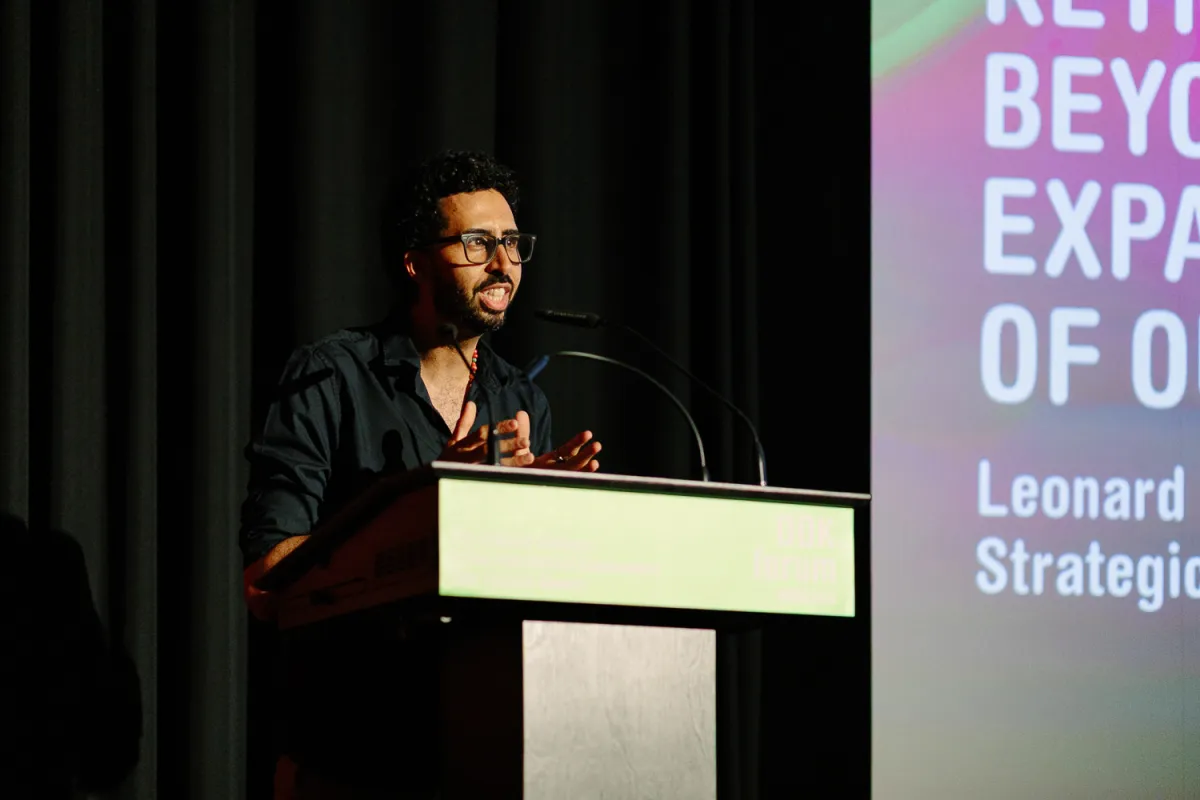


Editor’s note: On May 8, 2026, Leonard Cortana delivered a keynote address at DOK.fest Munich at the University of Television and Film (HFF München) titled “Beyond the Pitch: Rethinking Our Rituals Toward Expansive Living Archives of Future Dialogues.” Ahead of the festival’s Master’s Pitch, Cortana drew on his experience to map out a new way to approach these spaces at forums and festivals.
This text has been edited for publication in Documentary.
First, I would like to thank the organizers for curating such a welcoming space. This stage, made to look like a warm cosmopolitan living room, is a space where we can listen, digest, recommend, challenge, and hold stories together. Organizing a pitch session is, in itself, an act of hospitality. And the fact that we are gathered within a university reminds us that cinema is also a space of education: a place where knowledge is not only transmitted, but collectively shaped.
This idea of hospitality has stayed with me. One of my favorite definitions describes it as “providing a home away from home.” If we look at European cinematic traditions, documentary and comedy often revolve around hospitality: the guest who disrupts the host’s rules; the encounter between nationals and foreigners; the discovery of the world through the gaze of those who must adapt to it. In that sense, hospitality is never neutral. It is a negotiation of power, perspective, affect, and transformation.
Rather than speaking about hospitality only as a concept, I would like to participate in its practice. I hope to contribute to the curation of this shared space by inviting another presence into the room: the voice and legacy of South African singer, activist, and exile Miriam Makeba.
Makeba was living in exile after the apartheid government in South Africa revoked her passport because of her outspoken opposition to apartheid. Her exile transformed her into one of the world’s leading cultural ambassadors for African liberation struggles. Her song “Lumumba,” written for her grandson named after Patrice Lumumba, is a tribute to the first democratically elected Prime Minister of the Democratic Republic of the Congo. Lumumba became a symbol of African independence and Pan-Africanism after leading the Congo to independence from Belgium in 1960. Only months later, he was overthrown, arrested, and assassinated in January 1961. Written and performed by Makeba, the song mourns Lumumba’s death while celebrating his enduring legacy as a fighter for African liberation. The song says:
Each day brings more joy
Oh Lumumba
That’s my little boy
I named him after the great man (yeah)
Who fought for the liberty of the Congo
Patrice Lumumba
A-ha O Lumumba
May his spirit live on
In my little boy
The song became part of the broader cultural memory of decolonization, preserving Lumumba's name and ideals through music at a time when official narratives often sought to silence them. As this song accompanies our pitch sessions over the coming days, I hope it carries with it the spirit of Miriam Makeba: a space shaped by the resistance of African women, the celebration of our ancestors, respect for migrants and those living in exile, and a commitment to intergenerational solidarity and remembrance.
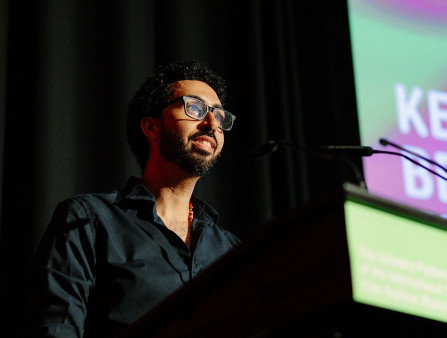
DOK.forum Master’s Pitch, DOK.fest München 2026
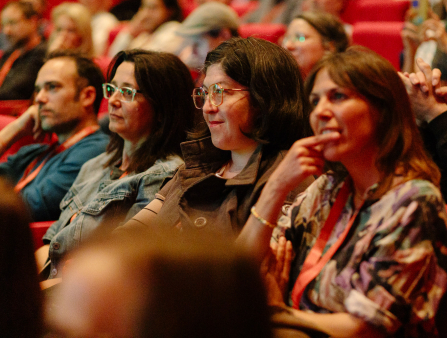
If hospitality is about creating the conditions under which people can truly encounter one another, then it is also sustained through the rituals that give shape to those encounters. Every community develops them, and our industry is full of them: rites of passage that we are constantly asked to reproduce, as though we were all living through a perpetual coming-of-age story. Yet rituals only matter if they can be questioned, improved, and reinvented. Otherwise, they become habits rather than acts of meaning.
Seventeen years ago, when I landed my first job in this field as an assistant programmer, my boss asked me to call a sales agent for a Greek project we had selected. At the time, my English, and frankly theirs as well, was somewhat approximate, and I thought they had said “sails agent,” as in someone organizing cruises. So I enthusiastically called a travel company and started looking for the best cruise deal, thinking how poetic it would be for the Greeks to arrive at the festival by sailing across the Mediterranean.
Rather than correcting me, my boss simply kept repeating: “You know, Leonard, I meant the one who brings all the catalogs to the roundtable.” As if that ritual alone could define an entire profession. And I should apologize to all the sales agents in the room, because I now know they do much more than bring catalogs to tables.
That misunderstanding stayed with me because, in many ways, it revealed what our work is really about: navigating rituals.
Since then, I have moved through many festivals, often smaller ones that are sometimes labeled “B” or “C” festivals, though I prefer to think of them as spaces of exchange and transformation. I have witnessed how our rituals are constantly reimagined across cultures: from networking meetings held in Scandinavian saunas, to Q&As hosted in private homes with small audiences to protect politically sensitive films in Rio’s favelas; from the creation of safe changing rooms at the entrance of festival venues designed to accommodate diverse gender expressions at queer film festivals in North Africa, to screenings followed by dawn discussions with Indigenous communities where ancestors are acknowledged before engaging with images.
I have even curated screenings where the electricity failed, and we simply continued by recounting the film through memory and voice, while gunshots outside punctuated our fabulated imaginaries.
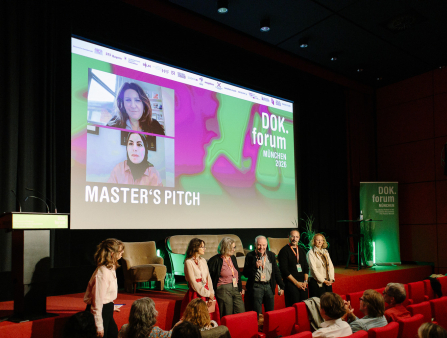
DOK.forum Master’s Pitch, DOK.fest München 2026
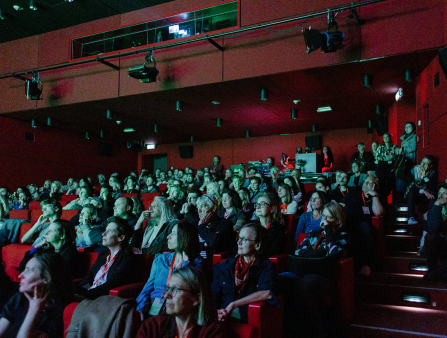
Later, I returned to academia, beginning my doctoral studies at New York University, to question the very essence of these rituals. I was fortunate to do so with the support of many mentors, including professors Robert Stam, Faye Ginsburg, and Marina Hassapopoulou, among many others, who shared with me a transnational and intercultural curiosity to better understand our film and industry worlds, our narratives, and the rituals through which we make sense of them. My research focuses on the legacies of assassinated activists, on how memory travels transnationally, on how different art forms transform and extend their intellectual contributions, and on the ways in which impact continues to shape documentary cinema as a form of legal evidence, thereby reopening trials. It traces how images, from drawings by Holocaust survivors to contemporary testimonies, have entered judicial processes.
It also examines the history of the Q&A as a cinematic practice. In the early years of cinema, religious authorities often framed post-screening discussions as exercises in moral correction, intended to prevent the perceived corrupting influence of on-screen “sins” from extending into the household. By the 1930s, with the rise of the star system, post-screening conversations shifted their focus. Q&As rarely addressed the film itself; instead, they became opportunities for audiences and journalists to discuss actors’ upcoming projects while probing the most intimate details of their private lives.
After the Second World War, however, the Q&A became increasingly politicized across many parts of the world. Moderators were often selected not simply to facilitate discussion but to use films as pedagogical tools to teach audiences the national values believed to have been eroded by the war. These conversations encouraged viewers to reconnect with often carefully constructed narratives of national identity, positioning the post-screening discussion as a method for cultivating the ideals of the “good citizen.”
I have also come to understand that inclusion is too often perceived, especially in Europe, as a moral diktat and obligation rather than an invitation to creativity, curiosity, and joy.
One of my most powerful experiences took place in Colombia during the Truth and Reconciliation Commission’s film exhibition work. An audience sat frozen before a military commander who admitted responsibility for the deaths of thousands of people. No one spoke. Everyone felt.
Later, in an interview, one of the curators shared with me that a member of his own family had been killed by that armed group. Suddenly, the meaning of that silence shifted. For him, and for me, the ritual had been transformed by memory.
If documentary cinema carries these rituals, then it also carries the responsibility to transform them and to allow those who have long been positioned as “guests” to teach us new ways of hosting.
We have structural barriers. The urgency of visas, who gets access and who does not, should remain one of our priorities, alongside funding and mobility. These barriers still limit the presence of Global Majority voices in juries, panels, and decision-making spaces.
And of course, there are also narrative constraints. I remember being told in Congo that some foreign mentors advise filmmakers: “Make a miserable first film, and then you will earn the right to make the second film you actually want.” And, as we all know, there is often no second film despite the absolute thirst of audiences to see other narratives. As if the first film, the film of wounds, urgency, and survival, could never heal itself through another narrative. These economies of expectation shape not only which stories are told, but how they are told.
Having spent the past few years thinking about inclusive models in the documentary industry, I quickly realized that you are not going to become everyone’s best friend. Yet I have also come to understand that inclusion is too often perceived, especially in Europe, as a moral diktat and obligation rather than an invitation to creativity, curiosity, and joy.
And this is a contradiction.
As the title of this keynote suggests, our rituals are the expansive archives of our future dialogues. And they invite us to rethink some fundamental questions.
We work in an industry that constantly engages with stories from all over the world, yet struggles to fully embrace the diversity it already encounters.
Think about it: in how many professions can you spend the morning watching a film from Southeast Asia with its creators, have lunch with filmmakers from the MENA region, discover stories from Central America in the afternoon, and end the evening in conversation with Indigenous filmmakers from North America?
So inclusion is not only ethical. It is also creative.
As the title of this keynote suggests, our rituals are the expansive archives of our future dialogues. And they invite us to rethink some fundamental questions:
How do we approach visuality for audiences who do not experience images in the same way?
How do we use existing technologies, subtitles, transcriptions, multilingual access, and accessibility tools to expand who can engage with films?
How do we create spaces where gender non-conforming people feel safe? And I am not only speaking about gender-neutral bathrooms, but about recognizing that cinema itself has always challenged, disrupted, and queered our understanding of the world. So why should heavy societal and non-creative norms dominate these spaces?
It is a big mission, and I would like to propose the beginning of a solution inspired by Agnès Varda and her concept of cinécriture, or “film writing.” For Varda, writing a film is not limited to dialogue or script. It is the improvisation of an actor, the movement of a camera, the rhythm of editing that shapes a continuous rewriting of meaning.
We are invited to co-design spaces where hospitality is not simply a concept, but a practice, one that truly takes into account the positionality, abilities, vulnerabilities, and realities of everyone present.
Today, we are also rewriting together. We write through how we design these spaces, how we listen, how we question, and how we hold each other’s stories. We enter and exit these rituals, learning, as I have learned, from different cultures of hospitality within the industry. At a time when documentary is expanding into the broader field of immersive media, and when we coexist with AI, video games, virtual realities, and new forms of storytelling, we are invited to imagine the most inclusive form of this cinécriture.
We are invited to co-design spaces where hospitality is not simply a concept, but a practice, one that truly takes into account the positionality, abilities, vulnerabilities, and realities of everyone present. To echo another of Varda’s metaphors: if every film character is a landscape, then perhaps our rituals can become sunrises, moments of opening, in a world that often feels as though it is moving toward darkness.
Many of us have, at some point, sat in a pitch session and felt something shift: an energy, a story, a voice that stayed with us and pushed us to create, to act, or simply to listen differently.
So, to all the filmmakers pitching:
Inspire us.
Invite us into your worlds.
Become the hosts of our shared hospitality experience.
Help us make this space as hospitable as your stories.
And let us transform this moment together into a space where togetherness is not a branding concept, but a sometimes difficult, often uncomfortable, yet necessary practice of education, dialogue, and empowerment.
Because, in the end, there is only one way to open landscapes within people: to open, widely, the imaginaries of our minds.