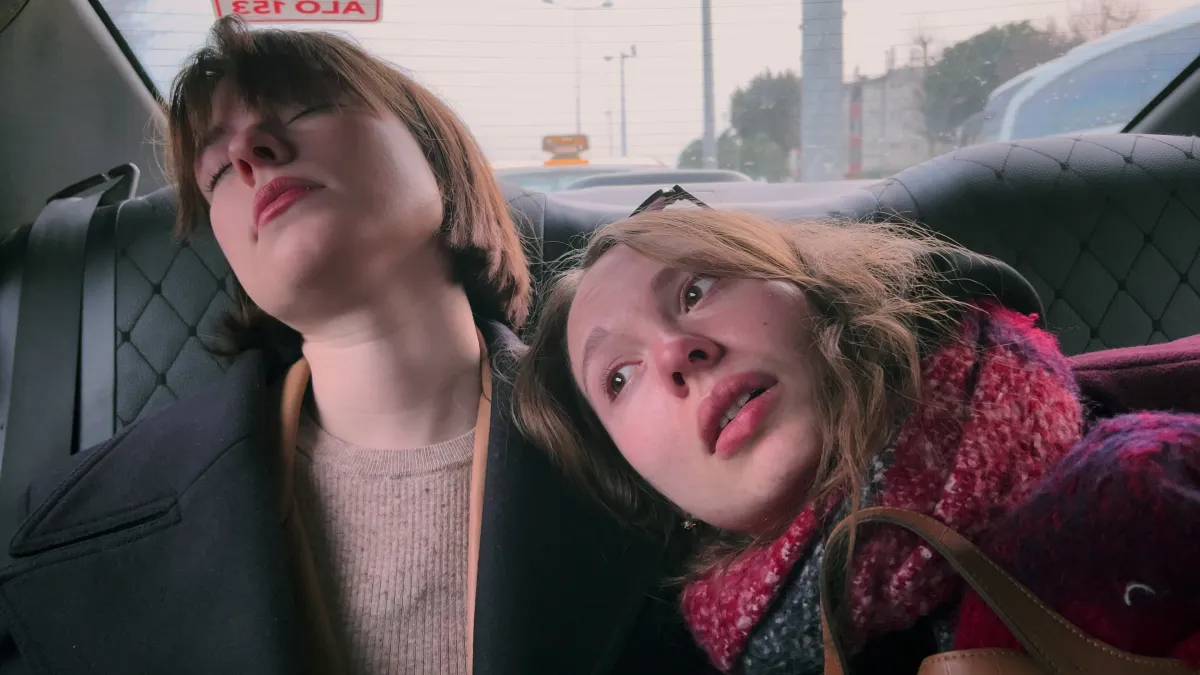


Julia Loktev’s NYFF and Venice-premiering My Undesirable Friends: Part II – Exile is, like last year’s NYFF-premiering My Undesirable Friends: Part I – Last Air in Moscow, a brutally riveting five-chapter epic that follows a group of Russian independent journalists branded traitors and terrorists in the eyes of the Kremlin. Primarily female, they risk everything to report on Putin’s corrupt regime and his senseless war in an effort to simultaneously save Ukrainian lives and free their own propaganda-run homeland.
As we learn from the opening text onscreen, this latest installment begins just two days after Last Air in Moscow ended, and also that a week before it was still possible to live in Russia and tell the truth, but now it seems “unimaginable this world ever existed.” Thus, Loktev decides to follow her “undesirable friends” as they dash to the airport, often on an hour’s notice, and into the great unknown of forced exile. In the process, she’s able to intimately document the new surrealities of daily life, like trying to stay under the radar of Kremlin assassins while finding a partner on Tinder.
Just prior to the NYFF debut of My Undesirable Friends: Part II – Exile, Documentary caught up with the acclaimed narrative and nonfiction filmmaker, who spoke about everything from shooting (in Prague, Tbilisi, Amsterdam, Riga, Kyiv and NYC) her abruptly rootless, peripatetic protagonists on an iPhone, to how Frederick Wiseman transformed her editing process, to thinking of meaning as a “luxury” in today’s chaotic times. The following interview has been edited for length and clarity.
DOCUMENTARY: When I interviewed you last year for part one’s NYFF premiere, I believe you had already shot all the footage for this second part but hadn’t dug into the editing yet. Which made me wonder how critical reception to Last Air in Moscow and/or world events might have impacted how you shaped Exile, if at all.
JULIA LOKTEV: Well, I hadn’t actually shot all of it. I was shooting up until April of this year. I don’t know if those things impacted the editing, though. What I try to have an impact on the editing is the footage itself.
But I was doing everything in parallel—distributing Last Air in Moscow, still shooting for Exile, and continuing to edit throughout. If anything, it’s more the reverse in a funny way. I just love editing so much. And I love the process of shooting as well. After promotional events, I find it very soothing to be able to come home to footage, or even to return to it in a hotel room and do the actual work, which is what I find most enjoyable. I’m not a professional pundit. I’m not a professional party-goer. Those are just necessary parts of distribution.
D: That’s interesting that editing actually allows you to tune everything out. Speaking of process, once again, your cinematography is both kinetic and extremely intimate. It feels like you’re constantly switching angles, zooming in ever closer. There’s also an almost nervous energy behind the lens, which I think helps keep us riveted. Could you talk a bit about how your decision to shoot on an iPhone and without a crew affected interactions with your characters?
JL: Yeah, it transformed everything because we were shooting vérité. What matters most is the physical conditions of the shoot, what’s happening in the room as you’re filming. The iPhone impacted that tremendously. The initial decision happened literally in a kitchen, in a split second. I just picked up the phone and never looked back. But the implications of that decision, the reverberations of it, really transformed the shoot.
First of all, many documentary filmmakers will shoot with a long lens for a close-up, which is really the illusion of proximity, because you’re standing maybe 12 feet away. With the iPhone, even with a 58-millimeter lens that I’d attached to it, I had to be at the normal, natural, organic distance that I’d be with a friend. Three feet away, you’re right there, and they’re responding to you. They’re in a relationship with you as they’re talking. They’re very much connected to the camera.
And I’m always there responding to the situation physically, especially in a group situation. Like at the studio at TV Rain, where there are a couple of dozen people running around, and the proverbial shit is hitting the fan, and you’re trying to catch things really quickly. It’s this incredibly heightened state of attention, of being in the moment. So much is constantly happening in the periphery. I find it thrilling. As a filmmaker, you just have to watch and listen.
Some people have said it’s like reality TV, but reality TV is shot with dozens of cameras. This is just one camera. And so the question is, how do you create that immediacy with one camera? And I have to admit, I’ve fallen in love with whip pans. I never thought I would, but now I truly have. You’re hearing something, and you suddenly have to pay attention to someone else. It is like a dance in that way. If you’re partner dancing, you have to read the most subtle cues. You’re making your decision of what you will do based on the tiniest moments. You’re trying to respond to what’s happening around you, factually and emotionally.
Many documentary filmmakers will shoot with a long lens for a close-up, which is really the illusion of proximity, because you’re standing maybe 12 feet away. With the iPhone, even with a 58-millimeter lens that I’d attached to it, I had to be at the normal, natural, organic distance that I’d be with a friend.
—Julia Loktev
D: That’s something you could apply to fiction filmmaking as well.
JL: I’ve said that this is better than any film school I went to.
D: You brought up reality TV, and like Last Air in Moscow, Exile is comprised of binge-worthy chapters, complete with heroic protagonists who also happen to be quite charismatic and photogenic. They’re media stars after all. Honestly, I sometimes felt uneasy having to remind myself that these are real people. I know you don’t distinguish between documentary and narrative, but I’d be curious to hear your thoughts on this entertainment factor. Even as it’s necessary to draw audiences in, does it risk audiences watching them at a fictional remove?
JL: That’s a really interesting observation. There’s a constant tonal shift because they are mostly very young. They’re charismatic and funny. Meanwhile, they’re talking about war crimes, or how to speak about conscripted soldiers in an invading country that is your country. There are all these really dark, deep issues that I think they struggle with.
And there is this dissonance, like when Lera talks about dating and Tinder, but then you have to remind yourself she’s been declared an extremist terrorist in Russia and has been convicted to years in prison in absentia for speaking out about Russian war crimes in Ukraine. But she is also this young woman who was 22 when I started filming her, who gets home from work and has a life.
I guess what I’d say is that I hope it’s entertaining—I do try to frame the shots in a way that feels cinematic—but that it’s never exploited for entertainment, if that makes sense. I don’t think you ever have that emotional distance where you can shut off.
I hear people saying that they felt they were like family members by the end of the film. Many times, we watch movies because we’re lonely and want to connect, and it is a way to live through something with people we feel we can connect with.
—Julia Loktev
D: No, you’re right. And even if we were perceiving them as fictional characters, people get drawn into fictional stories and care deeply about those characters all the time.
JL: More often, I hear people saying that they felt they were like family members by the end of the film. Many times, we watch movies because we’re lonely and want to connect, and it is a way to live through something with people we feel we can connect with. I think Exile is actually much more emotional and intimate than Moscow. I mean, a lot of stuff happens. People fall in love, people get divorced, parents die, children grow up. It’s about life.
D: This second part also follows the main characters from Part I, but introduces us to several we haven’t met before. How and why did you choose to include new storylines, primarily that of the couples: Petya and Natalka, Russian and Ukrainian respectively, who navigate marriage and journalism; and Lena and Yana, who face multiple forms of discrimination (as Russians in Europe, as lesbians, and as a result of Yana’s disability).
JL: Well, we do meet Lena and Yana in part one, when they’re roommates briefly. Lena was crashing at Yana’s place while her apartment was being renovated, but of course their story and their romance develops in Exile. Petya and Natalka are our new characters. Their story kind of inserts itself into the larger one, though it’s quite different.
Petya comes from very much the same milieu as the main characters. He’d worked at Rain since he was a teenager, and I was actually planning to film with him in Last Air in Moscow, but we were never in Moscow at the same time. He was always in Kyiv when I was in Moscow. I thought, He’ll be a foreign agent soon enough. You can wait. There were people I was filming with that I had earmarked “likely to be nominated next.” And he actually only became a foreign agent a few weeks ago. Congratulations!
But he was a very unusual character in that he’s a Russian journalist who’d worked for TV Rain and has this illustrious Ukrainian journalist wife, Natalka Gumenyuk, a powerhouse who writes for The Atlantic, The Guardian, Foreign Affairs, and is on CNN regularly. So their story follows a very different trajectory.
When I started filming them, I obviously had no idea where his story would lead. But he ends up making choices that are very different, and decides that being a journalist is not enough to change the situation; that he has to do more. But we don’t know that at the beginning. I just think they constantly provide a really interesting corrective, with her reminding us constantly of the plight of Ukrainian journalists. And strangely, they also provide much of the humor.
I once asked [Frederick Wiseman] about how he edits. His answer prompted me to focus on scenes, and to not approach the film as if I know the story; to not try to look for illustrations of what I think I know, but to study what I have in the footage.
—Julia Loktev
D: Yes, they’re a fun couple as well. As we wrap up, I also noticed that Frederick Wiseman, a filmmaker likewise drawn to exploring systems and institutions, was one of the many folks thanked in the credits. What was his involvement or influence?
JL: Frederick Wiseman is the first documentary filmmaker I became aware of as a filmmaker. When I was 19, I called his office and offered to be an intern, but he said he had nothing for me to do. But he’s been someone who’s been really influential in my process. He completely transformed how I thought about editing.
I actually had this crazy experience during the promotion for Last Air in Moscow. I was doing an interview with David Leitner for Filmmaker magazine, and he said, “Last night I rewatched the film with my uncle Frederick Wiseman. Can I put him on the phone?” My first thought was, “Am I being punked?” He said some incredibly beautiful words to me about Last Air in Moscow. I can’t even express how much that meant to me.
I once asked him about how he edits. His answer prompted me to focus on scenes, and to not approach the film as if I know the story; to not try to look for illustrations of what I think I know, but to study what I have in the footage.
D: You also mentioned last year that Part II would be about “what it is to take responsibility” and “what does it mean to be accountable?” Though you’ve never been a citizen of the Russian Federation, as a native of St. Petersburg, which also happens to be Putin’s hometown, do you likewise view these projects as a personal responsibility? What exactly has driven you to return to documentary filmmaking with this massive two-part epic decades after your last nonfiction work?
JL: When I started filming, I had no idea it was going to turn into two giant epic projects. We had no idea all these characters would have to leave their country, no idea how the world would change. We just thought it was going to be some film about young women getting named foreign agents.
But there’s a scene in the film where Lena says this remarkable thing. She’s talking about her life back in Russia. She says something like, “I didn’t always have money. I didn’t always have joy. I always had meaning.”
D: Yes, and “in a normal world, meaning is a luxury.” I wrote that down.
JL: So I think in a way I have lived a life of luxury for these past five years. I was working on a project that fell into my lap, but that I felt was incredibly relevant to the current situation—not just in Russia but globally. We’re facing this stifling of journalism, whether it’s Trump saying that there’s something wrong with a country that allows people to write negative stories, or Israel cracking down on reporters and trying to keep people from talking about their war crimes.
I feel like I’ve had this sense of duty, but I also recognize it’s a luxury to have meaning at this time, to be doing something that feels so relevant to the current moment. I’m incredibly grateful for that.