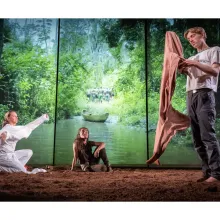
I first encountered the work of Milo Rau back in 2020, when his reimagining of the story of Jesus, The New Gospel, premiered in Venice. Set in the Italian town of Matera, where both Pasolini’s The Gospel According to St. Matthew and Mel Gibson’s The Passion of the Christ were likewise shot, the project was an on-the-ground collaboration with local residents, specifically African migrants locked in a real-life battle for human rights. Blurring fact and fiction, the film notably featured Enrique Irazoqui (Pasolini’s Jesus) and Maia Morgenstern (Gibson’s Mother Mary) alongside newcomer Yvan
Latest Posts
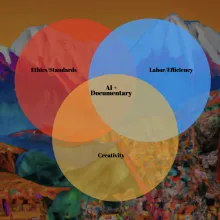
Welcome to The Synthesis, a new monthly column exploring the intersection of Artificial Intelligence and documentary practice. Over the next year, co-authors shirin anlen and Kat Cizek will lay out ten (or so) key takeaways that synthesize the latest intelligence on synthetic media and AI tools—alongside their implications for nonfiction mediamaking. Balancing ethical, labor, and creative concerns, they will engage Documentary readers with interviews, analysis, and case studies. The Synthesis is part of an ongoing collaboration between the Co-Creation Studio at MIT’s Open Doc Lab and WITNESS.
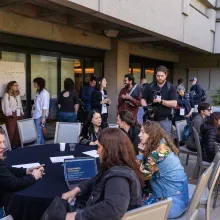
Fundraising for films is notoriously time-consuming and opaque. It can often seem like the dull but necessary part of making a film, a chore that some filmmakers worry about only after their film is already shot, when they realize they have to pay for finishing or recover costs. Others need start-up money to even get started. With sales growing more and more tenuous and grants being ultra-competitive, we look to learn from documentarians who recently funded their projects through donations and other more grassroots means. Documentary spoke with five projects in IDA’s Fiscal Sponsorship Program
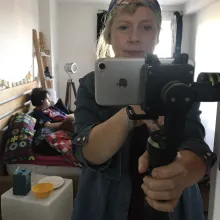
After spending her early career making documentaries for British television, primarily for the public service broadcaster Channel 4, Victoria Mapplebeck’s life took a sharp turn. Finding herself unexpectedly a single mother, she left the all-consuming job of a TV director and became a full-time film professor at Royal Holloway University as she raised her son Jim. With the advent of the smartphone camera, and the possibilities it held for telling intimate stories without the need for a big crew, Mapplebeck returned to filmmaking after a break of 12 years. In her first smartphone short, 160
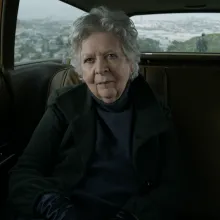
In 1975, an unusual would-be presidential assassin emerged. Sara Jane Moore, a middle-aged five-time divorcee and mother of four, a suburbanite turned informant for the FBI on various radical groups turned radical herself, attempted to shoot Gerald Ford. She served more than 30 years in prison before being released in the late 2000s. Robinson Devor is no stranger to unusual subjects. He’s previously profiled Los Angeles billboard queen Angelyne, the denizens of the Coachella Valley in Pow Wow (2017), and most infamously, a secret group of zoophiles in his debut doc feature Zoo (2007). In his
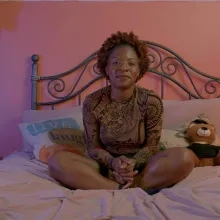
In Jessica Chaney’s I Am, five Black women directly address the audience to discuss their personal struggles with mental health—a therapist and a holistic life coach are both also on hand to help contextualize their stories, to demonstrate that no one need truly be alone in their personal journeys in anxiety, depression, and more. The film seeks to break down barriers in communication around how Black women specifically suffer these issues in this country. In collaboration with the 2022 Indie Memphis Film Festival, IDA presented a work-in-progress DocuClub screening of I Am.
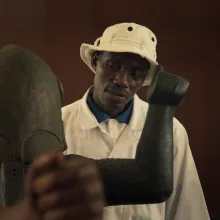
On March 15, 1990, French author and ethnologist Jacques Kerchache published a manifesto in Libération signed by 150 artists, scholars, and dignitaries imploring the Louvre Museum to open an eighth section devoted to the art of non-European civilizations, chiefly, Africa, Asia, Oceania, and the Americas. Developing upon the efforts of French intellectuals before him, who advocated for such inclusion of Indigenous art in cultural institutions, Kerchache wrote, “The masterpieces of the entire world are born free and equal.” The impact of the manifesto, neatly summarized by this adage, persuaded
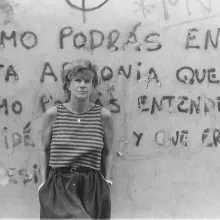
At the bottom of page 49 in a 1993 edition of the fabled Argentine film magazine El Amante , there is a sidebar titled “Experimental Cinema,” written by Narcisa Hirsch. At that moment, Hirsch was already a well-established artist for those who had heard of, or rather, seen her work. In that fragment, she rounds up some definitions for cinema, but ends up caring about only one: “Above all, there is the luminosity of images, the images that, once projected, make visible the others, the internal, the kept ones, the dark and forgotten ones, in the beam of light that crosses the field just to tear
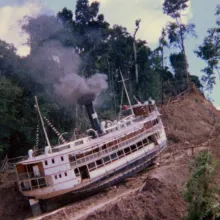
In 1979, filmmaker Werner Herzog flies to the jungles of the Amazon to shoot a film about a turn-of-the-century rubber baron, Brian Sweeney Fitzgerald, who strives to bring Caruso’s operas to the Peruvian city of Iquitos. As Herzog is adamant the film—Fitzcarraldo (finally released in 1982)—should not rely on special effects, the baron and the filmmaker have the same titanic task ahead of them: to transport a 320-tonne steamship over a hill and gain access to a neighboring river system. Another filmmaker, the American Les Blank, has been recruited to capture the tribulations surrounding and informing this technical feat. Blank’s 1982 documentary Burden of Dreams, newly restored and re-released by Janus Films, does much more than merely observe the resurrection of Sisyphus in the modern day. It also charts, and subsequently punctures, a man’s attempts to swaddle himself in the ill-fitting garments of that myth, to ennoble his self-inflicted suffering to the history books and pave over crime with punishment.
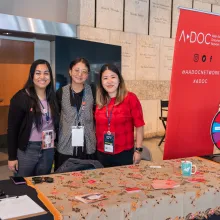
Before A-Doc (Asian American Documentary Network) formed its roots at IDA’s 2016 Getting Real conference, there was a decades-long history of Asian American filmmakers speaking truth to power through their work. About a decade ago, the inequality that permeates the documentary industry became obvious in the era of #DecolonizeDocs and #OscarsSoWhite. In response, A-Doc co-founders S. Leo Chiang and Grace Lee—along with a core group of Asian American film leaders—began organizing. Today, A-Doc is a national network of more than 1,700 members—and growing—that works to increase the visibility and