

Regarded as one of the world’s top documentary festivals, Copenhagen’s 23rd CPH:DOX (March 11–22, 2026) continued along its well-established path of combining artistic and challenging films with more audience-friendly and propulsive titles. Its selections and the film themselves opened questions about where—and for whom—documentary belongs.
The DOX:AWARD international competition’s strongest premiere, Amazomania, turns on an unresolved dispute over who owns footage of an Indigenous community, shot by a Swedish journalist in 1996. Moving next door, three of the 12 films in the same section were Danish. I felt this was disproportionate despite Denmark’s presence as a leading documentary producer (Mr Nobody Against Putin winning an Oscar during the festival highlighted this fact).
The selections overall ranged widely in their stylistic approaches and covered highly emotional, often autobiographical personal stories; detailed political and societal explorations, sometimes with a distinctly activist slant; and narratives that attempt to cover globally relevant themes. What distinguished the most accomplished films was the element of cocreation, a very zeitgeisty approach, that reshaped what the films could claim to know about their collaborators/protagonists. In addition, only two competition films were made by established filmmakers; the freshness from newer voices came across strongly even in the less successful works.
The three Danish films in the DOX:AWARD competition posed the sharpest test. The number is unprecedented compared to other recent editions, which prompted artistic director Niklas Engstrom to write, when asked, that the figure changes from year to year (in 2025 there was only one) and that “each of this year’s main competition entries earned their place on distinct terms, and that goes for the Danish films too […] When the quality is there, it shows up in the selection.” In summary, he praised Little Sinner for distilling nearly two decades of personal footage into a raw, singular piece of filmmaking; Petrolheads for the director’s eye and its portrait of friendship; and Christiania for its argument about the fragility of democratic ideals.
For me, the results were uneven. Little Sinner by Daro Hansen and Thomas Papapetros—in which the former tracks 20 years of her turbulent life from Damascus to Copenhagen and many spots in between—is indeed painfully raw and honest, but difficult to follow due to shaky, low-fi visuals and unclear storytelling. Karl Friis Forchhammer’s Christiania, in the famous Copenhagen neighborhood, is well-made but remains a local film about a local myth. The exception is Emil Langballe’s Petrolheads, which follows two neurodivergent friends—one of them the director’s brother—who are fascinated by cars. The fine ethical line it treads is a recognizable trademark of Danish cinema, and this example earns its place.
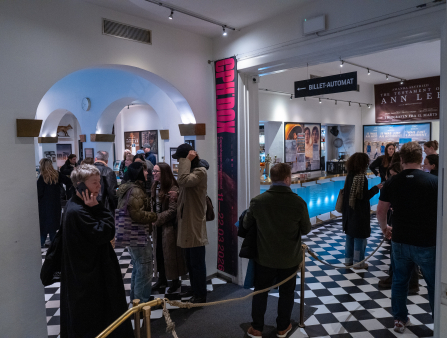
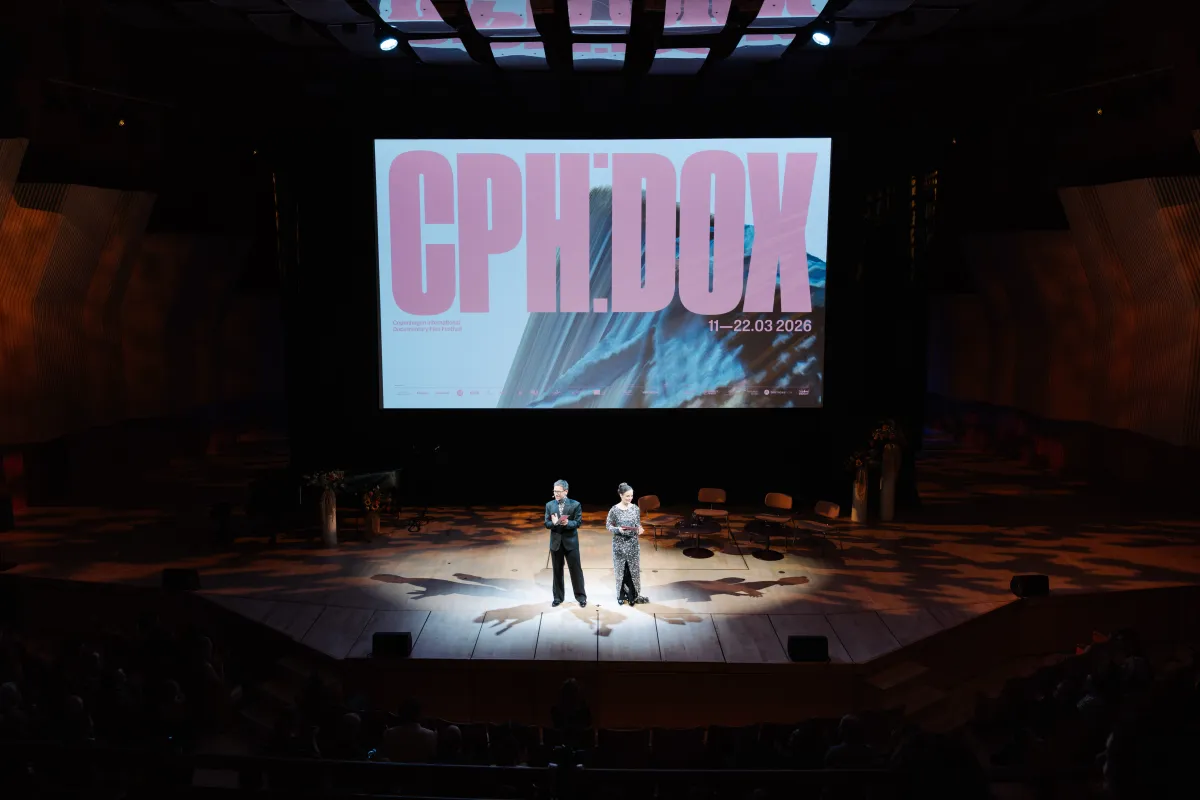
Grand Teatret, CPH:DOX 2026. Photo credit: Caroline Worning.
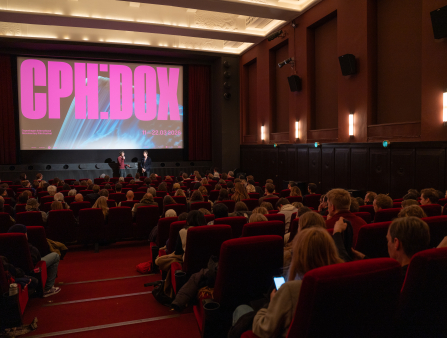
Among the non-Danish main competition films, the range was wide. The opening film, Mariinka, by Pieter-Jan De Pue, is an impressive follow-up to his 2016 Sundance prize–winning debut The Land of the Enlightened. The same authentic, highly kinetic, no-holds-barred energy and remarkable 16mm cinematography are brought to a Ukraine story about four protagonists, including two brothers who fight on opposite sides. His approach is idiosyncratic enough that criticism regarding a “Western gaze” wouldn’t even stick. Another accomplished film is French journalist and filmmaker Nolwenn Hervé’s debut The Cord, which won a special mention. The director gives us an unflinching look at Venezuela’s failed healthcare system through the eyes of activist Carolina, a force-of-nature protagonist who saves the lives of pregnant women.
In Daughters of the Forest, Mexican director Otilia Portillo Padua combines science, feminism, environmentalism, activism, and ancient Indigenous knowledge into a fascinating story of mushrooms, which unfortunately feels too much like ticking boxes. The impressionistic Georgian film A Song Without Home by Rati Tsiteladze—an account of the life of a trans woman who left her rural home for Vienna after being imprisoned by her parents for 11 years—combines a personal and political story. Rachel Taparjan’s Something Familiar, in which Taparjan, adopted as a child to the UK, goes searching for her birth mother accompanied by another woman from the same orphanage, is even more emotionally ambitious, but the overload of topics and storylines stalls it out.
There were two documentaries that attempted grand-scale storytelling. Ian Purnell’s Arctic Link, an account of how high-speed internet arrives in a remote archipelago near Alaska, connects different eras and worlds convincingly through its characters and benefits from excellent cinematography, but this is offset somewhat by its ultimate vagueness. The most ambitious film turned out to be the most underwhelming: Kenya-Jade Pinto’s The Sandbox composes a mosaic that shows how technological, political, and economic forces create a system of global surveillance, but none of these elements, or their connections, offers anything new to anyone following the topic.
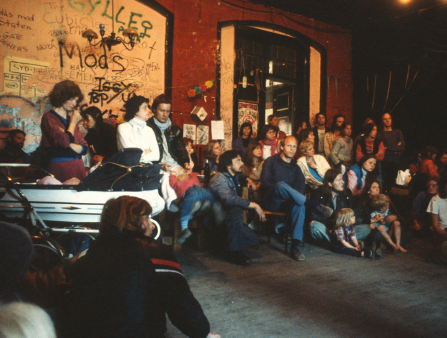
Christiana.
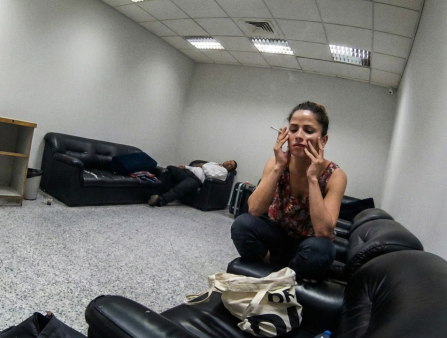
Little Sinner.
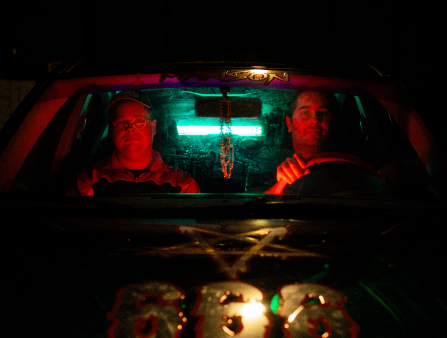
Petrolheads.
Whispers in May
The jury’s top prize in DOX:AWARD went to Whispers in May, the second feature by Shenzhen-based director Dongnan Chen (whose excellent 2023 short 14 Paintings screened at Sundance and IDFA). A lyrical coming-of-age road movie with fictional and mythical elements, it credits the four girls it follows as cocreators because the road trip at the film’s center was devised as a way for them, in Chen’s words, “to extend beyond their daily lives through the medium of film, which I think is more meaningful for the girls rather than capturing the reality of their struggles.”
The film opens in the Liangsham mountains of China’s Sichuan province, where 14-year-old Qihuo tends to her parents’ farm on her own, as her grandfather has recently passed. Her mother calls only to scold her. When Qihuo gets her first period, in the tradition of her Yi people, she is supposed to get a special skirt for her initiation ceremony into womanhood. She embarks on a four-day walk to Buxte, a town with large retail centers and cheaper prices, with her friends and classmates, Atnyop, Mengying, and Mengying’s little sister Itsi.
But Qihuo seems reluctant to grow up. She is still bright-eyed, playful, and enchanted by the magic of nature. Atnyop wants to work in factories after school to alleviate her family’s financial burden, whereas Qihuo is inclined to leave and continue her education, though she never says it directly. The mothers of the protagonists seem demanding and overbearing, yet the girls respect them. A parallel folk tale, told through beautiful, pictogram-like drawings, follows two sisters who defeat Coqotamat, a shape-shifting ogress connected to their mother.
Ming Xue and Xiao Xiao’s cameras follow the girls over winding roads and rugged mountains with elaborate framing, and the editing also reveals a fiction leaning. The mythical parallel story, accompanied by soft synthesizer music and echoing chimes that are often present in the sound design, along with accentuated natural sounds, give the film a magical vibe that completes rather than distracts from the documentary material. Chen is innovative without being flashy, placing the characters and story ahead of atmosphere and style.
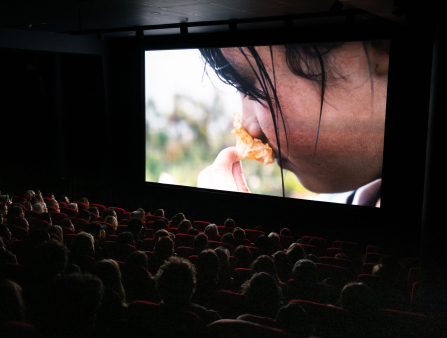
Whispers in May screening at Cinemateket. Photo credit: Alexander Leistiko
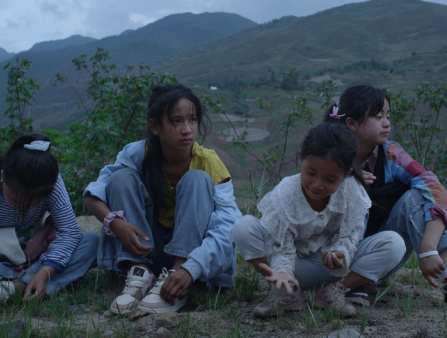
Whispers in May.
Amazomania
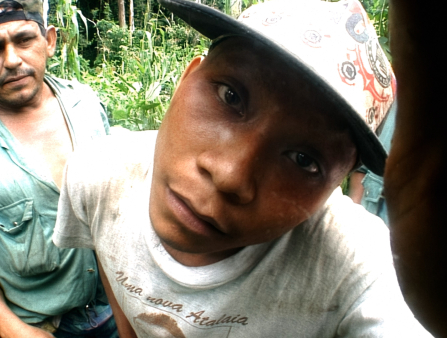
Another example of cocreation, but on a wider societal and less emotional level, Amazomania won the inaugural FIPRESCI Award at the festival. It also topped the critics grid of the Danish film magazine Ekko, and was my favorite in the selection. A true critics film, Amazomania is richly topical, structurally complex, ethically ambiguous, and built around a protagonist who is simultaneously a hero and a villain.
Swedish director Nathan Grossman’s (I Am Greta, 2020) film starts from the work of Swedish journalist Erling Söderström, who in 1996 accompanied an expedition of Brazil’s National Indigenous Foundation, led by Sydney Possuelo, in search of an uncontacted Korubo community in an attempt to prevent further deadly conflicts between the Korubo and local settlers and fishermen. Söderström shot a wealth of video material, some of which ended up in his 2003 documentary Hidden Tribes of the Amazon, but a lot of it remained unseen until Grossman was tipped about its existence. Amazomania’s first half consists entirely of this footage, digitized and revised in translation with the Korubo community, who are credited as executive producers.
In an early shot, Söderström appears in the jungle tying up his shoes, a machete notched in a nearby tree, announcing that he will attempt something that has never been done and is very dangerous. The middle section presents him as an explorer who sees himself as a Percy Fawcett of sorts—not a white neocolonialist just there to extract value for himself, but still blinded by the biases of his era. This is where the film’s key conflict lies—in our modern understanding of the lack of sensitivities from only 30 years ago.
The moment of first contact with the Korubo is unforgettable, as is a scene in which one of the community members looks into the camera, asking, “Who are you?” The whole segment is almost farcical in how both the expedition and the Indigenous group strain to convey good will and harmlessness.
But the final third of the film delivers the reckoning. In 2023, Söderström returns to the same group of Korubo with Grossman. Although they are in a protected area, the community now has solar panels, internet, and smartphones. “This is exactly what I feared,” says Söderström. But when angry Korubo demand a share of the profits from his 1996 footage, again his bias prevents him from registering the demand as legitimate, despite anthropologist Barbara Arisi’s reasonable and matter-of-fact explanations. The closing credits inform us that the conflict remains unresolved and that Söderström is planning another film in the region.
Amazomania’s production structure attempts a partial remedy: The film’s press notes tell us the Korubo community will receive 50% of the proceeds in addition to executive producer credit. In this way, the Swedish, Danish, and French coproducers do more than most to ensure an ethical positionality. But Amazomania remains, in structure, style, and storytelling, a Western film. That tension, rather than undermining its message, is exactly what makes it so thought provoking. It sharpens the ongoing debate about image ownership more precisely than almost any other recent documentary.
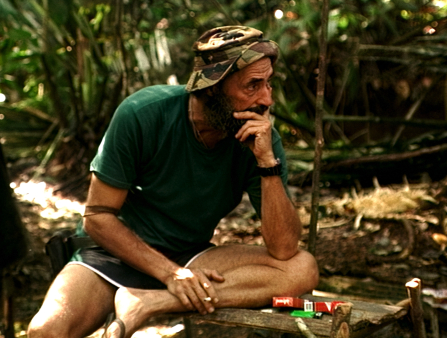
Amazomania.
The Phantom Pains of Rojava.
The Phantom Pains of Rojava
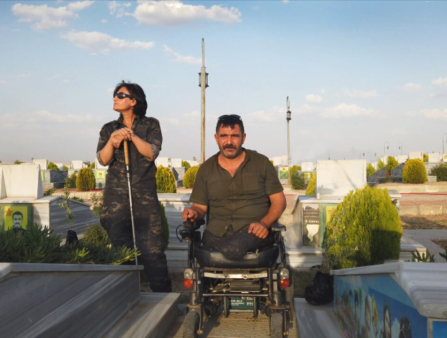
The HUMAN:RIGHTS award winner, The Phantom Pains of Rojava (an IDA Enterprise grantee), is by the Iranian-Swedish director Maryam Ebrahimi, whose previous documentaries, including the Emmy-winning No Burqas Behind Bars (2012), addressed the position of women in Afghanistan. This film leans on emotion more than analysis, but the craft will certainly satisfy such curiosity as well. Ebrahimi travels to the titular region in northern Syria to find the Kurdish guerrilla fighters who famously defeated ISIS at the decisive battle of Kobane in 2015. Celebrated then, now forgotten, they are hiding from Turkish drones and bombs.
The director’s voiceover connects the topic to her own story and memories of growing up in Iran and seeing amputees. More importantly, she creates a deep connection with her protagonists, especially with Sorkhin, an Iranian Kurd speaking Farsi, a high-ranking commander who lost an eye, had parts of her skeleton replaced with metal, and is now in charge of one of the secret “houses for the wounded” where Ebrahimi spends most of the film, immersing us in the stories and lives of the protagonists.
The director’s instinct to start with dark humor, a necessary component of staying sane in tragic situations, proves to be the right one. Fadakar, a wheelchair-using veteran, is frequently misplacing his prosthetic legs. One of the few men in the house, he takes care of the garden, cooks, visits his real legs (buried together with another comrade), and dreams of returning to the mountains. Rojda, a no-nonsense, authoritative but empathetic blind officer, can detect Turkish drones by sound before anyone else hears them. And Zann, the most affecting of the three, was a master sniper instrumental in the Kobane victory who was shot in the back of the head, leaving her paralyzed below the waist, with much of her speech taken from her. Her interactions with others open the viewer’s heart.
The title of the film comes from phantom limb syndrome, and Ebrahimi’s voiceover describes how she can hear the fighters cry in the night, while the camera shows an empty corridor, and painful cries echo in the soundtrack. The sound design carries two distinct musical themes—a melancholy, plucked acoustic string motif, and a piano-led theme communicating tragedy and pride, which are present but never overbearing.
The excellent image quality seamlessly connects to archive footage from Kobane, used sparingly but to great effect. The processing allows Ebrahimi to overlap the past and present, convincingly depicting the protagonists’ memories. Her own memories, which bookend the film, are accompanied by ghostly, blurry footage of coffins wrapped in Iranian flags. When she ends the film by overturning a tragic event into hope, she becomes more than this story’s guide: She is its emotional conduit.
This piece was first published in Documentary’s Summer 2026 issue.