
Squeezed among the rows of Spanish colonial and contemporary commercial buildings sits Cines Capitol, situated on the third floor of a mall near the heart of Guatemala City’s historic district.
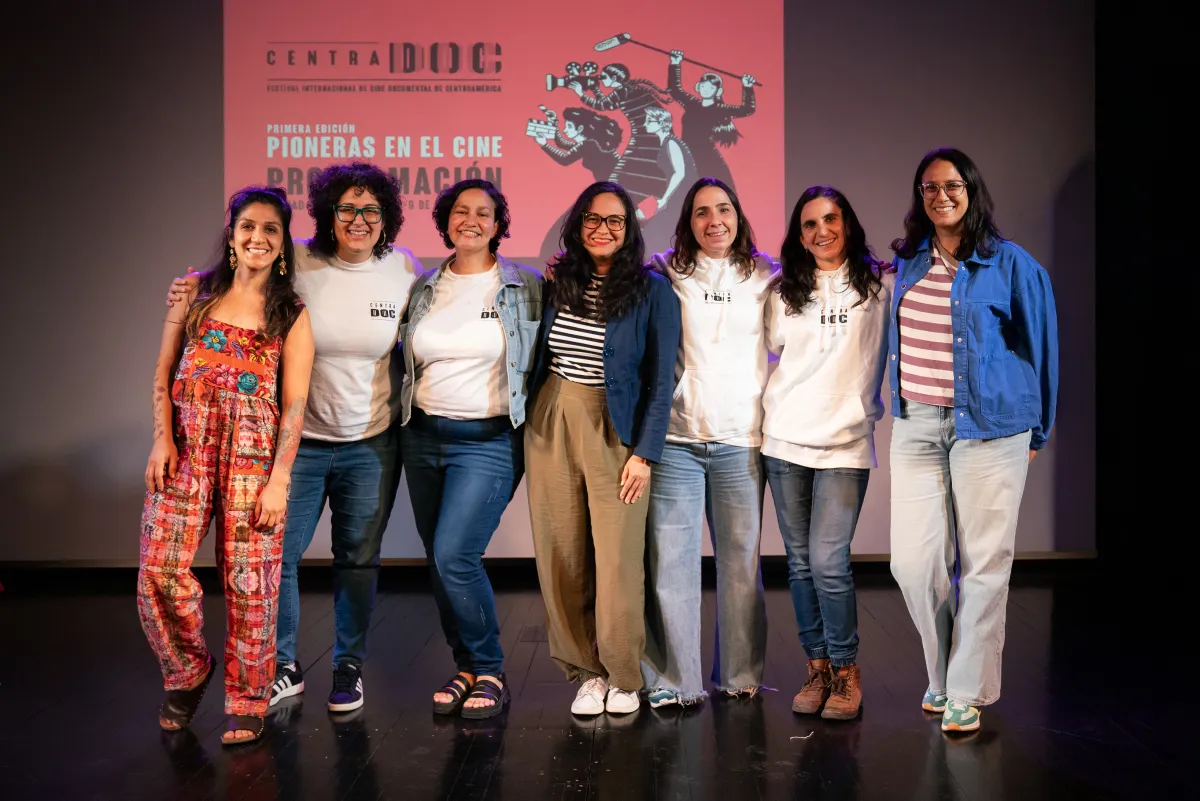
It was here that on August 4, 2026, the first annual CentraDoc—the region’s first festival fully dedicated to Central American nonfiction—kicked off. Founded by seven Central American women filmmakers, the festival ran for six days, attracting filmmakers from across the Isthmus and its diaspora.
Notably, the festival began with a block of shorts. This was a conscious decision. As co-founder Laura Bermúdez of Honduras tells Documentary, Central America is “a region of short filmmaking due to the reality of our funding situation.” The seven founders of the festival, who could be seen running about in signature white festival shirts, wished to tout the collective strength of this short-form output. Nicaraguan-Salvadoran co-founder Marcela Zamora Chamorro adds, “We produce a lot of short films of such a high quality, and I believe people haven’t really grasped this, both in Central America and abroad.”
Still, it was a gamble to open the inaugural festival this way and yet, half an hour before the screening was set to start, a line had already formed, snaking about the lobby. “We expected 100 to 120 people for the opening night screening,” Bermúdez excitedly remarks. “[Around] 270 to 290 showed up; it became impossible for us to accurately count them all.”
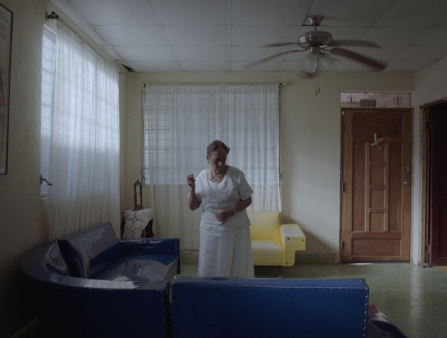
I arrived to find close to 150 people in front of me, having traveled from Los Angeles to share my short essay film Piñata Prayers (2025) as part of the Salvadoran delegation. The block featured one film from each participating country, meant to embody the creative range and ambition of the region’s current wave of filmmakers. These included the tender vérité portrait film I Dreamed of a Gentle Landscape (Soñe con un paisaje, 2025) by Costa Rican Kim Torres, the hybrid archival/performance film A Love Song in Spanish (2021) by Panamanian Ana Elena Tejera, and the world premiere of Indigenous Guatemalan Leyzer Chiquín’s black-and-white vérité film, The Thread and the Gunpowder (El hilo y la pólvora, 2026). An inauguration party followed at the nearby 502 Pizza, where filmmakers from across the region quickly mingled over slices and beer, discussing the night’s screening as well as their own projects until one in the morning.
The documentary form acts as a window into each country. And so collectively it’s a window into all of Central America.
—Marcela Zamora Chamorro
Zamora and Bermúdez know well the challenges faced by Central American nonfiction filmmakers; they’ve lived it themselves. Zamora premiered her feature The Offended (Los ofendidos) at IDFA in 2016, which profiled victims of government torture during the Salvadoran Civil War—including her father Rubén Zamora, who was a pro-revolution politician. She’s now living in exile in Mexico City, due in part to the contents of her film and her family’s political legacy. Meanwhile, Bermúdez is in postproduction on her first feature, Where the Sun Is Born (Allá donde nace el sol), having recently pitched at Cannes Docs and Docs Barcelona. Co-directed with Garifuna dancer Jorge García, the film follows García returns to his coastal home. The focus on this Afro-Indigenous community feels all the more timely, as within the last couple of months the newly elected far-right government of Nasry Asfura in Honduras has carried out displacements of Garifuna communities in San Juan and Tulito, and enacted a new pro-industry agricultural law, which Garifuna leaders say further threatens their lands.
Zamora says that “CentraDoc was born as a response to the closure of safe spaces free from censorship that has been occurring across Central America.” Out of the seven founders, Zamora isn’t even the only one in exile. Gloria Carrión of Nicaragua currently resides in Canada; she was forced to flee the country in just three days, stashing her recordings of women abused by the police among the few belongings she took with her. Due to her relocation and in order to protect identities, her short film Leaves of K. (Hojas de K., 2022) was reimagined as an animated project. Just last year, the LGBTQI safe space La Casa Rosada in El Salvador was controversially shut down, amid a wave of journalists and artists fleeing the country in exile. Similarly, this past July, the newly elected right-wing Costa Rican government of Laura Fernández fired Costa Rican Film Commissioner Marysela Zamora, offering no public explanation. They did so during the Costa Rican Film Festival (CRFIC) and just two weeks after the 2nd annual Costa Rican Media Market that Zamora founded. Elsewhere, Honduran filmmakers fought hard for the government to enact a cinema law in 2019, which established structured industry support through a national film office (DGCINE), a National Filmmaker Council (CNIC), and a national film fund (FONDECI). They now fear the Asfura government has restructured the law’s administration to limit artistic independence, and this has left these offices in a state of paralysis and uncertainty.
Documentary, due to its journalistic aspects and commitment to capturing lived-in realities, is particularly vulnerable to these volatile shifts within the region. There aren’t many notable film festivals in the region to start with—especially those focused on documentary. Both the International Film Festival of Panama (IFFPanama) and the Costa Rican International Film Festival (CRFIC) have programming sections and industry engagements that prioritize Central American and Caribbean film, including fiction and nonfiction. ACAMPADOC is the only dedicated documentary festival in the region, which is located in the rural northern Panamanian city of La Villa de los Santos. Designed as a camping retreat, it is open to filmmakers from across Latin America and programs films from around the world. ÍCARO, meanwhile, is the only festival dedicated primarily to cinema from all of Central America; they curate across fiction, documentary, and experimental forms. This is despite the region boasting a combined population of about 53–54 million people. For comparison, that’s roughly the same population range as South Korea and Colombia, and millions larger than Spain, Argentina, and Canada—all countries that not only have established film industries but a number of high-profile film festivals, some even specifically focused on documentary
Spaces like ÍCARO, ACAMPADOC, IFFPanama, and CRFIC are appreciated, but the founders of CentraDoc felt an urgent need to build a festival that explicitly platforms Central American nonfiction to encourage popular audience support for these films. By bringing filmmakers from across the nations together, they aimed to create a safe environment for urgent, delicate conversations, knowledge sharing, and bridge building—both internationally and within the region. “Generally speaking, I have come to know my colleagues’ projects through attending festivals outside of the region,” Zamora says. The moment felt right to create a shared festival that the Pan-Central American nonfiction community can call home. As Zamora puts it, “The documentary form acts as a window into each country. And so collectively it’s a window into all of Central America.”
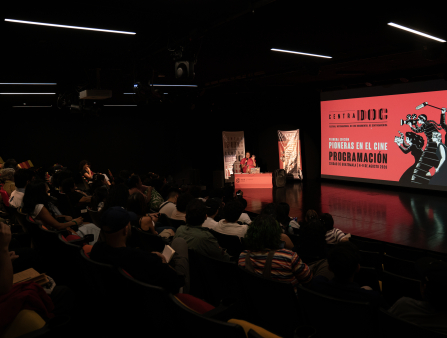
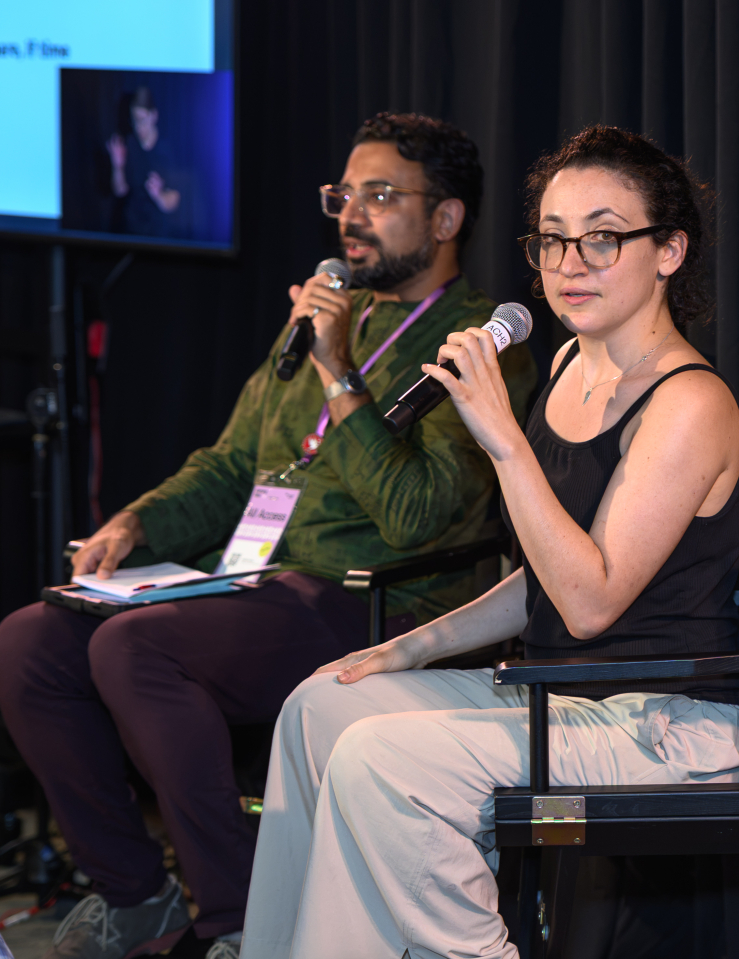
Ecuadorian programmer María Campaña Ramia talks about her work at IDFA during CentraDoc’s inaugural outing.
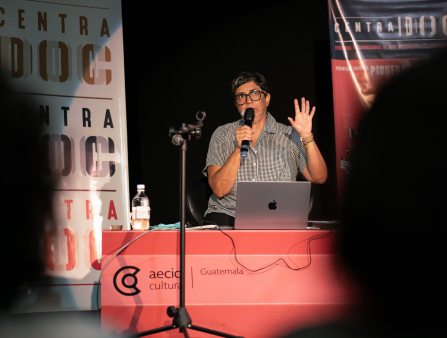
Tatiana Huezo leads a master class.
As with many Latin American endeavors, the work began in a WhatsApp group. Zamora invited six friends into the fold to put forth her dream of a documentary festival with an explicitly Pan-Central American focus. The group included the aforementioned co-founders, Gloria Carrión of Nicaragua and Laura Bermúdez of Honduras, as well as Anaïs Taracena of Guatemala, Isabella Gálvez Peñfiel of Panama, Marcela Esquivel Jiménez of Costa Rica, and Brenda Vanegas of El Salvador.
This kicked off an 18-month push to bring CentraDoc to life. That came with its own immediate challenges: “It became clear we all could not work at the same time,” Zamora notes. “Many of us are single mothers or single women. Making a living off film isn’t easy. Making a living from documentary film is even harder. Doing that as a woman in Central America is even harder.”
Zamora led the early foundation outreach, approaching the Ford Foundation for early funding that helped them develop a logo and visual identity for the festival. Perhaps the most crucial decision was around where to host this gathering. Due to the political conditions across the region, El Salvador, Nicaragua, Honduras, and Costa Rica were ruled out. Panama City, while checking off some necessary logistical features, presented a less obvious concern: Located in the far south, the city would have been an impractical choice for anyone to reach by ground transportation or a short, cheap flight.
The group eventually decided on Guatemala City. Zamora says, “For all its problems, [Guatemala] is the one Central American country that possesses a certain democratic stability.” Taracena tapped into her extensive network of local contacts, through which they were able to find partners, screening spaces, and event venues for the festival. These close relationships were essential. “We were never going to have the funds to pay in full for everything to make the festival possible,” Zamora explains. “We’ve had to make alliances. We’ve had to barter. None of that would have been possible without Anaïs.” Two key venue partners, Sociedad Fílmica Iximulew (which operates out of Cines Capitol) and the Cultural Center of Spain in Guatemala, are conveniently located within walking distance of one another in the Historic District. The festival also found satellite partners to operate parallel programming in other cities: Cinespacio in Quetzaltenango and Casa Pensativa in Antigua Guatemala.
After that, the focus shifted to establishing value-adds that could unlock further support for CentraDoc. For that, Zamora started with an old friend, celebrated filmmaker Tatiana Huezo, who is perhaps best known as the director of the critically acclaimed documentary Tempestad (2016). Based in Mexico, Huezo is half Salvadoran and was born there during the civil war. Her first feature, The Tiniest Place (El lugar más pequeño, 2011), profiles her grandmother’s village of Cinquera, which was obliterated by the military and left in ruins until its villagers returned to reconstruct it. The Cultural Center of Spain in Guatemala ended up covering her flight, accommodations, and honorarium as a special guest at the festival. In this role, Huezo would offer a two-day writing master class. As Bermúdez explains, the master class was designed to give back to the filmmaking community they hoped to gather. “We feel like it’s a democratic format,” she explains. “There are already labs in nearly every Latin American country where you have to apply and hope you get in, and if you are one of maybe eight selected, you get two to three days of targeted support.” This was a far more open offering, which they hoped would set CentraDoc apart.
Some of the founders had also reached out to María Campaña Ramia, the Ecuadorian programmer for IDFA, who eventually agreed to not only attend but also take part in a conversation about her programming career and her thoughts on submitting films to international festivals. Bermúdez says, “That, for us, took it to yet a whole other level.” With these two guests, CentraDoc was bridging the gap between the larger documentary community and the homegrown one the festival hoped to spotlight and nurture in equal measure.
Then came the sprint to fund the rest of CentraDoc, which required reaching out to various organizations and community partners within and beyond the region. In January 2026, they unlocked funds with Casa Centroamérica. Meanwhile, Taracena had an existing connection with Oxfam Guatemala and eventually secured their support for a planned panel on exiled filmmakers. They also helped pay for the festival cocktail party at Casa Amano. The Heinrich Böll Foundation helped cover two plane tickets for attending filmmakers, while Video Consortium contributed US$2,500 toward the cost of the opening night gathering at 502 Pizza. Crucially, the Ford Foundation also provided sufficient funding to enable Taracena and Zamora to focus solely on producing the festival for the three full months prior to its launch. Zamora says, “It’s so essential to support these budding programs because people need to eat. None of us are the daughters of millionaires. We are all workers.”
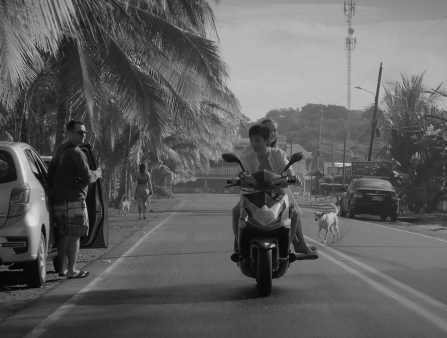
I Dreamed of a Gentle Landscape.
A Love Song in Spanish.
A propósito de la mujer.
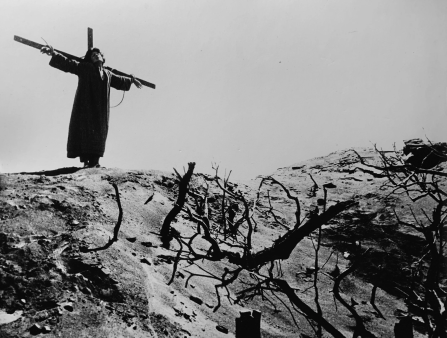
For the broader theme of the program, the founders set an overarching theme for the festival: “Women Pioneers of Film.” It was important for them to offer context: CentraDoc, a festival founded by seven women filmmakers, was not born out of a vacuum. The founders wanted audiences to learn more about the long tradition of women documentarians. They featured a dedicated block of films made by women in Central America dating back to 1933 (Imágenes de Managua, by Matilde Díaz), charting a history of creative expression despite adversity, and highlighting works of early regional feminist filmmaking (A propósito de la mujer, dir. Kítico Moreno, 1975), and leftist organizing (No apagarán mi sonrisa, dir. Victoria Campos, 1986). Across the week, the program sketched a culture of truth seeking as well as films pushing against established narratives
The founders established an invite-only process for the festival, in which each founder would seek out films by Central American talent they either already knew or learned about in industry spaces. They kept a broader range for feature films—from 2020 to world premieres—keeping in mind that the COVID-19 pandemic had derailed the distribution opportunities for local documentary features, which often struggle to land formal distribution both abroad and at home.
Although this first festival had a central historical feminist theme (and of the 19 films programmed, 14 were directed by women), Zamora is quick to note that the program will always reflect the full diversity of Central America. The program made a point to showcase features and short films by LGBTQI, Afro-descendant, and Indigenous directors. Importantly, I also noticed the films highlighted different terrains within Central America: rural coastlines in Costa Rica, suburban yards in Guatemala, dense urban neighborhoods in Honduras. The programmers paid close attention to how the varied geography of the land molds the stories we tell.
Each feature film was paired with a short film with formal or thematic commonalities. For Your Peace of Mind, Make Your Own Museum (Para su tranquilidad, haga su propio museo, dirs. Ana Endara and Pilar Moreno, 2021) was paired with the short film Grandmother (Ati’t, dir. Tirza Ixmukané Saloj Oroxom, 2023). Both feature playful styles; in Endara and Moreno’s feature, they profile Senobia, an elderly artist who creates art out of found, discarded objects and collects antiquities she arranges in her home to create a museum. The filmmakers take joy in capturing these artifacts as prized works, keeping a sense of whimsy and humor despite its often heavy subject matter. Similarly, in Saloj’s short, she marries imagery of Lake Atitlán’s environmental degradation with colorful animations, evoking the lake’s role as an elder who nurtures and gives life. In another pairing, the investigative feature What We Forget (Lo que olvidamos, dir. Zenén Vargas, 2024) screened after the short I Can Easily Return to the Past but Nobody Is There Anymore (Puedo regresar fácilmente al pasado, pero ya no hay nadie ahí, dir. Natalia Sánchez, 2026). In Vargas’s feature, we revisit the memory of a young left-wing student assassinated by a police officer. In Sánchez’s short, we watch her clip and reshape snippets of family tapes, contextualizing and recontextualizing them to draw upon a complicated sense of nostalgia. Crucially, none of these pairings came from the same country; the programming was designed to show the common thematic and aesthetic interests shared by filmmakers across the Isthmus.
The founders weren’t able to source Belizean recommendations in time for this festival. As Taracena explains, Belizeans “have a distinct history from the rest of Central America” due to British colonization. Because of this, it has been a lot harder for us to form ties with Belizean filmmakers.” Bermúdez and Taracena both note this as a growth area they hope to foster for future editions of the festival.
We want to dignify the filmmaker because we know what it takes. We want the filmmaker to be the center of CentraDoc.
—Marcela Zamora Chamorro
If the program was a didactic attempt to capture the state of nonfiction filmmaking in the region, it was also designed expressly to be both filmmaker- and audience-friendly. Outside the satellite city screenings, no two screenings or panels overlapped, ensuring that people could attend all of CentraDoc’s activities. Attendees wouldn’t have to worry about cost, either; all screenings were free to the public. Even the master class with Tatiana Huezo was free; it just required an application submitted prior to the festival. Additionally, CentraDoc paid a small stipend to each filmmaker for screening their film. This is a notably rare gesture from any festival, particularly one in its very first year. They also helped filmmakers find cheap flights and hotels to encourage attendance. The Cultural Centers of Spain in Honduras, Costa Rica, Panama, and El Salvador each sponsored filmmakers from their countries to attend the festival. “We want to dignify the filmmaker because we know what it takes,” as Zamora puts it. “We want the filmmaker to be the center of CentraDoc.”
Still, Taracena worried that attendance would be low. When they learned that 70% of programmed filmmakers communicated they would attend, she knew this added pressure to ensure directors would have an audience for their films and their attendant Q&As. But as the opening night block of shorts showed, there was clearly a local appetite for what CentraDoc had created.
Tatiana Huezo’s master class bore this out as well. They expected 50–80 applications. They ended up receiving 120. “We thought we should accept everyone, factoring in that approximately 30% would not show up,” Bermúdez shared. On the day of the master class, 180 people arrived. Around 45 filmmakers traveled from outside Guatemala to attend; 25 arrived from El Salvador alone, most of whom stayed for almost the entire festival. “The reality is that every single event had greater attendance than what we expected,” Bermúdez adds.
Quickly, the festival attendees developed a pattern. Screenings would be followed by groups breaking off to dine, who would then cross paths in the various bars, taverns, and other third spaces that dot the Historic District, and then moving the debates, conversations, and festivities to someone’s apartment. This pattern held up well within my chosen festival family of several cinephile Salvadorans, a Guatemalan local, and one adopted Costa Rican, down to the last night, where all the remaining attendees migrated to a bar with live music and sang Buena Vista Social Club’s “Chan Chan,” bidding the first-ever edition of CentraDoc goodbye.
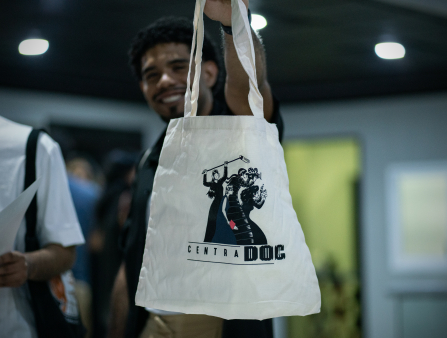
Early funding from the Ford Foundation helped CentraDoc develop a logo and visual identity.
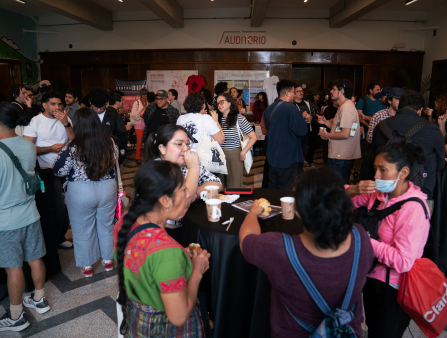
Filmmakers attending Tatiana Huezo’s master class mill about at the Cultural Center of Spain in Guatemala (CCEG).
The success of this festival was only possible through filmmakers who for decades, despite the uphill battles, have fought for space to share their films in a territory with a rich cinematic tradition. Zamora recounts how 20 years ago, she would shove her bedsheets and a projector into her car and drive across rural El Salvador. “I would drive to villages, hang my sheets, and project my films.” The country, like much of Central America, was emerging from wartime and was a barren land for documentary filmmaking in the 1990s and 2000s. There were no film festivals, no dedicated screening spaces, few foundations, and hostile governments. Eventually, Zamora was able to save up and upgrade to an inflatable screen. “I’ve carried them into communities, pumping them up myself. You are the projectionist, you place the seats, you are the emcee, you do it all!” CentraDoc feels like a welcome extension of that spirit, just on a larger scale.
As she puts it, “We’ve always carried the capacity for creating a film festival within us.”