Jodi Wille has been researching alternative spiritual movements since the ’90s, publishing, curating, programming, and documenting works produced by such subcultural communities. Her first feature, The Source Family (2012), explored the titular Southern Californian commune, and told their story using internal documentation produced by the group’s own members in the ’70s.
Wille takes a similar approach with her second documentary, Welcome Space Brothers (2023). The archive-driven doc chronicles the development of the Unarius Academy of Science, a self-described spiritual school founded in 1954 in El Cajon, California, and still active today.
Welcome Space Brothers focuses on Ruth E. Norman, or “Archangel Uriel” as she was referred to by fellow Unarians, who led the group throughout the 20th century. Although Unarius was ridiculed by the media for beliefs including the coming of aliens and the existence of past lives, Wille highlights the healing and rehabilitation Norman provided to her students. Norman encouraged expression through art, overseeing the production of film and television programming which featured elaborate costuming, set design, and practical visual effects. These videos include “psychodramas,” in which Unarians embodied previous incarnations in order to confront personal traumas.
As Welcome Space Brothers continues a theatrical rollout, Documentary chatted with Wille about her decade-long project of shaping the Unarians’ wild and wide-ranging archive into a cohesive doc that treats its subjects with dignity. The following interview has been edited for length and clarity.
DOCUMENTARY: In a director’s statement, you wrote that you first became aware of Unarius while they were actively producing public access programming. What prompted you to return to the group’s work?
JODI WILLE: I was captivated when I saw their videos on public access in the ’90s. A number of rare film collectors and musician friends whose taste I respected had been raving about these tapes, and were actively bootlegging VHS tapes off the television and trading them with friends across the country. I was intrigued and baffled. When I was invited to co-curate a museum exhibition for Baltimore’s American Visionary Art Museum in 2013, I decided to reach out to Unarius. They graciously invited me to look through their archive, and I expected to see just a little shelf of their films on the wall, but I ended up seeing thousands of three-quarter-inch videotapes, hundreds of costumes, and thousands of professional-quality color stills. This led to me programming their films at cinematheques in Los Angeles, New York, London, and being invited to show their film The Arrival [1980] at the San Francisco International Film Festival in 2015.
D: What were your first reactions to that footage?
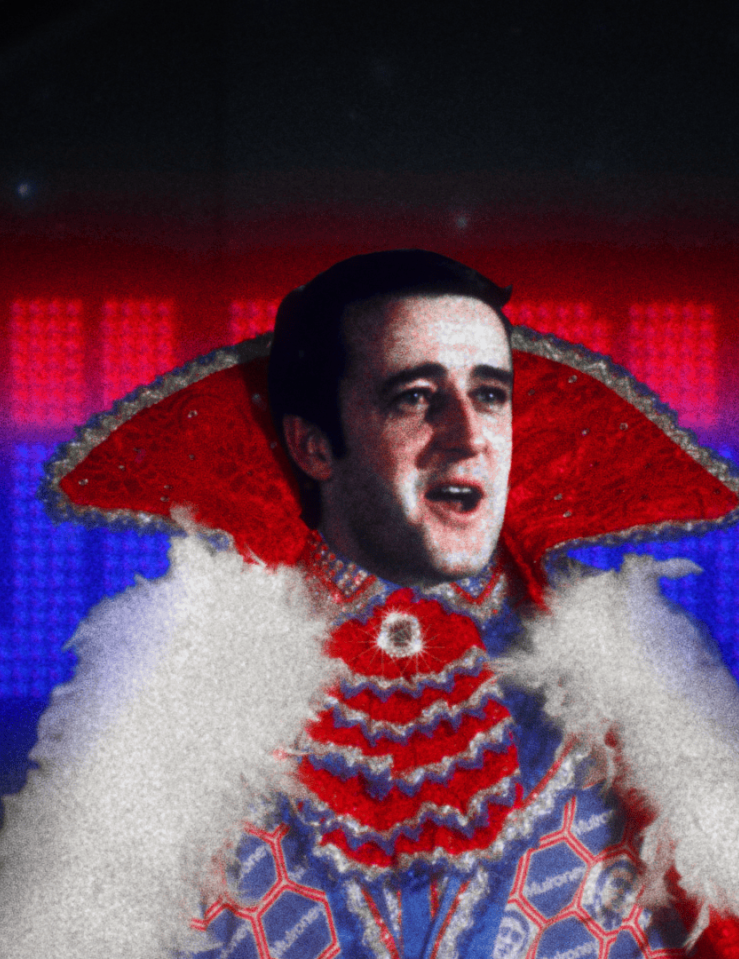
JW: In the ’90s, when I first saw these elaborate space operas that appeared to be directed by Liberace, I was a music video director, and I thought it was absolutely wild and very trippy. [The Unarians] seemed like a benign but out-of-their-minds community making these videos. That was my own limitation. I didn’t have the experience to understand at all what they were doing.
Revisiting Unarius’ videos about 20 years later changed my viewpoint entirely. After I went on my own path of discovery, spent a lot of time with the Source Family, and learned a lot about metaphysical and esoteric spirituality, I realized that what they were doing was this incredibly deep work to address trauma. Understanding that led to a new level of respect and understanding, and wanting to be able to convey that depth and complexity in the film.

The Arrival, as seen in Welcome Space Brothers. All stills courtesy of Unarius Educational Foundation

D: Can you talk about the process of exploring Unarius’ archive?
JW: I had the immense privilege to be able to stay overnight with Unarians, spend time with Unarians—drinking wine with them, hanging out until midnight—really hearing the real-life stories of the group, beyond just this face that they present to the public. I was able to visit many times over the years because I had started curating their films. What I’ve learned working with archives of unusual communities that are largely misunderstood for their practices or ideas is that it is really important to give myself time to return to the material, because I always learn things over a period of years.
I was able to understand the videos on a different level, understand what they were doing with the pageantry, what was behind it, who the key artists involved in the collective were, and what their personal dynamics were, which always influence every community, and I feel are really important to examine in a story like this.
D: Your film tells the story of Unarius through the stories of key figures in the group’s history: Ruth and Ernest Norman, Tom Miller, Stefan Yankoskie, and Vaughn Spiegel. Yet you were unable to speak to any of them [all are deceased except Miller, who declined an interview]. How did you approach telling those stories without firsthand accounts?
JW: That was the miracle of the archive, and the extraordinary good fortune we had of Unarius documenting their own people. Not only were they doing didactic videos, where they were sharing teachings, but they were also doing psychodramas, which were reflecting personal tensions within the group at the time.
I was able to interview several members of the group who knew these members well. I was able to interview Stefan Yankoskie’s sister in depth, who had a very different opinion of Unarius than the people inside the group, or even those who left. I just reached out to as many people and spent as much time in the archive as I could.
I had different ideas about these characters as a filmmaker, and about Ruth Norman, or “Archangel Uriel.” I think part of that was due to my own cultural programming. Who was this woman? Who was she to these people? Was she manipulating them? Was she narcissistic? Was she true to them? All of those were questions I had about her and the others while I was going through the video archives, and all of this documentation, and having these conversations.

Ruth E. Norman, as she appears in The Arrival.

The Arrival still, as seen in Welcome Space Brothers.
D: Before you directed Welcome Space Brothers, you directed a short film about Unarius, We Are Not Alone (2016). What went into your decision to develop that story into a feature?
JW: When I started interacting with Unarius and programming their films, I identified that this would be a really extraordinary story to tell. Thalia Mavros, who had started [her documentary production company] The Front, commissioned me to do a short film on Unarius. She allowed me to shoot for this short film over a period of two years, and that footage ended up in the feature film. So Thalia became a partner in the feature film.
Around 2018, I wanted to make the feature film in earnest, and someone connected me with Caryn Capotosto because I was looking for the right partner, and I was a big fan of her work. She had just produced Won’t You Be My Neighbor [2018]. Our connection was instantaneous. She really got the heart of the story. There were other producers who could only see this through the lens of a true crime story, because that’s what people are conditioned to understand about alternative spiritual communities in America. We only see documentaries on tragic groups. Caryn understood right away when I told her that I wanted to present a different point of view on these communities.
We joined forces, and then my now husband, Robert Ganger, came in as an executive producer, which really helped us move things forward, to get our deck together and everything else. Then our first partners came on. Nion McEvoy, who was incredibly important, brought the first funding in for us to shoot, and then we developed this close creative core over the years, of Caryn, Thalia, Rob, and Daniel Noah from SpectreVision, who was involved before they came in to give us funding to finish our film to premiere it. They came in with Elijah [Wood] in 2023, but he was creatively involved before that, just because we were friends. We were super grateful to have XTR come on board, and Matt Perniciaro from Diorama, who believed in the vision. And then, of course, we had seven editors.
D: Did these editors help you comb through the archive? How did the different editors contribute?
JW: We started with Jennifer Tiexiera and Alex Bohs, her partner. Both of them, but largely Alex, spent a lot of time in the archive, got to know the Unarians with me, and he was able to build out a very solid foundation with my help. That helped a lot to get other editors acquainted with the material, but even beyond the four-hour assembly, there was just so much to engage with.
One of the biggest challenges for me was to get people on board with the unusual vision. I wanted [the film] to be an empathetic and humanizing portrayal of a very outlandish, often misunderstood group, and I wanted to keep the humor, which is almost impossible to eliminate, but could easily fall into just a campy piece making fun of Unarius. Dava Whisenant ended up being the supervising editor on the film. Dava said the edit on this film is like a tightrope walk. It’s so easy to shift the tone by just removing one line. We had to really take our time and work carefully through it.
It was tricky, and I feel like the edit was not finished when we premiered it in 2023. I realized I wanted to go back in, and I was fortunate enough to be able to do that, and really sit with the film and tweak it. I’m basically one of those filmmakers who will keep editing until you rip it out of my cold, dead hands, and I’m so glad because every single change I made contributed to the way it is now.

Roots of the Earthman, one of the Unarius productions featured in Welcome Space Brothers.

Still from Crystal Mountain Cities, featuring costumes made by Unarians.
D: As we speak, you are in the midst of the film’s theatrical tour. There are some unusual stops, such as UFO Fest in Roswell, NM, and Space Craft Festival in Joshua Tree, CA. How has this plan changed from what you originally envisioned?
JW: The film was sitting for a while. It was well received at festivals, but we didn’t have a distribution partner, and we didn’t have the money to roll it out. Moby, who was a fan of The Source Family, saw the film when folks at SpectreVision shared it with him. He and Lindsay Hicks at Little Walnut got really excited about it and gave us money through a nonprofit arrangement we have with IDA, so we wouldn’t add to our budget. A totally tax-deductible donation to self-release the film. Daniel Noah had a management team at SpectreVision, Antonio D’Intino and Christina Campagnola, who came on board and served as our release partners. All of us got together and said, “What is our dream idea for this release?” I told them I would love to get it in as many theaters as possible.
I’ve learned that a number of theater bookers don’t care if [the film] is streaming, because the people who come to see movies in their theaters don’t want to stream. They want the in-person, real-life encounter. Thankfully for us, not only will I appear at some screenings, but the Unarians love showing up. They’ll travel, and they’ll show up in their vintage costumes, and they’re very engaging and open. So, we have a very special situation with this film, where from the beginning it has led itself to eventizing, in a spectacle sort of way, but one that lends itself to deep conversation. We’re continuing to work with the gift of being able to have an engaging in-person experience with people at theaters.