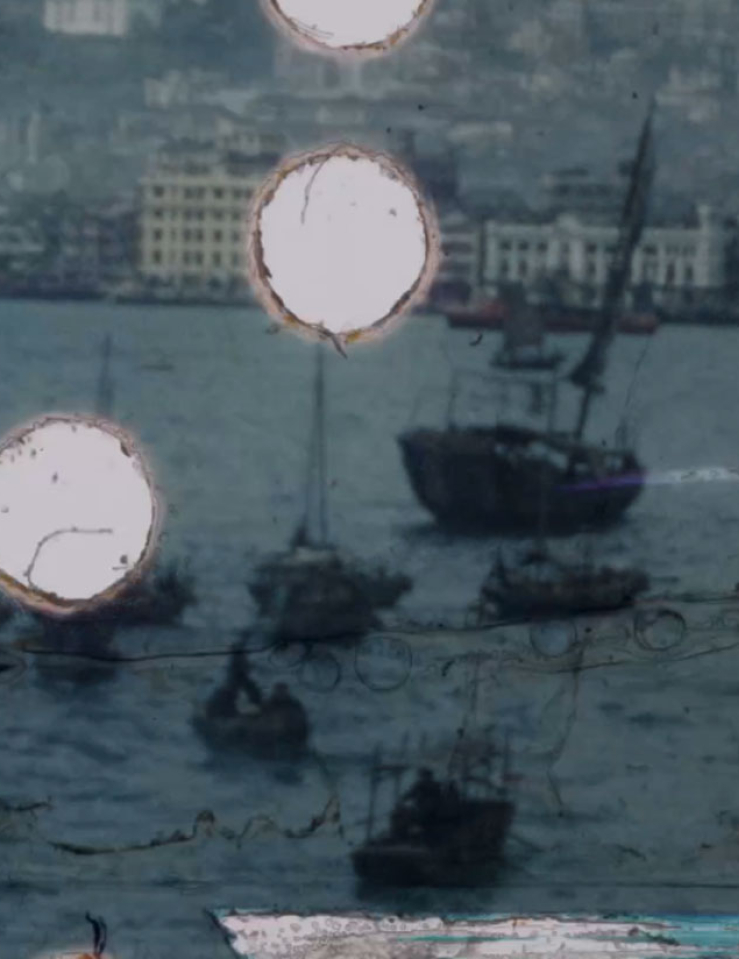


Beginning with How to Clean a Cast Iron Pan in 2012, John Wilson has created an invaluable, ongoing document of life in New York City in the 21st Century. Through various short films and his singular three-season HBO series, How To with John Wilson, the filmmaker has honed an unmistakable style. His work comprises dizzying montages of blink-and-you’ll-miss-it strange moments on the street, interviews with offbeat and interesting individuals, and unlikely disparate topics folded together in thematic ways that ultimately make sense.
Now Wilson has directed his first feature, The History of Concrete. Fresh off the ending of How To, he wants to study the world’s most common building material in depth. Fearing the subject matter may be too dry, he sardonically frames the film through the narrative structure of a Hallmark movie—a rigid formula explained in the backrooms of that company’s offices, in one of Wilson’s trademark surreal yet banal interviews.
Alongside concrete’s role in NYC’s infrastructure, the problems with its production and longevity, and a whole convention of builders (replete with a brick-wall-making competition), Wilson takes time to tour Rome, gets to know a bereaved musician, and observes a 3,100-mile marathon that takes more than a month to run around a single city block in Queens.
Ahead of the film’s theatrical release, Documentary sat down with Wilson over Zoom to discuss impermanence, pursuing plot threads, and shooting solo. We also got a few updates on various people who showed up in How To. This conversation has been edited for length and clarity.
DOCUMENTARY: One throughline in your work—especially How To, which stands as a capsule of New York City right before, during, and right after COVID-19—is mortality and impermanence. That theme takes center stage here.
JOHN WILSON: I think a lot of artists make stuff about the same thing their entire lives. I’m not saying that I don’t want to change that, but I think that’s part of the foundation of a lot of what I’m dealing with over the years. I have a really hard time with change, even in small ways. I think this is the largest version of that so far. I’m dealing with a thousand-year timeline in this movie, which was ambitious for this kind of work.
D: And a major subject in the film is that concrete isn’t a thousand-year material, that you’re more likely to get less than a century out of it. Was that something you knew going in, or did you learn about it in making the film?
JW: I discovered how imperfect this material was as I was making [the film]. I had a crack in the foundation of my house, and while most people would just hire a contractor to fix it, I got a bunch of books. I wanted to understand concrete on a molecular level. In doing that and talking to different experts, I realized how flawed this material is for building a lasting metropolis.
D: In one scene, you examine the crumbling Brooklyn-Queens Expressway [BQE]. So when Mayor Mamdani announced that the city would fix the part of the BQE it has direct jurisdiction over, I immediately thought of the film.
JW: I think it’s cool that they’re trying to do something with the BQE. It’s been in this quagmire for decades because nobody’s wanted to put their finger on it. Once you do, it’s going to be your responsibility, and it’s such a logistical nightmare, especially with all the NIMBY politics in Brooklyn Heights and the surrounding areas. I don’t know how to satisfy everybody, and that’s partially what this movie’s about. I think it’s really admirable that [Mamdani’s] team is proposing something, but I hope they don’t just build it the same way, and we have the same problem in the next 50 years.
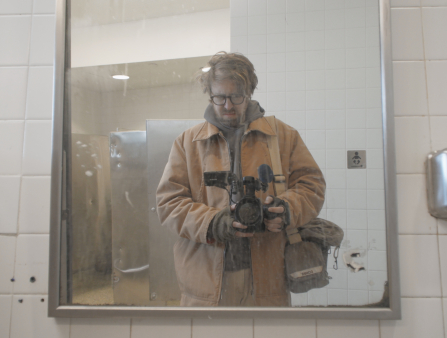
John Wilson shooting The History of Concrete

D: Since you’re going into the infrastructure of New York, I also thought a lot about the early twentieth-century urban planner Robert Moses. Was it a conscious choice to eschew him and his role in shaping the city?
JW: There’s a lot of stuff I omitted just because it’s what everyone immediately thinks of. It’s what I thought of initially, too; I think about Robert Moses a lot. But I did not want to be pedantic. I think everybody knows at this point the impact that Robert Moses had on the city, and I didn’t need to regurgitate that. Any time I felt like I was veering into cliché or a well-worn groove about the way New York is designed, I tended to reject it and pivot toward something I hadn’t seen represented before, like someone who lives next to a concrete recycling plant.
I omit a lot of factual information that could teach people about concrete. Stuff like that was maybe in the first draft of the film, but I cut most of it, just because you can do your own research. I get tired and jaded by my own ideas as I’m even making them. I need to isolate whatever the existential issue is and lean into that. In this case, it was impermanence. It was cyclical behavior and how to break from it, or even if it’s healthy to break from cyclical behavior.
D: You mentioned repairing your basement, which is a carryover from something we see in How To. Is there any footage you shot for the show or your shorts that made it into the film?
JW: Most of it was shot during this production period. There were one or two shots we were approved to take from the old archive, like when I’m talking to a Times Square security guard about my billboard for season one of How To. There are certain things I needed to give some context in the first few minutes. But I like to shoot all-new stuff for every project, even if I do have my archive.
D: You also returned to mostly being the sole cinematographer after working with a team for How To.
JW: It was mostly a budgetary factor, but I also just like filming everything myself. I’m a bit of a control freak, and I feel the most connected to the imagery in the film when I shoot it myself. I was filming basically everything for How To as well. There was a lot of B-roll that people helped to harvest from the second unit, and there was an amazing crew. This time, I just had my friend Nellie [Kluz] working on spec to film things like patterns of chewing gum on the sidewalk. And I was doing it right along with her. I’m in East New York outside a Checkers, looking at the drive-thru in 100-degree heat. I’m back to doing all the hard work myself.
I think it’s important to feel the hands of the artist, to feel that the documentarian is the instrument as well. And I think that comes across to the viewer a lot of the time. A lot of my favorite stuff is like that. You look at George Kuchar’s work, and he’s clearly filming all of it himself, and you get that because it has his personality, something no one else can recreate. I think that, as a protective measure, it’s important to do as much yourself as you can.
D: You’ve done entirely short-form work before this, and you have another series lined up. What made this the right subject for your first feature?
JW: I immediately thought of this as a feature. It was kind of random that I ended up in TV. I always wanted to get into film, and I even thought of How To episodes as little movies. I wanted to experiment with a longer format because I could fit so much within concrete. I’m always looking for subject matter that can contain all of these other ideas, like the way pedestrians use sidewalks or a taxonomy of different imperfections in the city. This almost felt like a prequel to How To. It’s the foundation on which all of the other stuff was built. It’s like the Marvel villain origin story.
I think it’s important to feel the hands of the artist, to feel that the documentarian is the instrument as well. And I think that comes across to the viewer a lot of the time.
—John Wilson
D: How many of the tangents you find are things you discover during filming, as opposed to things you’re already aware of and realize you can fold into the theme? I’m specifically thinking of things like the Sri Chinmoy Marathon.
JW: That was one of the first things I focused on. I think my brother told me about it because he’s a competitive runner. It made so much sense to me to fit that in there, because they have the most sustained relationship with concrete throughout the film. When I’m coming up with an idea for a project, I try to find as many events as I can with a natural endpoint that I can revisit throughout the course of a production. A race has a finish line and takes a certain amount of time, and these conventions are on certain dates, and you have enough of those plates spinning at the same time. You follow each thread and see if it bears fruit. Hopefully, something else happens on your way to pursuing this other stuff, giving it an added layer of emotional depth. Then you piece it all together.
D: Any notable threads you pursued here that didn’t bear fruit?
JW: I hung out with a bunch of jellyfish experts for a while. They talked about how overdevelopment on the Jersey Shore is increasing the jellyfish population to the point that no one can swim in these man-made lagoons anymore.
D: That sounds so interesting, though! To me, at least.
JW: I know. I love that scene. They were bone-dry, but I really liked them. That scene got reduced to just the names of funny boats when I was talking about sand. I use every part of the animal. If I can’t use a full scene, I’ll try to find the funniest B-roll from that day and turn it into a little interstitial or something. I also went to my high school reunion and filmed a bunch there. That was nice for a minute, but I ultimately cut it. I just try a bunch of stuff. And nothing is fully off the table for use in future stuff.
D: Do you stay in touch with anyone you’ve met through your projects?
JW: Yeah. People who have been in the show talk to me. A lot of them are just in my neighborhood, so I see them all the time. The musician I met, he still promotes liquor. I have a back-and-forth with the anti-circumcision guy [from the How To episode “How to Cover Your Furniture”], because he’s performing his original music all around the world. So he’ll send me pictures and stuff of him busking in England or something.
D: Did you send him the video of Stavros Halkias on Subway Takes [in which Halkias decries circumcision]?
JW: Oh no, but somebody sent me that.
D: Make sure he sees it. He should know that somebody’s out there carrying on the good work.
JW: I don’t think he makes the TLC Tugger [an alleged foreskin-regrowing contraption] anymore. I mean, I have one here at my house, but I don’t know if he’s making them custom.
D: Did he give that to you gratis?
JW: Yeah, it was free.
D: That’s really nice of him. Did you ever find out what the Avatar fan club [from the How To episode “How to Remember Your Dreams”] thought of The Way of Water and Fire and Ash?
JW: Oh, they loved it.
D: I’m very glad to hear that.
JW: Yeah, I watched the most recent Avatar on a plane. It was fun.
D: I’m not sure James Cameron would want you to watch it that way.
JW: Fuck James Cameron.