In the deeply religious Christian nation of Uganda, homosexuality is a crime punishable by death. But after returning from a stint in South Africa, David Kato wanted to fight to liberate oppressed Ugandians who were forced to remain in the closet due to the nation's anti-homosexual bill. As Uganda's first openly gay man, David Kato fights to defeat this bill while overcoming brutal physical and verbal persecution in Call Me Kuchu, a documentary by Malika Zouhali-Worrall and Katherine Fairfax Wright. Working against a violent culture of anti-homosexuality, David's story is highly personal; the film is deeply embedded in his everyday life, following him from his home and out into the world among his peers and his enemies. The film takes a turn for the worse when a senseless act of voilence rocks the movement, but the central theme of hope prevails as the narrative clings to its message of promoting international human rights.
Call Me Kuchu screened Monday, November 11 at the Landmark in Los Angeles as a part of the IDA Documentary Screening Series. Directors Malika Zouhali-Worrall and Katherine Fairfax Wright spoke to Criticwire's Steve Greene about the slow process of building trust with the Ugandan LGBT community.
Watch below:
You can watch more moments from this Q&A at our IDA Screening Series playlist on our YouTube channel
Learn more about the other docs set to play in the IDA Documentary Screening Series
Filmmaker Alex Gibney, who is usually working on a handful of documentary projects at any given moment, doesn’t have much time to respond to questions. But seeing how the IDA just honored him with the Career Achievement Award at the 29th annual IDA Documentary Awards, he spared us a few minutes of his time to email back some short quips.
Luckily, since Gibney has been in the field for so long, we can also draw from a wealth of other articles about and by the man himself. We invite you to read a few words, both new and from the archives, from this year’s IDA Career Achievement Award honoree, Alex Gibney, below:
On Gibney’s father, who started his career as a naval interrogator.
He was also a journalist. He was curious and a truth-seeker. Learned that from him.
What was the inspiration for his first film?
The death of pinball and the coming of videogames. After that, a classroom that was run as an imaginary country with disastrous results: corruption, mendacity and greed from the boys; gossip and civic responsibility from the girls.
On following the path of corruption.
I am interested in abuses of power. I tend to be more interested in the perps than the victims - though the suffering of the victims can never be ignored. But to stop crimes, you have to understand how the criminals work.
How his documentaries "break the rules":
The playful archive in Enron, the murder mystery narrative in Taxi, the actress and the mood in Client 9 (one friend called it "documentary noir," a term I like a lot), the graphics in We Steal Secrets—one character revealed entirely through his online chats.
Is all documentary filmmaking personalized, inextricably linked to its creator?
Enron was narrated by Peter Coyote, but I think the style and the "attack" makes it personal. One of the great things about docs now is that they are "authored" films: they are nonfiction, and respect the unpredictability of nonfiction, but are also told in ways that reflect the point of view of the author.
About his company, Jigsaw Productions:
I work with talented and dedicated people and genius editors. My films all take a long time to make (Armstrong took five years) but I do a number of them at one time. Not unlike a law office, or, perhaps better, the office of a private eye. Lots of cases and clients with interesting stories that sometimes take time to tell.
On not getting an interview with Julian Assange for We Steal Secrets:
I had this one meeting very late in the process. I sat in a room with him for six hours straight, maybe two bathroom breaks. It was a negotiation. He had no intention of giving me the interview. I kept trying to steer him to a discussion of larger principles in which he seemed not to be particularly interested. He was sucked down into his own maelstrom of malice. When he comes down off his pedestal, he can be a kind of charming, funny guy. But too often he’s on this pedestal doing nothing more than image-burnishing, which I found very dispiriting. I thought it was going to work, that he was going to agree to an interview, and then the next day we got a note from him saying that he was too tired.
Why filmmakers can be more effective than investigative journalists:
I do think that documentary filmmakers sometimes have an ability to use different cinematic methods that may be more effective at combating the doublespeak of officials in power. People in power today often use the traditional media’s rules of "objectivity" and phony balance to insure that lies are often given the same weight as the truth. But like many indie docmakers, I have a formal freedom that can sometimes allow me to expose official depravity better than traditional news reporters.
On the use of dramatic reenactment in Client 9:
There's something about this kind of escort service that involves acting. It's like the clients walk into an erotic film. The bookers will tell the women what the clients are interested in...so miraculously you show up for your "date," and your escort is chatting with you about Carmen. Well, that's a fiction.
About his visual choices for Enron: The Smartest Guys in the Room:
The visual style of the film followed the themes of the story. My cinematographer—the incomparable Maryse Alberti—and I used Sony's 24P HD camera to create a look as glossy as the image Enron had sought to create. And because the film was about the illusory nature of a fraud, we made an aesthetic out of reflections—whether in the way we shot the gaudy facades of the Enron buildings or the way we emphasized the mirror images of our interview subjects in the reflective surfaces of the tables around them.
On his receipt of the IDA Career Achievement Award:
I’m honored and a little afraid. Is this a hint?
Read more from and about IDA Career Achievement Award honoree Alex Gibney:
The Write Wing: Defining the Role of the Writer in Nonfiction
Do You Swear to Re-Enact the Truth? Dramatized Testimony in Documentary Film
The Casino That Jack Built: Alex Gibney Takes on a Disgraced Lobbyist
THE SQUARE and Spurlock's INSIDE MAN Take Top Honors at 2013 IDA Documentary Awards
Winners in the 2013 IDA Documentary Awards were announced during tonight's program at the Directors Guild of America, giving Jehane Noujaim's The Square top honors with the Best Feature Award. The first major film acquisition by Netflix, The Square follows a group of Egyptian activists as they battle leaders and regimes, and risk their lives to build a new society of conscience.
Also announced in the ceremony was the Best Short Award, which honored Slomo, directed by Josh Izenberg. An inspirational portrait of neurologist turned rollerblader, Dr. John Kitchin, Slomo has been an audience favorite at festivals around the world garnering a number of audience and jury awards.
During the ceremony, which was hosted by comedian and award-winning stage and screen actor, Paul Provenza, two series awards were also presented. The Best Continuing Series Award went to the PBS series Independent Lens. Now in its 12th season, the weekly series features original documentary films made by some of the best independent filmmakers working today. The Best Limited Series Award went to the CNN Original Series Inside Man, hosted by Oscar®-nominated documentary filmmaker Morgan Spurlock.
IDA’s Career Achievement Award was presented to Academy Award®– and Emmy Award-winning director, producer and writer Alex Gibney whose body of work includes Mea Maxima Culpa: Silence in the House of God (2012), Client 9: The Rise and Fall of Eliot Spitzer (2010) and Taxi to the Dark Side (2007), which won an Oscar® for Best Documentary Feature. This year saw the release of Gibney’s latest films We Steal Secrets: The Story of Wikileaks and The Armstrong Lie. Producers Matthew Tolmach and Frank Marshall (The Armstrong Lie) presented the Career Achievement Award to Gibney.
Presented for just the fourth time in the 29-year history of the Awards, the IDA Amicus Award went to Impact Partners co-founder Geralyn Dreyfous, who also founded the Utah Film Center. Dreyfous’ executive producing and producing credits include the Academy Award®-winning Born Into Brothels, The Invisible War, as well as 2013's The Square and The Crash Reel. Presented by Academy Award®-winning actor and advocate Geena Davis, the IDA Amicus Award recognizes friends of the documentary community who have contributed significantly to the field.
Filmmaker Laura Poitras received IDA’s Courage Under Fire Award, in recognition of "conspicuous bravery in the pursuit of truth." Along with Glenn Greenwald, Poitras broke the story of NSA whistleblower Edward Snowden, revealing the PRISM program. Poitras is working on a trilogy of films about America post 9/11, which includes My Country, My Country (2006) and The Oath (2010). Poitras is currently in Berlin editing the third film of the trilogy, a documentary about NSA surveillance, and accepted the award via live remote. Presenting the award to Poitras in Los Angeles was William Binney, who worked at the National Security Agency for over 30 years before resigning in protest over the agency’s data mining programs.
The Jacqueline Donnet Emerging Documentary Filmmaker Award, which recognizes the achievements of a filmmaker who has made a significant impact at the beginning of his or her career in documentary film, was presented to Zachary Heinzerling. Cutie and the Boxer, Heinzerling’s feature documentary debut, premiered in January at the Sundance Film Festival, receiving the US Documentary Directing Award.
A complete list of nominees and winners can be found on the IDA Awards page.
by Lisa Hasko and Katharine Relth
In the past few years, crowdfunding has gone from the new buzzword to an integral part of the independent film funding landscape, especially when it comes to documentaries. Some people say running a campaign is a full time job. Others even equate it to having a newborn baby. But one thing is for certain: just as with most large undertakings, planning is everything.
At our November 18 Doc U event at the Cinefamily Theater in LA, Crowdfunding: Raising Money the New-Fashioned Way, we heard from Principal and Evangelist at Indiegogo and IDA Board Member Adam Chapnick, founder and CEO of crowdfunding and distribution platform Seed&Spark Emily Best, and filmmakers Lotti Pharriss Knowles (I am Divine), Camilo Silva (After 68), and Tracy Droz Tragos (Rich Hill), all of whom have recently completed successful crowdfunding campaigns. From this lively conversation, deftly moderated by IDA's Fiscal Sponsorship Program Manager Amy Halpin, we at IDA have comprised this crowdfunding tool kit to better help you navigate the maze of this rapidly growing fundraising strategy.
PRIOR TO YOUR LAUNCH
Build your list. (But really, do this consistently.)
According to Adam Chapnick of Indiegogo, if you’re not adding one person to your list everyday, you aren’t doing it right. In other words, it should always be a priority. After you’ve recognized this, take the time to learn where to focus your outreach to build your list and audience.
Any crowdfunding strategist will tell you that strangers are not likely to be your bread-and-butter donors. The most crucial group of people is your social network and the list you’ve (hopefully) been building over the prior months -- think Facebook groups, email lists and your Twitter feed.
But how do you build your list if you don’t have one? Our panel of experts recommends reaching out to groups, other organizations and blogs that would be interested in your subject matter before you launch your campaign.
Think about your campaign far in advance of your planned launch date.
At a recent Film Independent panel, Lisa Callif, partner at Donaldson + Callif, stated that "Most of [her] successful clients had 6 - 12 months preparation for their campaign prior to launching." A good place to start that planning process is to line up publicity opportunities several months before your campaign launches. Reach out to bloggers who might be interested in your film’s subject matter. Contact radio stations. Start to research and get in touch with like-minded organizations and other press outlets to let them know about your film project. After you’ve made those contacts, organize press to come out at certain times prior to and during your campaign.
It might also be helpful to think about suitable upcoming events that might make your documentary's topic more visible and relevant. This groundwork will help leverage that extra time you need to create a buzz about your upcoming campaign.
Research which platform is right for you.
Each crowdfunding platform has different fee structures and offers a variety of ways you can set up your campaign, so it's important to find one that will work with your project's overall fundraising strategy. Some platforms, like Indiegogo for example, allow for fixed and flexible campaigns while others, such as Kickstarter, are fixed only. A fixed campaign means you must meet your goal to be able to receive the funds you raised, while a flexible campaign gives you more breathing room: you receive your funds regardless of whether or not you meet your goal, but at a higher fee rate. Be sure to pay close attention to the fee structure and what you will be charged if you do/do not meet your goal.
While you're at it, it helps to check out campaigns that have successfully met their goal. These are your role models. What did they do right? Did they have a compelling trailer? What were their incentives like? How did they involve their donors and keep them interested? Keep these things in mind as you set up your campaign page.
Know where and how long to set your goal.
Crowdfunding campaigns shouldn’t be your only fundraising strategy. Unless you’re a giant fish in the documentary community, you’re unlikely to raise your entire budget this way. Based on experience and the knowledge of our panelists, we know the average donation to any crowdfunding campaign is $25. Using this metric and your list size will help you determine an achievable goal.
Keep your goal on the lower end of the spectrum so that your campaign is certain to be a success. People are more likely to donate when a project has clear momentum. And if you surpass the set amount? Even better!
Now that you know how much you want to raise, you can decide on the length of your campaign. Film Lead Marc Hofstatter of Indiegogo says their research shows the average campaign lasts 47 days, with anything between 30 - 40 days being most common. Many experts suggest that shorter campaigns can actually be advantageous since it’s less likely you’ll have long lull periods that tend to happen with a 60 day campaign. That’s a long time to keep people excited about your project and only creates more work for you!
Know your audience and use them to promote your campaign.
Let people know what their donations are going toward and how they are making a difference. Why is it important for them to donate to your project? What aspects of the project will their donations be assisting?
Our panel also suggested that you consider whether you will need a fiscal sponsor. Will your audience be donating in larger increments and expecting a tax deduction on their gift? If so, you’ll want to look into fiscal sponsorship prior to setting up your campaign. Not sure what fiscal sponsorship is? You can learn more here.
Director Tracy Droz Tragos (Rich Hill) recommends establishing a set group of donors that she refers to as "bundlers," or fundraisers who pool other contributors from their social network. Bundlers will asking their community (some of which might have overlap with your own) to spread the word for you. "Can you bring in at least 10 people to donate $10?" You’ll be surprised by how these supporters can truly bolster your campaign.
And now, it's time to launch!
It might also be advantageous to consider launching your campaign in two stages. A "soft launch," where you identify your core circle and ask them to be ready to donate early, can really help you start at a base level. Aim for collecting 20 - 30% of your goal in the first couple of days of this soft launch. Reach out to your inner circle beforehand to ensure they know to donate within this crucial time frame. Your "hard launch" will be the launch date that you publicize through press and your social networks. When strangers and those that your bundlers have asked to come in see that your campaign has strong early momentum, they will be even more inspired to give.
As in the making of a film, this initial prep phase will require the most time and effort. But it will also ensure that you're ready put your head down and start raising those funds!
DURING YOUR CAMPAIGN
Be aggressive! The filmmakers on our panel agreed that they had to get over being shy about asking for money. Since it can sometimes take people a few visits to your campaign’s page before they convert from a visitor to a donor, you shouldn’t be afraid to promote and engage your social network regularly. One way to keep them involved is to engage your audience in your creative process and help them participate in the project by sharing your experience with them.
Like panelist Tracy Droz Tragos astutely noted, running a crowdfunding campaign is like having a newborn: you have to check on it every two to three hours. For the days that your campaign is live, maintaining it should be Priority #1. Make it your full-time job. If you don’t have the resources to commit yourself to it during all of your waking hours, it might be time to bring someone committed to the project on board to help you part-time.
We also recommend sending out one-to-one emails to make a more personal ask to your inner circle. Reserve some of these core donors for lull periods, which are usually in the middle of a campaign, to help maintain momentum.
YOU REACHED THE FINISH LINE! ALMOST...
Be sure to send out your promised incentives and thank yous in a timely fashion or at any dates that you specified. It’s a big job, but you’ll be more likely to retain donors if they trust you.
As you start that next phase of applying the dollars you have raised to your production, keep in contact with your list. Track your progress in videos, emails, social posts, and other engaging ways so they can see your project come to life.
A recent finding shows that serial campaigns - or multiple campaigns for the same project - actually work! It’s unrealistic to expect to meet all of your fundraising goals at once. Segment out your crowdfunding, and be extremely targeted about what you are fundraising for in stages and phases.
In closing, here are some helpful links that will give you even more advice on running a successful crowdfunding campaign:
After completing his latest documentary feature, Errol Morris professed that the film captured "the strangest interview I’ve ever done." And for Morris, the man famous for the invention of his interviewing machine aptly coined The Interrotron, this conversation with former Secretary of Defense Donald Rumsfeld is just one of thousands he’s conducted over the course of his filmmaking career. So to refer to it as "the strangest" is certainly saying something.
After developing a personal fascination with Rumsfeld's "snowflakes"—the enormous mountain of memos he composed during his almost fifty years of public service—Morris asked Rumsfeld to read and explain these memos for his cameras. When he sat down with Rumsfeld to interview him for what would become The Unknown Known, Morris was interested in digging deeper into the unfamiliar territory that is Rumsfeld’s mind. What he found there was not a substantive accumulation of evil. Instead, Morris’s film presents a man so understated and controlled in his own humanity that his lack of regard for his own actions leaves the audience chilled. With masterful understanding of the documentary artform that few others possess, Morris’s film meticulously pieces together what it can from Rumsfeld’s complicated "web of words" to present an impression of a man that no one can possibly fully understand.
The Unknown Known screened Thursday, November 7 at the Landmark in Los Angeles as a part of the IDA Documentary Screening Series. Director Errol Morris sat down with Indiewire's Dana Harris, who fielded a question from the audience regarding the most satisfying thing about making this film.
Watch his answer below:
You can watch more moments from this Q&A at our IDA Screening Series playlist on our YouTube channel.
Learn more about the other docs that have played in the IDA Documentary Screening Series
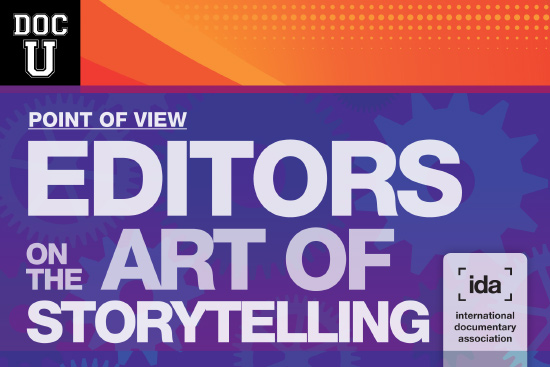
Doc U Point of View:
Editors on the Art of Storytelling
Tuesday, December 17, 2013
Discussion & Audience Q&A: 7:30pm - 9:00pm
The Cinefamily - 611 N. Fairfax Avenue, Los Angeles, CA 90036

Great documentaries are made, not born, and the place where that happens is in the editing room. A good editor can save a documentary director's neck; a great one can make a director look like a genius. So, who are these saviors and alchemists and what special storytelling skills do they have that filmmakers can benefit from?
Join us for a lively and illuminating discussion with high caliber editors moderated by Emmy-nominated editor Lillian Benson, A.C.E. (Eyes on the Prize II, Bridging the Divide—Tom Bradley and the Politics of Race). Confirmed panelists: Johanna Demetrakas (Crazy Wisdom: The Life & Times of Chogyam Trungpa Rinpoche, Angels in the Dust), Maya Hawke (Plimpton! Starring George Plimpton as Himself, Cave of Forgotten Dreams), Yaffa Lerea (Project Runway, Ken Burns' Baseball), and Kim Roberts, A.C.E. (Inequality for All, Last Call at the Oasis).
The IDA Documentary Awards is the foremost event dedicated to the art of documentary film. Winners of the 29th Annual IDA Documentary Awards will be announced on December 6, 2013 in Los Angeles at the Directors Guild of America.
It can be difficult for a documentary to successfully highlight both a personal profile and an activism narrative in a mere hour and forty minutes. But Barbara Kopple's latest feature, Running From Crazy, somehow successfully weaves a message of activism into the story of the life of Mariel Hemingway, the youngest granddaughter of one of America's most celebrated authors. As a woman who now accepts the long line of Hemingway suicides (seven since her great-grandfather, to be precise), Mariel has dedicated her later years to becoming a very public presence in the realm of suicide prevention. The film came about as a sort of matchmaking exercise, with the Oprah Winfrey Network approaching Mariel and Barbara separately to gauge their interest in participating in the project. After a long and impassioned meeting between the two women, Mariel agreed that this film could be the place where she would totally open up for the first time. Running From Crazy became not just a film about Mariel and the tragic history of her family; it became a celebration of the Hemingway's complete and total embrace of joy.
Running from Crazy screened Wednesday, November 6 at the Landmark in Los Angeles as a part of the IDA Documentary Screening Series. Director Barbara Kopple spoke to Indiewire's Dana Harris about wanting to get underneath the Hemingway myth and understand this family on a very intimate level.
Watch below:
You can watch more moments from this Q&A at our IDA Screening Series playlist on our YouTube channel.
Learn more about the other docs set to play in the IDA Documentary Screening Series
The upcoming Winter issue of Documentary magazine will take a comprehensive look at the all-important elements to any documentary:
Sound and Music!
Production sound, sound design, editing and mixing, composing, music licensing and music supervision, and music documentaries: It's all here, for your reading—and maybe even listening—pleasure! Experts from across the documentary spectrum share their insights about their secrets to sonic synchronicity.
But wait. There's more!
Thanks to the popularity of the education-themed Fall 2013 issue, we are launching a new column that will spotlight a documentary program in a school, university or college. We kick off the column with a profile of George Washington University's Documentary Center.
Elsewhere in the Winter issue, Frederick Wiseman talks to us about his latest opus, At Berekley, which premieres on PBS' Independent Lens in January; filmmaker Katie Dellamaggiore shares her experiences taking her acclaimed film Brooklyn Castle to Israel and Palestine as part of the American Film Showcase; and we review the book Killer Images, a collection of essays about documentary, memory and the "performance of violence,' edited by IDA Documentary Awards nominated filmmaker Joshua Oppenheimer (The Act of Killing).
So, treat yourself to a little holiday joy: join IDA today and get Documentary magazine year-round—Winter, Spring, Summer and Fall!
Tim Jenison is a man who likes to figure out how things work. As the founder of the San Antonio-based hardware and software company NewTek, Inc., Tim is excited by the idea of digging deep to discover the parts that make up the whole. After receiving a copy of David Hockney's Secret Knowledge: Rediscovering the Lost Techniques of the Old Masters from his daughter, Tim became obsessed with determining how Johannes Vermeer's paintings could possibly be so photorealist. His theory, somewhat of an offshoot of Hockneys, contends that Vermeer used optics to guide his brush. After several experiments, the invention of a mirrored device, and the creation of a life-size replica of the scene depicted in Vermeer's "The Music Lesson," Tim Jenison set about recreating his very own Vermeer.
Between the interviews with key people in Tim's life, his visit to Holland for research, and the hundreds of days put into building the studio and working on the painting, the filmmakers and Tim collected over 2400 hours of footage. This was eventually whittled down into the 80 minute documentary Tim's Vermeer, directed by the oft-silent half of Penn & Teller. Famously known for their magic act as well as their skepticism, Tim's story was a natural fit for this pair, who uses the film and Tim's project to ask if there really is a concrete distinction between an inventor and a painter.
Tim's Vermeer screened Tuesday, November 5 at the Landmark in Los Angeles as a part of the IDA Documentary Screening Series. Producer Farley Ziegler told Criticwire's Steve Greene that it was more important to carve out a story than to strive for a particular runtime.
Watch below:
You can watch more moments from this Q&A at our IDA Screening Series playlist on our YouTube channel.
Learn more about the other docs set to play in the IDA Documentary Screening Series