On December 29, 2013, three Al Jazeera English journalists were imprisoned in Cairo. Today marks the 100th day of the detainment of Mohamed Fahmy, Peter Greste, and Bahar Mohammed in the Egyptian capitol, who were charged with spreading false news, belonging to a terrorist group and operating without a permit. Al Jazeera is holding a press conference and symposium in New York City this afternoon to mark the occasion, and to call on the Egyptian Authorities to immediately release its journalists.
The International Documentary Assocaiation was invited to include a letter of support in the press packet for this event. Below is the letter from IDA's Executive Director Michael Lumpkin in support of the release of the three journalists. Please read the letter and sign on with your support to the #FreeAJstaff petition.
April 6, 2014
His Excellency Adly Mahmoud Mansour
Office of the President
Al-Ittihadia Palace
Cairo, Arab Republic of Egypt
Dear President Mansour,
The International Documentary Association (IDA) represents over 2,000 filmmakers in North America and around the world. As a non-profit, non-governmental organization dedicated to defending the rights and freedoms of documentary artists, activists and journalists, we believe that the free flow of information is vital to fostering an informed, compassionate, and connected world.
We are deeply troubled by the ongoing detention of three Al Jazeera journalists who have been arbitrarily imprisoned by Egyptian authorities since December 29, 2013. Peter Greste, Mohamed Fadel Fahmy and Baher Mohamed are professionals who work to present impartial reporting on current events in Egypt. The IDA is profoundly concerned that their ongoing detention constitutes an attempt by the Egyptian government to inhibit critical reporting and suppress freedom of expression.
We urge you to immediately release Peter Greste, Mohamed Fadel Fahmy and Baher Mohamed, as well as all journalists being held behind bars in Egypt.
Sincerely,
Michael Lumpkin
Executive Director
The University of California at Santa Cruz (UCSC), tucked between mountains and the redwoods of the central Pacific coast, is famous for its progressive values and faculty/student activism. This legacy thrives in UCSC's acclaimed master's program in Social Documentation/Film-Digital Media, nicknamed "SocDoc."
Documentary spoke to B. Ruby Rich, co-founder of and professor at SocDoc, as well as its former director of graduate studies; and John Jota Leaños, associate professor and director of graduate studies, via email about the history and mission of the program.
How did the program get started in 2005?
B. Ruby Rich and John Jota Leaños: In the early 2000s, the Community Studies Department decided to start a graduate program in what it called "social documentation." Today, we call ourselves "SocDoc." The idea was to transfer the department's interdisciplinary richness (anthropology, history, sociology, geography) into a basis for documentaries on the kind of communities with which faculty and students were already collaborating. Renee Tajima-Peña (now at UCLA) and B. Ruby Rich launched SocDoc to attract students committed to social change and with a passion for using documentary in the service of under-represented communities and unexamined issues. Though our program is now in the Film and Digital Media Department, it has kept the same interdisciplinary framework and continues to involve faculty in the social sciences and humanities in our advising and curriculum. They're our secret weapon.
What are the goals and mission of the program?
The SocDoc Program aims to train students to use documentary at the highest possible level, professionally and ethically, to advance social justice and bring attention to people and issues that might otherwise go unremarked. SocDoc is committed to a cohort model of learning, in which students collaborate rather than compete and in which learning and achievement are intertwined, along with creativity and service.
What are the program's strengths and weaknesses?
Our strengths are in our approach to the interdisciplinary to documentary filmmaking. Not only do we train students in techniques of documentary (lighting, sound, editing, motion graphics, animation, post-production), we also prepare students with social-science research methodologies in courses on ethnographic writing and documentary fieldwork taught by professors from the departments of anthropology, sociology, literature, feminist studies and beyond. Students also take electives in doc project-relevant subject matter in a wide range of graduate courses throughout UCSC. Technical exercises, workshops and preparation combine with the ethical, methodological and critical studies training to guide our students in the production of doc projects that go "beyond the story," creating social impact and personal transformation for characters, audiences and documentarians alike. We are also invested in developing character and narrative strategies for documentarians, not only for creation of time-based video but also to establish new media content and audience participation beyond the film festival, community screening and website.
Weaknesses? SocDoc presently offers only an MA degree. But the good news is that we are in the process of converting to an MFA program and will be able to offer this terminal degree within a couple of years.
How much theory and film history do you offer in addition to technical education?
SocDoc teaches courses on documentary history and critical theory. We prepare students in understanding the complex history and new directions of documentary filmmaking and production through a foundational course and occasional special events, and students can take many other courses via the department's PhD curriculum. We don't believe in teaching one without the other.
Does your emphasis on social justice and human rights differ from other programs?
Yes, very much so. We attract a terrific group of students from around the country and the world who want to make a difference with their work. Our faculty and students tend to come from diverse perspectives and cultural backgrounds, which informs the ways we look at social justice and human rights.
What access do students get to the tools of production and post-production?
Students are well equipped with both production and post-production equipment, thanks to the resources of the Film & Digital Media Department in which SocDoc is housed.
What is the program's relationship to the San Francisco Bay Area community?
Many of our faculty, guest lecturers and workshop leaders are part of the very active documentary media community in the Bay Area, including longtime lecturers Jennifer Maytorena Taylor (New Muslim Cool; Paulina) and Leo Chiang (Mr. Cao Goes to Washington; A Village Called Versailles) and founding production specialist Spencer Nakasako (now at UC Berkeley School of Journalism).
Can you say something about the makeup of your faculty?
Leo and Jennifer are fantastic documentary filmmakers with impressive track records in the field. They guide students through logging, structuring and editing their films. B. Ruby Rich is our film historian, critic and theorist. John Jota Leaños focuses on documentary animation and alternative documentary forms (photography, new media). Lewis Watts is our resident documentary photographer, who resides in the Art Department. Marcia Ochoa is an anthropologist who teaches documentary methodologies and ethnographic writing to our SocDoc students. We also work with literature professor Karen Kei Yamashita on documentary writing and anthropologist Megan Moody on teaching our students social-science research methodologies. Filmmaker Gustavo Vazquez, who is chair of the Film and Digital Media Department, has taken over Spencer Nakasako's former production "boot camp," which plunges students into shooting ambitious projects the minute they arrive.
What about Santa Cruz makes it a special place for documentary film students?
UC Santa Cruz has a long history of being a center for activism, social justice and critical studies. SocDoc continues this tradition through the production of public media and documentary (note that we have also turned out remarkable photo documentarians). The interdisciplinary dimension makes it special; this is a world-renowned campus of very student-centered professors with whom our students are able to study. In fact, they have to; we require every student to work with a professor in the subject area of their documentary. It's remote enough to allow a unique community to develop, while close enough to make Bay Area and LA excursions easy. We also tap into the lively documentary community in the Bay Area (and to the south) with guest lectures by media-makers and leaders such as Sam Green, Dawn Valadez, Alex Rivera, Wendy Levy, Evangeline Griego, Judy Irola, Kate Amend, Lucy Walker and many others. With all the area film festivals, we've also been able to incorporate such important filmmakers as Hubert Sauper and Josh Oppenheimer. Plus, the ongoing events of our larger department keep the energy going.
Has Ruby's extensive experience in curating/journalism/exhibition influenced the kinds of students you look for?
Yes, we approach documentary from a much more holistic perspective-as a practice that is grounded in social locations, not just production protocols, and that is founded in ethics as much as camera brands, emphasizing collaboration not just with crew but with subjects and communities, placing documentary into a social fabric that it can affect.
What is SocDoc's track record in job placement and alumni achievement?
We have an astonishing success rate with our alumni. Several have had successful careers as independent documentary filmmakers. Recent graduates have landed significant grants and support for new projects, and others have won awards for work created in the program. Just a few examples:
- Juan Mejia, from our very first cohort (SocDoc class of 2007), had his thesis film Uprooted (about Afro-Colombians removed from their ancestral lands into refugee camps) shown in numerous festivals, where it won awards and was broadcast on PBS under the auspices of the National Black Programming Consortium. Juan won a Tribeca Fellowship for his sequel and got matching funds from Colombia's cultural ministry and is now finishing the film in New York City.
- Tad Nakamura (class of 2008) was commissioned right after graduation to direct Jake Shimabukuro: Life on Four Strings by CAAM (Center for Asian-American Media), which had a national PBS broadcast and went on to win the Gotham Audience Award.
- Kimberly Bautista (class of 2009) had had immense international success with her documentary Justice for My Sister, about feminicide in Guatemala. The film has shown in numerous film festivals and taken the Audience Award at many. Like many SocDoc alums, she's distributing with New Day Films.
- Bridgette Auger, who came to SocDoc as a photographer and trained in video with us, has been reporting from the Middle East since graduating in 2011. She just had her new piece This Is Not Me acquired by SnagFilms.
- Melissa Koch (class of 2012) won a Frameline Completion Award for her thesis film, The Infamous T, on a year in the life of a homeless queer teen entering a new host family program. It premiered in Frameline's LGBT festival in San Francisco and at the prestigious Margaret Mead Film Festival in New York City.
How does the cost for your program compare with other schools?
We are the probably the cheapest option available to students interested in this kind of training. Our students can take classes and receive guidance from professors from different disciplines and experts in various fields on campus, including environmental studies, sociology, anthropology, psychology, etc. We will become more attractive and more competitive in the next year or two, when we offer an MFA instead of the MA. We also work in small cohorts. Students get a lot of attention, help and guidance from their mentors and peers in the program. Annual tuition is just over $11,000, and that is often covered by students' securing teaching assistant positions. Out-of-state students can convert to in-state after one year.
How does the program help support grads later on in their careers?
We offer professional training and exposure to many professionals in the field. We also nurture relationships between students and professors beyond the two-year MA program. Many students have worked for, been placed by and received references from faculty and via professional connections made during their time here. Thanks to the collaborative cohort model, they also help each other and have a vibrant alum network exchanging information and jobs.
Fact Box
Duration of program: Two years (admission for fall quarter only, full-time enrollment only)
Degree Offered: MA in Social Documentation
Components of Program: Documentary history, critical theory, interdisciplinary courses, technical training, production
Number of Students: Seven to 10 traditionally admitted out of about 40 applications
Internship Placement Opportunities: No internship program at present, but many students arrange internships with Bay Area documentary filmmakers after graduating.
Frako Loden is adjunct lecturer in film, women's studies and ethnic studies at California State University East Bay and Diablo Valley College. She also reports on film festivals for Fandor.
IDA and FIND Present their Case on Orphan Works to the House Judiciary Committee
IDA and Film Independent, through attorney Michael C. Donaldson, testified April 2 before the House Judiciary Committee in Washington, DC. Donaldson urged Congress to consider documentary and independent filmmakers when crafting new legislation on orphan works, which are copyrighted material whose owners cannot be found after a diligent search has been made.
Donaldson backed adoption of recommendations made by the Copyright Office in 2006. That approach called for a case-by-case solution, which would impose limitations on remedies against users of orphan works in the event a rights-holder emerged after the filmmaker had made a substantial search for the owner prior to the use. Under current law, a filmmaker is threatened with huge damages and injunctive release when they use unlicensed material, no matter how hard they looked for the owner.
Donaldson commented, "Fair use can often provide a partial solution for the documentary filmmaker, but is not available to a feature filmmaker who wants to base a film on an orphaned book or who wants to remake a wonderful, but orphaned film." His testimony was in support of an Orphan Works bill that passed the Senate in 2008 but ultimately stalled in the House, and was in line with the comments he and the USC Intellectual Property and Technology Law Clinic filed in March with the Copyright Office.
Watch Michael Donaldson present this orphan works case to the House Judiciary Committee:
As part of The Art of Documentary series, the IDA screened the award-winning film The Naked Room at the Landmark Theater in Los Angeles on Thursday, March 13. The film shows a whole world without leaving a single space: the examination room in a children's hospital in Mexico City. Listening to the children, their parents and the doctors during consultations allows us to have a more profound and complex view of our social reality and of human nature.
Filmmaker Nuria Ibáñez was traveling and unable to attend the screening, so we solicited questions for the filmmaker from our Twitter audience. See below for questions from the Twittersphere, including a few from our own engaged IDA staff members.
What led you to look at childhood through the eyes of children that have suffered trauma?
I could see through these children's experiences not only the representation of their own stories, but mainly the reflection of our social reality and human condition.
The subjects seemed very unaware of the camera and seemed to be responding very naturally. What techniques or equipment did DP Ernesto Pardo employ to accomplish this? How was the sound recorded: camera mic or boom mic?
We used an EX3 sony camera—which is not very big—and sometimes a very simple steady to be stable during the long conversations. That was all. Regarding the sound, the sound operator Federico [gave] them all (doctors, parents and children) a wireless microphone, and he used a boom. I was so interested in getting a clean sound because I filmed during the renovation of the hospital, and I had a lot of background noise.
Why was The Naked Room structured the way it was? Did you plan this raw, direct style from the beginning?
The structure was one of the most challenging aspects of the doc during the editing process. This structure allows us to underline a final message that is not explicitly expressed in each individual case, but it is conveyed with the sum of all the different stories. I filmed each consultation in only one shot, because I didn't want to interfere with the natural conversation of each one of them. I was not thinking about the editing while I filmed. I focused on observing and listening the children as if a camera would have not been present. So yes, I planned this direct style from the beginning.
While making The Naked Room, who was your target audience? What feeling did you want us to leave with? What action would you want the audience to take?
I never thought about a target audience. This film is about human condition and I think we all are reflected in a way or another.
I think the film gives space to different feelings and reflections at all levels. But one of the most strong feelings that I still experience is the fragility of human kind. I want people to be open to diverse stories without judging, avoiding prejudices.
Have you screened the film for any of the subjects (children, parents, psychologists) who participated in the film? If so, what was their reaction?
Not yet, but it is happening in June. I'll keep you updated about the reactions.
How did you come upon the title The Naked Room? How are the children now?
Because I filmed it in a room, and because this room gave them a way to bare their souls. I tried to detach from them as not to confuse them, and to avoid confusing myself as well. However, I'm looking forward to seeing them in June.
What is next for the film?
The film is in the promotional film festival process and educational distribution is coming soon. Anyone interested can contact Magic Lantern for further information.
What is next for you?
A film about outdoors and landscape.
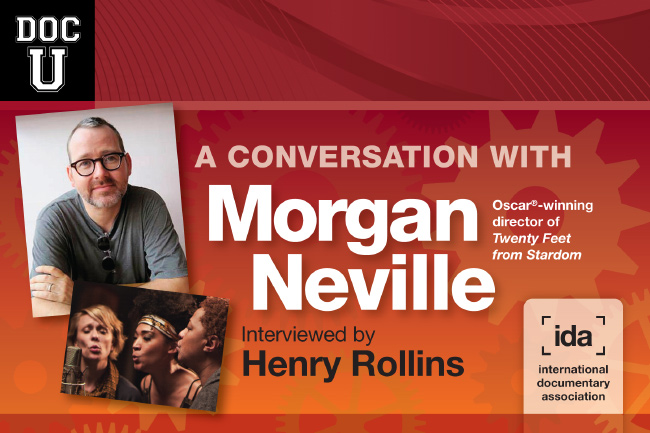
A Conversation with Morgan Neville
Interviewed by Henry Rollins
Wednesday, March 26, 2014
7:00pm - 8:30pm
Cinefamily
611 N. Fairfax Avenue, Los Angeles, CA 90010
Join us for a special evening as we go in-depth and behind-the-scenes with LA’s own Morgan Neville, director and producer of the Oscar®-winning, box office-smashing Twenty Feet from Stardom. Morgan will be joined for this on-stage interview and clips program by another local hero, writer/punk-rock icon/radio DJ/actor Henry Rollins. Morgan and Henry will not only discuss Morgan’s incredible ride with Twenty Feet, but look back on his 20-year career making music and fine art documentaries and explore the vitality and versatility of the music doc form—past, present, and future. This performance is one night only. Don’t miss it.
Here comes the sun—and, with it, the Spring 2014 issue of Documentary magazine!
Yes, it's been a long, cold, lonely winter, but as sure as the jacarandas and cherry blossoms will brighten the landscape again, so will the latest issue, where we offer you tips about Making Your Doc Abroad.
Working with crews, translators, expeditors and fixers...shooting in dangerous places...securing the right insurance for you, your crew and your doc: These are some of some of the many things you need to know about before you pack up your gear and venture into foreign territory in search of the truth. Filmmakers Jehane Noujaim, Ross Kauffmann, Rachel Beth Anderson, Marilyn Ness, Sebastian Junger and Linda Goldstein Knowlton, as well as experts from ProSight Specialty Insurance, share their experiences and insights.
And that's not all!
China is the fastest growing economy in the world, and it's also a looming presence in the documentary community. We take a look at some of the key players in this vital market.
Finally, Ramona Diaz shares her impressions of Morocco, where she shared her film Don't Stop Believin': Everyman's Journey with a range of audiences, and taught an intensive doc-making workshop, all under the auspices of the American Film Showcase.
Elsewhere in the Spring issue, we also talk to Oscar-nominated filmmaker Rithy Panh about his upcoming release, The Missing Picture; educators/media artists B. Ruby Rich and John Jota Leaños talk about their SocDoc masters program at University of California, Santa Cruz; and IDA Award nominee Jason Osder writes about how Jeff Malmberg's Marwencol inspired his filmmaking career.
So stow away your parkas and boots and embrace the season of renewal; join IDA today and get Documentary magazine year-round: Spring, Summer, Fall and Winter!

Doc U: Selling Your Doc
Sales Agents’ Tips and Tales
Tuesday, February 25, 2014
Discussion & Audience Q&A: 7:00pm - 8:30pm
The Cinefamily
611 N. Fairfax Avenue, Los Angeles, CA 90036

Admit it. You want to sell your documentary. You worked on it for years, went into debt over it, agonized over every frame of it, and now it's done. You're proud of your work. You know that it has value. Not just the moral, feel-good kind, but tangible, monetary value. But who will buy it? How will you sell it? What will you charge for it? And how in the world do you handle a negotiation over something like that? Or find the right people to be on your side? Well, the last part is taken care of. We have assembled a stellar panel of sales agents/producers, all experts in the field, with years of experience selling documentaries. For one night only, they are all on the your side, demystifying the process, and sharing what they know.
Please join Kevin Iwashina, Managing Partner of Preferred Content; Josh Braun, co-President of Submarine Entertainment; and Annie Roney, founder and CEO of ro*co films for a peel-back-the-curtain look at the world of buying and selling docs.
We're happy to announce a new showcase for exceptional international documentary film! Supported by the Hollywood Foreign Press Association, The Art of Documentary will screen three award-winning international documentaries at The Landmark Theater in West LA. This screening series showcases films that each represent masterful filmmaking craft and a unique and artistic approach to nonfiction storytelling. Recognized by film festivals renowned for showcasing significant filmic achievement, the films in this series each unite compelling real-life stories with exemplary filmmaking technique to create a truly cinematic documentary experience.
THE MISSING PICTURE, directed by Rithy Panh and winner of the 2013 Cannes Film Festival in the Un Certain Regard program, will be the film to launch the series on Thursday, February 20, 2014 at 7:30pm. The film recounts the director's firsthand experience of how his family and friends suffered at the hands of the Pol Pot's communist regime. THE MISSING PICTURE is a unique documentary that manages to recreate a historical moment that would never be told if not for the sheer creative mind of Panh's innovative storytelling method.
THE NAKED ROOM, directed by Nuria Ibáñez and winner of the Morelia International Film Festival prizes for Best Feature Length Documentary and Best Documentary by a Woman, shows a whole world without leaving a single space: the examination room in a children's hospital in Mexico City. Listening to the children, their parents and the doctors during consultations allows us to have a more profound and complex view of our social reality and of human nature. THE NAKED ROOM will screen Thursday, March 13 at 7:30pm.
SACRO GRA, director by Gianfranco Rosi and winner of the Golden Lion at the Venice International Film Festival 2013, the film tells the tale of a part of Rosi's own country where he roamed and filmed for over two years in a minivan on Rome's Grande Raccordo Anulare, or GRA. Elusive characters and fleeting apparitions emerge from the background of this winding zone. The film will screen Wednesday, March 19th at 7:30pm.
For more information on all the films in the series and to RSVP, please visit The Art of Documentary.

PRESENTED BY THE ACADEMY AND THE INTERNATIONAL DOCUMENTARY ASSOCIATION: Screenings of the nominated documentary features, with filmmakers and special guests in attendance. Friday February 14 through Sunday February 16, 2014 at the Academy Theater at Lighthouse International, 111 East 59th Street (between Park and Lexington), New York, NY
See full schedule and purchase tickets
James Lebrecht. Photo: B. Doug Jensen
Whether you are a seasoned documentary filmmaker or in the throes of your first film, your project can rise or fall on the sound of your film. There are many things you can do to improve your chances of getting a great sound mix. What follows is my advice from the standpoint of experience as a sound designer and mixer.
Record the Best Sound You Can
The fast-paced, tight-budgeted world of documentary filmmaking is not the best breeding ground for capturing great audio. The lack of a good sound recording can make it impossible to use an otherwise wonderful moment or, at best, make its sound stick out like a sore thumb because its imperfections are so obvious. Often in this case, the change in sound quality can pull an audience out of the film.
I believe that it pays for itself to include a seasoned location sound recordist on your team. These people have the experience and hardware to compensate for the most challenging recording circumstances. An added bonus is that there is one less thing for you to worry about, so you can concentrate on the other tasks at hand.
If you're unable to hire a recordist, all is not lost. Be sure that you know how to patch together and use your microphones and recorder. Do a test with all of your equipment before you go out to shoot. Make some test recordings and listen back to make sure that the sound is clear and not full of noise or distortion. When you get to your shoot and have your equipment set up, you should perform a confidence check. It's not enough to trust what you are hearing in your headphones. Record a short test section of material and play it back.
Many filmmakers augment their lavaliere and boom microphone setup with a small, portable recorder. Units like a Zoom H4n are used as a backup recording in case something goes wrong with their primary setup. Who knows, it might save the day if your subject hits the lavaliere microphone or the boom operator isn't pointing the microphone in the right direction. (Don't laugh; I've heard this.) Be sure that the recorder is placed close to your subject and is hidden from the camera.
While you are on location, be sure to capture wild sound and room tone. Especially if you are recording in an exotic location such as a tropical island or isolated rainforest village, spend some time recording the ambience of the place. Establishing shots can be greatly enhanced by an accurate, unique sound bed. Your sound designer is not likely going to have that Bolivian Masked Gnatcatcher in his library, nor is that going to be easy to find. And if you are going to film an old bus passing by for your B-roll, please record sound at the same time.
Room tone is used to help smooth out edits in the production sound. Your sound editor will want you to provide an organized collection of room tones. Simply naming conventions like "Flaco in red shirt" or "Dr. Conroy's office" will help your editor to quickly match up the room tone with the appropriate scene. Not everyone remembers to record room tone, and to be honest, it's not always a good match. Often, a background will change over time. Traffic outside the window may increase in intensity, as it gets closer to the evening commute. The same can be said for insects. As night falls, many insects (and frogs) become very vocal. The best room tone can be captured during gaps in the production sound. That is why you give your sound department long handles when you export your OMF (open media format) or AAF (advanced authoring format) file from your editing system.
Find the Right People to Work With
Just as some cinematographers are better for certain films than others, the same holds true for the sound team and composer you choose. Ideally, your composer and sound house should be experienced at working on documentaries. Although there are similarities to working on narrative films, there are aesthetic differences that apply to the sound for a documentary.
Narratives, typically, have clean dialogue and surround-sound ambiance. Many documentaries are shot vérité style and have a rougher, "as it happened" quality to their sound. Actually, a few imperfections can legitimize the audio as being just "like it happened." Stereo or surround ambiances, if not presented the right way, can tip your hand that you are embellishing the audio, making it seem less realistic and less legitimate.
There are other audio skills that are utilized more often in documentary films. An experienced documentary mixer will be familiar with the art of creating and mixing sounds so that they sound like they were part of that footage. This is useful when a film uses a lot of vintage or newsreel footage, because the sound that accompanies archival newsreel footage is often married to an announcer's voice. Perhaps the most valuable skill a documentary mixer can have is being adept in salvaging bad production sound. As much as you can try, there will be times that your audio is less than studio quality. Problems like a noisy environment, wind noise or distortion can make it hard or impossible to use important sound. A skilled mixer will know what is possible to fix and will know how to do so quickly.
Collaboration and Communication
Filmmaking is a collaborative art form. It's imperative that you find people who are a good fit for you. Talent and experience are important, but it's crucial that you find folks with whom you can communicate. They need to hear what you are saying and should have something to say in return.
A thorough and lively communication between the filmmaker and the sound folks can go a long way toward getting a great sound mix for your film. The more you understand what they will do with and for your sound and the more they understand the desires and needs for your film, the better. To paraphrase Martin Mull, talking about sound isn't quite as difficult as dancing about architecture, but it can be hard to talk about something that you can't see.
Who will you be talking with? On some films, the same person is the sound supervisor, sound designer and mixer. Each job has its own set of tasks.
A sound supervisor's primary responsibility is hiring the crew, managing the budget and making the arrangements that keep the sound machine rolling forward. Many times they are also the lead artistic connection that the crew and filmmaker has before the mix. When that is not the case, it's usually because there is a sound designer on the show.
Most people think that a sound designer only creates new sounds such as the vocalization of a dinosaur or the mechanics of a robot. And that might be the case on some big-budget action narratives. In documentaries, it's more common for a sound designer to look at the film as an overall concept, and look after the artistic choices made in all of the sound departments. However, their greatest influence can be heard in the sound effects and the mix. This focus on the added ambience and sound effects is one reason that a lot of sound designers are also mixers.
The final interpreter of the filmmaker's vision for the sound is the mixer. The mixer executes the presentation of the sound, keeping in mind the emotional and technical needs of the film. Each film has its own character. Some documentaries are edited aggressively, some are sumptuous (full of lush landscapes and ambiences) and some can be realistic and gritty. The mixer needs to treat the audio with the visual and editorial style of the film in mind.
The mixer needs to find the right balance among all of the audio elements in the film. I tell people that my job as a mixer is to make it effortless for the audience to hear the film. In fact, I need to be their advocate. Here's an example: By the time of the mix, a filmmaker will know all of the dialogue by heart. The audience, on the other hand, is hearing the words for the first time. I have to listen and mix as if I am hearing it for the first time as well. This means making sure that the wonderful music that has just been added to the film doesn't overpower the audience's ability to make out the words. On the other hand, that wonderful score needs to be present, otherwise it can't do its job.
The mix should be a time of artistic satisfaction and excitement (the good kind). You should always feel like you are well supported and that your ideas have been given the opportunity to be heard. You aren't there just to say whether it's too loud or too soft, but to consider all aspects of the mix. You want to pay attention to things like how gracefully a sound is introduced, whether or not it's the right sound, or if something is missing or could be better.
The time available for a mix is often short, but with good preparation and a competent mixer, you should see (and hear) your film gain a level of completeness that was missing before. If you start off with good production sound and find people to work with who are capable, you are bound to be happy with the final mix.
James Lebrecht is president and lead designer of Berkeley Sound Artists.