John Lightfoot is a program officer at the California Council for the Humanities, an independent, nonprofit state partner of the National Endowment for the Humanities. Since 2007, he has managed the California Documentary Project, a competitive grant program for documentary film, radio and new media. As a filmmaker, John has over 15 years experience producing and directing short and long-form independent and public television documentaries. His films have won several awards, have been broadcast on PBS, and have screened at festivals and art museums nationally. He holds an MA in American Studies from Brown University and an MFA in Cinema from San Francisco State University.
Reserve your seat today for access to John and other influential funders from The Fledgling Fund, the Sundance Documentary Fund, and more!
Doc U
is the International Documentary Association's series of educational
seminars and workshops for aspiring and experienced documentary filmmakers. Taught by artists and industry experts, participants receive vital training and insight on various
topics including: fundraising, distribution, licensing, marketing, and business tactics.
Confronting the Past with Documentary: The 2011 Toronto International Film Festival
Built two years ago to provide the Toronto International Film Festival organization with a perennial headquarters, and the Canadian city with a muscular independent showcase, the TIFF Bell Lightbox is redolent of the isolating quirks of festival-going. Office-like and rectangularly prismatic, with three stories of theaters, the building's amenities are strangely conducive to hyper-personalized experience. The escalators are narrow; the slim, cushioned leisure benches placed on each floor barely accommodate two adults. The walls and windows form an overwhelming, almost smarting whiteness to greet those emerging from darkened screenings, as though intending to discourage conversation and instead cauterize one's post-cinematic perceptual rawness. A row of elevators is tucked inconspicuously, almost begrudgingly, behind the main staircase, and the bathrooms are at times frustratingly digital in their attempt to provide maximum convenience. (A urinal flushed three times during one visit, but I had to wave my hand for nearly 20 seconds before a paper towel dispenser to get it to work).
This unbearably tasteful modernity was an appropriate enough prison in which to be stuck for a solid week in September, when the Lightbox housed the majority of the year's TIFF press and industry screenings away from the public bustle of the galas, director appearances and panels. The child-like geometry of the architecture, the pervasive blankness, and even the Jacques Tati gag-ready toilets and sinks are like a pure canvas upon which one can splatter a response to any given showing, then stand back afterward to see what sticks. After the first screening I attended at the festival, of Corinna Belz's Gerhard Richter Painting, I ran to the men's room to wash my hands. After placing my palm underneath a crooked, black spigot, an apropos squiggle of opalescent gray appeared across my fingers, accompanied by a perky whirring. I watched the squiggle smear into an abstract blob before pressing it into my other hand and rubbing, as though praying for the automated faucet's activation.
That soapy excretion might have been more viscerally piquant than anything Richter produces in Belz's film--though we watch him exact his obsessive methods with meticulous detail. Short on archival interludes and biographical anecdotes but brimming with real-time studio footage, the documentary is one of the most brutally honest renderings of the practice of visual artistry. Richter's previous moments of inspiration, some of which are briefly described for neophytes, seem all the more precious because Belz can't seem to capture him in one. Her blocking, however, remains uncannily tactful throughout: In one session, we watch Richter scrape a myriad of prime colors into a gruel-like substance with a squeegee, and the camera is careful to keep his tense hands or brooding face in the frame until the piece has reached some sort of completion.
Richter's foundering appears in some respects the product of stringent stylistic adherence--once an upstart who collapsed representative distinctions between photography and painting, he now churns out abstract series that treat color as texture and vice versa. This calcification of personal aesthetic is what similarly makes Neil Young Journeys, Jonathan Demme's third concert documentary with the aging folk-rock musician (and incidentally one of the two Demme films that played TIFF this year), so subdued. Shot during a contemplative solo performance at Toronto's Massey Hall before a hushed audience, the movie is more or less a live rendering of Young's recent album, Le Noise, with the addition of a few benignly belted-out hits. Demme spackles the set list with footage of Young driving from his hometown in suburban Ontario to the venue and narrating the trip with generic reminiscences; the elliptical format seems as sturdy and complacent as Young's rustic-sounding, modal guitar tunings.
Accessibility of public personality, or the lack thereof, haunted another doc that played TIFF: Sarah Palin: You Betcha!, which starts out as a quest for the "reality" behind the titular politician and swiftly devolves into a portrait of the frustrations of journalistic impregnability. Director Nick Broomfield travels to Wasilla, Alaska, and interviews Palin's parents, her former pastor, and a circus of former career confidants before getting anticlimactically booted from a rally for asking the wrong questions. Broomfield doesn't dig much up that we don't already know--and occasionally treats yesterday's memes like they're exposé gold--but his decidedly non-American self-deprecation provides Palin's troubled celebrity with cultural depth. That Broomfield humiliates himself for the sake of understanding a trigger happy, right-wing governor-turned-failed vice presidential candidate from the non-contiguous US is an intimidating indicator of the loopiness of our global political climate.
In these three films, Nick Broomfield--who once turned to Heidi Fleiss with similarly humble scrutiny, and who can be considered the subject proper of Sarah Palin: You Betcha!--Neil Young and Gerhardt Richter are all in a sense interacting with former versions of themselves. The TIFF roster possessed such a glut of documentaries by both mainstays and newcomers that it's virtually impossible to tease out any intentional thematic strands from the programming; still, many of the choices I made in my screening schedule depicted the confrontation of essentially unassailable pasts. This even included dialogue with national history: The Argentinean film Fatherland, directed by Nicolás Prividera, has a cast of anonymous unknowns in street clothes wandering about Buenos Aires' famed La Recoleta mausoleum, reading passionate quotes by their forefathers. The movie's text-heaviness and "lest we forget" sobriety aren't interacting with the country's incunabula so much as presenting it, but the utterly undramatic recitations by men, women and children of all ages likeably flatten the distance between revolutionary and civilian.
Werner Herzog's Into the Abyss, too, engages with the past, providing a patiently apolitical look at two twentysomethings who were incarcerated for murder in their late teens. Herzog clearly sympathizes with the young man who's been sentenced to capital punishment (the other received life imprisonment), but he can't or won't refute the evidence incriminating him, either, and eventually his languid conversations with the death row resident take on a futile rhythm. Breaking from the structural playfulness that defined his early nonfiction work, Herzog's receptiveness and fidelity to his subjects' narratives closely resembles his approach in the remarkable Little Dieter Needs to Fly, another film that found beauty in idiosyncratic courage. We're shocked by the rawness of the testimony from the other inmate's repentant father, serving a life sentence himself, and in the newly-wedded wife of the same perpetrator, happily pregnant by artificial means. That this last, touching talking head is immediately followed by footage of an empty execution room neatly encapsulates Herzog's cynical humanism--the rainbows we're offered in life very often lead directly to the grave.
By contrast, in Crazy Horse, I could feel Fredrick Wiseman almost coquettishly challenging his own philosophy. Cataloging professional prurience with his typical unobtrusiveness--"Spanish fly-on-the-wall"-style doc, can we call it?--Wiseman takes us back- and on-stage at the famed Parisian cabaret of the title, where choreographer Philippe Decouflé is reinventing the peep show. Rehearsals of full musical numbers take up much of the two-hour-plus running time; we see skinny, interchangeable blondes parading nakedly, their bodies severed and superimposed upon by vertiginous lighting effects. The film's journalistic detachment from this material eventually becomes a kind of joke that invites us to enjoy the club as a sensory rather than erotic or social experience. Wiseman has always maintained that his camera doesn't alter what it captures, but this assertion has become even more complex in the director's last three performance-study films. At TIFF, Crazy Horse felt like something of a recondite culmination, of both Wiseman's recent career path and the festival's tendency to cater to the individual filmgoer. Talented strippers seem to be dancing only for you, just as the luxury of automated sinks convince you that your hands are a privilege from which to rinse waste.
Joseph Jon Lanthier is a California ex-pat who writes about art and media.
My Father, The Spy: Carl Colby's Documentary Sheds Light on CIA Director William Colby
By Michael Rose
The CIA's Predator drone missile strike that killed the American-born al Qaeda operative Anwar al-Awlaki in Yemen last month set off a heated discussion in policy circles about whether it was legal to attack a US citizen. A spate of editorials and articles demanding the release of the secret presidential finding justifying the use of lethal force has gained some traction among pundits, the ACLU and others, but has been met with a big yawn from the public. (The October 9th edition of The New York Times reported on the contents of the legal memorandum, by the Justice Department's Office of Legal Counsel, that justified the decision.) Contrast this to revelations about waterboarding and secret renditions and we might conclude that there's been a shift in opinion about the use of secret warriors doing the bidding of the president.
Clearly, the public's attitude has come a long way since the Church Committee Senate hearings on intelligence in the mid '70s shocked the country with revelations of CIA-sponsored assassination attempts on Fidel Castro and Patrice Lumumba, the destabilization of Chile, the opening of mail and other misdeeds, all sponsored by the CIA. A new documentary by Carl Colby, The Man Nobody Knew: In Search of My Father, CIA Spymaster William Colby masterfully takes us into the dark corners of this world. It chronicles the life of the filmmaker's father, CIA Director William Colby, whose testimony to the Senate panel prompted numerous reforms in the agency. The film takes us back to that era and gives us a much-needed framework with which to think about the legal limits of power and the moral choices we make.
The Man Nobody Knew also examines another long-running war, Vietnam, for which Colby developed the counter-insurgency strategy, as we try to assess the effectiveness of similar policies in the ten-year-old war in Afghanistan. In another instance of American life coming full circle, the current policy was crafted by the new head of the CIA, David Petraeus, before he exchanged his general's combat fatigues for a suit and tie at the agency.
The Church Committee hearings were sparked by a series of New York Times articles by Seymour Hersh, who reveals in the documentary that William Colby was one of his main sources. While Colby's predecessor, Richard Helms, was known as "The Man Who Kept the Secrets," Colby became seen as the man who spilled the beans, especially the dirty secrets, dubbed "The Family Jewels"--a remarkable denouement to a career that evolved from World War II hero who parachuted behind enemy lines, to Cold Warrior who rigged elections in Italy to defeat the Communists, to chief engineer of the counter-insurgency strategy in Vietnam. Colby was the model of the good gray man of the center who did what was asked of him, even if he didn't believe it would work--but who finally broke ranks.
"It had to do with his Jesuit upbringing," explains Carl Colby. "It's about questioning the moral imperatives." The Papal shock troops, organized by the Jesuits, known colloquially as "The Company," were a tool to be used wherever needed to thwart the Reformation, but also to reform the Church. The CIA, also known as "The Company," was a tool to be used by the president to thwart the Communists. These tools have a way of getting away from their masters, however, and taking on a life of their own. In the case of Colby, the film makes it clear that he reached a point where his sense of morality overcame his sense of duty.
His world view was forged during his service in World War II. Former New York Times reporter David Halberstam once explained to me there was a clear divide between the World War II and Vietnam War generations. "We were torn, in contrast to the correspondents of World War II and Korea, where there was a great legitimacy of purpose and policy," he said in an interview about reporting in Vietnam. "We became caught between traditional definitions of loyalty, patriotism and saluting the flag, and a higher definition, it seemed to me in our minds, of democracy--the need to tell the truth on something that was a lie."
As CIA station chief in Saigon, Colby didn't appreciate Halberstam and the other young reporters. As Carl Colby reflects, "He'd say, ‘These people aren't seeking the truth; they are seeking ways to bolster their arguments.'"
But the seeds of doubt had also been planted in the CIA director's mind. Standing on a mountaintop overlooking a fog-shrouded valley in Laos, and talking to one of his case officers, Vint Lawrence, who'd organized the Hmong tribes there, he was asked "if this is going to work out," says Carl. "My father replied, ‘Maybe not.'"
How Colby pere moves from this realization to upend the practices of the CIA is a remarkable story that takes us into the shadowy world of foreign policy and into the personal journey of one man who not only witnessed history but made it and paid the price for the choices he made.
As we search for a way to wind down our current wars and contemplate the increased use of Predators to do our dirty work, we should take a look at the questions raised by this important film and have a public discussion about how we want our country's moral compass to be set.
The Man Nobody Knew , a First Run Features release, opens in Los Angeles on October 14 at the Landmark Nuart.
Michael Rose is a Los Angeles-based writer, producer and director.
Now, the IDA is continuing our strong relationship with Berlinger and his work by hosting Doc U: A Conversation with Joe Berlinger followed by a special preview screening of HBO Documentary Films' Paradise Lost 3: Purgatory at the Cinefamily this Monday, October 17.
We're proud to announce a special preview screening of HBO Documentary Films' Paradise Lost 3: Purgatory, the third documentary feature Berlinger and Bruce Sinofsky have produced for HBO over the past two decades covering the trials, convictions and incarceration of the West Memphis 3. Before the film begins, IDA's Board President Eddie Schmidt will engage in a behind-the-scenes discussion with Berlinger about the making of the Paradise Lost films. The two will also touch on Berlinger's own legal struggles with Chevron around his 2009 film Crude.
We hope you can join us at 7pm at the Cinefamily for a rich discussion and a captivating story.
To learn more and buy tickets for this event, please visit our EventBrite page.
Doc U
is the International Documentary Association's series of educational
seminars and workshops for aspiring and experienced documentary filmmakers. Taught by artists and industry experts, participants receive vital training and insight on various
topics including: fundraising, distribution, licensing, marketing, and business tactics.
Dragonslayer, Tristan Patterson's vérité doc about a very semi-pro skateboarder in Southern California, has wowed audiences and critics alike. The film took home prizes at SXSW and Hot Docs this year, and will be hitting theaters starting November 4 in New York City. Drag City and Killer Films are handling the distribution.
Dragonslayer uses new camera technology to create a jaw-dropping landscape of sound and vision. It is experimental without being tedious, rigorous without being too formal (or formal without being too rigorous). It combines the best elements of the history of cinema, documentary and photography in an original form that doesn't feel so much reverential as respectful. Most important, it is the most human documentary I have seen in a long time. Following its screening at the DocuWest film festival in Colorado, I tracked down Patterson through Facebook, and he agreed to an interview.
Documentary: While watching Dragonslayer, I was often subtly reminded of other films and filmmakers. I said to a friend afterwards that it almost felt like a cross between the Maysles Brothers' Salesman, Penelope Spheeris' Suburbia and Larry Clark's Kids, but visually inspired by Godard's Breathless, Jim Goldberg's photo essay "raised by wolves" and underground culture in general. While the film was steeped in the work of these artists in terms of storytelling, use of sound and visuals, and empathy and love for the characters, Dragonslayer moved beyond them.
Tristan Patterson: I love the idea that Dragonslayer reminded you of all these things, but I don't think the film would be what it is if I had approached it by saying, "This is going to feel like a cross between Salesman and Suburbia, but visually inspired by Breathless." Talk about the anxiety of influence--I'd probably spend the rest of my life thinking about how to perfectly manufacture that Molotov cocktail, and never get off my couch.
In reality, the idea behind Dragonslayer was almost absurdly simple: I'm going to film Skreech [the protagonist] and try to create something that feels authentic to his life. Also, I'm going to give him a Flip camera and no direction whatsoever (other than to try to remember to press record!). I really had no other preconceived agenda or ambition for what the result might be. It could have been an experimental art piece, a strange video you discover on YouTube at 3:00 a.m.-anything, really, so long as I felt that I had accurately captured his life in cinematic terms that felt correct to me. Thinking this way, paradoxically, allowed for a collision of influences I definitely would have never come up with on my own.
D: In terms of process, when did you start working with the footage?
TP: When I was shooting the film, I was constantly trying to understand the film I was shooting, so it was kind of this thing where the more I shot, the more I learned about what the film was going to be. It was like I started shooting with a blank page and stopped shooting when I felt like the page had been filled by a new kind of map that might be able to lead me to this really strange place I'd been dreaming about going.
The process of putting the footage together became like trying find the map's key. I knew what the destination looked like in my dreams, but I had to make it real; I had to figure out how to actually get there. This is where film references really left me high and dry. There was nothing I could point to and say, Dragonslayer is going to be like that, so we'll just edit accordingly.
The only real idea I had going into editing was that I felt like the film should feel like some kind of lost garage-punk album no one has ever heard before. So I had this idea of creating tracks. Maybe track one cuts out abruptly, track two starts in the middle of a song, track three gets interrupted by cops kicking in the garage door, track four is just a feedback loop that lasts for 30 seconds. And from there I could kind of draw these musical analogies to the footage I was working with. Needless to say, we edited for a year!
D: With all of the references I was throwing around, I neglected to mention music. It makes a lot of sense that it's being distributed by Drag City because it feels like it's very connected to the art that comes out of there-and, yes, it feels like an album, and music is central to it. With all the films I mentioned before, there is a musicality to them in the sense that they are all about rhythm as much as narrative. Still, it's the narrative force that makes it work as a movie. Oftentimes with docs, it's easy to want to be done so badly that we tend to finish, only to discover that the real end is yet to come. Was that the case here? It felt finished when the two main characters left on their journey. However, it's what follows that completely elevates the film.
TP: That was absolutely the case here, and this really gets back to your first question about influence and how to move beyond it. Toward the end of shooting, I'd started to view the film in these kind of lovers-on-the-run terms, like I was making my version of Bonnie and Clyde or Badlands, only instead of running from the law, Skreech and his girlfriend Leslie were packing all their belongings into a beat-up Ford Taurus and going on the run from the suburbs! I just thought it was such a perfect ending, I couldn't believe it was actually happening in real life! I also knew I had this voiceover I wanted to use where I had asked Skreech to describe his ideal world. His answer is this kind of stoned-out meditation on everything around him being frozen in time; I had started to conflate it with the moment of exodus I was witnessing--like if only you could freeze time at that exact moment you hit the road with the girl you love and just go on living with her forever in that moment.
But something about the voiceover kept nagging at me. Skreech's ideal world was about something else, something way more complicated. I started to view this brilliant lovers-on-the-run conclusion I'd been dreaming about as reductive, or even cheap. I needed to uncover what this strange voiceover was actually about, so I started shooting again and didn't stop until I truly believed I'd found an authentic answer.
D: It is an authentic answer, and it takes the movie from being really good to great!
Michael Galinsky is partners with Suki Hawley and David Beilinson in award-winning production studio Rumur. They are currently working on a film about the connection between stress and pain.
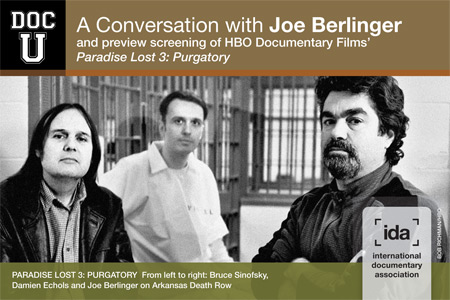
Doc U: A Conversation with Joe Berlinger
Doc U presents a conversation with filmmaker Joe Berlinger (Crude, Brother's Keeper, Metallica: Some Kind of Monster) followed by a special preview screening of HBO Documentary Films' Paradise Lost 3: Purgatory, the third documentary feature Berlinger and Bruce Sinofsky have produced for HBO over the past two decades covering the trials, convictions and incarceration of the West Memphis 3. With the trio’s release in August, Berlinger and Paradise Lost 3 have received international attention for what Variety has described as a "masterwork of explanatory journalism, advocacy and perseverance" and "destined to rank as one of the major achievements in American documentary."
Followed by a special preview screening of
HBO Documentary Films' Paradise Lost 3: Purgatory
Monday, October 17, 2011
7:00pm - Doors Open
7:30pm - Eddie Schmidt moderates discussion with Joe Berlinger
8:00pm - Screening of Paradise Lost 3: Purgatory
Directed by Joe Berlinger and Bruce Sinofsky; Produced by Joe Berlinger;
Senior Producer Nancy Abraham; Executive Producer Sheila Nevins
10:00pm - Q&A with Joe Berlinger after the film
Wine Reception to Follow
The Cinefamily
611 N. Fairfax Avenue
Los Angeles, CA 90036
Tamir Muhammad currently serves as Director of Feature Programming at the Tribeca Film Institute where he’s responsible for directing and developing programs such as Tribeca All Access, TFI Sloan Fund, and other initiatives. He started his career with Tribeca in the office of Founder Jane Rosenthal during the inaugural year of the Tribeca Film Festival. Since that first year he has held several positions at numerous other festivals including The New York International Latino Film Festival and Urbanworld.
Earning his B.F.A. at New York University (Tisch School of the Arts), Tamir also went on to serve as an international staff member for the University, traveling to such countries as South Africa, China, Brazil, and Cuba. He currently serves on the board for Firelight Media and Moving Mountains, Inc. along with consulting for other art organizations. Tamir also has several years of film and television production experience to his credit dating back to a stint at Department of Film (Goldcrest) and has scouted and developed the careers of several filmmakers.
Reserve your seat today for access to Tamir and other influential funders from The Fledgling Fund, the Sundance Documentary Fund, and more!
Doc U
is the International Documentary Association's series of educational
seminars and workshops for aspiring and experienced documentary filmmakers. Taught by artists and industry experts, participants receive vital training and insight on various
topics including: fundraising, distribution, licensing, marketing, and business tactics.
Lisa Kleiner Chanoff is co-founder of Catapult Film Fund. She is an investor and philanthropist with a long history of involvement in education and the arts, as well as health and poverty issues. Lisa’s passion for early venture support has led to crucial first funding of projects, from San Francisco area education and poverty alleviation work to providing the initial funding for a school for girls and community center in the Kibera slum of Nairobi. She has provided investment and grant support for documentary films on human rights and environmental issues.
Lisa founded Catapult Film Fund, along with filmmaker Bonni Cohen, in order to fill a gap in the documentary funding landscape for development support and to enable important and moving documentary films to get off the ground.
Lisa has a J.D. from University of California, Hastings College of the Law and practiced law in San Francisco and with the Civil Rights Division of the U.S. Department of Justice in Washington D.C. After leaving law practice, Lisa received a master’s degree in Museum Studies and worked with museums in the San Francisco bay area designing exhibitions and education programs.
Reserve your seat today for access to Lisa and other influential funders from the Sundance Documentary Fund, The Fledgling Fund, and more!
Doc U
is the International Documentary Association's series of educational
seminars and workshops for aspiring and experienced documentary filmmakers. Taught by artists and industry experts, participants receive vital training and insight on various
topics including: fundraising, distribution, licensing, marketing, and business tactics.
Today, the IDA announced the four feature-length documentary films selected to receive a total of $75,000 from the newly established Pare Lorentz Documentary Fund. The Fund was created with support from The New York Community Trust to illuminate pressing issues in the United States and to honor the legacy of the landmark documentary filmmaker Pare Lorentz.
IDA received grant applications from 165 filmmakers from across the U.S. and around the world, and submissions were judged on their objective research, artful storytelling, strong visual style, and high production values, as well as the reflection of the spirit and nature of Pare Lorentz’s work.
The four productions receiving grants will shed light on a variety of critical issues including the coerced sterilization of Mexican-origin women during the 1960s and 70s, the future of America’s middle class, the country’s failings in the war on poverty and the healing of our nation’s racial divide.
The four projects include:
¿Más Bebés? ($20,000)
Renee Tajima-Peña, Producer/Director
¿MásBebés? poses a provocative question: Was the maternity ward at Los Angeles County-USC Medical Center a border checkpoint for unborn babies? The feature documentary uncovers the untold history of Mexican-origin women who allege they were coercively sterilized at the hospital during the 1960s and 70s.
As Goes Janesville ($20,000)
Brad Lichtenstein, Producer/Director
First GM closes. Then related business shut down. Next, the Governor of Wisconsin tries to kill unions. What is the future for America's middle class? As Goes Janesville has the answers, and they're not so good.
Rise and Fall of ACORN: America's Most Controversial Anti-poverty Organization ($20,000)
Sam Pollard, Producer/Director
At the height of its power, ACORN, an organization devoted to fighting poverty in the United States, is destroyed. In a story stranger than fiction involving embezzlement, a fake pimp, and a right wing conspiracy plot, Rise and Fall of ACORN examines how our nation's war against poverty is really fought.
American Village ($15,000)
Mary Posatko, Co-Director/Co-Producer, Emily Topper, Co-Director/Co-Producer
Almost forty years after their father is shot by three black teenagers in Baltimore, a white family of thirteen looks for the murderers. The search forces a confrontation between America's white middle class and black urban "underclass," but they discover a shared desire to heal. Filmed by the victim's granddaughter.
Pare Lorentz Documentary Fund Finalists include:
American Arab - Usama Alshaibi , Director/Producer
Best Kept Secret - Samantha Buck, Director and Danielle DiGiacomo, Producer
Broken Heart Land - Jeremy Stulberg & Randy Stulberg - Directors/Producers
Can't Stop the Water - Rebecca Ferris, Director
Charge - Mike Plunkett , Director and Anna Farrell, Producer
El Sistema USA - Anthony Drazan, Director and Jaimie Bernstein & Elizabeth Kling, Producers
Gabe Tomorrow - Francine Cavanaugh & Adams Wood, Directors/Producers
Gideon's Army - Dawn Porter, Director and Julie Goldman, Producer
Green Shall Overcome - Megan Gelstein, Director/Producer
Jessica Gonzales vs. the United States of America - Katia Maguire & April Hayes, Directors/Producers
Seed - Sandy McLeod, Director
Untitled Kivalina Documentary - Jenni Monet, Director/Producer
The Pare Lorentz Documentary Fund is a program of IDA’s Filmmaker Support Services, which provides fiscal sponsorship support to over 300 documentary film productions. Proposals for the Fund are accepted annually in April.
Visit http://www.documentary.org/parelorentz for more information.
Emily Verellen has been the Director of Programs and Communications at The Fledgling Fund since 2008. Emily provides strategic communications, expanded outreach and audience engagement support for the Creative Media Initiative. Emily is the co-founder of The Binti Pamoja Center, a women’s rights and reproductive health center in Nairobi, Kenya. In 2006, she received a grant from The Fledgling Fund to publish a book about The Binti Pamoja Center, LightBox, which features photographs, stories and autobiographies from the teenage members of the Center. All of the funds earned through the sales of LightBox support The Binti Pamoja Center Scholarship Fund.
Emily graduated from American University with a BA in International Development, Anthropology and Communications, and from the London School of Economics with an MA in International Development and Population Studies.
Reserve your seat today for access to Emily and other influential funders from the Tribeca Film Institute, the Sundance Documentary Fund, and more!
Doc U
is the International Documentary Association's series of educational
seminars and workshops for aspiring and experienced documentary filmmakers. Taught by artists and industry experts, participants receive vital training and insight on various
topics including: fundraising, distribution, licensing, marketing, and business tactics.