Meet the IDA Documentary Award Nominees: Davina Pardo -- 'MINKA'
By KJ Relth
With her short film Minka, director, producer, and photographer Davina Pardo initially set out to tell a very specific kind of story. What she didn’t take into account was fate’s inevitable intervention: John Roderick, whose memoir about his farmhouse (or minka, in Japanese) was the inspiration for this film, passed away before their first scheduled interview. Instead of throwing out the project, Pardo and her producer, Andrew Blum, turned their attention on Roderick’s adopted son, Yoshihiro Takishita, the man who helped the American journalist realize his dream of setting up permanent residence in a 250-year-old minka.
This quiet story is told primarily through meditative shots of the exteriors and interiors of the minka, accompanied by thoughtful reconstruction of memories from Takishita himself. Flipping through old photographs helps him recall his adopted father who has only recently passed on from this world but whose spirit remains somehow forever etched into the very foundation of this antique, magnificent structure. This brief film ends where it began, leaving the viewer with an ephemeral yet satisfying glimpse into one possible meaning of "home."
Pardo’s short film has been nominated in the Best Short Documentary category at the 2011 IDA Documentary Awards. We sat down with the filmmaker to learn more about her inspiration, how she had to be flexible, and the major obstacles they overcame to get the film where it is today.
IDA: How did you get started in documentary filmmaking?
Davina Pardo: In college I wanted to be a photographer, but I was always passionate about social issues and wasn’t sure how to reconcile these interests. After graduation, I was very lucky to get a job working as David Cronenberg’s assistant on his film Spider. At the end of each shooting day, we’d watch rushes at the film lab—and I think it was then that I fell in love with moving images. Suddenly it clicked that this was how I could combine my creative and social interests. I applied to the documentary film program at Stanford and started making films there.
IDA: What inspired you to make Minka?
DP: My producer, Andrew Blum (who also happens to be my husband), is a journalist who’s written a lot of about architecture. He received a press copy of John Roderick’s memoir about the house, and I was intrigued by the idea of telling a person’s story through their home, and of this particular house as a vessel of memory. So we contacted John Roderick and asked if he’d be willing to participate in a film based on his book.
IDA: What were some of the obstacles and challenges in making this film? How did you overcome them?
DP: The biggest obstacle was definitely when John Roderick died at 93. He was excited about the idea of a film, and we had made plans to interview him in Hawaii, where he had retired. But a few weeks before our scheduled shoot, he became quite ill and asked that we come film right away. We were there the next day, but he was too weak to talk. All of his friends had gathered, and of course, Takishita-san, and I was grateful to spend time with everyone as they gathered to celebrate John’s life.
IDA: How did your vision for the film change over the course of the process from pre- to post-production?
DP: After John died, Takishita-san wanted to continue making the film, and our focus shifted to him as our primary storyteller. We had always thought of it as a film about memory, but the tone changed; it became more of an elegy to John and a story about loss. Otherwise, our sense of the house as a metaphor for a relationship stayed consistent.
IDA: As you've screened Minka, how have audiences reacted to the film? What has been the most surprising or unexpected about their reactions?
DP: I think what’s been most satisfying, and definitely surprising, is the way audiences have embraced everything Minka leaves unsaid. It’s a very quiet film, but that hasn’t kept people from really connecting to it emotionally, and letting the mysteries of love, and families, and places, wash over them.
IDA: What documentary films or documentary filmmakers have served as inspirations for you?
DP: So many, including Heddy Honigman, Nicholas Philibert, James Longley, Deborah Shaffer and Anne Aghion.
Want to learn more about the 2011 IDA Documentary Awards? Visit the Awards page for a full list of nominees, honorary award winners, and more.
Buy tickets to this year's Awards ceremony and fundraising event.
Meet the IDA Documentary Award Nominees: Barbara Hammer's 'Maya Deren's Sink'
Editor's Note: Barbara Hammer's Maya Deren's Sink has been nominated in the Best Short category at this years IDA Documentary Awards, to be held at the Directors Guild in Los Angeles on Friday, December 2. Below is an interview we conducted with Hammer last August in conjunction with her him having been included in DocuWeeks 2011.
Synopsis: Maya Deren's Sink is an evocative tribute to the mother of avant garde American film, as recounted by those who knew her. Teiji Ito's family, Carolee Schneemann and Judith Malvina float through the homes recalling in tiny bits and pieces words of Deren's architectural and personal interior space. Clips from Deren's films are projected back into the spaces where they were originally filmed, appearing on the floorboard, furniture and in the bowl of her former sink. Fluid light projections of intimate space provide an elusive agency for a filmmaker most of us will never know, as film with its imaginary nature evokes a former time and space.
IDA: How did you get started in documentary filmmaking?
Barbara Hammer: There was no lesbian cinema to study when I was in film school in the '70s, and so I decided to document my own life. Later I made essay documentaries on invisible histories, looking at who makes history and who is left out. Finally, in Maya Deren's Sink, my 80th-something film, I return full circle to my mentor, the filmmaker who inspired me to make films, Maya Deren.
IDA: What inspired you to make Maya Deren's Sink?
BH: I decided for sure I should be a filmmaker when I saw Maya Deren's Meshes of the Afternoon in a film history class. It was the only film by a woman screened during an entire semester, but I saw a different viewpoint, a new way of making film. I saw a woman's cinema.
Nearly 40 years later I was sitting in the Anthology Film Archive lobby when I hear that the sink that used to be in Maya Deren's home was picked up for the archive. I couldn't wait to see the sink, and as soon as I saw it I wanted to project an image of Maya Deren in it, and then back in her homes in both New York City and Los Angeles. Perhaps I could bring her to life again in some new way and pay tribute to my mentor.
IDA: What were some of the challenges and obstacles in making this film, and how did you overcome them?
BH: The biggest challenge was finding the people who knew Deren and who would give me an interview. There is always detective work with documentary filmmaking, and when you choose as your subject a major figure who is well known and who already is an established historic figure, people are protective and often not forthcoming. That just meant I had to look further afield.
I feel especially indebted to Tavia Ito, the daughter of Teiji Ito (composer and Deren's second husband) and Gail Ito (Teiji's second wife after Deren), who told me wonderful stories and who brought Deren to life with details about her daily life. When Tavia played her flute I couldn't help but hear refrains from her father, who composed the soundtrack for Meshes of the Afternoon.
IDA: How did your vision for the film change over the course of the pre-production, production and post-production processes?
BH: My vision radically changed twice. I realized that projections of Deren's films on the walls, ceilings and floors of her homes were not enough to bring back her presence. I needed an actor. By chance, at a party, I met a young woman who looked like Maya Deren and loved her work. Deren also was a theoretician of film, and with the actor Bekka Lindstrom I could populate her former homes with Deren's words. I needed a sense of a presence, of Maya Deren, not a person playing her, so with the help of the wonderful editor, Stephanie Testa, we were able to abstract the actor.
Secondly, I wanted to avoid the static depiction of the "talking head" documentary. The creative breakthrough came when I thought, If the walls of Maya Deren's homes could talk, the people who knew her could speak as memories from the past. I positioned these voices within picture frames that hung from the walls, and overlaid the lips or faces with an aged parchment paper. Voila!
IDA: As you've screened Maya Deren's Sink--whether on the festival circuit, or in screening rooms, or in living rooms--how have audiences reacted to the film? What has been most surprising or unexpected about their reactions?
BH: Audience members who know Maya Deren's films are thrilled with this intimate portrait. Those who haven't yet seen her work are motivated to seek them out. I was delighted when Maya Deren's Sink won the Teddy Award for Best Short Film at the 2010 Berlinale.
IDA: What docs or docmakers have served as inspirations for you?
BH: Trin T. Minh-ha, Agnès Varda, Ziga Vertov and Chris Marker have all made milestone films that have illuminated my path as a documentary filmmaker.
Want to learn more about the 2011 IDA Documentary Awards? Visit the Awards page for a full list of nominees, honorary award winners, and more.
Buy tickets to this year's Awards ceremony and fundraising event.
There’s never been a better time to go solar. And now that IDA has partnered with Sungevity, that time is now!
If you go solar before December 31, Sungevity will give you $1000 AND match that amount in a donation to the International Documentary Association.
Not sure if solar is the right choice for your home or location? Sungevity offers a free iQuote service virtually, without the pain or hassle of booking an appointment at your residence.
To learn more about this $0 down solar lease for your home and how you can help your favorite non-fiction non-profit, visit Sungevity online.
At the December 2nd Awards, the Italian documentary shot and directed by Massimo D’Anolfi Il Castello will be recognized with the award for Best Cinematography; Senna (edited by Chris King & Gregers Sall, directed by Asif Kapadia) will receive the Best Editing award; and Better This World (original music by Paul Brill, directed by Katie Galloway and Kelly Duane de la Vega) will be presented with the Best Music award.
View the trailer for Better This World:
Learn more about Senna:
And here's the gorgeous trailer for Il Castello:
The 27th Annual IDA Documentary Awards will be held on Friday, December 2nd at the Directors Guild in Los Angeles.
Get your tickets today!
We’ve officially landed three amazing personalities from the world of non-fiction to host this prestigious fundraising event. Representing the dizzying diversity of documentary filmmaking, filmmakers Josh Fox and Tiffany Shlain and IDA Board President Eddie Schmidt will each bring their own unique flavor to the events of the night. Accompanying the MC responsibilities will be Oscar®- nominated documentary filmmaker, Lucy Walker, who be spinning live during the show.
Emmy Award-winning and Academy Awards-nominated filmmaker Josh Fox is also the founder and Artistic Director of International WOW Company, a film and theater company that works closely with actors and non actors from diverse cultural backgrounds. Fox’s work is known for its mix of gripping narrative, heightened imagery and its commitment to socially conscious themes and subjects. With International WOW Company, Fox has received a Drama Desk Nomination, an Otto Award, five grants from the National Endowment for the Arts and five prestigious MAP Fund Grants, an Asian Cultural Council Fellowship among many other awards and honors. Fox’s film work includes the Emmy Award winning, and Academy Award® nominated, documentary Gasland and Memorial Day.
Honored by Newsweek as one of the “Women Shaping the 21st Century,” Tiffany Shlain is a filmmaker, founder of The Webby Awards, co-founder of The International Academy of Digital Arts & Sciences and a Henry Crown Fellow of The Aspen Institute. Her work in film & technology has received 48 awards and distinctions and her last four films premiered at Sundance, including The Tribe and Connected: An Autoblogography About Love, Death & Technology. A celebrated thinker and speaker, she is a visiting professor at The University of Wales, is on the advisory board of M.I.T.’s Geospatial Lab, has advised Secretary Clinton and presented the 2010 Commencement Address at UC Berkeley.
Eddie Schmidt is an Oscar®-nominated filmmaker, writer/producer, and commentator, as well as the Board President of the International Documentary Association (IDA). He produced four feature documentaries that premiered at the Sundance Film Festival, including This Film is Not Yet Rated, and Twist of Faith. For television, Schmidt has directed, produced, and written documentary and comedy specials and series for the likes of HBO, IFC, Lionsgate, PBS, A&E, E!, Current, and GSN. This year, he appeared throughout Current’s 50 Documentaries to See Before You Die, and was one of six experts consulted on the series. Since 2009, Schmidt has served as President of the IDA, a nonprofit community and resource for documentary filmmakers.
Lucy Walker is an Academy Award® and Emmy Award-nominated documentary filmmaker, whose directing credits include the Oscar-®nominated Waste Land, Countdown to Zero, and Devil’s Playground. Lucy has won many festival and critical accolades for her films. Her television credits include Nickelodeon’s Blue’s Clues, for which she was twice nominated for Emmy Awards for Outstanding Direction in a Children’s Series, and several award-winning narrative short films. As a film student at NYU'S Graduate Film program, Lucy moonlighted as a musician and DJ – hence our choice for Ms. Walker’s spinning skills at the Awards!
The 27th Annual IDA Documentary Awards will be held on Friday, December 2nd at the Director’s Guild in Los Angeles.
Our first stop is Washington, DC, where our Doc U will be focused on answering the question: Can Your Doc Really Change the World?
These days, it seems as though more and more non-fiction filmmakers are trying to change the world through emotional, cause-driven documentaries. But if one is hoping to use the power of film to advocate for solutions to complex issues and urge people to take action, how can you make sure your film has the greatest possible impact?
On December 5, join Nina Seavey, Director of the Documentary Center at George Washington University, as she moderates a discussion with founder and Executive Director of Just Vision Ronit Avni, Associate Director at the Center for Social Media Angelica Das, founder/principal at The 2050 Group Adam J. Segal, and co-founder and Executive Director of Working Films Robert West as they discuss the ways and means of producing documentary films with the potential to effect real change.
Our panel of filmmakers, organizational change-makers, and communications experts will address big questions and more. What they have to say could change the way you think about changing the world.
DOC U ON THE ROAD
Made possible by a grant from
The Academy of Motion Picture Arts and Sciences
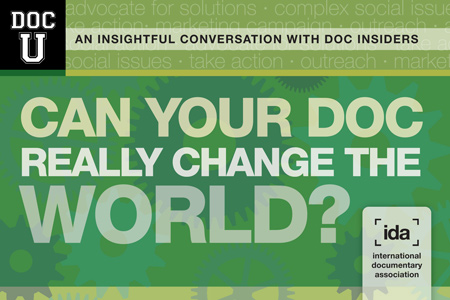
Doc U: Can Your Doc Really Change the World?
In Association with:
    |
Monday, December 5, 2011
Doors Open: 6:30pm
Discussion & Audience Q&A: 7:00pm - 8:30pm
Stay for a drink and mingle with the panelists after the event.
West End Cinema
2301 M Street Northwest
Washington, DC 20037
To continue to secure and protect the rights of documentary filmmakers, so that they/you will remain free to create this unique and essential art form, we need your support to sustain our advocacy work.
Currently, the IDA is working on many pressing issues affecting documentary filmmakers. Particularly urgent is the work we are doing to renew the DMCA (Digital Millennium Copyright Act) exemption, as well as to have the exemption apply to Blu-Ray footage. The IDA initially helped documentary filmmakers win a three-year exemption that allowed a filmmaker to take materials from DVDs and use those film clips for criticism and commentary. For over a century, filmmakers have had the right to make fair use of copyrighted work in their films, and we are working hard to ensure that this right remains protected.
If the exemption is not renewed, filmmakers will lose their ability to utilize footage from DVDs.
What can you do to protect the rights of documentary filmmakers?
Become an IDA member, and encourage others you know to join. If you are already a member, donate and please donate generously.
And, there are benefits!
All members receive a complimentary subscription to Documentary Magazine and invitations to various IDA events throughout the year. And, depending on your membership or donor level, you may receive reserved VIP seating at the 27th Annual IDA Documentary Awards, IDA’s annual fundraiser, set for December 2nd at the Directors Guild of America.
THANK YOU FOR YOUR ONGOING SUPPORT.
Meet the IDA Documentary Award Nominees: Ruby Yang and Thomas Lennon--'The Warriors of Qiugang'
Editor's Note: Ruby Yang and Thomas Lennon's The Warriors of Qiugang has been nominated in the Best Short category at this year's IDA Documentary Awards, to be held at the Directors Guild in Los Angeles on Friday, December 2. Below is an interview we conducted with Yang and Lennon last February in conjunction with her film having been nominated for an Academy Award for Best Documentary Short Subject.
In the days leading up to DocuDay LA and DocuDays NY, we at IDA will be introducing--and in some cases, re-introducing--our community to the filmmakers whose work has been nominated for an Academy Award for either Best Documentary Feature or Best Documentary Short Subject. As we did in conjunction with last summer's DocuWeeksTM Theatrical Documentary Showcase, we have asked the filmmakers to share the stories behind their films--the inspirations, the challenges and obstacles, the goals and objectives, the reactions to their films so far, and the impact of an Academy Award nomination.
So, to continue this series of conversations, here are Ruby Yang, director, and Thomas Lennon, producer, of The Warriors of Qiugang, which is nominated in the Best Documentary Short category.
Synopsis: Zhang Gongli is a farmer who grew up in the village of Qiugang, in Anhui Province; his house and fields lie near the banks of the Huai River. In 2004, private chemical companies took over an old state-owned enterprise that had long produced pesticides and dyes in Qiugang. As production ramped up, black waters disgorged from the plants and flooded the fields of Qiugang. Fish died, crops failed and villagers grew alarmed by the large numbers of their own succumbing to cancer.
When his own fields could no longer be farmed, Zhang filed a lawsuit against the factory that adjoins his land. He lost. This marked the beginning of a stubborn and often dangerous campaign that spanned five years. The Warriors of Qiugang follows Zhang and his allies in the village as they draw up a petition to bring to Beijing, recruit support from the local media, reach out for help from a local NGO, and in time, make contact with environmental activists from across China. From clandestine trips to the nation's capitol to private negotiating sessions with factory representatives, the film reveals a rare portrait of grassroots activism in contemporary China--of villagers wrestling with, and transformed by, China's headlong rush into modernity.
IDA: How did you get started in documentary filmmaking?
Ruby Yang: In 1979, I was at San Francisco Art Institute studying painting and enrolled in a class on avant-garde films. I was mesmerized by the beauty and simplicity of the films by Bruce Conner, James Broughton and filmmakers from that generation. One year later, I started to make my first short film.
Thomas Lennon: I thought I wanted to be what back then was called an experimental filmmaker. I would go to hear Stan Brakhage speak, would watch films like The Act of Seeing with One's Own Eyes. And then, quite late--I was out of school and trying to earn a living in New York--I realized that content really mattered to me, information mattered to me.
IDA: What inspired you to make The Warriors of Qiugang?
RY: A supporter told me about an NGO she was excited about, Green Anhui, in Anhui Province--not too far, actually, from where we'd done our AIDS film, The Blood of Yingzhou District. I'd been wanting to do a film about the environment in China. Tom was reluctant, actually. He was engrossed in trying to jump-start a public health campaign in China about tobacco, about smoking--similar to what we had done with Yao Ming and AIDS on Chinese TV. That was his obsession and he lost over a year of his life to that. Meanwhile, the field producer Guan Xin and I started gathering footage in Anhui. It was a while before I realized there was a film there.
IDA: What were some of the challenges and obstacles in making this film, and how did you overcome them?
TL: In a way, China is the most exciting place in the world to make films in because everything changes at such a staggering pace. (When I'd come back to Beijing to work with Ruby after a month in New York, there'd be a skyscraper that hadn't been there before.) So there are stories everywhere you turn. But it's a hard place to work, too, because trust is in short supply. Permissions are always hard. It fell to Ruby and to Guan Xin to win over the villagers, who were already taking considerable risk by waging this campaign--much less having a camera on them. Guan did a great job; he became a friend, a fixture in the village. But access was and remained a huge obstacle.
RY: The film was filmed over almost four years. [It was] Hard to sustain access, hard to sustain energy, hard to keep up with a changing story, and also brutally expensive.
IDA: How did your vision for the film change over the course of the pre-production, production and post-production processes?
RY: The turning point was a scene when all the villagers gathered to sign a petition. It was nighttime, summer. The room was filled with smoke and sweat. On the one hand, the scene was crackling with contemporary excitement. But it was also a scene that went deep into Chinese history and tradition--the petition to the Emperor in Beijing. After that scene, I was committed; there was no turning back.
IDA: As you've screened The Warriors of Qiugang--whether on the festival circuit, or in screening rooms, or in living rooms--how have audiences reacted to the film? What has been most surprising or unexpected about their reactions?
TL: We actually haven't seen the finished film with audiences that much yet. It was a difficult film to finish; we were in the edit room for months in New York and showed it to friends in steps along the way. We made huge changes based on the reactions that we got--many of which surprised us. We would shape a scene to convey one thing and we'd be floored at how, with the cultural and language barriers, it would be read as conveying something completely different. So that was a very important set of test screenings that changed the film radically.
IDA: Where were you when you first heard about your Academy Award nomination?
TL: By 2010, I was a scarred veteran of this process. This is my third nomination, and the second in the short-documentary category, which is structured to inflict maximum psychological damage. Here's the thing: In late October, you get word that your film has made the short list of eight films. That means you have a real shot at getting a nomination--and you know it. And then you wait. And wait. By January, you're not in good shape. The morning of, I knew the Academy was going to post the nominations. I thought, I'm not going to sit here, like Jesse Eisenberg in the last scene of The Social Network, clicking and re-clicking my computer waiting for the results. So I walked the 40 blocks up to my office. It was cold, a lot of snow on the ground. I held my cell phone in my hand. At one point I looked at it and said, Hmm, 9:00 a.m. No one has called me. That probably means it's not going to happen. Then a friend called, screaming.
RY: Tom and I have done three shorts in China. The first won an Oscar--such a surreal experience, just a dream for a filmmaker. The second film, Tongzhi in Love, is a special film, one we really love, and it was short-listed and then...didn't make it. Tom is right: That was psychologically tough, because with a short film, even more than with a feature, the Academy is the platform. There aren't many others. This year I was trying to steel myself. The morning of the Academy nominations is nighttime where I live, Beijing. I told my husband, "Let's go out to dinner. Let's think about something else." While I was at the restaurant a Hong Kong friend called me. And a few minutes later, Tom Skyped my cell from New York.
IDA: What docs or docmakers have served as inspirations for you?
TL: We were once asked that question by Errol Morris, except he asked, What filmmakers...And Ruby answered, Stan Brakhage. And I was speechless. When she and I started working together almost 10 years ago, we went out to lunch when we barely knew each other, and we talked about Stan Brakhage. In a funny way, that great avant-garde artist might not mind being called a documentary filmmaker. So many great inspirations, but for now let's just honor him.
The Warriors of Qiugang will be screening Saturday, February 26, at 9:00 a.m. as part of DocuDay LA at the Writers Guild of America Theater in Beverly Hills, and Sunday, February 27, at 3:00 p.m. at DocuDays NY at The Paley Center for Media in Manhattan.
Pentagon Papers Chase: Ellsberg Doc Questions US Military Decisions--Then and Now
Editor's Note: The Most Dangerous Man in America is nominated for an 2011 ABCNews VideoSource Award for best use of footage, and as part of the POV series for a Limited Series Award. What follows is an article from the Spring 2010 issue of Documentary when the film was released theatrically.
By the spring of 1971, the United States was six years into a grisly ground war in Vietnam. The American public was fed up. Little did they know that they had an ally in none other than a key architect of the war.
Sitting in his office at the powerful RAND Corporation in Santa Monica, California, a high-level Department of Defense war strategist was poring over a top secret study summarizing 20 years of covert US maneuvers in Vietnam. Slowly, the analyst realized that everything he--and the American public--knew about the war was based on lies. Reaching a boiling point ten years in the making, he made a life-altering decision to leak the study to The New York Times. In the dark of night, he started copying all 7,000 pages...and prepared for jail.
The "Pentagon Papers" scandal was off and running. By June, TV anchors were reporting a shocking new statistic every day. President Richard Nixon, still embroiled in Vietnam, went ballistic and determined to crush the man that Secretary of State Henry Kissinger deemed "the most dangerous man in America." By the time the dust settled, this one-man act of civil disobedience had resulted in a landmark Supreme Court free speech ruling, Nixon's downfall and the beginning of the end of the Vietnam War.
The unlikely man behind it all is Daniel Ellsberg, the subject of The Most Dangerous Man in America. His story might seem an obvious subject for a documentary, but can you make a compelling movie when your hero is a soft-spoken expert in decision theory, whose most dramatic act of espionage was making copies?
Directors/producers Judith Ehrlich and Rick Goldsmith seem to think so. The film won a Special Jury Prize at the International Documentary FilmFestival Amsterdam (IDFA), a Freedom of Expression Award from the National Board of Review, audience awards at the Mill Valley and Palm Springs Film Festivals and an Academy Award nomination for Best Documentary Feature
Ehrlich and Goldsmith tell Ellsberg's story through interviews with key players, archival footage and artsy re-enactments woven together by cool, dangerous music provided by The Wire composer Blake Leyh. Ellsberg himself narrates with excerpts from his book Secrets: A Memoir of Vietnam and the Pentagon Papers. When one listens to him read his own beautifully turned phrases in a comforting, yet authoritative voice, it's hard to imagine anyone else bringing the same intensity and emotional clarity to the story.
But the idea to use Ellsberg as the narrator actually sparked a major creative debate between the film's directors at the outset of their collaboration, a debate that lasted well into the final cuts of the film, yet ultimately teased out the film's true narrative.
"We saw the film really differently from the beginning," says Ehrlich. She and Goldsmith first met at the Zaentz Media Center in Berkeley, where they both had an office. When they discovered they were each developing a project on Ellsberg, they decided to collaborate, but soon found they had very different ideas about how to tell the story. Ehrlich had recently directed a documentary about World War II protesters, The Good War and Those Who Refused to Fight It. "I saw the film as being more personal and more about a spiritual transformation," she explains. Goldsmith came to the project after making Tell the Truth and Run: George Seldes and the American Press, a documentary about a muckraking journalist and his ideas and ideals about his profession. Says Goldsmith, "My concern was: Are we going to lose credibility? Are we going to lose not so much objectivity, but believability?"
While Goldsmith, as lead editor, worked on cuts using an omniscient narrator and archival footage, Ehrlich and assistant editor Lawrence Lerew made alternate cuts using Ellsberg as the narrator, and even using re-creations. "We were kind of cutting two different films for a while," says Ehrlich.
But both Ehrlich and Goldsmith describe this creative tug of war as essential to their discovery of the film's ultimate through line: Not a political thriller about the Pentagon Papers leak, but a personal account of what events led a privileged military strategist to become a peace activist. "So much of the story is about struggling with decisions," explains Goldsmith, who ultimately found the objectivity he was looking for in the stories of how each of the key subjects in the film struggled with their roles in the leak. "So much of Dan's story--certainly in the first part of the film--was about that. And so much of the other people's stories, like the journalists and the lawyers and the Nixon Administration guys, was: What do I do? Do I do the right thing?"
Ehrlich and Goldsmith continued to welcome outside ideas throughout their process, and share credit for the film's success with contributions from cinematographers Vicente Franco and Dan Krauss, sound designer Jim LeBrecht of Berkeley Sound Artists, and Michael Chandler, the Oscar-nominated editor of Amadeus, who helped sculpt the final cut.
The filmmakers also struggled with how to use the extensive archival material they found, which added up to hundreds of hours. "That was the good news and the bad news," says Goldsmith who, along with Ehrlich, spent over a year just viewing and logging the material. The Nixon tapes, with no centralized source or transcriptions, were the biggest challenge. But they caught a break with the news footage--thanks to Nixon. "It was somebody's job, we learned, in the Nixon White House to record the news every night," Goldsmith explains. He and Ehrlich found Nixon's news tapes at the National Archives, and an attorney verified that all their selections for the film fell under fair use.
Ehrlich and Goldsmith made artful use of archival footage from the Vietnam War, selecting only those shots that would highlight Ellsberg's journey from war architect to war protestor. For scenes of a trip Ellsberg took to Vietnam, they combined stills of him in Vietnam with carefully culled first-person moments of archival footage to create an intimate view of the devastation in Vietnam. Says Goldsmith, "I think that's a credit to the editorial team-having the stills move and integrating it with actual footage so it feels to the viewer like you're seeing Daniel in action."
Ellsberg had no say in the film's final cut, but actively supports the film as part of his ongoing effort to challenge modern-day Americans to question US military activity. And his story does seem to resonate with a new generation. During the Palm Springs International Film Festival in January, Ehrlich screened the film for a thousand high school students. "That was my favorite screening ever, I think," Ehrlich enthuses. "A hundred hands went up with questions: What can I do to change the country? What can I do to make our government more transparent and be a better citizen?" Notes Goldsmith, "They get that this is not a film about the past. This is a film about the present. They get that instantly."
The Most Dangerous Man in America is currently in limited theatrical release through First Run Features and airs on PBS' POV this fall. To find out how to take part in a community screening event, visit www.mostdangerousman.org, the film's Facebook fan page, or follow Ellsberg on Twitter: @DanielEllsberg.
The Most Dangerous Man in America: Daniel Ellsberg and the Pentagon Papers will be screening as part of DocuDays LA on Friday, March at 7:00 p.m. at the Writers Guild Theater in Beverly Hills and DocuDays NY on Saturday, March 6 at 2:45 p.m. at the Paley Center for Media.
Elizabeth Blozan is freelance writer and director of the documentary Rebel Beat: The Story of LA Rockabilly. She can be reached at betty@bettyvision.com.