Editor's Note: On October 17 at the IDA offices in Los Angeles, IDA will present a Master Class on Directing and Executive Producing with Abigail Disney. The filmmaker will discuss the specific challenges of making social issue documentaries and using them as a tool for change. Learn more and purchase tickets.
Women in war: Images that spring to mind are of women being dragged away from their children, raped as spoils or abducted as trophies. Seldom do we visualize them in combat, or as more than passive victims. But victims they increasingly are, as women and children have come to be acceptable collateral damage and targets of war strategy.
Rarest of all, until now at least, are images of women aggressively pursuing peace and justice in the midst of war. But these images are plentiful in the stirring Women, War & Peace, a five-part public television series about the changing role of women in global conflict and peacemaking.
Women, War & Peace, conceived by veteran documentary filmmakers Abigail E. Disney, Pamela Hogan and Gini Reticker, launches Women and Girls Lead, an expansive, three-year, ITVS-sponsored "public media initiative designed to focus, educate and connect citizens across the globe working to help women and girls realize their potential in the 21st century." According to Tamara Gould, vice president of ITVS International, this initiative "is built around a slate of 50 documentaries by independent filmmakers from around the world, telling character-driven stories of leaders on the frontlines of education, human rights, economic development, health and democracy."
Women, War & Peace airs on successive Tuesdays, from October 11 through November 8, as a PBS special. Other projects in Women and Girls Lead include Half the Sky (Prods.: Maro Charmayeff, Jamie Gordon, Mikaela Beardsley), based on the book by Nicholas Kristof and Sheryl WuDunn, which is slated to air on Independent Lens in late 2012; and Kind-Hearted Woman (Dir./Prod.: David R. Sutherland), about an Oglala Sioux woman fighting abuse, which will air on Frontline in 2013.
Asked how this slate of programs plans to reach beyond the white, middle-class, middle-aged viewer of public television, Gould says the initiative will target niche communities on mobile devices, gaming platforms and social media, as well as international audiences through partnerships with foreign broadcasters and through the Internet. "We're in this moment where independent filmmakers are telling wave after wave of stories of women and girls from every corner of the world," she asserts. "Sex trafficking, maternal mortality, child marriage... So the first challenge is how do you tell these stories and not have people turn away? Another challenge is the deafening media din: How do you take these stories and break through the noise? Perhaps the biggest challenge, though, is that there's so much progress being made and yet too little attention and collaboration. So how can you help bridge the gaps and help people focus and connect on the issues that matter most?"
One theme that Women and Girls Lead focuses on, and which Women, War & Peace emphasizes, is women and girls as agents of change. It's not only a time-tested storytelling trope, but it steers viewers away from the uninspiring, and often repellent, image of women as eternal victims. Says Gould, "It was so clear that the subject and approach of the series--really examining how war and conflict can look different from a female perspective--was emblematic of what we were looking for in the Women and Girls Lead initiative."
In its first episode, Women, War & Peace tackles a daunting documentary challenge: How to depict the heroic actions of women whose faces, and even voices, must be disguised and distorted? I Came to Testify focuses on the Muslim women and girls of the Bosnian town of Foca who were raped by their own countrymen--sometimes their neighbors--in the Yugoslav wars. In the early 1990s, the world became aware of the existence of rape camps in Eastern Bosnia and horrifying statistics of rape victims in the tens of thousands.
Beginning in 2000, the United Nations Yugoslav War Crimes Tribunal in The Hague was convened to record the women's stories and prosecute war crimes, and for the first time in history, rape was defined not just as a war crime but as a crime against humanity. Women such as Witness 99 and Z.R. courageously risked ridicule and shame to testify in a global forum, revealing that rape had become a systematic and deliberate tactic in ethnic cleansing.
Producer/writer Hogan says her crew was prepared for the necessity of hiding the women's identities for their protection. Rejecting facial pixilation as dehumanizing, cinematographer Kirsten Johnson let the women's simple hand gestures like stubbing out a cigarette bear all the pain, rage and dignity of their experience.
Episode 2, Pray the Devil Back to Hell, shows the horror of rape and violence through imagery borrowed from public posters in Liberia, where the multilingual population can easily understand the issues at stake. The film, which earned the Best Documentary Feature award at the 2008 Tribeca Film Festival, is making its US broadcast premiere in this series. Directed by Reticker and produced by Disney, Pray the Devil Back to Hell follows the riveting Leymah Gbowee in her successful efforts to bring together Christian and Muslim women in forcing Liberian dictator Charles Taylor and his enemy warlord factions to negotiate a peace in 2003 after years of brutal civil war.
The women left their homes and traveled to Accra, Ghana, where they sat outside the negotiating hall. The male faction leaders, unaccustomed to fully subsidized junkets, treated the conference as a holiday and didn't take the talks seriously until the women, led by Gbowee, barricaded them inside until they came up with a plan. Ultimately, the women went from cowering in their homes, unable to feed their families, to becoming a force for peace that exiled Taylor and brought regime change to Liberia. "We campaigned until we forgot that we could even be raped," Gbowee maintains in the film. Their efforts helped elect the first African woman head of state, Ellen Johnson Sirleaf, in 2005. Sirleaf acknowledged "the powerful voice of women," which brought her to triumph and stable leadership over a murderous strongman.
Episode 3, Peace Unveiled, moves to Afghanistan and the fortunes of women in wartime there. When the Taliban were in power before 2001, education for women was banned. As a result, almost 90 percent of Afghan women are unable to read or write, and women working outside the home are subjected to terrifying death threats. In this atmosphere, members of the 3,000-member Afghan Women's Network risk their lives to educate and gain electoral seats for women in the administration led by Hamid Karzai, to have a voice in its negotiations with the misogynistic Taliban. The AWN's view is that Karzai's regime concedes too much to the Taliban, and it is up to them to venture out into the unsafe streets to campaign for votes. "This terrible suffering inflicted on the women and girls of Afghanistan is not cultural--it is criminal--and we must do everything we can in our power to stop it," says US Secretary of State Hillary Clinton in the film. "I pledge to the women of Afghanistan: We will not abandon you. We will stand with you always."
Clinton is a strong presence in this series, a trusted player in global peacemaking. Hogan maintains, "Her confirmation hearing as Secretary of State made it loud and clear: Women's issues would be treated not only as a humanitarian issue but as national security policy. She is a pivotal figure for us."
Episode 4, The War We Are Living, highlights the fight for the life of a small village of Afro-Colombians who have lived off small-scale, artisanal gold-mining for centuries. They are now being bullied off their ancestral land by multinational interests--just the latest stage in the country's 40-year civil war. Two women have stepped up to fight both shadowy paramilitary forces and moneyed corporations, determined not to be chased out of the only home they've ever had. This episode dramatizes another deliberate tactic of war-displacement--and how it kills human dignity and tradition. Narrator Alfre Woodard says of one of the women, Clemencia Carabali, "She found that in wartime, women could organize more freely than men." Carabali and her network of African-Colombian women drive on country roads and rivers along which hundreds of people have been killed in deliberate terror campaigns, keeping track of the citizens and fighting for the right to own the land they've worked for generations.
Episode 5, War Redefined, is a magisterial summation of the themes introduced in the more sharply focused preceding episodes. Disney quotes Don Steinberg of the International Crisis Group as saying that peacemaking is the most dangerous profession in the world. Hogan hopes that Women, War & Peace will "cause it so that, when people think about or prepare for war, their discussion will include the impact on everybody--not just the soldiers but the true, human picture of the impact of war. In many places, it is more dangerous to be a woman than a soldier. If we can provide a different lens through which to view war, to cause a paradigm shift, we want to play a role in it."
Frako Loden is adjunct lecturer in film, women's studies and ethnic studies at CSU East Bay and Diablo Valley College.
What do Ken Kesey, Martin Luther King, Jr. and the late Formula One racecar driver Ayrton Senna have in common? Some of you might be thinking, "King organized a bus boycott, and Kesey drove a painted bus full of psychedelic experimenters across the country. So, maybe it's wheeled transportation that would bring in Senna."
Well, what ties them together is that they are all featured in three recent nonfiction features that seamlessly use archive footage as if it were the raw material from a vérité documentary.
"We call it archival vérité," says Alison Ellwood, who edited and co-directed (with Alex Gibney) Magic Trip, which chronicles Kesey and the Merry Prankster's acid-fueled trip across the US in 1964. The film was released in August through Magnolia Pictures and will air on HISTORY in 2012.
Ellwood and Gibney were sitting at the Sundance Festival reading a New Yorker article about Kesey's odyssey; the article mentioned a trove of 40 hours of 16mm footage of the Pranksters that Kesey had stored in his barn. "When we got back from Sundance, we contacted the family," Ellwood recalls. The filmmakers learned that there were actually about 100 hours of film and several hours of audiotapes. Unfortunately, the footage was shot by a bunch of very stoned and tripped-out amateurs.
Moreover, the Pranksters had repeatedly tried over the years to edit the footage, but instead of making work prints to create the numerous cuts, they used the original reversal film. Then they projected these cut versions over and over again for their amusement. This celluloid abuse tore sprockets and scratched the film and didn't result in a coherent, finished epic. Kesey eventually gave up trying to edit the footage, and he packed it away in his barn, where its damaged fragments began to decay.
Ellwood and Gibney were initially disheartened--until the UCLA Film and Television Archive received a grant from the Film Foundation to restore what is now dubbed the Ken Kesey Merry Prankster Collection. Audio was another story. HISTORY Films stepped in with some support, and Don Fleming from the Alan Lomax Archive set about working his digital magic on the hours of wobbly, scratchy sound captured on a Nagra, as well as numerous interviews recorded while the participants were watching various rough cuts of the film-which would serve as a running commentary for Magic Trip.
Ellwood explains that she and Gibney had originally planned to re-interview the surviving Pranksters, "But we found that the earlier interviews were fresher." The filmmakers did shoot one interview and cut it into the film, but "It took you out of it."
They decided to go with the off-camera commentary approach and create a seamless narrative feel. Three of the archival interviews defied Fleming's skilled approach, however; test audiences couldn't hear the dialogue. As a solution, the filmmakers hired actors to perform the transcripts of the interviews, as well as a few re-creations of key scenes that the Pranksters had missed filming, but later recollected in the interviews. In addition, actor Stanley Tucci plays an unseen narrator/interviewer. These conceits, as well as animated maps and the use of a few newsreels for context, enhance the overall approach to constructing Magic Trip.
The six-year process has brought back to life a moment in American history that Ellwood thinks is important. It was a time during the Cold War when Americans were afraid of nuclear annihilation, and the country was shrouded in a "darkness of fear. Kesey was trying to tell people to get out of the bunkers, and don't listen the fear mongers," she maintains, and sees parallels between that all-encompassing fear of a nuclear Armageddon and the hysteria that gripped post-9/11 America. Her hope is that after seeing Magic Trip, "People walk away with a sense of adventure."
A similar motivation to revive interest and re-interpret seminal events in American culture prompted Swedish filmmaker Göran Olsson to create his film about the Black Power movement in the United States. The Black Power Mixtape 1967-1975, which premieres September 9 through Sundance Selects and will air on PBS' Independent Lens, is largely comprised of footage shot by various Swedish television crews during that era and stored in the network's basement.
"I'd heard rumors among documentary filmmakers for 20 years about this footage," says Olsson. "When I found it, it was obvious to me that you could create a very interesting film." Resurrecting this cold case file of archive footage and making a film "was my duty."
The original productions aired on Swedish television and were very popular because, according to Olsson, "There was a connection between Sweden and the Civil Rights movement, especially after Dr. King won the Nobel Peace Prize." We see that King and the Black Power movement were being vilified by FBI Director J. Edgar Hoover in the US as Communist-inspired threats to the United States, and Hoover singles out the Black Panthers' school breakfast program as proof. Olsson wanted to show audiences "the effort the FBI put into harassing these people."
The creators of the original documentaries gained unprecedented access to the Black Panthers and others because they were trusted as sympathetic. Most American producers at that time wouldn't have driven into Oakland neighborhoods, let alone knocked on Panther leaders' doors. But the Swedish journalists did, saying, "We're from Sweden and we're wondering if we could talk to you."
The producers earned their trust, and consequently some of the prime movers of the Black Power movement--Stokely Carmichael, Angela Davis, Eldridge Cleaver, Huey Newton and Bobby Seale--discuss activism, democracy, social change and civil rights with a candor and openness largely unseen in their engagements with the American media. And there are intimate moments as well, such as Carmichael at home with his mother as she expresses her concern for her son's safety.
Finding the footage and turning it into a new project didn't present the same technical challenges for Olsson as it did for Ellwood and Gibney. The original films were shot by talented documentary crews and were well preserved. The Swedes had used reversal film stock, but had also made a dupe negative and work print, so the camera masters had never been cut or projected. They were pristine. The transfer to high-definition video, using modern color correction, actually made them "look better today," says Olsson.
The biggest dilemma was whether to intersperse the historical footage with contemporary interviews or let the scenes play out. Inspired by DA Pennebaker's commentary tracks on his DVDs, Olsson decided to "keep the audience in the room" and not cut away to interviews. Instead the interviews he recorded with contemporary authors, professors and hip-hop artists such as Erykah Badu and Talib Kweli play out as a sound bed without interrupting the images. These new sound bites are mixed with existing "audio commentary" from Harry Belafonte, Bobby Seale and Angela Davis. The Black Power Mixtape 1967-1975 earned the World Cinema Documentary Editing Award for Olsson and Hanna Lejongvist.
This vérité approach to creating something new from found footage was the solution that British filmmaker Asif Kapadia opted for as he grappled with how to transform 5,000 hours of archive footage into a compelling film about three-time world champion Formula One driver Ayrton Senna.
The producers of Senna thought their project would take a traditional route--archive footage, plus fresh interviews, some re-creations and location shoots blended together to create something new. But as Kapadia began slogging through the hours and hours of material, he realized, "This is a movie."
Each race was covered by numerous cameras, including cameras mounted on board the cars. The pre-race meetings were covered by crews that the drivers trusted, so the crews captured some very candid and tense moments; and since Senna was a hero in both his native Brazil and Formula One-crazy Japan, TV outlets from those countries had covered him exhaustively. Adding in home movies, other news footage and some amateur videos, Kapadia figured that Senna's life and career was "all on camera."
The filmmaker worried that breaking away from this amazing cache of footage with on-camera interviews and other bits would break the spell over an audience that a movie can create. His background in theater enabled him to engage the material as a drama and the raw video as coverage.
"No interviews, no stills--we had to dramatically make the points," Kapadia explains. He did conduct interviews with people who actually covered the races and knew Senna. These form a running audio narrative in much the same way that Ellwood, Gibney and Olsson render their interviews. Unlike in the Magic Trip, though, Senna doesn't employ a narrator.
Doing something out of the ordinary is usually a hard sell to an executive producer who's happy to see a project delivered in a conventional format. Kapadia was relentless, and after repeated showings of renditions of the film using his approach, he won over the producers who saw his vision of "cinema."
The resulting 104-minute film won the World Cinema Documentary Audience Award at the 2011 Sundance Film Festival band had grossed over $8 million at the box office worldwide at press time.
Not every subject is ideally suited for an "archival vérité" film, but if you stumble on a project with a vast amount of footage and compelling central characters--and you're supported by forward-thinking producers--you may want to let the footage tell the story.
Michael Rose is a Los Angeles-based writer, producer and director.
The socially– and politically–connected crowd will include celebrities, producers, directors, writers, and industry executives to create an occasion that is the documentary film event of the year.
The IDA Documentary Awards include honors for Best Feature, Best Short Subject, Best Limited Series, Best Continuing Series, and the David L. Wolper Student Award, and recognizes films for exemplary Cinematography, Editing, and for use of Music. IDA also presents the HUMANITAS Award for a film that strives to unify the human family, through exploration of stories from different cultures, the Pare Lorentz Award, which recognizes films that demonstrate concern for the appropriate use of the natural environment, and addressing social justice, and The ABCNews VideoSource Award, to a project that best utilizes news footage as an integral component.
IDA Awards sponsorship packages are available at a variety of levels and for multiple year partnerships. To become a sponsor of this spectacular celebration, please contact Cindy Chyr at cindy@documentary.org or call (213) 534-3600 x7400.
Want to learn more about what it means to be an IDA Documentary Awards sponsor? Download the Awards Sponsorship Package.
You can also read more about last year's ceremony and award winners.
DocuWeeks 2011 dimmed the lights on its final screening at the Laemmle Sunset 5 in Los Angeles last Thursday, September 8. We’re sad to see the popcorn boxes and empty beverage containers cleared from the theaters, and it’s bittersweet to see all our DocuWeeks filmmakers off on their own paths with their films in tow.
Filmmakers and IDA Members mingle at the DocuWeeks Wrap Party.
After we cleared our eyes and sorted through all the great things we’ve seen since August 12, we sat down to look at exactly what happened at the 15th edition of DocuWeeks. What we found was a pretty impressive amount of time spent talking, thinking, and breathing documentary!
Over the four weeks of screenings...
>> We screened over 400 hours of documentary programming between 17 features and 7 shorts in two cities.
>> We had a combined total of 144 filmmaker and talent Q&As in both LA and NY.
>> The team from Dying to do Letterman clocked in the most Q&As, and had the closing night Q&A in Los Angeles!
The Dying to do Letterman team.
>> We had our first non-human Q&A participant in Sesame Street’s Elmo. Special thanks to Kevin Clash for bringing Elmo to life!
Connie Marks and Philip Shane of Being Elmo.
>> Filmmakers traveled from as far afield as Switzerland (Nick Brandestini, Darwin), Poland (Pawel Kloc, Phnom Penh Lullaby), England (Phil Grabsky, The Boy Mir) and Haiti (David Darg and Bryn Mooser, Sun City Picture House). These filmmakers make DocuWeeks truly international!
Pawel Kloc, director of Phnom Penh Lullaby.
>> We grew DocuWeeks’ social media presence on Facebook and Twitter from the ground up! We plan on keeping the conversation going, too. Join us for more on what’s going on in the lives of DocuWeeks alums.
More mingling at a Member Mixer at The Standard Hotel, Hollywood.
>> Our fabulous filmmakers weathered the storm in New York—literally! Hurricane Irene may have slowed us down, but it didn't stop us from showing great docs to the NYC community.
>>Menage a Trois Wine, the Standard Hotel Hollywood, and Stella Artois sponsored three Friday night Member Mixers at the Purple Lounge at The Standard.
And that was just the 15th edition. Who knows what Sweet 16 will bring?
Thanks so much to all the participating filmmakers, subjects, theaters, sponsors, and dedicated audience members who told their friends to tell their friends about DocuWeeks. We can't wait for DocuWeeks 2012!
1969 was a watershed year in America. Richard Nixon took the reigns of the US presidency. It was the year of Woodstock, the Chicago 8 trial, the Stonewall riots and Charles Manson's murder spree. Sesame Street debuted, and the Beatles played their last concert, on a London rooftop. It was also the year in which 52-year-old Conrad "Prof" O. Johnson, a music teacher at Kashmere High School, in a rough section of Houston known as "the Bloody 5th" Ward, shook up the world of school stage band competitions. A year earlier, inspired by an Otis Redding concert he had attended in 1967, Johnson set out to transform the sound and style of the Kashmere Stage Band he had been directing. So he began incorporating funk and soul arrangements. The experiment worked. Not only were his students inspired, but they won national awards, played internationally and continued to do so until Johnson retired in 1978.
But Prof's legacy didn't end there. The recordings Johnson made of his award-winning stage band found a new audience two decades later when DJ Shadow sampled the namesake track "Kashmere" for a song on Prince Paul and Dan The Automator's Handsome Boy Modeling School CD. Other DJs and music fans began digging through thrift store bins to find the band's recordings. Then, in 2006, the California label Stones Throw reissued a two-disc compilation of the Kashmere Stage Band. An NPR story about that reissue convinced Los Angeles-based producer/director Mark Landsman that he needed to track down Johnson and learn more.
"I just turned on the radio and a blast of incredible funk hit me," recalls Landsman. "The reporter came on and said, 'Isn't this incredible? This doesn't sound like 14 or 15 year old kids, does it?' and I said back to the radio, 'No, it doesn't.' Prof came on talking about breaking the color barrier, winning the most outstanding band in the nation--the first time a black band ever did."
Landsman immediately went through the Houston phone book checking every Conrad O. Johnson, and the first one he called was Prof's son. "Your father is really inspiring me right now," Landsman told him. "I'm a filmmaker. I think this would make a powerful film."
Landsman began his own career teaching film in New York City public schools and has made several documentaries about teenagers. His first feature, Peace of Mind, chronicled a year in the lives of Palestinian and Israeli teens returning home from an Israeli-Arab summer camp in Maine and their struggle to maintain their friendships. In 2001, he directed Books Not Bars, a documentary short about a minority youth group working to keep other teens out of prison. "I struggled a lot when I was that age, trying to find my place in the world--not knowing quite where to fit in," he notes. "So I naturally gravitated towards teaching and filmmaking so I could address those questions."
When he was teaching, Landsman was also struck by how difficult it was to get funding for the arts in schools. "To me that felt like a great injustice," he says. "When I was in school, I took access to arts education as a given. Why do the suburbs have art, music, dark rooms, rehearsal rooms? Why do they have access, but not inner-city schools? That didn't feel right, particularly in a country that has such a legacy of arts and music. How do you expect the next Stevie Wonder to arrive? Drop from the sky like Superman? No, it's going to be through a figure like Conrad Johnson. He was the predominant positive force in his students' lives."
At the time, Landsman was producing shorts about inspirational Americans for a cable network. He flew to Houston to spend a few days filming Johnson and interviewing some of his former students. "When I met him that first week he was teaching violin to elementary school girls who went on to play at Carnegie Hall last summer," Landsman recalls. "Prof was a very proud man but also humble. He didn't have to wave his accomplishments around. It was enough to know that his band was great. He never hung up his hat and he never swung it around. He just wore it.
"We talked about his story and how it would translate into a film," Landsman continues. "Here was this amazing little cool dude who was 90 years old and like 90 pounds. But he had a kind of mighty quality that was immediately apparent. He had a real presence. He whipped out his sax and played a song he had written for his wife. The richness just kept unfolding. It was pretty clear to me he was going to be an incredible person to follow."
Landsman worked out a pitch to turn Johnson's story into a narrative film. Through mutual friends, he was introduced to independent producers Keith Calder and Jessica Wu (The Wackness), but they told him they had a full slate and couldn't take on another feature at the time. But when asked if he had any other ideas, he told them he'd learned some of Johnson's students were planning a reunion concert as a tribute to their mentor, and he wanted to make a documentary about it. Calder and Wu lit up and said, according to Landsman, "If we were going to do a documentary, this is the kind we would do." They signed on, but with the understanding they were going to fund it incrementally at first, to see how it developed.
With that promise, Landsman telephoned Craig Baldwin, a Kashmere High alumnus who was organizing the tribute. The filmmaker begged Baldwin to move the concert up from that summer to the beginning of 2008, fearing that he'd lose Calder and Wu's backing if he had to wait that long. If the alumni hadn't finally relented and agreed to move up the concert's date--without giving anything away here--it would have been a very different film.
Baldwin is a perfect example of Johnson's influence on his students. "Craig could have grown up to be a felon," says Landsman. "He wasn't a thug, he was a wannabe thug--which is probably worse. And Prof caught him breaking into the auditorium just to touch a piano. He wanted to know what it sounded like; he hadn't had any musical training. He was kicked out for breaking and entering, but he wanted to be in the band, and eventually proved himself to Prof. He truly believes he wouldn't be alive today if it weren't for Prof's intervention."
"The biggest thing for me," says Gerald Calhoun, who played bass in the Kashmere Stage Band and went on to a professional music career, including playing with Grover Washington Jr. and Stevie Ray Vaughan, "was that all my life I'd been wishing that someone would tell the story of that time. That people would see this is where I came from and the effect Prof had on students like us."
Another alumnus, Gaila Mitchell--who went on to become a high school band teacher herself-recalls how Johnson used to joke how someday they'd make a movie about him. She concurs that teachers can and do make a difference: "We can change people's lives--Prof's music lives on through us," then adds, "I had given up teaching before the movie and then afterward I got a call from a high school offering me a job, and I took it."
For Landsman, the making of Thunder Soul had an almost predestined spirit in the way all the pieces of the film fell together. "I kept telling the producers I felt like there was another producer involved, like some higher hand [propelling the project forward]. It was a bit crazy."
Perhaps the craziest example happened in post-production. Landsman and his editor, Claire Didier ("a huge creative force in this project," Landsman notes), felt stuck because they lacked sufficient visuals to tell their story. "We just had some photos, but no archival footage, no motion pictures," he says. "We thought we were just going to have to piece the story together with creative treatment of the photos." They had called every archival library, every television station in Houston, all without luck. "They either didn't have any material, or threw it out in the '80s, or one said they'd lost some stuff in a fire," he explains.
Then two weeks into editing, one of their production assistants called out of the blue to say he was on a set with a guy who back in 1972 had worked with Charles Porter, the first African-American television reporter in Houston, on a 30-minute documentary about the Kashmere Stage Band, and would Landsman be interested in seeing that? "I'm like, Hell, Yeah!" he recalls.
Landsman and Didier contacted Porter, who gave them the rights to use his film. "We were blown away by what we saw, and it became the spine of the film," says Landsman. "We had a half-hour of footage and we used maybe every frame of it. Charles was so gracious. When he had first tried to pitch the story at his TV station, he was told no one would care about some black high school students, but he took it upon himself to do it anyways."
Thunder Soul premiered at South by Southwest in 2010 and won the Audience Award. After the premiere, there was a live performance of the reunion band. As the film began to garner attention, including Audience Awards at Hot Docs and Los Angeles Film Festival, and a 2011 Spirit Award nomination, actor (and Texas native) Jamie Foxx stepped in as executive producer to help provide the film a theatrical release. Foxx said in a statement earlier this year: "I can't wait to share Thunder Soul with the world so that everyone can enjoy this one-of-a-kind experience. It's such an entertaining and inspirational story that touches your soul and awakens the human spirit in the way that only love and the power of music can."
In a 2006 interview, Johnson said, "My goal was to help the children understand. I had a chance to witness jazz when it was in its infancy. I had the chance. I wanted to spread that joy to the kids I taught." And now the film of that accomplishment is set to "spread that joy" to audiences worldwide.
Thunder Soul opens in theaters September 23 through Roadside Attractions.
Ron Deutsch recently co-wrote the documentary OK, Buckaroos!, on the life of singer Jerry Jeff Walker. Interviews he did with shlockmeisters Herschell Gordon Lewis and David Friedman in 1980 were released for the first time as extras on the American Grindhouse DVD in July. He also teaches cooking classes in Austin, Texas, and writing for The Criterion Collection as Chef du Cinema, pairing films and food.<
Telluride is literally made for film festivals. Even a novice like me learns that right away. I'd just arrived at the 8,800-foot elevation of this remote Colorado box-canyon village with a Wild West reputation (Butch Cassidy committed his first bank robbery here in 1889) and was worried that my shortness of breath would keep me from a screening a few blocks away. Suddenly a Land Rover pulled up and a voice called out, "Need a ride?" Roger Ebert once said Telluride was "like Cannes died and went to heaven." Unfortunately its thin oxygen content kept him from coming at all and required his wife, Chaz, to seek medical attention for herself. But I was blessed with altitude fitness, shuttle rides and the upgrade-to-patrons'-line coupons to get me into every screening of my choice.
Being a first-timer, I wasn't sure that documentaries would play a big part in the lineup. But I shouldn't have doubted an event whose head office is in the San Francisco Bay Area, a bastion for the nonfiction film. So my Telluride experience coincided with a bonanza of documentaries by famous and prolific directors.
I went for the longest first: Martin Scorsese's three-and-a-half-hour-long Living in the Material World focusing on the late Beatle George Harrison, the "quiet" or "spiritual" of the Fab Four. I thought my lifelong devotion to Harrison, and Scorsese's treatment, would make this consistently exciting viewing, but some witnesses (notably German photographer Astrid Kirchherr and Harrison's widow, Olivia-who is also one of the film's producers) are allowed to speak at tedious length, while intriguing episodes such as the "unconscious plagiarism" controversy of Harrison's "My Sweet Lord" are passed over. An unexpected pleasure is the recollections of Phil Spector, producer of All Things Must Pass and Concert for Bangladesh. The film's power lies in showing how the Harrison touch-- a single guitar line in "And I Love Her," for example--graced both the Beatles sound and Harrison's solo career with romance, mystery and transcendence. Many of Harrison's friends--and he had many--evoke a lingering memory of the man playing his acoustic guitar in the garden, changing people's lives just by being with them.
Werner Herzog's latest, Into the Abyss: A Tale of Death, a Tale of Life, is a gut-wrenching account of a 2001 triple homicide and its causes and consequences. Just days before the execution of 28-year-old Michael James Perry in Huntsville, Texas, Herzog interviews the condemned man and several people touched by the senseless killings. He draws a despairing portrait of life in southeastern Texas, with families scarred by alcohol, violence and incarceration--but not without the occasional humor displayed by incidental informants. While never extenuating the crimes for which Perry will die, Abyss makes a powerful argument for the futility and destructiveness of the death penalty. And like many of Herzog's documentaries, he leaves us with an epilogue that we can take away as a miracle or a horror.
Small miracles and underdogs are the themes of Telluride's two environmental documentaries, both of which drew rapturous audiences. The Island President, from Jon Shenk (The Lost Boys of Sudan), profiles Mohamed Nasheed, young president of the nation of Maldives, a chain of 2,000 tiny islands in the Indian Ocean. Climate change is inundating these flat islands at a rate only somewhat slower than the 2004 tsunami, which reduced the nation's Gross Domestic Product by half. Faced with the outright loss of his country's resources and land area, the candid and creative Nasheed is compelled to make his case for a carbon-neutral future at climate talks in Copenhagen and urges alpha countries like China, Great Britain and the United States to follow his example.
Micha Peled concludes his "Globalization Trilogy" (Store Wars [2002], about Wal-Mart; China Blue [2005], about jeans factory workers) with Bitter Seeds, a vibrantly photographed investigation into the tragedy of central Indian farmers who get caught up in biotech broker Monsanto's genetically modified seed-purchasing program, fall into debt and shame, and commit suicide by drinking pesticide. Such suicides have numbered over 200,000. The small miracle here is the daughter of one such farmer who yearns to be a journalist reporting on the frontlines of this environmental crisis.
In Perdida, Viviana García Besné presents the fruits of an exhaustive search into her family's secret history of film production and exhibition. Why so secret? Because the Calderón films' sleazy and sensational content--vampires, masked wrestlers, sex slaves, rock 'n' roll, Aztec mummies--was a source of near-national shame. This frankly indulgent and personal documentary is a people's history of Mexican cinema that constantly leaps over the border into Hollywood connections and traces of long-vanished movie palaces.
Crazy Horse, Frederick Wiseman's backstage look at the Parisian nude cabaret founded in 1951, follows exasperated choreographer Philippe Decouflé and his comically obsessed "artistic director" Ali Mahdavi's efforts to wrangle their performers into a new "avant-garde" show. Before seeing this film, I had no idea of the somewhat tacky and limited nature of the nightclub, which is geared to tourists but makes solemn claims to expressing the erotic and transformative nature of women. The most fascinating scenes include an audition in which we learn that Russian performers have the best buttocks and that transsexuals may sneak in but will never be hired.
Maybe it's unfair to compare the Crazy Horse to the Tanztheater of Pina Bausch, the late German dancer and choreographer. But seeing Wim Wenders' Pina the day before the Wiseman film compels an evaluation of the way documentaries represent human bodies in frenzy and passion. Unlike fellow viewers who marveled at the way 3-D enhanced the film, I found the performances immersive enough without optical tricks. Without any biographical information about Bausch (who died in 2009, five days after a cancer diagnosis), and talking heads limited to brief testimonials by dancers on her influence on them, this is an enthralling series of performances by an uncompromising and diverse crew of dancers.
Two of the strangest and most satisfying documentaries came from a festival tradition that reaches outside of filmmaking. Among Telluride's annual features is the choice of a cinephile arts figure to program half a dozen favorites. This year's guest director was the legendary Brazilian singer-songwriter Caetano Veloso. Veloso, along with Gilberto Gil, was the founder of Tropicália (or Tropicalismo), the 1960s arts revolution of Brazil that also featured Gal Costa, Os Mutantes and Tom Zé and led to prison and political exile for both Veloso and Gil.
Veloso admits he was skeptical when encouraged by festival co-director Tom Luddy to include Tânia Quaresma's 1975 Nordeste: Cordel, Repente E Canção. Before seeing this film, Veloso worried it would be one of those "so flat films on the [Northeast] region's arts and culture." But it made it onto Veloso's roster and entranced a small Telluride audience at its sole screening. Highly reminiscent stylistically of Les Blank's 1970s films about American roots music, Nordeste richly layers performances of improvisational bombastic literature read aloud by their artists from tiny books (cordel) and a South American-style "dozens" boasting competition (repente), as well as lovely songs of romance and farewell (canção) accompanied by the viola caipira, or Brazilian steel-string guitar.
Not one of Veloso's choices, but putting him front and center, Marcelo Machado's 2011 doc Tropicália is an entertaining if bewildering overview of mid-'60s Brazilian pop culture. As an American only somewhat familiar with the repression and controversies of that era, I could have used some more historical background. But it's the exposure to other worlds and alternate universes that documentaries provide, and Telluride packed this year's Labor Day weekend with the best of these.
Frako Loden is adjunct lecturer in film, women's studies and ethnic studies at CSU East Bay and Diablo Valley College.
Classroom Confidential: 'American Teacher' Schools on a Misunderstood Profession
American Teacher, the new documentary from Academy Award-winning filmmaker Vanessa Roth (Freeheld), is one of those films which makes you want to cry, or scream, or both.
The bright young public school teachers profiled in the film, from a cross-section of communities ranging from rural to urban to suburban, are people you would want your kids to spend their days with. Articulate and committed, these teachers represent the best and brightest of the education field. And yet long hours, low pay and scant respect for the profession undermine a career path that ought to be respected and revered.
"We can't ask teachers to take a vow of poverty and then expect miraculous results," Ninive Calegari, one of the producers of American Teacher, remarks. "If we want a different future for our kids and grandkids, we'll need to give this priority the time, attention and money that it deserves."
American Teacher was inspired by Teachers Have It Easy: The Big Sacrifices and Small Salaries of America's Teachers, a book co-authored by Calegari, Daniel Moulthrop and Dave Eggers, in which teachers reflect on the pros and cons of their jobs. Calegari, a veteran public school teacher, and Eggers, whose mother had been a teacher, co-founded 826 Valencia, a nonprofit tutoring, writing and publishing organization now active in eight cities across the US. The organization galvanizes volunteers to support teachers and work with students, and has been duplicated in 30 satellites internationally.
Teachers Have It Easy was on The New York Times Best Seller List, but the authors wanted to reach a larger audience with their message about the necessity of giving teachers the value and support they deserve. Working with Vanessa Roth, they traveled all over the US, visiting many schools and spending time in many classrooms. Roth felt very strongly about the importance of teaching and points out that kids spend as much time with their teachers as with their parents. "Teachers not only affect what our kids learn in books, what they retain or how they score on tests, but how our kids look at the world, and who our kids become," she notes.
The film follows four teachers over the course of a school year, while weaving in observations from students, parents, colleagues and education experts. Each of the teachers faces personal quandaries that impact their perspectives on their profession. Rhena Jasey, a Harvard-educated elementary school teacher from a middle-class African-American family, makes ends meet by living with her parents. After several years of hard work, she finally decides to move to a charter school where starting salaries are $125,000. Johnathan Dearman chose teaching because he believes in its importance and loves it. As one of few male teachers at his San Francisco charter school, he is an important role model for his students, who adore him. But after a long period of struggling to support his family, he decides to leave teaching and go to work for his family real estate company-a job that he admits is far less satisfying but allows him to fulfill his responsibilities as a husband and father. Jamie Fidler is an energetic young elementary school teacher well along in her pregnancy. She has to take on extra tutoring to augment her salary, and when she has her baby, she gets only six weeks maternity leave, and is soon back in the classroom because she and her husband cannot afford to lose her salary, or her job. Eric Benner is a dynamic history teacher in rural Texas who earns the devotion of his students, colleagues and parents. He also coaches three sports teams. But to support his family, he must take on a second job selling stereo equipment-and the long hours away from home take a toll on his marriage; his wife files for divorce.
Despite the crisis situation that emerges from American Teacher, the film is not a rant, nor is it depressing. Rather, it has the effect of making us greatly admire these young people, and then curse a system that defeats and wastes their enthusiasm, their training and their commitment.
As Eggers and Calegari wrote in a New York Times editorial, "When we don't get what we want in our military endeavors, we don't blame the soldiers...If the results are not there, we blame the generals, the secretary of defense, the Joint Chiefs of Staff. No one contemplates blaming the men and women fighting every day in the trenches for little pay and scant recognition. And yet in education we do just that. When we don't like the way our students score on international standardized tests, we blame the teachers. When we don't like the way particular schools perform, we blame the teachers and restrict their resources."
American Teacher opens September 30 in New York and Los Angeles through First Run Features, followed by community screenings across the country planned in conjunction with teachers, schools, districts, as well as local and national organizations. For more information, click here.
Wanda Bershen is a consultant on fundraising, festivals and distribution. Documentary clients have included Sonia, Power Trip, Afghan Women, Trembling Before G*D, Blacks & Jews. She has organized programs with the Human Rights Film Festival, Brooklyn Museum and Film Society of Lincoln Center and currently teaches arts management at CUNY Baruch. Visit www.reddiaper.com.
This sponsorship is on the heels of a generous grant from the HFPA; and another generous grant from The Academy of Motion Picture Arts and Sciences to take Doc U on the road to cities outside of Los Angeles.
All of us at the IDA are truly grateful for IMAX's generous support of the documentary film community. THANK YOU IMAX!
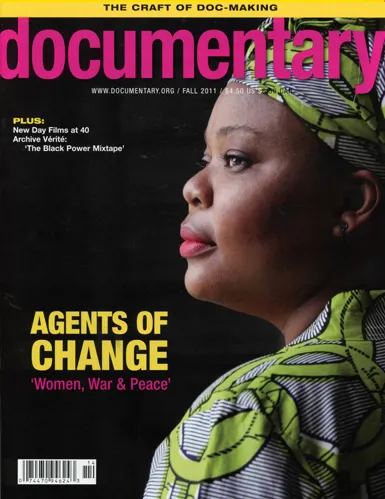

The Craft of Doc-Making Fall 2011
We look at each aspect of the craft of docmaking in a different way—not necessarily comprehensive or definitive, but different,
Features
Columns
The donations, totaling over $1.5 million, were handed out at the Grants and Installation Lunch at the Beverly Hills Hotel on August 4, where actress Elizabeth Moss (Mad Men) accepted the check on IDA's behalf.
Upcoming Doc U events include Writing for the Non-Fiction Screen, which will feature writer/producer and IDA Board Executive Member Sara Hutchison, writer/producer and IDA Board Member Steven Reich (Avalanche: The White Death), writer/producer Sharon Wood (Straight from the Heart, The Celluloid Closet), writer/producer P.G. Morgan (Revenge of the Electric Car) and writer/director/producer Freida Lee Mock (Maya Lin: A Strong Clear Vision). Past Doc Us have focused on topics ranging from making the perfect trailer to women who have devoted their lives to the art of verité.
We are so grateful for the HFPA’s generosity and dedication to our community. Thanks, HFPA!