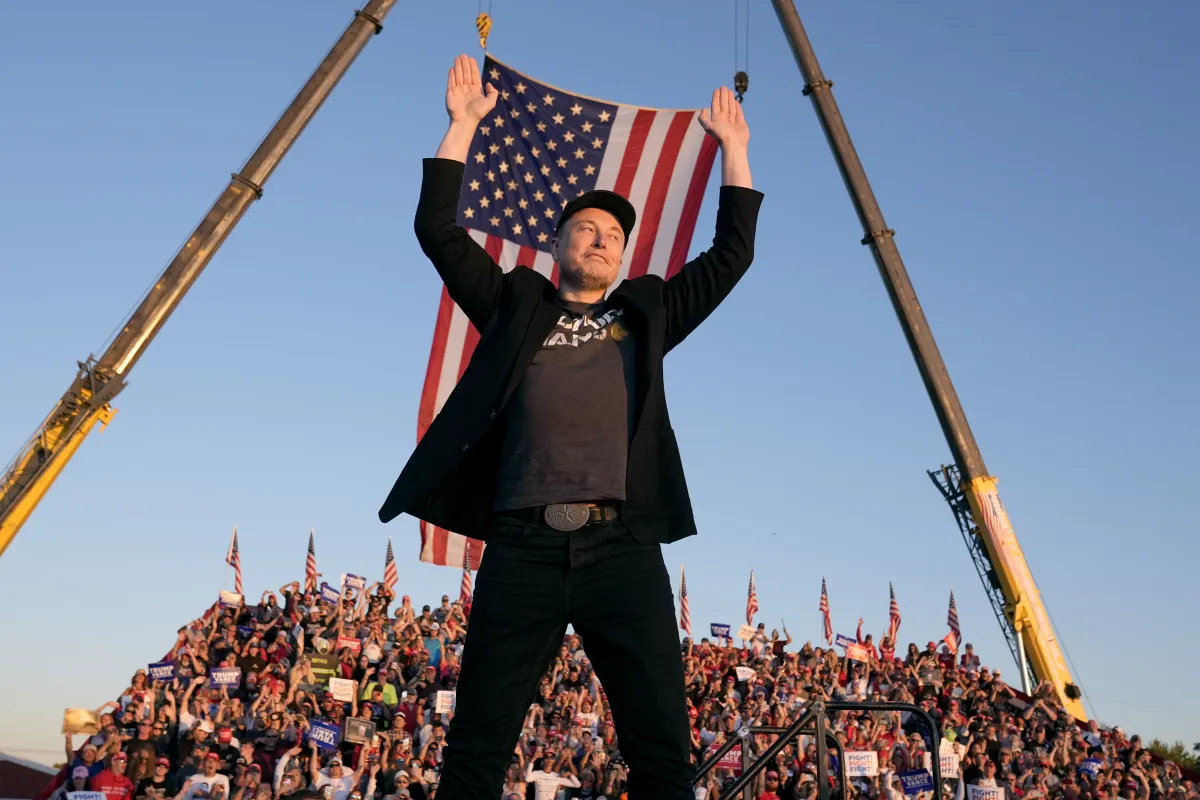


Alex Gibney is no stranger to megalomaniac manipulators. Having unraveled the economic bamboozlement of Enron (Enron: The Smartest Guys in the Room, 2005) and the lies at the heart of Elizabeth Holmes’s fraudulent health-tech corporation Theranos (The Inventor: Out for Blood in Silicon Valley, 2019), the American nonfiction filmmaker could be called a master of exposing masterful illusionists. It makes him an ideal candidate to now face up to the world’s richest man: Elon Musk.
Clocking in at nearly four hours, Musk is an appropriately massive documentary that takes stock of a man who has exploited almost every aspect of our digital infrastructure. Gibney rightly shows how the Pretoria-born tech entrepreneur failed plenty of times in his life, but how he also managed to turn electric vehicles into menacing data collectors, mutate Twitter into the fascist-friendly social media platform X, and allow his Pentagon-enlisted chatbot Grok to churn out sexualized images of women and minors.
In Gibney’s eyes, the stakes have never been higher: Musk posits that the controversial tech icon could be responsible for the impending destruction of the planet, or at least the bloodletting of any democratic institution that still stands in the way of his sci-fi movies-informed utopian/dystopian vision for our collective future.
Unsurprisingly, Gibney was met with immediate resistance from the subject of his film. As soon as the project was announced in March 2023, Musk dismissed it on Twitter as a “hit piece,” to which Gibney replied, “How would you know?” After the Venice premiere, Musk went further, calling the film “a hit piece that misses” and “boring for 4 hours,” and Gibney “a bitter old man who lost the plot.” Meanwhile, Gibney’s production company, Jigsaw, faces a potential defamation suit. The film itself, however, is a measured response to Musk, chronologically tracking his stratospheric rise toward becoming the Trump-bankrolling rocket mogul who wants to forsake Earth and colonize Mars.
In true Muskian fashion, Gibney’s film also takes on increasingly grotesque forms. It only feels right that a film about a man who believes the world is a digital simulation run by higher powers borrows from the grammar of video games and other mediated forms of unreality: Gibney even sourced the billionaire’s own public statements to construct an AI avatar of Musk with whom the director has an actual sit-down interview throughout the doc. Still, watching an uncannily artificial Musk speak before Gibney’s “camera” feels apt; it makes the human presence in the film all the more powerful.
The roll call of Musk’s talking heads includes Tesla co-founder Martin Eberhard, tech journalists Kara Swisher and Zoë Schiffer, and Nobel-winning AI pioneer Geoffrey Hinton, as well as notable women who played important roles in Musk’s life. His first wife, Justine Musk, and Ashley St. Clair, the mother of one of his children, deliver especially spine-chilling accounts as they reflect on Musk’s eugenics-leaning obsession with assisted reproduction.
The day after the film’s Out-of-Competition world premiere in Venice, Documentary spoke with Gibney on the Lido about his journey from Tesla owner to skeptic, the making of Musk’s AI avatar, and the ways in which documentary cinema can still scrutinize power. The following interview has been edited for length and clarity.
DOCUMENTARY: At the outset of Musk, it feels like you are still finding your footing. You even foreground that you saw Musk differently back when Tesla still seemed like a force for good. Was that nuance a way to preempt the charge that this is a hit piece?
ALEX GIBNEY: I try to realistically portray my own journey because back in the day, I was an admirer of Musk. The solar panels and Powerwall were good, and, as I say in the film, I even owned a Tesla.
D: Do you still own it?
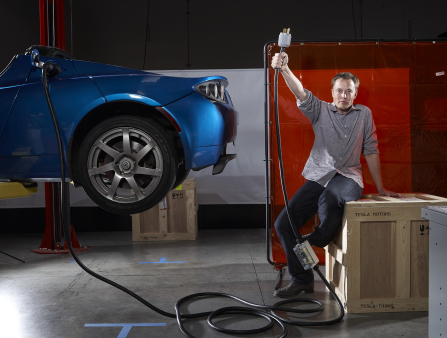
AG: I don’t, but it’s not like I took a hammer to it or anything like that. From afar, I sort of admired this maverick who took on the Big Three from Detroit and produced an electric car that could slow global warming. Even his sort of geeky, inarticulate bumbling seemed charming in a way. I wanted to keep that vibe in the film, because I’m the first-person narrator, and I go on a journey of my own, one that started with a certain affection for what he was doing.
D: I had a great time feeling increasingly worse while watching. It raises the question of how entertaining it should be to watch the world collapse before your eyes.
AG: Well, I hope it’s entertaining. I’m making a movie, right? That’s the goal. At the same time, there is a serious purpose, but serious is not the same as somber. When you’re treating the character of Elon Musk, you have to engage in a kind of narrative rhetoric that embraces who he is. He’s a guy who answers serious questions with poop emojis. So when the axe falls on Twitter, we render it through a first-person video game. Same thing at DOGE. We worked with game designers to make those video-game sections as entertaining as possible, even though you’re witnessing a level of performative cruelty that had to be explored.
D: How did you work with the tension between the visual grammar a permanently online Musk revels in and the conventions of what we might now call “legacy” documentaries?
AG: Elon’s world is one of video games and social media platforms. This film needed to steep itself in that language in order to turn it inside out. You need to embrace the air of unreality in order to bring a sense of reality to bear. You have to explore the tools of deception and manipulation to get out the other side. That’s why we came up with the AI avatar of Elon Musk. It’s not just a gimmick: it came out of Elon’s own obsession with the idea that we’re living in a simulation, including the notion that we’re being played in a video game by aliens of the future.
D: I was on the fence when the avatar first appeared, until I saw it working as an ironic counterpoint to the deeply human testimony from his inner circle. Is that friction the point?
AG: Exactly. His performative, unreal attempt at self-creation collides with this very moving testimony from people who are trying to tell it as it is. That is a key tension. It gives the film some of its power.
I’m engaging with this character, which we purposefully framed so that it looks directly at you. It was like witnessing Frankenstein’s monster come to life
—Alex Gibney
D: What was it like to interview Musk’s avatar?
AG: We designed his image in coordination with MakeMake: what jacket he would wear, what chair he would sit in. But throughout our various rough cuts, it was just a still image with his audio underneath. It doesn’t make sense to spend a lot of time on visual effects if you don’t know whether it’s going to end up in the movie.
Then, as the avatar came alive toward the end, there was a disquieting moment. Suddenly, you’re engaging with the unreality of the avatar, which nevertheless assumes a kind of personality. Similarly, if you’re not careful, you can fall into the trap of believing that an LLM is really paying attention to you, or has some sort of emotional intelligence, rather than being an algorithm that predicts your next idea. So I’m engaging with this character, which we purposefully framed so that it looks directly at you. It was like witnessing Frankenstein’s monster come to life, which reminds me that one of my key inspirations in figuring out how to structure the film was Guillermo del Toro’s Frankenstein [2025]: the creation of an avatar who assumes an increasingly vast body of knowledge about the human world.
D: It speaks to the Freudian uncanny, which brings me to Musk’s relationships with women. Their testimonies are the most profound segments of your film. What was it like to speak with them?
AG: It was very powerful. These are all really interesting women. In a sense, I’m getting closer to my Frankenstein character, and through them, I’m also understanding both his charm and his malignancy. Initially, they were all enchanted with him. Justine Musk [his first wife] also feels profound sadness and regret because she remembers a fundamental happiness she once shared with Elon. Now, she wonders: Was that real or not? Has he changed? Is that something that’s been lost, or was she being conned? You can read those mixed emotions on her face. I was also tremendously impressed by Ashley St. Clair’s emotional authenticity and her courage in speaking truth to power, and in speaking a kind of emotional truth we all recognize.
D: I found Ashley St. Clair a fascinating, even hopeful character. She once identified as a hardcore MAGA influencer, yet your film shows how nuance and complexity creep in through her experiences with Musk. It reminded me that deeply entrenched people can change, and that I, too, hold wrong prejudices about people on the other side of the political spectrum.
AG: One of the things people like Musk do, on his platform and elsewhere, is create artificial divisions. While he creates enemies, he also has a loyal cadre of followers who effectively act as a kind of cult. One of the things I’ve learned, having done a film about a cult, is that there is no them, there is only us. At some level, we’re all human beings, capable of change and growth, if we’re given the opportunity to go there. The difficulty for people is how to change your mind or your point of view. Acknowledging that the point of view you had before is, in fact, false, is very hard. It means you have to question your initial decision, effectively, to have joined the cult, which somehow invalidates you as a human being. You need to have the strength and capacity to see your life as a journey rather than a series of snapshots. And in a journey, you can always decide to turn right or turn left.
You want [your subject] to tell you the way they think the world is, even though you know they may be lying to you.
—Alex Gibney
D: In some of your films, you’ve faced the heart of darkness head-on. Here you can’t. Do you still want that sit-down with Musk, or did the film make it unnecessary?
AG: I feel I’ve covered it in the way I made the film. Of course, you never want to turn down an opportunity to talk to somebody. But the reason to sit down with somebody is that you have to believe that, in some fundamental way, they’re going to give up something of themselves in all honesty. I’m not sure Musk is in a place where he’s willing to engage with that kind of self-reflection. He’s still, and may always be, in the realm of self-invention. So my guess is that if I were to sit down with Musk and talk to him, it would be a little bit like sitting down with the avatar.
D: In the films where you did have a certain figure of evil in front of your camera, what was it like to be that close to the fire?
AG: It’s tricky to use the word evil. Because then you get to a place where this character is almost not human. But I have sat in front of people who have wielded tremendous power or abused their power. And, weirdly, my job in those moments is not to judge them or engage in confrontation, but to see if I can get them to present themselves in the way they would like to be presented.
D: That sounds a lot like Errol Morris’s interview technique.
AG: I think so! I’m a big admirer of Errol, although I do things somewhat differently. But, yes, you want them to feel comfortable revealing themselves. Then, in the cutting room, if you’ve been lied to or manipulated, that’s your opportunity to figure out how to set it right cinematically for the audience, so that you don’t fall into the trap of being credulous.
I found this process quite complicated when I did a film about Lance Armstrong [The Armstrong Lie, 2013]. My assignment was not to investigate the guy who was proven to have doped, because that hadn’t happened yet. My job was to follow him for his big comeback. It was fun to talk to him. There was something very charming and engaging about him. At the same time, I knew enough about him to know that he was a manipulator and that he likely doped. You want them to tell you the way they think the world is, even though you know they may be lying to you.
D: What keeps drawing you to such vast stories of self-invention, exploitation, and misdirection by people and institutions in power?
AG: I’ve always been fascinated by the conundrum of power. To make things happen, you need power, and to pretend otherwise would be foolish. But when people gain a lot of power, they tend to believe in their own papal infallibility, and there’s a danger they will abuse it, often because they engage in the idea of noble-cause corruption: I’m here to benefit humanity. Therefore, it’s important that I don’t have to follow the rules everybody else has to face, because I’m the savior. So how do you gain and exercise that much power without being corrupted by it, without losing your bearings, and without engaging in a kind of cruelty that punishes us all?