

Capitalists have never run out of new ways to exploit the working class.
How, then, are today’s workers keeping pace in finding new ways to fight back? Continuing his focus on labor rights as seen in his first film, Factory to the Workers (2021), Croatian filmmaker Srđan Kovačević seeks an answer to this question in his sophomore feature project, The Thing to Be Done, which premiered in the International Competition at DOK Leipzig.
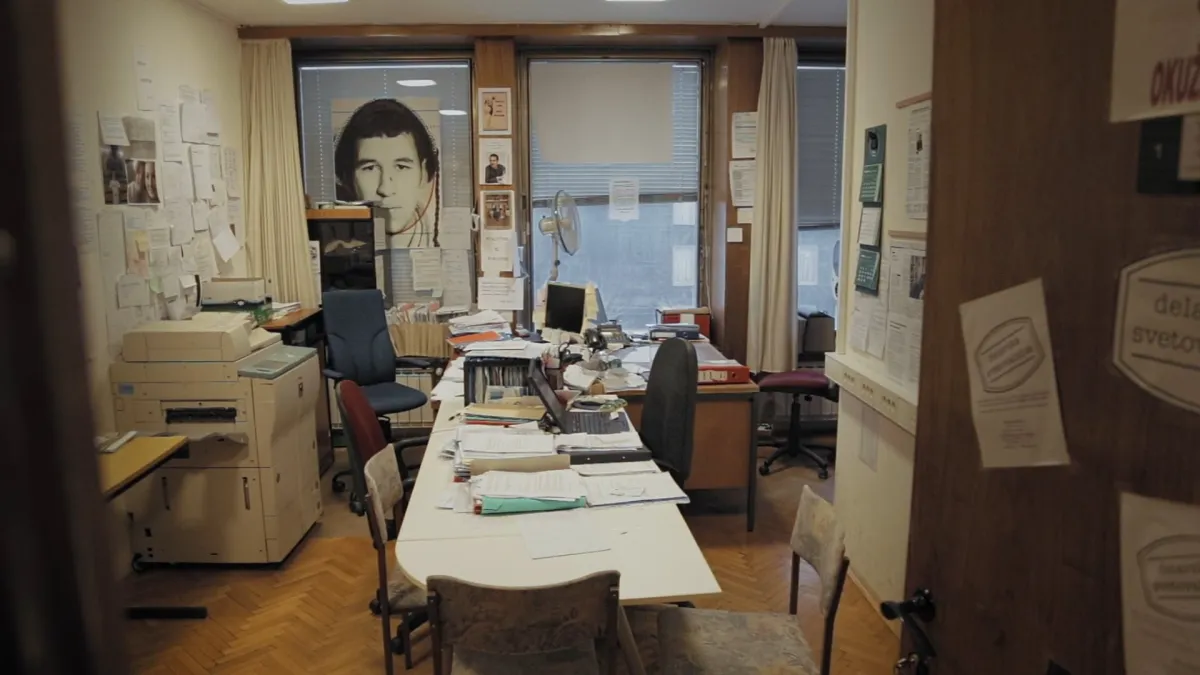
Filmed over five years, this observational doc follows the daily routines of Goran Zrnić, Goran Lukić, and Laura Orel, the three staff members of the Workers’ Advisory Office in Ljubljana. Amidst constant phone calls in their small, cluttered office, they listen to the stories of visiting workers, explain relevant laws and regulations to them, and offer guidance on defending their rights in the workplace. Not only are many of those visiting the Office overworked and underpaid, but some are victims of insidious schemes, such as being paid minimum wage and then forced to pay their insurance out of their salary back to their employer.
Kovačević has dozens of titles to his name as a cinematographer, including Ivan Ramljak’s Peacemaker, the other Croatian entry in the DOK Leipzig competition this year, which went on to win the Golden Dove prize. In his own film, his camerawork is touching and precise, often lingering on his participants’ faces in closeups and medium shots to capture their pain and triumph in simple yet moving moments. In one particularly memorable scene, a migrant worker visiting the office repeats a translated sentence that seems to perfectly crystallize the film’s key tenet: “The enlightened rebel will shake up the thrones of power.” The Thing to Be Done illustrates just how rampant labor exploitation has become, but it also shows how we can fight back by organizing and taking care of one another.
Following the film’s world premiere, Documentary spoke with Kovačević about prioritizing the political over the personal in his work, his practice of sharing profits from his films with their protagonists, and why he’s intent on telling successful stories of political praxis. This interview has been edited for length and clarity.
DOCUMENTARY: What first brought you to the Workers’ Advisory Office?
SRĐAN KOVAČEVIĆ: I was part of a small leftist political organization in Zagreb that worked with unions to make their policies more inclusive and flexible. Someone mentioned that there was a small office in Ljubljana doing incredible work with migrants. Back then, it was called the Advocacy Office for Migrants.
D: I think the name change, as mentioned in the film, was a great idea because the common identity most of us have is that of a worker. In the film, we don’t really get any background information on the three office staff members or any of the workers who come into the office. The film doesn’t focus on individuals but on the collective—on the issue itself. Was this a conscious decision on your part?
SK: Of course. I find that films that focus more on the personal usually tend to be less political in how they talk about the system. It’s not really important what their personal lives look like—how their houses look or what they dream of—because their work shows what’s important. The tendency in most documentary films today is for authors to go into the personal. I’d say that’s a kind of trap of capitalism. People often don’t have the political knowledge or tools to talk more clearly about the system—and the system is the real problem. We are just the product of it. If we always speak about the product and not about the causes, we fall into that trap.
The tendency in most documentary films today is for authors to go into the personal. I’d say that’s a kind of trap of capitalism. People often don’t have the political knowledge or tools to talk more clearly about the system—and the system is the real problem.
— Srđan Kovačević
D: We hear the phrase “We’re not a union” a lot in the film. How different is the Office’s work from that of unions?
SK: I’d say the Office’s work offers another approach to caring for people. When we think about protecting workers’ rights, we usually think about unions. But unions in Croatia more or less—some even exclusively—focus on collective bargaining. The work they do isn’t really up to date anymore. I always had the impression that that was not enough. Since we transitioned from socialism to capitalism, the labor market and company structures have changed dramatically. Under socialism, around 20% of companies had 500 or more workers and were considered large, about 50% were medium-sized, and around 30% were small. Now, under capitalism, large companies make up only about 0.4% of the market, small businesses around 5%, and micro-companies about 90%. This change has really affected how workers can organize. Unions haven’t kept up with the times. Today, in those small companies—and in a labor market where people often change jobs—workers don’t tend to join unions.
Union membership in Croatia and other former Yugoslav states has fallen dramatically over the last 30 years. I think maybe only a third of the labor force is unionized now. In many companies, you can’t even do collective bargaining because there aren’t enough workers. When I heard about the Workers’ Advisory Office in Ljubljana, I was immediately drawn to see what they were doing there. We heard that they work one-on-one and try to solve whatever problem a worker brings in. But they also depend on membership fees. So, it’s union work—but for the 21st century.
D: How effective did the Office’s work seem to you?
SK: I think it’s really effective. If nothing else, people at least get information they didn’t have before. Some come with serious problems, like not being paid their salaries, and we see in the film how those can be resolved. Having someone who’s got your back is really important. That’s one part of their work. They also engage in collective fights, usually in collaboration with unions, like the one with the Port of Koper in the film, which was a success. I think everyone who visits the Workers’ Advisory Office gains something from it.
D: The exploited workers are in a very vulnerable position, especially migrants, and are often reluctant to seek help. What was the process of filming them like?
SK: Some people like being filmed, some don’t, and some are neutral. I’d ask if it was okay to film them during their conversations with the people from the Office. I always said, “I’m not interested in the personal—I’m interested in the problem and in good examples of solving or dealing with it.” I was filming alone, just like in Factory to the Workers, with a Canon 6D and a 24–105mm f/4 zoom lens. I built an arm that I attached to the hot shoe, with two microphones on it, and used a sound recorder. When a worker’s visit ended, I’d drop the camera, run after them in the hall to get their signature [for the release form], and then come back and start filming again.
Film is a product of collective labor. That’s why, with my first film, Factory to the Workers, we made a film solidarity agreement and divided the shares equally—one quarter each for the production house, the protagonists, the authors, and myself, since I had several roles.
— Srđan Kovačević
D: Filming ended in 2022. What’s the situation like at the Office now?
SK: There are now five full-time staff members working there. They have several thousand members whose membership fees pay their salaries, which is really important. It’s not a project-based organization. The situation is similar to what we see in the film because there haven’t been any real systemic changes. Changing the system and the laws is the hardest part. They’ve had some success, but not enough. That’s why so many people are still coming in. There’s an agreement between the former Yugoslav countries stating that workers coming to Slovenia must stay with their first employer for one year. Those workers are basically slaves during that first year. That’s something the Office hasn’t been able to change, but it really needs to—because at least half of the people who come to the Office face exploitation in their first year of employment. There’s still a lot of work to do on the systemic level.
D: Your films start with a note about a profit-sharing agreement between the film workers and the protagonists. How does this agreement work?
SK: Film is a product of collective labor. That’s why, with my first film, Factory to the Workers, we made a film solidarity agreement and divided the shares equally—one quarter each for the production house, the protagonists, the authors, and myself, since I had several roles: director, cinematographer, sound recordist, and executive producer. The profit from Factory was around €3,000. Not much. But what matters to me is the political aspect of it. We all worked on the film, so we all share in the profit. It’s simple and clear. This time, we’re translating the film solidarity agreement into English and making an open-access blank copy available online so anyone can use it. What’s important for me isn’t the small amount of money, but that others start using the model and that it has some kind of impact on the industry.
D: Your directorial work so far has been about workers and labor rights. Will your future projects follow this path? Are you working on anything currently?
SK: With these two films, my focus was on political praxis that I thought was successful. I’m not working on anything similar right now. I’m still looking for something else that I can consider a successful political praxis in my neighborhood, instead of going to other parts of the world. We’ll see if I find one.
Editor’s Note: This piece has been updated with Kovačević’s accurate nationality.