

“How does the transformative power of documentary film become diminished by the absurd notion that it can somehow be won or lost?” That is how film director and producer Keith Wilson tees up his equally playful and cutting live cinema performance, Pleased to Announce.
First performed at CPH:DOX (with encore performances at Cannes Docs, DC/DOX, and Camden), Wilson’s piece is part memoir of his time on the awards campaign as producer of Reid Davenport’s I Didn’t See You There (2022) and part critique of the for-your-consideration cottage industry that’s seemingly swallowed up the documentary field in the last few years.
Armed with just his laptop and a self-deprecating sense of humor, Wilson skewers the way the rush to earn accolades has skewed the way many documentary filmmakers (himself included) see and value their work. In this conversation with fellow live cinema practitioner Maya Daisy Hawke (editor of Oscar-winning Navalny), Wilson talks about why this critique is best-suited for a live performance, why he embraces failure in this very form, and what conversations he hopes to incite in documentary spaces. The following conversation has been edited for length and clarity. — Manuel Betancourt
MAYA DAISY HAWKE: I thought we would start with a question about a question. I was recently a part of a live cinema event with Joe Bini called Edit Your Way Through Life. You were there and asked us about how we felt when we did live work. I was curious why you wanted to know that, and I would love to know how you would answer that question.
KEITH WILSON: I wanted to ask that question because, as somebody who does live cinema, it is something I think about a lot. I experience a lot of emotions, both preparing it, and going through the conceiving, and the editing, and piecing all these disparate materials together, but also emotions in terms of the piece itself, and in terms of preparing to be the person who holds the space of the event, and very much is a part of the event.
MDH: It’s definitely part of the high wire act of it that is as old as time. Watching somebody get up on stage and potentially fall without a net is priceless. How could you not want to see that? To put myself in that position, I always ask myself, Why am I doing this? And often, right when the lights go on, What was I thinking here?
KW: So, your Why am I doing this? moment happens right when it starts?
MDH: When does yours happen?
KW: Mine usually happens the day or a couple of days before, when I’m scrambling to get ready. It’s like, Why am I doing this to myself? And I have to walk myself back and be like, Well, this is what I do. I remember I saw you, Joe, and Sam Green, the night before this piece premiered at CPH, and each of you was like, “It’s going to be great. You’re going to do fine.”
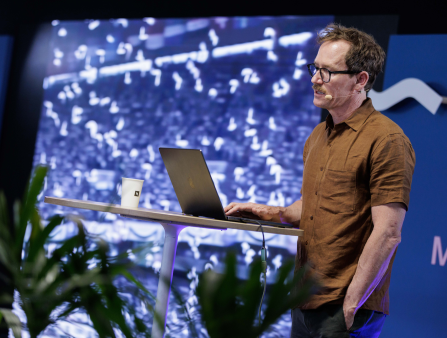
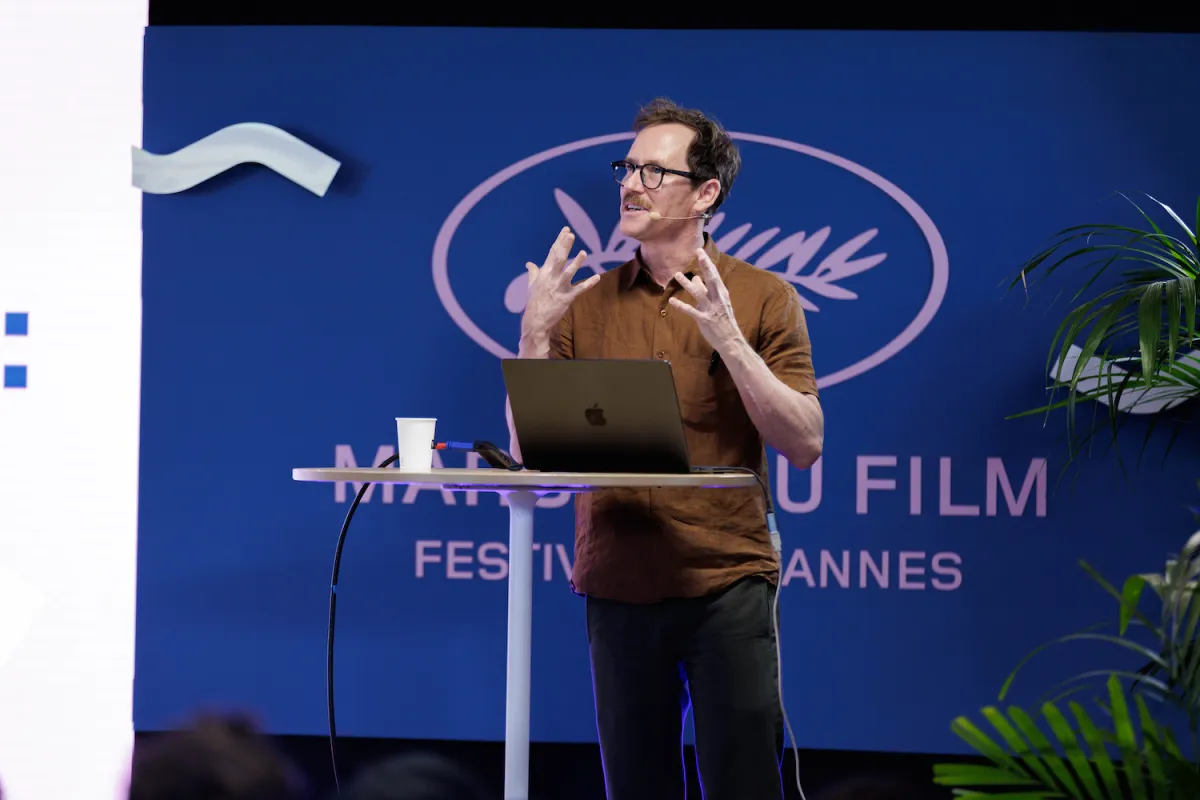
Keith Wilson performs Pleased to Announce at Doc Day in Cannes 2026. Courtesy of Marché du Film
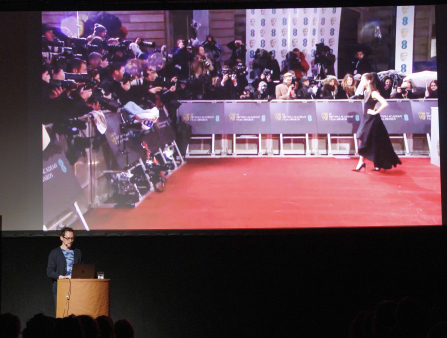
Keith Wilson premieres Pleased to Announce at CPH:DOX 2026. Photo credit: Light of Scene. Courtesy of CPH:DOX
MDH: You can’t talk about live cinema without talking about Sam Green. For me, he was really important. You knew him back in the day, in San Francisco, right?
KW: Sam Green was my first documentary teacher at Film Arts Foundation. I’d never taken a film class or anything, so he was my first documentary and film teacher. And then a few years later, at the Portland Documentary and Experimental Film Festival, which doesn’t exist anymore, it was this beautiful blend of those two forms—he did one of his first pieces on his laptop. I actually don’t even remember the content, but I remember the form. It was a very early Sam Green; it wasn’t very polished. He was just on his laptop, I think he had a composer or somebody doing music, but it was very pared down, and it was really exciting to me because I just saw the potential for another way of making documentary.
MDH: I saw him perform a piece in LA right before I gave my first Sundance Lab master class. And I thought about Sam and his laptop and the microphone, and I was like, Oh, this is it. At that time, I was really early in my career, and I didn’t have anything to show, really, except for my work I was distributing on Facebook, which was why I was there. But I made a piece, showed a video I’d shot in cutting rooms, and told stories about films I’d been fired from or had quit, instead of doing a masterclass. And with live music. And it was a great moment for me, but it was really hard to convince the tech side of it to go along with the idea. The projectionist, who ultimately was wonderful, was like, “No, we’ll play the clips, and you do the talking.” I always find that the tech is the hardest part about live cinema.
KW: It’s a bit of a teaching moment for tech staff that is usually competent, but not really set up or hired to understand what I’m doing. For my last piece, Moore for Sale, which premiered at Camden a few years ago, part of the performance is about failure. It’s about my failure to get a film made, and so in the performance I fail, and so I’m giving this away, but my computer glitches. I fail in front of everybody, and I have to make sure that the tech staff is okay with that, that they don’t rush to help me fix the glitches that are planned and embedded into my keynote presentation.
MDH: That’s so genius. That’s leaning into the whole danger. People don’t realize; They think the danger is you standing up there, but the danger is a technical disaster.
[Editor’s Note: As if on cue, Keith’s Zoom cut out at this exact moment, and it takes him a few minutes to come back]
MDH: You’re back! Okay, so tell me more about tech issues.
KW: Well, you have to get people on board with the idea, and then have to take responsibility for helping you do it. They’re there to make sure things are seamless, so when I don’t want something to be seamless, polished, or perfect, I have to be like, “This is the reason this is going to happen.”
Could you talk a little bit more about your Sundance masterclass, what it was supposed to be, what you were expected to do, and then what it turned into and why? I sortaknow the story, but I don’t think many people do.
MDH: As an editor, my favorite thing in the world is when people come visit my cutting room, and I get to show them stuff. I just imagined it was like a giant cutting room, and everybody was looking over my shoulder at what had just come out of the oven that moment. I knew that I could pretend like I was ad-libbing, but actually scripted it, and I rehearsed the hell out of it by myself, so that everything would land. It would seem like I was just riffing, but suddenly it would land in sync with the picture—casual, but perfectly timed, which is exactly what I’m going for as an editor in all my editing, so that it does not feel contrived. Especially in documentary, you feel like you’re seeing something unfold, with magical timing. That’s what I’m always going for.
KW: I didn’t realize that it was planned in order to make it look as if it was just off the cuff. Very impromptu, very conversational, but rehearsed.
MDH: It’s like what you do with the technical malfunction as a device. You’re seeing my screen capture, and it looks like you’re in my screen. Then suddenly you’re playing something, and it becomes quite formal and beautiful. But it comes out of a real scratchiness.
KW: What did that do for you personally, for your artist self?
MDH: I always come at this as an editor, and it felt really important to me to represent editors as real. It was a way for me to be visible and to be a character in this world who sometimes said unexpected things, or to be a bit more outspoken and frank about my experience as an editor. Do you think of yourself as a character when you’re on stage?
KW: I do, and I think that’s part of the anxiety, getting into that character, and accepting the responsibility and the expectation that other people have of being a character with emotions. It’s one of the reasons I want to do it in the documentary space: we’re expected to be hyper-competent. It’s always about trying to convince funders or the industry that I’m competent, that I can deliver a film, that it’s going to be exactly how I pitch it, that it’s going to do great work in the world, and I just find that too often to lead myself and others to produce not great work. I like being the person who fails in public. And my privilege allows me to do that without suffering any real consequences.
My definition of a documentary film is that something’s going to happen in front of the camera that is not planned, and not expected, and live cinema is sort of an ultimate expression of that.
—Maya Daisy Hawke
MDH: My definition of a documentary film is that something’s going to happen in front of the camera that is not planned, and not expected, and live cinema is sort of an ultimate expression of that. You can rehearse and craft it so it works, but you can still maintain the experience of not knowing what will happen next for all of us. Actually, it’s real. You really don’t know what can happen when you’re up on stage, and we play with that, but it is a sacred idea about documentary that needs to be echoed back into the community, of This is what documentary is. You don’t script. You don’t storyboard. In this moment, we are moving towards a type of documentary made from paper cuts that delivers what has been commissioned, and that’s a bit anti-documentary, in my view.
Tell me about why you decided to make a piece about awards campaigns. Why make it live cinema versus a more conventional documentary?
KW: Do you mean why did I take on the risk of being a performer and doing it live, or do you mean the risk of burning some bridges in our industry?
MDH: Both. Taking on a risky subject in a risky format.
KW: I’ve been thinking about awards and awards campaigns ever since doing my first big one, for a film called I Didn’t See You There, and for the first time engaging in what I call the “awards industrial complex,” and engaging in getting documentary branch voters—and only those voters—to watch my film and care about it and vote for it. The process and the costs—the emotional, financial, time, and relationship costs—and the way it just took over were very surprising to me. The way that peeled back the curtain about how things work, how the industry works, how awards work, and how awards are won or lost was very informative to me, and also kind of deflating. It just burst a little bit of a bubble for me.
MDH: The first time I ever met you was at Camden, and I got to see the two of you doing your double act. It was pure charisma. Was the process of that, the effect of that, and the effectiveness of that part of the inspiration process?
KW: I remain incredibly proud of this film. I loved going around with Reid and talking about it. And when I saw you, it was at the beginning of the awards campaign process, where we were starting to get our pitch down and do our dog and pony show. I love being at Camden, and it felt great at first. And then it just started to feel like real and stressful work, and I started playing the game and getting competitive with other film teams and people I liked. It started to infect the overall positive experience I’ve had with this film, and I just really dislike that.
And so I collected these bad experiences, and some good ones, and started talking to enough people about how I was thinking about doing a live piece or a project about awards campaigns, and I said it enough times that it started to become a real thing. Doing it live made sense because it was the way that I could wrap my head around it. For my last piece, I critiqued the way we get funding and the barriers to making work. This one is also an institutional critique about awards campaigns and where our time and money are spent trying to get nominations and statues, which felt like the right way to continue doing that. Also, I can do things in a live piece, make points, and create an emotional experience in a way that I do not know how to do with a standalone film. It felt like the right way to bring together all of these people who work in the documentary world and then critique this entire process. And I include and implicate myself in the piece. It all feels like a way to hopefully generate some conversation about why we’re doing this.
MDH: It was electric being there at CPH:DOX when I when I first saw you do the piece because the piece was so great, but also who was in the room. It felt productive. And so, maybe as a way to wrap this up, are you finding people sharing those kinds of stories with you more since you’ve been doing Pleased to Announce?
KW: Ever since I started talking about doing the piece and then doing it, people love to share their stories about awards campaigns. Every time I tell people that I’m doing a piece that’s critiquing awards campaigns, everyone says, “Oh my God, thank you.” There’s just an exasperation. We all sort of dislike it and talk about how hard it is, yet continue to do it. I don’t want to sound pompous or overly important, but the way people react to me tells me I should keep doing this.