

Sam Green has spent the better part of the last two decades making feature-length “live documentaries.” Works such as The Love Song of R. Buckminster Fuller (2012), A Thousand Thoughts (2018), and 32 Sounds (2022) are screened alongside a benshi-style performance by the director and a live musical score. This year, the filmmaker has returned to a standard screening formula for his latest project, the decidedly non-standard The Oldest Person in the World.
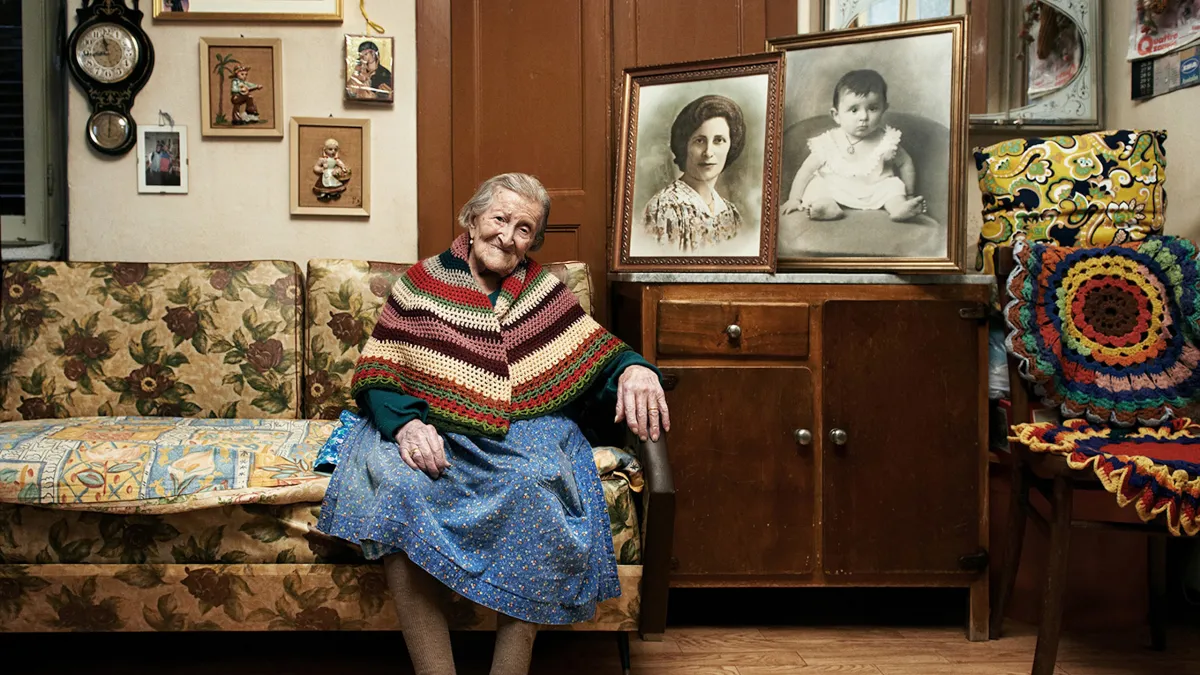
The Oldest Person in the World, which premiered at Sundance, sees Green cross oceans to monitor the revolving door of supercentenarians into the Guinness World Records and out of this earthly plane. Shot over ten years, the director travels from Brooklyn to a Piedmontese commune to a Jamaican parish and elsewhere, following the passing of the baton between various 116- and 117-year-olds, interviewing them and their family members along the way.
But The Oldest Person quickly discovers the limits of its premise. The extremely elderly, Green comes to realize, don’t always make for the liveliest interview subjects—and pushes beyond them, spreading to include subplots concerning Green’s own mortality, the death of his brother, and the wonder he finds in his son’s childhood. The sum of these parts amounts to a documentary about time itself. As such, it’s fitting that Green comes to think of his film, by its conclusion, as a sort of infinite documentary—one he will revisit ten years hence, and perhaps someday bequeath to his son.
I spoke with Green ahead of his film’s Canadian premiere at Hot Docs, and our conversation touched on the similarities between the oldest person in the world and a river, testing the limits of documentary form, and what the Guinness World Records can tell us about our short time on earth.
DOCUMENTARY: Can you talk to me about your decision not to make this one as a live documentary?
SAM GREEN: I’ve always felt that the subject suggests the form. I made my live cinema piece with the Kronos Quartet, because a regular documentary about a string quartet would have been boring. But a live cinematic experience is a totally different form. With The Oldest Person in the World, it’s different. I’m very thankful it’s not a live thing, because it’s heavy for me to be saying that stuff over and over again. So I’m happy this is a regular movie and it can go out in the world the way regular movies do.
D: Do you feel like you learned a lot from the live process?
SG: I learned a lot about writing and editing. When you’re up in front of people, you can really feel what works and what doesn’t. You can feel the timing when you get it right and when you don’t. I’m not somebody who is into pandering to the audience, but I do feel like you’re making work to move people—to get into their system.
D: The new film also feels very made-in-the-moment. It’s prone to flights of fancy and improvisation. Everything feels open, and even the ending is hardly an ending at all.
SG: That’s the nature of the subject matter, as well. If you make a film about the oldest person in the world, two months later, it’s out of date. Oddly, this has not gone out of date yet [at the time of the interview, the oldest person in the world is still Ethel Caterham, who’s held the title since April 30, 2025]. But any day now…
In a way, it has to be open-ended, which is part of why I like the subject matter. It’s impossible to fix.
D: This is what drew me to the film. Every new edition of the Guinness World Records, a lot like documentary film, freezes a moment in time that immediately becomes outdated.
SG: There was a part of my interview with the Guinness World Records editor that I tried to work in for a long time. He spoke about the book constantly going out of date. They go to print, and already so much has changed. “It’s our curse,” he told me, and as he was talking about it, he made this wave gesture expressing the passing of time. Something about this really got me. There’s something weird and heartbreaking about it. The documentary impulse is to try to hold on to time. It is this river, and you’re trying to put a little dam up, and it’s hopeless. It’s a losing battle. But that’s art, I guess.
The documentary impulse is to try to hold on to time. It is this river, and you’re trying to put a little dam up, and it’s hopeless. It’s a losing battle.
—Sam Green
D: In a more process-oriented sense, with a ten-year project of this scope, how did you decide what to include and exclude?
SG: It happened 100% in the editing suite. There’s a version of this you could make that’s like, The oldest people, they’re so kooky! or The oldest people, they’re really something! At some point, we were pitching that, but the film doesn’t really have the material to deliver that. All movies are like this—they seem very easy at first. When I started, I confused the oldest people with the woman from Harold and Maude [1971]. I thought they would all be these sassy old people, dropping bombs of wisdom. They’re not. When you’re 117, you’re not doing anything. You’re not saying profound things. Your life is very small, and you basically want to have a snack and take a nap.
I knew it would be something else because I wasn’t interested in folksy stories from old people. I was interested in making a movie about time from the perspectives of people who have experienced the most time on the planet. It took a long time of playing with things to realize that if I filmed my kid, that could be a counterpoint. From there, the other stuff slowly started to seep into the piece. It’s one of the things I love about documentary: you set off with an idea, and the world tells you otherwise. The world is more interesting than what I could think up.
D: This isn’t your first film dealing with the elderly. I find echoes of your portrait of Annea Lockwood’s sound recording practice with the 116-year-old who just enjoys being touched, having her hair brushed. There’s a through-line of attentiveness to the five senses. What connections do you see between 32 Sounds, for instance, and this new film?
SG: I was working on both at the same time, so I’m sure they share some DNA. Both films are trying to wrestle with the limits of the form. With 32 Sounds, one of the huge challenges was: How do you make a film about sound? Documentary is such a predominantly visual medium. We watch movies in a very lazy way—sonically. You don’t usually lean in and listen at all. How do you get people to actually listen? I was surprised when it got an emotional reaction from people, considering it’s an experimental movie about sound. A big part of that was just getting people to listen differently, using their ears and their bodies to open them to a more emotional experience.
With The Oldest Person, the challenge was how to make something about time. In a way, if I made just one movie, I don’t think it would have the same import as this bigger gesture that will last a lifetime and maybe longer, and will just get better and better, stronger, deeper, over time, with the more time that accrues to it. Both films are trying to push the form beyond the limits of documentary.
D: I’m also thinking about Annea Lockwood’s river recordings, the way that meaning accrues between the repetition and subtle differences discovered when you dip a microphone into a flowing body of water. How do you think about repetition and difference in this project?
SG: I feel like the oldest people have become this tempo for the film. They measure this inexorable flow of time. They’re all people who have lived remarkable, ordinary lives, and there’s something gripping but also very mundane and repetitive about that. It’s like a piece of music where that’s one tempo alongside these other tempos. In this first film, you have me, my kid, my mom, and my brother. But for part two, there’ll be a lot of freedom. I could make something about the tech bros who are trying to live forever, with the same refrain as “the oldest people.” There’s something inherently interesting about seeing people over time, and I will always be on the edges of the film, getting older. I like the part in this film where I’m looking at myself at the start and end of the production, and I say, “Jesus, I’ve aged.” It’s hard for one’s vanity, but at the same time, you’re alive, and that’s a great thing.