
Online Feature

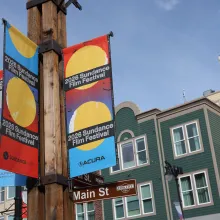
Sundance is a unique crossroads of industry and independence, where you are able to be surprised by films that you didn’t see coming—films that often end up disrupting the film industry’s ideas of marketability, contending for awards and being placed on all sorts of year-end lists, if they’re able to find the right support. As Sundance Film Festival looks to a future away from Park City, looking into questions of location, land, capital, culture, and evolution, I find myself attracted to the films in the 2025 lineup that seek context and answers to these same questions: Move Ya Body: The Birth of House, BLKNWS: Terms & Conditions, Seeds, Free Leonard Peltier, and Khartoum.
In the weeks since the National Endowment for the Arts announced major changes to its application criteria, many nonprofits across the country have been anxiously awaiting clarity regarding what this might mean for their prospective Fiscal Year 2026 grants. In particular, in recent weeks nonprofit managers and filmmakers are scrutinizing how the NEA applies two recent Executive Orders aimed at shutting down DEI and LGBTQ+ programs.
The lineup of the 2025 Sundance World Documentary section was more expansive in its geopolitical interest than last year’s. This year the dissenting subtext assumed functional pointedness, with each work making a broader statement against hostile governments. The theaters went packed and audiences cheered as the snow-clad Park City lent an otherworldly, almost mythical safe space to the independent makers and their works. Although there is speculation of the festival moving out of state in 2027, it is difficult to imagine a setting more suited to Sundance than Utah. The inconveniences, like the high altitude and the extreme dry weather, somehow added to the charm and made me feel, albeit perversely, like I had earned the right to be an attendee.
APA members Debra McClutchy and Eugen Bräunig are eager to discuss the comprehensive new guidelines they’ve co-authored, “Working with Archival Producers.” From breaking down their roles during various stages of production to ideal onboarding scenarios, the document is, first and foremost, a means to advocate for a tangible job description and reasonable workloads. Despite the desire to establish concrete parameters for this work, there is also ample room for adjustment. In our conversation below, McClutchy and Bräunig discuss how they came to co-author this new guideline, how it complements the APA’s previous document on GenAI best practices, and member feedback.
Oleksiy Radynski is one of the most fascinating figures in contemporary Ukrainian cinema. Since his early shorts, Radynski has worked in observational documentary and archival footage. In films like his feature-length debut Infinity According to Florian (2022), he explores culture, historical memory, and community, particularly within Kyiv’s urban landscapes. The full-scale invasion shifted Radynski’s focus more decisively towards found footage, as he became increasingly engaged in the recovery of previously forgotten Ukrainian cinema. Ahead of its world premiere, Documentary spoke with Radynski about Special Operation’s challenging production, the semiotics of surveillance cameras, and the depiction of imperialism through landscapes.
Largely composed of artful, meditative shots that relish in quotidian minutiae—meal prep, bathtime, daily prayer—Sam Abbas’s Europe’s New Faces is a striking and emphatically humanizing portrait of African migrants residing in a specific Paris squat. Though the film’s 159-minute runtime seems somewhat daunting on its face, the filmmaker’s eye for exquisite detail quickly quiets the viewer’s roving mind. Below, our conversation covers his initial encounter with Parisian squats, how he acquired access to shoot an emergency C-section, and the process of enlisting The Beast and Nocturama director Bertrand Bonello for the score.
“Why even have a contest if you’re going to disregard the votes?” Founded four years ago, Decentralized Pictures is a nonprofit organization that gives awards to filmmakers through its platform based, in part, on the scores they receive from the platform’s users. The company—whose mission is “democratizing the film industry”—has some big supporters. In addition to filmmaker Roman Coppola and his family’s American Zoetrope studio, which helped found DCP, their board includes veteran indie agent Bart Walker and director Sofia Coppola. While some filmmakers who have participated in Decentralized’s contests have been enthusiastic about the company and the funds they’ve received, the Sidewinder Films Award revealed some deeper issues at the company.
Interviews with sales agents, sales news, project announcements, and industry trends at DocSalon panels at the 2025 European Film Market (February 13–19). The 2025 edition of the Berlinale has been one of the coldest in recent memory, with the German capital covered in snow for almost ten days and the thermometer occasionally hitting -10°C. The A-list gathering, which ran from 13–23 February this year, saw a brand-new management team take over the festival direction. The festival’s American director Tricia Tuttle appointed German-French executive Tanja Meissner to head the EFM.
Angelo Madsen’s (North By Current) newest film, A Body to Live in, is an ode to body piercer, performance artist, and photographer Fakir Musafar (1930–2018). Madsen, who befriended Musafar in the last 14 years of his subject’s life, utters offscreen near the end of the film that he wishes he had begun this project when the founder of the “Modern Primitive” movement was still alive, to speak with Musafar directly about his westernization of Indigenous spirituality from a contemporary perspective. Both a critique and love letter to the divisive “Gender Flex” symbol, A Body to Live In is a sonic immersion of what it means to find community and be human. Ahead of its world premiere at True/False, Documentary chatted with Madsen over Zoom to discuss his friendship with Musafar, respect for Musafar’s legacy through a critical lens, and the difficulties of financing and marketing “niche” trans stories.
It’s tempting to pick nits about the relative merits of prizewinners and other films, and even more tempting to take a handful of the 346 new films as somehow indicative of the festival as a whole, but the truth is that a slate the size of IFFR’s can make proclamations about its strength difficult: two different attendees can carve distinct paths and have dissimilar takeaways. That’s one reason why a festival is more than just the films one watches.