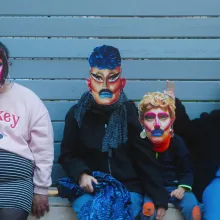

It’s only us; there’s no them. That’s the provocation at Tribeca’s 2025 Immersive exhibition, titled In Search of Us, mounted in partnership with Onassis ONX and Agog. The exhibit seeks to challenge the act of othering that is so entrenched in media landscapes with “us vs. them” ideologies. About half of the show is comprised of documentary or documentary-adjacent work. This dispatch includes review of four exemplary nonfiction works.
Online Feature
Maintenance Artist, directed by Toby Perl Freilich, is a fascinating look at Mierle Ukeles—an undeterred feminist and advocate for the working class who constantly defied labels. Just prior to the film’s documentary competition debut, Documentary caught up with Freilich to learn how she ended up collaborating with this unconventional and unusually empathetic character.
This article is a condensed and slightly adapted version of a talk I delivered on June 8, during the Skjaldborg documentary film festival in Patreksfjörður, Iceland, titled “The Press Playbook: How To Get Your Doc in the Spotlight.” What follows reflects both the structure and tone of that session—direct, personal, and grounded in real-world practice.
The documentary world lost a bright light on April 12, when Andrea Blaugrund Nevins died of breast cancer. Nancy Kates details her legacy as a tenacious, compassionate filmmaker who brought her optimism to every project.
It is all too easy to overlook nonfiction film at Cannes, where documentary is, if you go by institutional classification, largely a vehicle for chronicling the history of cinema. This year, the most compelling documentaries were found in the parallel festival showcases. The winner of the Œil d’Or (Golden Eye for the best documentary at Cannes) Imago, from Deni Oumar Pitsaev, was in Critics’ Week. Likewise, ACID had the most formally challenging documentary this year at Cannes, Sepideh Farsi’s Put Your Soul on Your Hand and Walk, and it was Directors’ Fortnight that premiered a Ukraine documentary with stunning and often inventive cinematography, Militantropos, by the Tabor Collective.
Suzannah Herbert’s Natchez is a multilayered, character-driven look at the titular town in Mississippi (U.S.), which is wholly dependent on a declining industry. In this case, the manufacturing is of whitewashed tales that have turned into hardened history. For generations, Natchez has been financially dependent on its antebellum tourism industry, in which hoop-skirted docents in grand mansions regale visitors with, as one knowing character puts it, a “Southern construct” that’s “used to sell tickets.” Just prior to the film’s Tribeca Documentary Competition premiere, Documentary caught up with Herbert (Wrestle) to learn all about her stellar sophomore feature. Last week, Tribeca announced that Natchez won not only the best documentary feature prize but also special jury awards for cinematography (to Noah Collier) and editing (Pablo Proenza).
Close to the start of her hypnotic documentary The Memory of Butterflies, director Tatiana Fuentes Sadowski describes the moment that inspired the film. While looking through a selection of propaganda images taken by a company operating in the Amazon during the late 19th-century rubber boom, Sadowski came across a posed portrait of two young Indigenous men. In the image, the pair stands hand in hand dressed in Western clothes, stiff suits and ties, gazing at the camera with solemn, unreadable expressions: Omarino and Aredomi. Documentary spoke to Sadowski shortly after the film’s premiere at the Berlinale, where the documentary jury awarded the film a special mention, about the ethics of colonial archive, cinematic speculation, and sound as a threshold. This interview has been edited for length and clarity.
In Imago, the Chechnya-born filmmaker Déni Oumar Pitsaev journeys to a Chechen enclave in Georgia named Pankissi, where his mother has secured a plot of land for him to settle down. He spends time with his mother, with whom he’s close, and a hearty cousin and a friend, but he has barely seen his father since his parents divorced when he was nine months old. That’s on top of a childhood marked by his and his mother’s stays in Kazakhstan, Chechnya, and—when the Russians attacked Grozny in 1996—St. Petersburg, where she changed his Chechen name for his protection. After Imago won L’Œil d’Or, the best documentary prize of Cannes, Documentary interviewed Pitsaev about starring in a film about his life journey and the balance between pre-planning and responding in the moment.
Last year, national and international press widely reported on what The Globe and Mail described as “the most tumultuous year in the festival’s history,” complete with sweeping personnel changes, social and financial pressures, and the temporary closure of their flagship Ted Rogers Cinema. Though Hot Docs managed to pull through for its 32nd year with a new executive director (Diana Sanchez, formerly of TIFF) and a replenished staff (some of the programmers, including department head Heather Haynes, returned after their prior exodus), what frightened this hamstrung fixture of Toronto’s flailing film scene was dismally clear. Social issues don’t entirely permeate the programming, nor do their chosen films observe such issues in totality, but Hot Docs has always strived to stay in tune with urgent matters of the present, especially through films that align their audience’s point of view with what will one day be the right side of history.
Amid the past few decades of Holocaust-focused works, queer artist Kinga Michalska has found a unique approach to “the Holocaust memory documentary” in their native Poland. Their feature-length debut, Bedrock, is a psychological journey through the contemporary sites of former concentration camps and mass graves. It also poses the rhetorical question: What does “never again” really mean? Bedrock premiered in the Panorama section at the Berlinale, where Documentary spoke with Kinga Michalska.