
Filipino filmmaker Baby Ruth Villarama understands how insidious state-sanctioned censorship has become for documentary filmmakers. After her documentary Food Delivery, Fresh from the West Philippine Sea was blocked from screening at film festivals and theaters in the Philippines earlier this year, she agreed to a meeting at a cafe with an acquaintance she had met through professional circles. The conversation was genial at first, remembers Villarama, then became “passive-aggressive.” The contact encouraged her “not to hate China, because they’re an ally” and suggested she be more “sensitive” to “how China might be perceived.”
Villarama wasn’t too flustered by the encounter, as “this is often how the pressure shows up,” she explains, referring to China’s censorship efforts. “Peer-to-peer, casual, and deniable. There are no written directives, no stated affiliations, and nothing overtly coercive, yet it can still function as a form of influence by encouraging artists to second-guess or self-edit.”
In the case of Food Delivery, the film got into hot water with the Chinese government earlier this year by exposing the struggles of Filipino fishermen in territory that is disputed with China. Screenings were canceled two days before its scheduled March premiere at the grocery chain Puregold’s CinePanalo Film Festival, even though Puregold was a funder of the film.
Three months later, when the film had its premiere at Doc Edge in New Zealand, China’s Consulate-General issued a letter to the festival, calling for Food Delivery to be pulled, claiming that the documentary was “rife with disinformation and false propaganda.” That official response, published by the festival, appears to confirm Villarama’s earlier suspicions about her documentary being targeted by the Chinese state. Doc Edge went ahead with its screenings, and Villarama acquired the rights to distribute Food Delivery independently across the Philippines and worldwide.
Villarama’s experience is not unique. Countries around the world are increasing the suppression of films critical of the state’s political agenda. From official acts of content control to subtle threats of intimidation or inflaming protests, these actions stifle both filmmakers working on politically urgent docs and others making and programming films, even when the screenings are abroad. While countries like China and Russia are known for their state-controlled media and international propaganda apparati, other nations are also escalating these efforts.
Filmmakers and programmers say the global threat of censorship is growing more dire. “It has definitely gotten worse,” says Aditi Sharma, the Artistic Director of India Doc Fest, a new documentary film festival. “If you’re a filmmaker or a programmer, you’re always considering what you might or might not be able to make or show.”
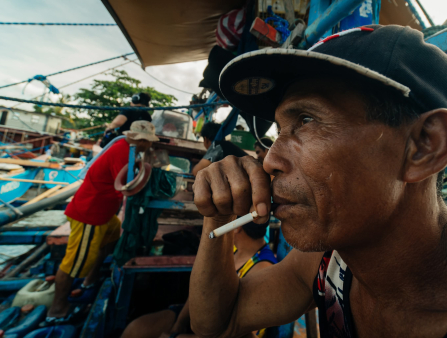
Food Delivery. Image credit: Ivan Torres. Courtesy of Baby Ruth Villarama
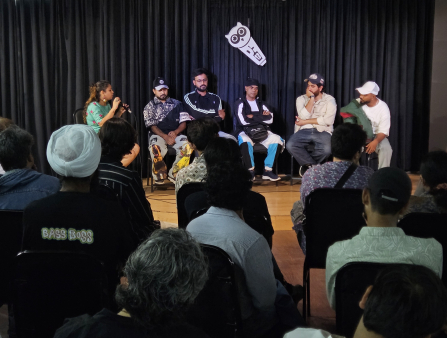
Panel discussion at India Doc Fest. Courtesy of India Doc Fest
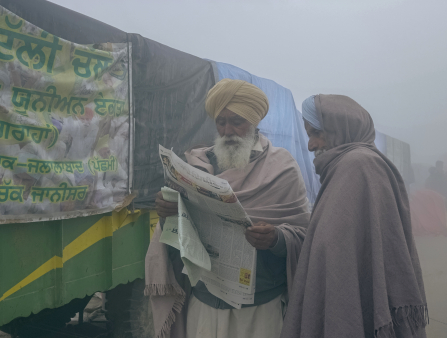
Farming the Revolution. Image credit: Akash Basumatari. Courtesy of Nishtha Jain
From Israel to India, Governments Expand Official Bans
Though media censorship has been a hallmark of authoritarian and autocratic regimes for decades, such restrictions only appear to be expanding as democratic freedoms dwindle and nationalism rises around the world.
In 2024, in Israel, for example, the Ministry of Culture and Sport banned the documentary Lyd (2023), which looks at the history of the titular town in relation to the Nakba, claiming the film presented “a distorted picture of reality” that could incite “unrest and tensions.” Around the same time, the Ministry also warned the country’s cinemateques not to screen another historical documentary called 1948: Remember, Remember Not (2023). In East Jerusalem, there was also an incident in which police stopped a screening of the omnibus film From Ground Zero: Untold Stories From Gaza (2024), invoking the country’s counterterrorism law.
Ever since China implemented the National Security Law in Hong Kong in mid-2020 and amended film censorship regulations the following year, many films have been required to modify their content during the approvals process, or have been ultimately cancelled due to delays in obtaining approval. Hong Kong and the struggles over its democracy are particularly sensitive jurisdictions and topics. According to one report documenting such incidents, at least 23 films in the region have been cancelled due to censorship issues. In December 2025, authorities denied a screening permit for a drama by Kiwi Chow, the director of the 2021 Hong Kong protest documentary Revolution of Our Times.
In European countries such as Hungary, Slovakia, Georgia, and Turkey, where new laws have banned “LGBTQ propaganda” and clamped down on “foreign interference,” film programmers have been forced to be more careful about how they showcase movies that might be at odds with their right-wing governing parties. This year’s Istanbul Film Festival removed its queer-themed films section. In 2023, the country’s venerable Antalya Golden Orange Film Festival was shut down completely after the Culture and Tourism Ministry pulled its support over the inclusion of a documentary called The Decree (2023), which was critical of Turkey’s state of emergency laws. “If our documentary is first accepted to the competition and then removed as a result of pressure, this is called censorship,” the film’s director, Nejla Demirci, wrote in Turkish at the time.
An illustrative case study of these shifts is India’s current nationalist government, whose strict and sometimes seemingly arbitrary approval processes under the Ministry of Information and Broadcasting have presented escalating challenges for festivals and filmmakers (which Documentary reported on previously), particularly over the last few months. In India, all publicly exhibited films must either receive a certificate or an exemption from the Ministry’s Central Board of Film Certification (CBFC).
In November, Rajee Samarasinghe’s 2025 Rotterdam Festival selection and 2025 Spirit Award nominee Your Touch Makes Others Invisible, which addresses the forced disappearances of the Tamil people during Sri Lanka’s Civil War, was denied an exemption by the CBFC to screen at the International Film Festival of India (IFFI) in Goa at the last minute, even though programmers were bullish about showing the film for months, indicated by emails shared by the filmmaker.
Because the longstanding Indian festival was founded and continues to be run by the government, Samarasinghe was surprised IFFI had expressed interest in July. Months went by, with the IFFI even offering a $600 screening fee in early October with an official acceptance, conditioned on the film receiving a clearance from the CBFC.
However, when the festival’s lineup was announced, Samarasinghe’s film was nowhere to be seen. “They said that sometimes the government simply withdraws clearance from certain films, and that this title is politically sensitive enough to have triggered that,” he wrote over email. “We don’t know exactly what happened behind the scenes, but it seems clear that either the Indian government, the Sri Lankan government, or both did not want the film shown.” Documentary has reached out to IFFI for comment.
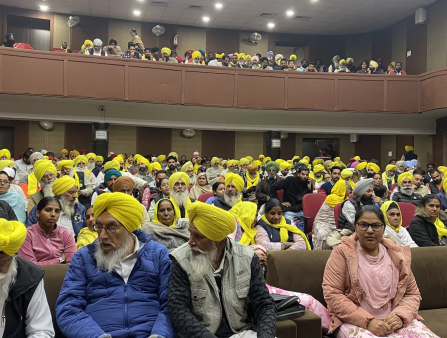
A farm union screening of Farming the Revolution in Panjab. Courtesy of Nishtha Jain
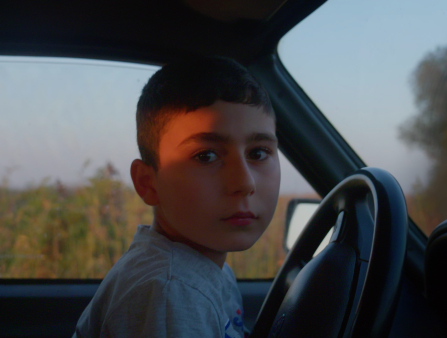
My Sweet Land. Courtesy of HAI Creative
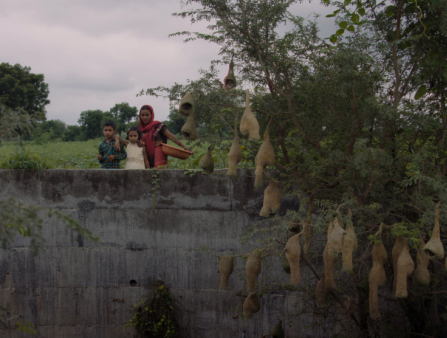
Marching in the Dark. Courtesy of Clin d’Oeil Films
Smaller-scale, independently-run film festivals are also being targeted in India. This October, the inaugural India Doc Fest in Delhi had three of its films affected: My Sweet Land (2024), a documentary about the disputed territory of Nagorno-Karabakh (and an IDA Enterprise Development Fund grantee); 2024 Hot Docs winner Farming the Revolution, which chronicles the massive farmer protests from 2020–2021; and 2025 CPH:DOX Human Rights Award winner Marching in the Dark.
“Because the right-wing influence is so much,” says India Doc Fest’s Aditi Sharma, “One misstep and you can attract national security laws, and it’s worse if you’re from the minority community.”
“So you don’t only have to protect yourself,” adds Sharma. “You have to protect the filmmaker, the venue, and the audience, so there’s this pressure to stay in the safe zone.”
Sharma was still surprised that the three films didn’t receive clearances to publicly screen. According to Sharma, My Sweet Land, in fact, wasn’t even officially rejected—it simply didn’t receive a yes or a no from the CBFC, and festival organizers didn’t have time to seek clarification. Farming the Revolution previously played at numerous festivals across India, and Marching in the Dark, about a widow seeking community among other women whose farmer husbands have committed suicide, doesn’t appear obviously political. India Doc Fest decided to screen Marching in the Dark privately.
Both Sharma and Farming the Revolution director Nishtha Jain suggest the festival’s location in Delhi may have added extra scrutiny. Says Sharma, “Things in Delhi can get volatile, because people do come out to protest here.” A few months ago, another screening of Farming the Revolution at the Alliance Francaise in Delhi was cancelled due to a new government regulatory shift issued to all foreign cultural centers, according to Jain.
“Censorship in India is not something new,” says Jain, “especially films about Kashmir. However, the censorship has become much worse with this government, especially films that are critical of right-wing fundamentalism.”
You have to protect the filmmaker, the venue, and the audience, so there’s this pressure to stay in the safe zone.
Aditi Sharma, Artistic Director of India Doc Fest
Earlier this month, in December 2025, a power struggle erupted between the Ministry of Information and Broadcasting and the more politically progressive Indian state of Kerala, where an initial 19 films were denied permission to screen at the 30th International Film Festival of Kerala. Initially, Kerala’s Cultural Minister defied the national directives and instructed the festival to screen all of the films without official clearance, but then festival organizers partially caved, collaborating with the Ministry to keep the bans in place for six films—including the Indonesian hybrid docudrama A Poet: Unconcealed Poetry (2000), Israeli director Nadav Lapid’s Yes (2025), and the Palestinian film All That’s Left of You (2025)—while letting the other films screen.
In a public statement issued on December 21, 2025, led by veteran documentary director Anand Patwardhan, the signatories were “shocked and dismayed” at Kerala’s government for backtracking and “condemn[ed] this act of censorship by the Central government and the capitulation by the Kerala government.”
How Pressure Jumps Borders, From New York to Berkeley
Government efforts to suppress screenings outside their own countries are also growing. Not only did China put pressure on programmers in the Philippines, New Zealand, and at an event in Geneva, Switzerland, to stop screenings of Food Delivery, Fresh from the West Philippine Sea, director Baby Ruth Villarama also reports that her own personal Facebook page was blocked during those screening events over the summer. “I was mass reported by trolls, and couldn’t access it for almost four months,” she says. The filmmaker thought this was another example of the campaign waged by China against her film. “I think they are getting more aggressive,” says Villarama. “Clearly, they want to control whatever narratives there are about China.”
There’s an increasingly thin line between official state actions and non-state actors. In an unprecedented example of international censorship from this October, the inaugural IndieChina Film Festival in New York was canceled after heavy pressure from Chinese authorities. “It was quite a surprise,” says IndieChina founder Zhu Rikun, who has a long history of showcasing independent Chinese work. Zhu launched DOChina, the Documentary Film Festival China, in 2003, and helped start the Beijing Independent Film Festival in 2004. Both were shut down in China in the 2010s.
Zhu hadn’t anticipated the lengths to which Chinese authorities would go to halt his new U.S.-based venture. “I thought maybe the authorities wouldn’t be happy about the festival, and they might bother me,” says Zhu, who has lived in New York for a decade. “But I didn’t expect they would harass and threaten the guests and the filmmakers, and my family and friends.” Reports from Human Rights Watch and international publications claim that filmmakers invited to the festival were taken by police and questioned. Zhu’s own father called him from China and urged him not to do anything that would hurt China, according to the New York Times.
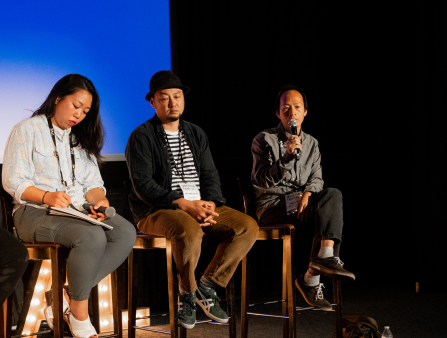
Zhu Rikun (R) speaking at a Getting Real ’18 panel. Image credit: Susan Yin
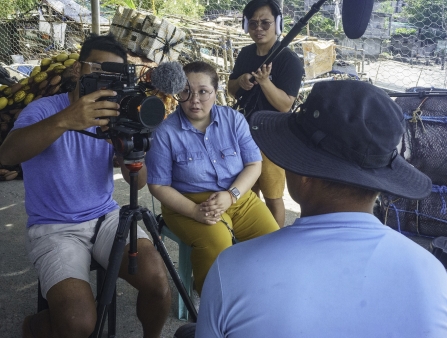
Baby Ruth Villarama (C) BTS of Food Delivery. Image credit: Nana Buxani. Courtesy of Baby Ruth Villarama
What happened to IndieChina is indicative of the wide-ranging tactics countries like China are implementing to suppress public screenings of documentaries it wishes to censor beyond its borders. While IndieChina included some documentaries that tackled taboo topics in China, such as Old Friends From Jiangnan (2024), about survivors of reeducation camps; Another Part of This World: The Ghost and Its Double (2025), which captured the COVID pandemic in China; and, perhaps most problematic, Fire Is Burning (2023), about the Hong Kong democracy protests. Nevertheless, all participating filmmakers were targeted, even those with films with less politically sensitive subject matter. “I’ve never seen anything like it,” says Shelly Kraicer, a veteran Toronto-based programmer of Chinese films.
Zhu also suggests China’s influence in New York might be connected to the large Chinese community there. For instance, New York-based Chinese student groups were behind some of the pressure tactics. One of the festival venues, the HERE Arts Center, received an email that was shared with Documentary and written on behalf of “a group of Chinese students currently studying in New York.” This email encouraged the venue to “carefully examine the intentions of the organizers and the content being presented, make a reasonable evaluation, and possibly consider cancelling or limiting the publicity of the event.”
By comparison, ten years ago, a series called Cinema on the Edge presented 29 independent Chinese films from the shut-down editions of the Beijing Independent Film Festival (BIFF) in New York City without as many obstacles. Kraicer, one of the curators of the series, recalls that Chinese authorities were “concerned.” At first, Chinese officials misunderstood the screening’s connections to BIFF and tried to pressure BIFF’s Chinese programmers to stop the program. But once Kraicer and their team made it clear the Beijing-based curators were not involved and took the extreme step of stopping all publicity and promotion for the event, the screenings went ahead without further problems.
For Kraicer, who has programmed Chinese films for festivals in Rotterdam and Vancouver, the pressures faced by IndieChina were unique. “It’s not going through the motions of trying to object,” he says, “but it’s actually taking thorough steps to make these screenings stop.”
This threat of protest and accompanying safety concerns have been repeatedly used as the justification for both censorship and self-censorship of screening activities...
Jordanian-Armenian filmmaker Sareen Hairabedian has faced similar pressure campaigns over My Sweet Land, which have disrupted the documentary’s global release. After winning three major prizes at Jordan’s Amman International Film Festival in July 2024 and being chosen as Jordan’s official Oscar entry, Hairabedian’s film was soon the victim of a diplomatic censorship campaign.
In November 2024, the film was withdrawn as Jordan’s official Oscar submission and subsequently banned from screening in Jordan. In an official statement, Jordan’s Royal Film Commission admitted to withdrawing the submission because of “diplomatic pressure” from Azerbaijan. While Azerbaijan’s Ministry of Foreign Affairs denied the claims of official interference, it still applauded Jordan’s decision and accused the film of being “against the territorial integrity and sovereignty of Azerbaijan.” (In 2023, Azerbaijan invaded the region of Nagorno-Karabakh, where the film is set, expelling the ethnic Armenian population to neighboring Armenia.)
Hairabedian still isn’t sure how Azerbaijan could successfully exert pressure over Jordan, but the two countries have strong ties, even though Hairabedian also notes Jordan has a significant Armenian population.
Additionally, in April 2025, the Human Rights Center at the University of California, Berkeley, rescheduled a screening of My Sweet Land originally timed to coincide with Armenian Genocide Remembrance Day. “It was a big shock to me that this happened in the U.S., at UC Berkeley,” says Hairabedian. The screening was first canceled after the Human Rights Center was alerted by Berkeley Law Dean’s Office of the possibility of demonstrations by Azeri students, who had asked about whether it would be permissible to carry signs of dead bodies. At the same time, they received a letter of protest sent by the Azerbaijani Consulate. In September, the screening was rescheduled.
While Human Rights Center Executive Director Betsy Popken says they could not confirm the government was behind the activation of student protesters, she was concerned that the pressure from the Azerbaijani government could lead to non-student protesters joining any potential actions against the screening. According to Popken, the screening was not postponed “because of pressures of the government, but only because there was the threat of protests.” She says, “We had to staff up with a certain number of people and needed the extra time to do that.”
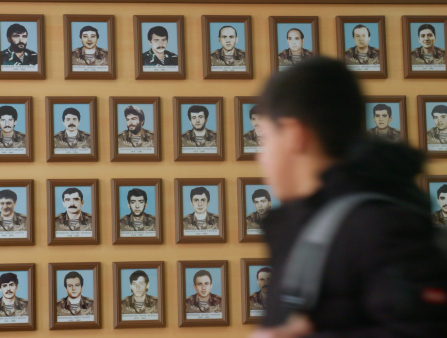
My Sweet Land. Courtesy of HAI Creative
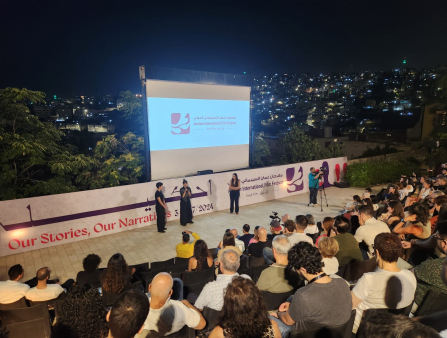
Post-screening Q&A after a screening of My Sweet Land at the Amman International Film Festival in 2024. Courtesy of Sareen Hairabedian
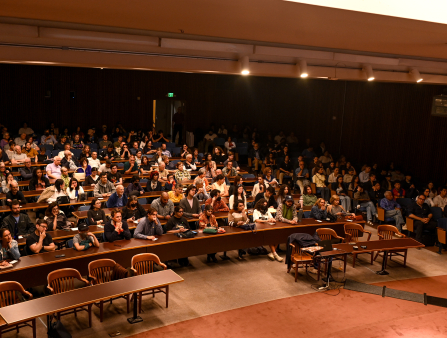
The rescheduled UC Berkeley Human Rights Center screening of My Sweet Land. Image credit: Maggie Andresen. Courtesy of Sareen Hairabedian
This threat of protest and accompanying safety concerns have been repeatedly used as the justification for both censorship and self-censorship of screening activities, whether in response to the Chinese students expressing their discontent toward the IndieChina Film Festival or the Azeri community planning to make noise around the screenings of My Sweet Land. While such threats of protest or political crackdowns can certainly be real and lead to dangerous consequences, such as when violent agitators and police collaborators shut down multiple January 2024 screenings of Anand Patwardhan’s 1992 documentary Ram Ke Naam in India, in most cases, it’s more about intimidation than actual shows of force.
Such tactics have been effectively employed, both in the U.S. and abroad. In the last few years, coordinated campaigns to shut down screenings of the documentary Israelism (2023) on U.S. college campuses have succeeded, as have the push to cancel screenings of the Oscar-winner No Other Land (2024), from Melbourne, Australia, to Aurora, Illinois.
There are also recent examples of the embattled Ukrainian government employing such tactics to defend itself in its information war against Russia, most noticeably in attempts to shut down screenings of the 2024 documentary Russians at War. First, screenings were cancelled at the film’s world premiere at the Toronto International Film Festival after Ukrainian officials and activists targeted the screenings, where the festival cited “significant threats to festival operations and public safety.” Other screenings were similarly canceled, such as at the Zurich Film Festival, which also claimed “security reasons,” and Belgium’s DOCVILLE festival, where organizers canceled the showings “out of respect for the Ukrainian people and specific request of the Ukrainian Embassy.”
The New Calculus: When Keeping Filmmakers Safe Means Keeping Films Hidden
In these trying times for freedom of speech and the rise of more aggressive autocratic politics, film programmers and filmmakers around the world suggest the old ways of doing things may no longer suffice.
To mitigate risk, one programmer, who preferred not to be named due to their involvement in curating politically sensitive films, suggests that festivals can employ strategies to evade government censorship. These include keeping filmmakers anonymous, framing the films to emphasize craft over politics, and avoiding marketing that sensationalizes the sensitive issues at hand.
Likewise, a Czech-based organization called KineDok, which screens documentaries in untraditional venues across Hungary, Georgia, Slovakia, Romania, and the Czech Republic, offers a guide for “7 Tips on Providing Safe Space” in a report called Film Screenings Under Pressure. Suggestions include “tailor your approach to align with the vulnerabilities and preferences of your audience,” “consider the language and overall promotion strategy, especially for films that address sensitive topics,” and “consider alternative screening spaces (or private/invitation-only screenings) where safety is guaranteed.”
It can get more people involved, and the film talked about in a more in-depth manner, which really begs the question: ‘Why do we censor if the backlash brings more attention to the injustices?’
Sareen Hairabedian, Director of My Sweet Land
IndieChina’s Zhu Rikun feels a responsibility to continue to showcase Chinese independent films, and is wrestling with how to move forward. On one hand, unlike when he was in China where he and his fellow organizers tried to keep a low profile and “silenced ourselves,” he says, “now I want to let people know what happened.” But to try to go on with the festival next year, Zhu acknowledges, “Maybe I have to try to do it in an underground way.”
Similarly, India Doc Fest’s Aditi Sharma suggests certain films may simply be better served by keeping them out of the government’s purview. “The lesson I’ve taken from all of this, not for the sake of the festival, but for the sake of the filmmakers, is that it’s not necessarily safe to take these films to the Ministry,” she says, “because if they don’t know about these films already, then the films and filmmakers are now on their radar.”
While moving to private or underground screenings obviously deprives movies of a larger platform, Sharma says, “Festivals in these times have to adapt and not to risk the filmmakers’ safety. That can protect the festival and the filmmakers in the years to come.”
Even so, Sharma warns that the dangers to filmmakers and festivals may only increase further. “Even if they’re not targeting filmmakers today, that’s not going to stop them from doing it tomorrow,” she says. “It’s not just what the government is doing; but it’s about what it’s capable of doing.”
My Sweet Land director Sareen Hairabedian, however, offers a different, perhaps more encouraging view. She suggests that many of the attempts at censorship have backfired. After many successful screenings of My Sweet Land, such repressive tactics have “also just proved that there’s a big backlash when these censorship acts happen,” Hairabedian says. “It can get more people involved, and the film talked about in a more in-depth manner, which really begs the question: ‘Why do we censor if the backlash brings more attention to the injustices?’”
Editor’s Note, January 2, 2026: An earlier version misquoted Sareen Hairabedian’s comment on Jordan having a significant Armenian population.