


Welcome to The Synthesis, a monthly column exploring the intersection of Artificial Intelligence and documentary practice. Co-authors shirin anlen and Kat Cizek will lay out ten (or so) key takeaways that synthesize the latest intelligence on synthetic media and AI tools—alongside their implications for nonfiction mediamaking. Balancing ethical, labor, and creative concerns, they will engage Documentary readers with interviews, analysis, and case studies. The Synthesis is part of an ongoing collaboration between the Co-Creation Studio at MIT’s Open Doc Lab and WITNESS.
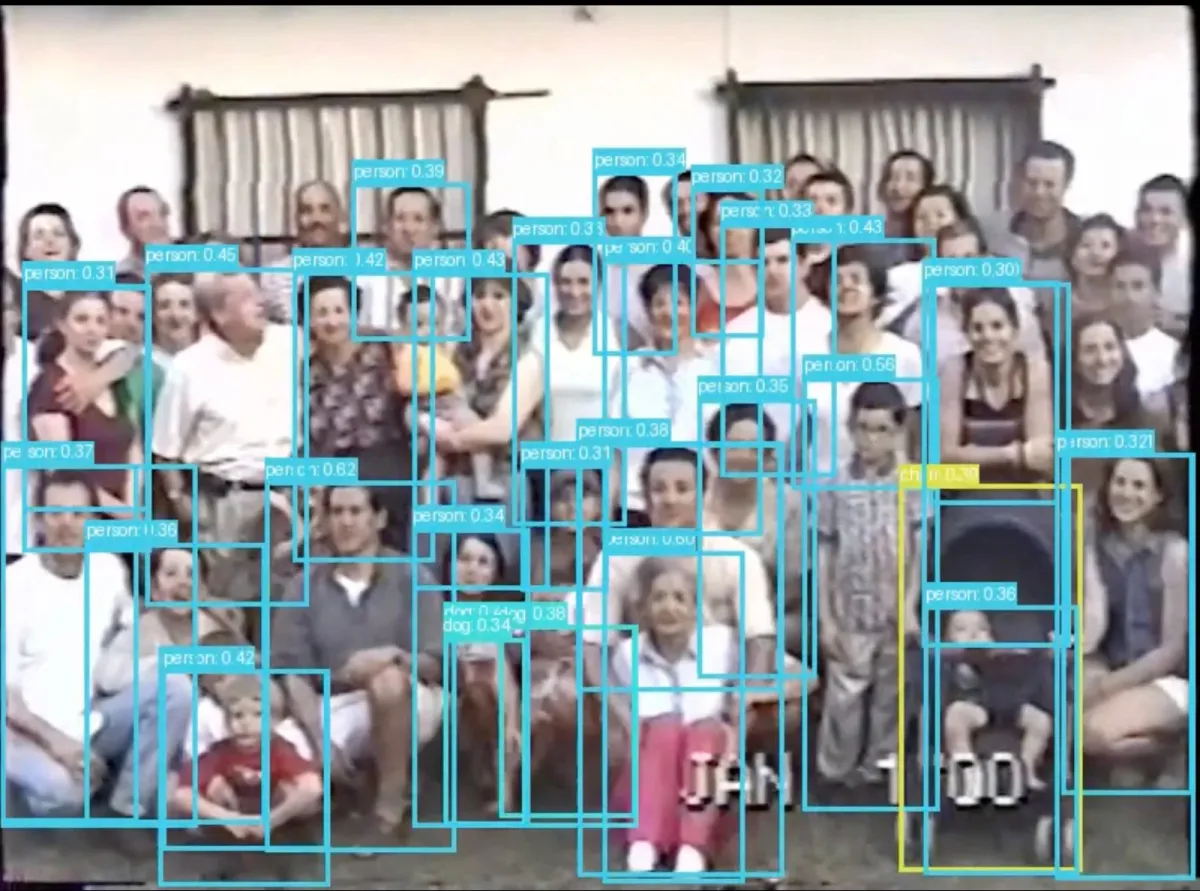
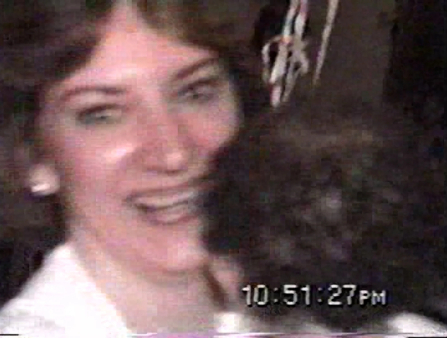
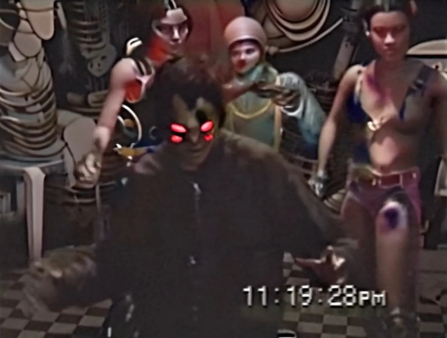
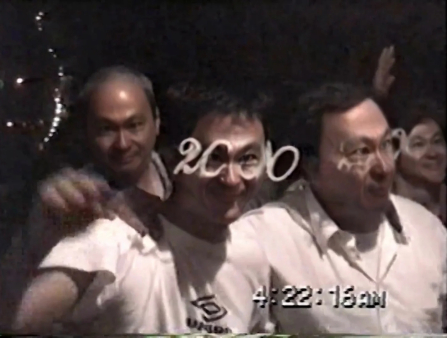
Juan David Cárdenas and Bibiana Rojas’s The End of Times (El fin de los tiempos) melds a family’s collection of authentic archival VHS home videos into AI machinations. It starts simply. There’s a narrator—increasingly unreliable—who presents herself as a daughter named Salomé searching for understanding into her mother’s descent into depression. Salomé recounts stories as she replays glitchy, interlaced footage of a particularly wild house party that really did take place in Buga, just outside of Cali, Colombia, on the eve of Y2K at the turn of the millennium.
As the footage is replayed over and over, with increasingly outlandish stories recounted by “Salomé,” the premise soon unravels, and eventually the image collapses too. Viewers are pushed to question memory, family, mental illness, politics, exile, and the colonial powers of computational excess. To arrive at this, the filmmakers draw on a wide range of AI tech, including custom-built tools from Artefacto films, as well as more commercial tools such as Roboflow, Hale, PICA, Basic, Faceswap, and ElevenLabs for voice cloning.
Following their world premiere at the Venice Film Festival, the co-directors spoke with Documentary via Zoom, Rojas from Sardinia, Italy, and Cárdenas from Bogotá, Colombia. They discussed why they turned to AI to create what they call an “imaginary documentary,” and why humor and irony are key to telling stories about history and memory. The following interview has been edited for length and clarity.
DOCUMENTARY: What kind of experimentation led you to make this documentary?
JUAN DAVID CÁRDENAS: This is our second film working together as co-directors. The word we use to describe it is “anarchivism,” a way to approach the archive. It’s not only an aesthetic position, but it’s also a historical position—and a political position as well. For us, the idea of the archive is necessarily linked to the idea of memory. The archive contains imagination of the past, imagination of the relationship between past and present, and also imagination of projections for the future.
D: Was AI your starting point?
BIBIANA ROJAS: We had the intuition to work with AI at the beginning, but we didn’t know how. We’re both university professors. We took two courses at the University of Barcelona with Colombian filmmaker Jorge Cabarello Ramos, who has experimented extensively with AI. We looked at montage strategies, repetitions, slow motion, and sometimes voice. We were interested in analytic AI, such as Roboflow, and systems of face recognition.
JDC: Currently, you can find two realms of AI for image and sound. The first one is analytic. You don’t intervene in the image, but you can analyze it through different alternatives. And the other one is generative, and with this one, you can intervene in the material to create new images, new sounds.
D: Can you pull the curtain back on your source material?
JDC: It comes from my family. It’s 70 hours, it covers around five decades of mainly parties. I have a huge family. My father has 12 brothers and sisters. They are my aunts and uncles, and I have around 50 cousins. And the second generation, you can imagine, around 70. We like to reproduce as a family! So we spent around a year watching the footage, analyzing it, and trying to discover a kind of plot. For that year, we were only trying to classify it.
D: As humans... not computationally.
BR: Entirely humanly.
JDC: Because we needed to get close to the material. I was getting close to it as a family member, and Bibiana was getting closer to it as a filmmaker. And that was amazing, because I could tell her stories behind the images, and she was piecing it together. At a certain point, we realized that the focus of the film was the party at the turn of the millennium. It became the center point of the footage and of the film.
BR: This party is very special, because it’s not a common tradition in Colombia. It’s a common tradition of this family.
D: And so from that point, that’s when you started introducing the AI elements.
JDC: That took a long time! Because we don’t have a division between pre-production, production, post-production, the writing in the beginning, and the closing in digital terms in the end. After a while, I was so confused and disappointed. I was thinking, Oh my god, this is not going anywhere, but we were selected for the VdR–Rough Cut Lab, and everything changed. After that selection, there was a lot of interest in our film. We realized maybe we have something big.
D: Is this a new genre of documentary? What is your relationship to the term “documentary”?
BR: We don’t think that we have a documentary in here. It’s more fiction. We draw on reality, but we are also very playful with it, because some of the history in the movie is not true.
D: But documentary has a long tradition of hybridity. In the context of this moment, what are the responsibilities of documentarians, or people working with archives? Is there a need to explicitly articulate the grammar of that language to audiences in order for meaning to be attained?
JDC: If we want to use the word “documentary,” we’re working in a kind of imaginary documentary. Because what we’re trying to do with the archive is to imagine alternative worlds. We’re trying to show how reality contains possibilities, with the intervention of technology. In other words, I would like to describe this film as a technological hybrid because technology is the material pretext to examine the promises of progress from the perspective of Latin America. For us, it’s so important; it is a revision of the promise of progress. And the promise of progress is embodied in technology. That’s why we are mixing the very past of image, VHS, a dinosaur, which is extinct, and AI, which is the promise. Even if it’s the promise of destruction.
D: I am really curious about your film meeting the audiences. How have audiences experienced the film?
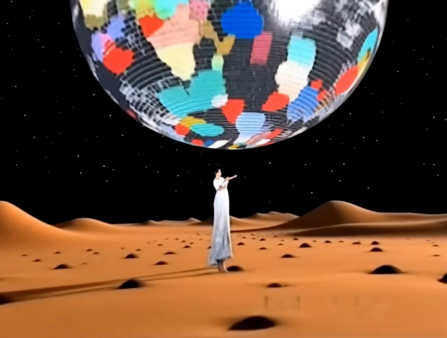
BR: In Venice, we didn’t have the chance to talk to the audience too much. But in Sardinia, I had a small projection in an anarchist house here. Older audiences, who don’t have experience with AI, said the parts of the movie in which we show how AI works was really amazing, because we showed the process of how to do it: the prompts, and how the image reveals itself in these platforms.
JDC: People are really shocked because we don’t fulfill the contract with the spectators. In the beginning, they think that this is a common documentary or a visual essay. But, after 30 minutes, everything changes, and we create this documentary of multiverses with the technological intervention. They are so shocked because they could not describe the kind of experience in terms of the contract the film had with them. They were questioning, Is this reality? It’s not reality, but it’s not false in the end, and it’s not true in the end, either. We are on another level, and in the final 10 minutes, when everything explodes with the creation of new images based on the original images, they are not afraid to destroy this contract because it’s being reconstructed. It’s not only a fake documentary, it is another level of mixture between true and false, reality and fiction. To me, that was a challenge during the process, and an achievement after showing the film and receiving feedback from spectators.
D: What is the new contract? Where do we go from here?
JDC: To me, the term is imagination. Let’s try to imagine reality. We are not trying to represent reality. We’re not committed to representation. We don’t want to represent. Other filmmakers may want to do it, and it’s important. But for us, this double contract that is representation in memory, these are not our contracts. I would prefer to describe it as trying to shed some light on imagination. Just to invite people to imagine in terms of political imagination: How is it possible to create an alternative world? Not rejecting the new technologies as if they were the devil. No, we have to introduce them, because they have this possibility, even if they are used in war and for destruction.
BR: I want to think that irony and humor are a way to do that, also. To do it in a playful way. For us, it’s important to do that in our films, to have a little smile at the end, and cumbia, but also think about it in a critical way. I think this contract depends on the viewer, because if you are from Colombia, you’re going to understand at the beginning of the film that we are playful with reality. Because if you know the history of Colombia, in the second version of the mother—in the sadness of the mother—you understand that it’s a mockumentary.
JDC: We discovered at the end of this film that there were a lot of people who were watching for the second or for the third time when they had the link. They were taking notes and Googling them. I think this is a film full of links.
BR: It’s a hyperlink film.
D: What were they Googling?
BR: For example, Jaime Garzón, to know if it is true. The comedian Jaime Garzón is a real person. But, for example, the situation with the plane? Not true.
D: Right, so just checking facts. I mean, it’s the way we watch everything now, right?
JDC: For sure. It’s the current spectator.