

“Gotta light?”
—Woodsman, Twin Peaks: The Return, Episode 8 (2017)
On July 1, 1946, half the celluloid in the world was hauled to the Marshall Islands to shoot the U.S. Army-Navy detonation of two atomic bombs. One hundred and four still cameras, 208 motion picture cameras, and 18 tons of film stock descended on the atolls to film Operation Crossroads. The filming crew included eight B-17 bombers on autopilot equipped with automatic cameras; controlled remotely, they flew into the first test’s mushroom cloud and recorded the world’s first drone footage.
For Crossroads’ first test, Able, the flight crew stuck a photograph of Rita Hayworth on the bomb and christened it “Gilda,” after her blockbuster film noir character. Soon after its inception, the Bomb grew cinematic.
The first reaction to Able, however, was one of aesthetic disappointment. In PBS’s unimaginatively named The Bomb (2015, dir. Rushmore DeNooyer), one talking head says, “You didn’t see ships flying through the air.” In the film’s archival footage, one of the senators invited to witness the demonstration grumbles, “I’m a bit disappointed as to the size of the flash.”
But the nuclear documentary has endured, snaking over time into two divergent strands: (1) mainstream docs, which have tended toward conventional, often celebratory, histories of Western bombs even as they claim an abstract moral revulsion over nukes in general, and (2) the counter-histories of political and quasi-documentaries, which interrogate official discourses to uncover subterranean layers of state propaganda, geopolitical inequality, and the persistence of colonial violence too often erased by the sublime imagery of the Bomb.
The same cameras that had captured what The Bomb’s disappointed senator dismissed as an insufficiently apocalyptic detonation failed to record the erasure of something far more permanent. Before the first reel of film was exposed, the atoll’s Bikinians were forcibly evicted to make way for the American bombs. From its very birth, the act of documenting the doomsday machine has reproduced the violence of its subject.
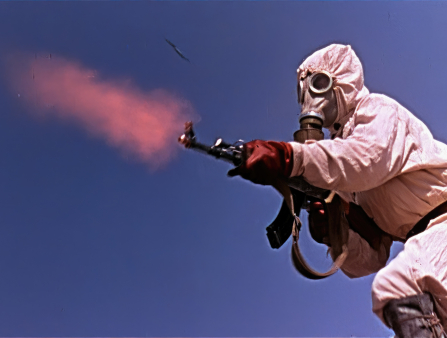
Trinity and Beyond: The Atomic Bomb Movie. Courtesy of AtomCentral

Crossroads. Courtesy of Bruce Conner Family Trust
Good Bomb, Bad Bomb
The Bomb is just one example of the many big-budget post–Cold War docs—produced mostly by American public media or U.S. production houses—that came draped in a star-spangled superiority celebrating American (and, to an extent, Western) progress and domination. Time and again, those most harmed by these weapons are rendered invisible.
A potted history of nuclear weapons, The Bomb includes a voiceover that gloats that Able “is the first nuclear explosion to be witnessed by the public,” glibly consigning to the dustbin of American exceptionalism those hundreds of thousands of Japanese civilians who had already been subjected to that catastrophic spectacle the previous August.
Similarly, in Trinity and Beyond: The Atomic Bomb Movie (1995, dir. Peter Kuran), William Shatner, Captain Kirk himself, narrates a triumphant story of nuclear testing from Los Alamos to the ratification of the 1963 Partial Test Ban Treaty (formally known as the Treaty Banning Nuclear Weapon Tests in the Atmosphere, in Outer Space and Under Water). Unfortunately, the Moscow Symphony Orchestra’s bombastic accompaniment is as generic as the images are predictable.
The most egregious example of this neocolonial subgenre of atomic documentaries is Lucy Walker’s Countdown to Zero (2010), which concentrates not on the politico-military-industrial systems that allow nukes to proliferate, but rather on the possibility of bad actors pilfering the Bomb. The film’s guiding spirit, former CIA officer Valerie Plame, insists that the real threat comes from men in turbans and beards. Guided by its implicit belief in the righteousness of the American bomb contra the immorality of Russian, Chinese, Indian, and Pakistani (but not necessarily English, French, and Israeli) bombs, this doc is in love with its neoliberal talking heads. If Tony Blair has to be made to peddle antinuclear ethics, then the future is truly bleak.
In the world of such law-and-order cinema, no mention can be made of the United States’ first-use nuclear doctrine, nor of China’s policy of no first use. Theoretically anti-nuke, this is the nuclear doc as imperialist propaganda.
The Atomic Cafe. Courtesy of Kino Lorber
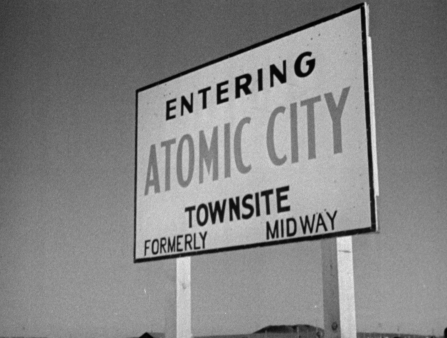
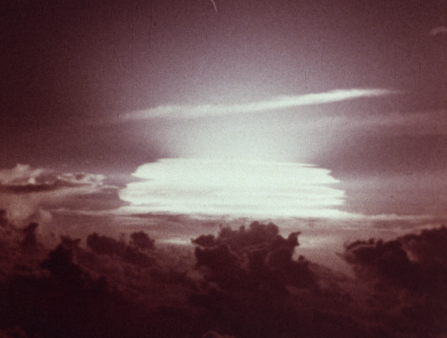
This orientalizing mode finds its truest expression in the obscurantism extended to Israel’s nuclear weapons. Indeed, Countdown to Zero is the Thomas Friedman of nuclear docs: hawkish, reductionist, unabashedly Zionist, and, as Edward Said once described the bloviating Friedman, “remarkably jejune.” A long montage takes us through each nuclear state: the UK and French tests are passed over quickly, with ambivalent voiceovers from old newsreels, and Israel gets a 3-second spinning newspaper, the Sunday Times headline from October 1986 that exposed the Israeli bomb almost 20 years after it was first tested. But the film does nothing to clarify the ultra-secretive nature of Israeli weapons programs.
In U.S. law, the 1997 Kyl-Bingaman Amendment prohibits American companies from releasing satellite images of Israel with higher resolution than those already commercially available. For years, this allowed Israel to conceal its illegal actions in the occupied territories as well as keep its nukes cloaked. Israel is also the only nuclear power that has never allowed independent inspections of its arsenal (until 2009, even North Korea let the International Atomic Energy Agency inspect some of its facilities).
None of this appears in any of these slickly produced docs; PBS Frontline’s Remaking the Middle East: Israel vs. Iran (2025, dir. James Jacoby) and the Foreign Policy Association’s Red Line: Iran, Israel and the Bomb (2014) are more worried about Iran, which does not have nukes, than Israel, which does (and has attacked six of its neighbors in the past year).
Nor is there mention of Mordechai Vanunu, the nuclear technician turned whistleblower who leaked photos of the Negev Nuclear Research Center to the British Sunday Times (for that, one must turn to Michael Karpin’s 2001 A Bomb in the Basement). Forty years later, Vanunu is still forbidden to leave Israel or even talk to foreigners.
Conversely, when it comes to non-Western nukes, Countdown to Zero lovingly lingers on archival scenes of bloodthirsty chest-thumping. Cheering masses of the People’s Army greet news of China’s first successful test; jubilant Indians burst firecrackers in the streets after the Pokhran tests; faceless Pakistanis bellow “Allahu Akbar” as the underground Chagai-I bomb blows off a granite mountaintop; Party elders congratulate Kim Jong Il and weep with joy.
The message is clear: American bombs and those of its allies keep the peace. Everyone else’s threaten it.
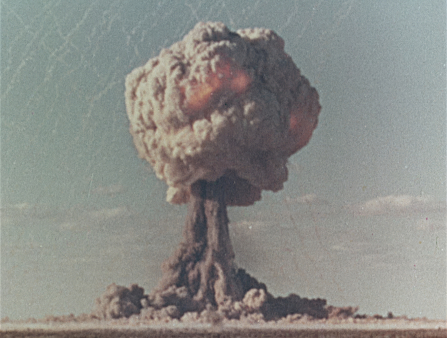
Atomic: Living in Dread and Promise. Courtesy of Hopscotch Films
Atomic: Living in Dread and Promise. Courtesy of Hopscotch Films
Unnamed Tsar Bomba documentary screenshots.
Hijacking the Archive
Much of the archival footage used in many of these bomb docs was filmed by the 1352nd Motion Picture Squadron of the U.S. Air Force—the so-called atomic cinematographers. (Trinity and Beyond is dedicated to them.) If you’ve seen Godzilla (2018) or Dr. Strangelove, you’ve seen some of their work. Operating out of the secret Lookout Mountain Laboratory in Laurel Canyon between 1946 and 1969, this unit produced thousands of propaganda films for the Atomic Energy Commission, the Department of Defense, and other government organizations. Generations of docs have drawn from that deep archival well.
During its formative years, the cinematic imaginary of the Bomb was shaped by the U.S. government’s compulsive need to document its own military might. Since then, many filmmakers and artists have used this same footage for a different purpose. A tradition of sorts has emerged—through de/re/contextualization, remix, cut-up, collage, audiovisual counterpoint, temporal manipulation, looping, dissonance—of the détourned nuclear doc. Going against the grain of the neocolonial or mainstream nuclear documentary, this hijacking has led to strange subversions of the sources of official representation.
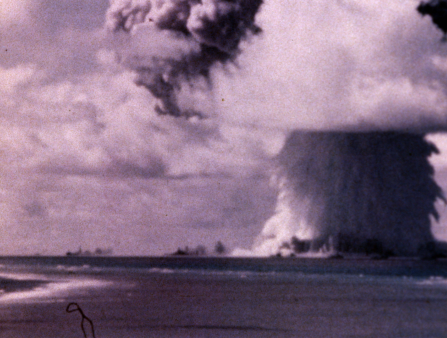
A few weeks after Able underwhelmed its assorted spectators, the Motion Picture Squadron captured Test Baker with much more rococo moving pictures. A 23-kiloton plutonium bomb—of the Fat Man type that the U.S. had dropped on Nagasaki the previous year—was tested underwater. The ocean swallowed the blinding flash of detonation, brighter than a thousand suns, so the wall of pure energy that rips through the water’s flesh can be clearly observed.
In Crossroads (1976), the American artist Bruce Conner—connoisseur of dead film, founder of the Rat Bastard Protective Association—scavenges footage of Baker to turn an atomic detonation into a meditation on what the literary theorist Frances Ferguson called the nuclear sublime, the awe and terror evoked by nuclear technology and its imagery.
Crossroads unfolds in 24 shots over 36 minutes, in which the bomb obsessively repeats itself. Initial bursts a few seconds long keep getting stretched out, until a final, hypnotic six-and-a-half-minute atomic water ballet stops time itself—soundtracked to a gauzy drone by Terry Riley and Patrick Gleeson. Stripping away everything nuclear documentaries rely on to represent the bomb—political framing, context, narrative—Crossroads confronts us instead with the stark phenomenology of the blast.
I do hope that you will not feel that there is anything objective about the information I’ll give you. I must emphasize that our presentation … is biased, due to our very strong feelings about the subject of this film.
—Peter Watkins in Resan (The Journey, 1987)
The film’s experimental reconstruction of the atomic explosion as a purely aesthetic event risks repeating the original sin of the fawning nuclear documentary, spectacle as erasure. But Conner stretches this aestheticization to such excess that it begins to reveal a politics of looking. The repetitive hyperbole exposes what the American state had already done to aestheticize the bomb into an endlessly repeatable, visually sublime image. Watching Crossroads once was almost pleasurable; watching it the second time, I was seized by a cold panic.
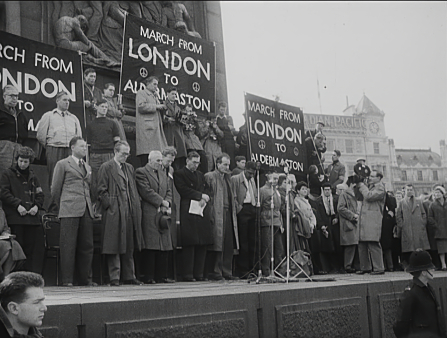
Where Crossroads blurs the line between documentary and conceptual art, Mark Cousins’s Atomic: Living in Dread and Promise (2015) is an exercise in postmodern bricolage. Composed entirely of archival images enveloped in Mogwai’s pulsing score, Atomic is oddly poetic and frequently ironic. Celebratory clips of the Bomb jostle with Ban the Bomb rallies (many of which were led by women, like the Greenham Common Women’s Peace Camp), X-ray videos, NMR spectroscopy, seeds sprouting like sperm, ravenous Georgia O’Keeffe flowers, cherry blossoms in Hiroshima turning into radioactive dust, molecules, mammograms, and more!
Cousins’s composite montage, pioneered by Soviet filmmakers like Dziga Vertov, owes a great debt to The Atomic Cafe (1982, dirs. Kevin Rafferty, Jayne Loader, and Pierce Rafferty), the most well-known deconstruction of America’s nuclear paranoia. Splicing together clips from government civil defense docs (like the “duck and cover” drills shown to schoolchildren in the 1950s), PSAs, propaganda films, and old cartoons, the film repurposes familiar tropes to provoke hidden connections and absurdist hilarity. “You are here to participate in an atomic maneuver,” drones a sergeant in an old military training reel:
Watched from a safe distance, this explosion is one of the most beautiful sights ever seen by man. You’re probably saying, “So it’s beautiful, what makes it so dangerous?” Basically, there are only three things to think about: blast, heat, and radiation. ... Truthfully, [radiation] is the least important of the three effects.
The Journey.

The Testimonies of Radioactive Colonialism
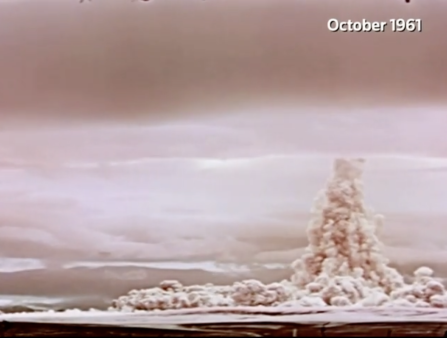
Compared to most of the 12,000-plus nukes in existence today, the bombs that went off over Hiroshima and Nagasaki were tiny, their explosive yield roughly 15,000 tons of TNT each. Five years ago, the Russian State Atomic Energy Corporation declassified an unnamed Soviet doc (1961) about the biggest bomb ever dropped. In October 1961, the Soviet Union’s 50-megaton hydrogen Tsar Bomba, thousands of times more destructive than Hiroshima’s Little Boy, was detonated 13,000 feet over Novaya Zemlya in the Arctic Ocean. The flash was visible in Norway, and the mushroom cloud pierced the stratosphere and into the mesosphere, eight Everests high. Despite the inevitable note of propaganda extolling the glorious Soviet bomb, the Tsar Bomba documentary was never meant for public circulation; it turns out to be a remarkable account of Soviet atmospheric testing.
Like many Trinity scientists, Andrei Sakharov, the physicist who oversaw the Tsar Bomba project, soon soured on the Bomb and became a dissident. His revolt mirrors the spirit of the greatest epic ever made about being nuclear. From its very first scene, Peter Watkins’s Resan (The Journey, 1987) champions defiance; over a black screen, Watkins addresses the viewer: “I do hope that you will not feel that there is anything objective about the information I’ll give you. I must emphasize that our presentation … is biased, due to our very strong feelings about the subject of this film.”
Watkins has earned this directness. An incendiary figure in avant-garde cinema, he is best remembered for the harrowing pseudo-documentary The War Game (1966), which blended fictionalized news footage with reenactments by nonprofessional actors to depict a hypothetical nuclear attack over Kent. Real quotes from establishment figures—a bishop, a nuclear strategist—calmly endorsed nuclear war. Made for the BBC, it exposed the inevitability of the sociopolitical and bureaucratic collapse after nuclear conflict. The BBC suppressed it, claiming it was “too horrifying for the medium of broadcasting.”
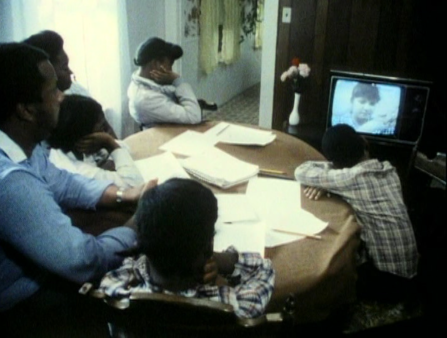
That questioning of a mediatized reality is also The Journey’s central preoccupation. “This film,” Watkins’s voiceover explains, is about “the systems under which we all live, and the mechanisms they use to deprive us of information and participation.” In sharp contrast to documentaries that abstract policy and propaganda, we are taken—for the next 14 ½ hours—to 15 countries across 5 continents to sit at kitchen tables with ordinary families as they reflect on their perceptions of nuclear war and the human stakes of global systems.
The Journey includes hibakusha (“bomb-affected”) from Hiroshima and Hamburg; Pacific Islanders living lives overturned by nuclear testing; working- and middle-class families from the Soviet Union, Western Europe, the U.S., and Latin America; Algerian immigrants in France; and members of a dirt-poor Mozambiquan women’s collective. The meta-doc’s epic length is deliberate; Watkins’s humanism privileges reflection and dialogue over what he calls the “Monoform,” which flattens complex reality in service to the news-entertainment complex.
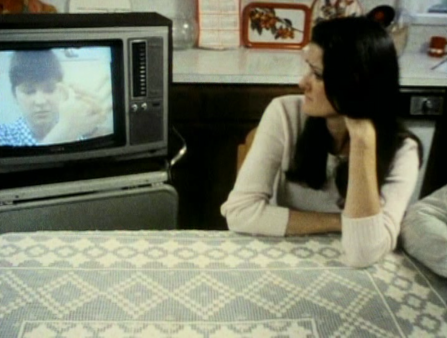
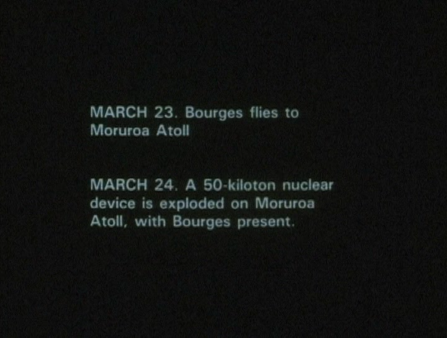
Some of the film’s most poignant scenes are testimonies from Tahitians displaced by nuclear testing in French Polynesia. They have lost their homes, their land, and are even losing their languages. Their plight is similar to that of the Marshallese, who were forcibly evicted from Bikini Atoll to make way for Operation Crossroads.
Their real subject is what Indigenous writers Winona LaDuke and Ward Churchill termed ‘radioactive colonialism’: powerful nations use lands and peoples, in their own marginalized communities and the Global South, for nuclear activities—testing, mining, waste dumping—revivifying the colonial script of domination and resource extraction.
The physical and psychic tolls on uncomprehending islanders—as well as U.S. servicemen casually bathed in radioactive mist at test sites—are also chronicled in Half Life: A Parable for the Nuclear Age (1985, dir. Dennis O'Rourke) and Radio Bikini (1988, dir. Robert Stone). Incorporating old propaganda films, both expose Washington’s callous cruelty to victims of radiation.
Half Life reveals how inhabitants of Rongelap and Utirik, atolls downwind of 1954’s Castle Bravo H-Bomb test, were repeatedly used as guinea pigs, whereas Radio Bikini is experienced through the voices of Kilon Bauno, the eloquent chief of the displaced Bikinians, and John Smitherman, a Navy pilot and “atomic veteran” of Crossroads. Near its end, the camera slowly zooms out from Smitherman, whom we have been seeing in close-up throughout. In a gutting climax, we realise he has no legs, and his left hand is bigger than a baseball glove. Smitherman was so badly irradiated that his legs swelled like balloons till they burst. By the time the doc was released, Smitherman was dead.
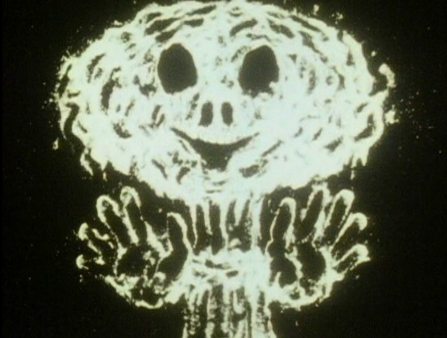
Like The Journey, neither of these films aspires to objectivity; they attempt, instead, to bear witness to the exterminating angel that is the imperial Bomb. By repurposing many of the same government-produced clips that were used in The Atomic Cafe, they strip away atomic lies. A montage in Half Life juxtaposes U.S. generals pontificating in propaganda newsreels with placid scenes of life on the Marshall Islands, then abruptly cuts to footage of the mushroom cloud. The result, without narration or context, exposes the tragedy of peripheral populations pushed out of the way of the center’s nuclear tests, be it through displacement or irradiation.
These docs become dissections of technological prowess and national pride, of the media and its editing choices, and, ultimately, of power. Unlike more mainstream films and the news media, they sidestep the seductions of the imperialist dust of the mushroom cloud to critically interrogate its imagery and ideology.
In fact, their real subject is what Indigenous writers Winona LaDuke and Ward Churchill termed “radioactive colonialism”: powerful nations use lands and peoples, in their own marginalized communities and the Global South, for nuclear activities—testing, mining, waste dumping—revivifying the colonial script of domination and resource extraction.
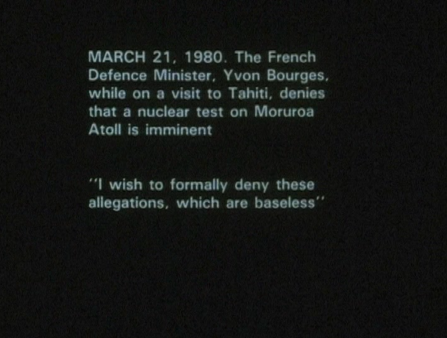
The Journey.
For example, the most nuclear-bombed nation on earth is the Shoshone Nation. In 1951, Washington violated the Treaty of Ruby Valley to establish the Nevada Proving Grounds on Western Shoshone land. Ever since, “downwinders” and their lands have been contaminated with radioactivity. Similarly, the Shiprock Mill Site in New Mexico’s Navajo Nation mined uranium for bombs until 1968. By 1980, more than a quarter of its Navajo miners had died of radiation-induced cancers.
The global story of nuclear weapons reeks, without exception, of the stench of colonialism. The French tested their bombs in Algeria and Polynesia, the Soviets in Kazakhstan and the Arctic. The Chinese tested in Uyghur regions, the Israelis on traditional Bedouin land, and the British in Aboriginal country. To commemorate its successful tests in the Ras Koh Hills of Balochistan, Pakistan celebrates May 28 as Youm-e-Takbir, the Day of Greatness; many Balochs who still suffer from the fallout mourn it as a “black day.”
Next door to Pakistan, the deadly legacy of India’s 1974 and 1998 tests is covered in Anand Patwardhan’s Jang Aur Aman (War and Peace, 2002). “The blast occurred 3 kilometres to the north of this village on May 11 [1998],” Rajkumar Bishnoi, a schoolteacher in Khetolai, barely a few miles from the Pokhran site, says in the film. “The whole village saw the rising smoke and dust particles.” A 600-year-old community of eco-conservationists, the Bishnoi people battle a cancer mortality rate four times the national average.
War and Peace connects nuclear nationalism to hypermasculinity and the resurgence of the Hindutva right. The right-wing Shiv Sena organizes a puja where an icon of Lord Ganesha presides over a stage-set nuclear test range. Young men slit their palms to sign their names in blood on pro-bomb petitions. We see child victims of uranium mining—“Touch wood,” asserts the former head of the Bhabha Atomic Research Centre in the very next scene, “we haven’t had [a single casualty] due to radiation in the whole country.”
“The government is like a mother,” a Bishnoi elder laments. “If a mother feeds poison to its own child, what is the child to do?” Every nuclear state extracts from its margins first.
Confronted by the nuclear sublime, the impulse to document and archive succeeds most often when it queers the pitch—experimental remixes, conceptual bombardment, subaltern testimonies, radical cris de coeur—and unsettles the very terms of perception and representation.
Into the Mushroom Cloud
Nukes are back in style. The UK is pumping almost US$20 billion into its new sovereign warhead. In October 2025, Vladimir Putin announced that Russia had successfully tested the unlimited-range Burevestnik cruise missile. Some days later, Donald Trump declared on Truth Social that the U.S. would resume nuclear testing for the first time in decades.
Because of innovations in what the anthropologist Joseph Masco calls “nuclear technoaesthetics”—the imaginative infrastructure that makes the nuclear state possible—the Bomb’s terrible beauty has gone underground, into numbers and charts and needles on seismographs. The impending nuclear destruction of the Cold War has been neutered for us atomic amnesiacs. Earlier this year, the Doomsday Clock—a metaphor for our proximity to annihilation, operated since 1947 by the Bulletin of the Atomic Scientists—moved to 89 seconds to midnight, the closest it has ever come to the putative apocalypse. It was widely derided on social media.
The “essential feature” of nuclear war, Jacques Derrida once said, is that it is “fabulously textual.” Because it hasn’t happened yet, we can only speak and write about it. The total (and totalizing, totaling everything) scale of nuclear destruction is too terrifying to contemplate, let alone rationalize or explain. Straight documentary reckonings, with their pretensions to objectivity, often crumble into representational crisis. All state-sanctioned histories fail, all genteel teleologies flounder. Confronted by the nuclear sublime, the impulse to document and archive succeeds most often when it queers the pitch—experimental remixes, conceptual bombardment, subaltern testimonies, radical cris de coeur—and unsettles the very terms of perception and representation.
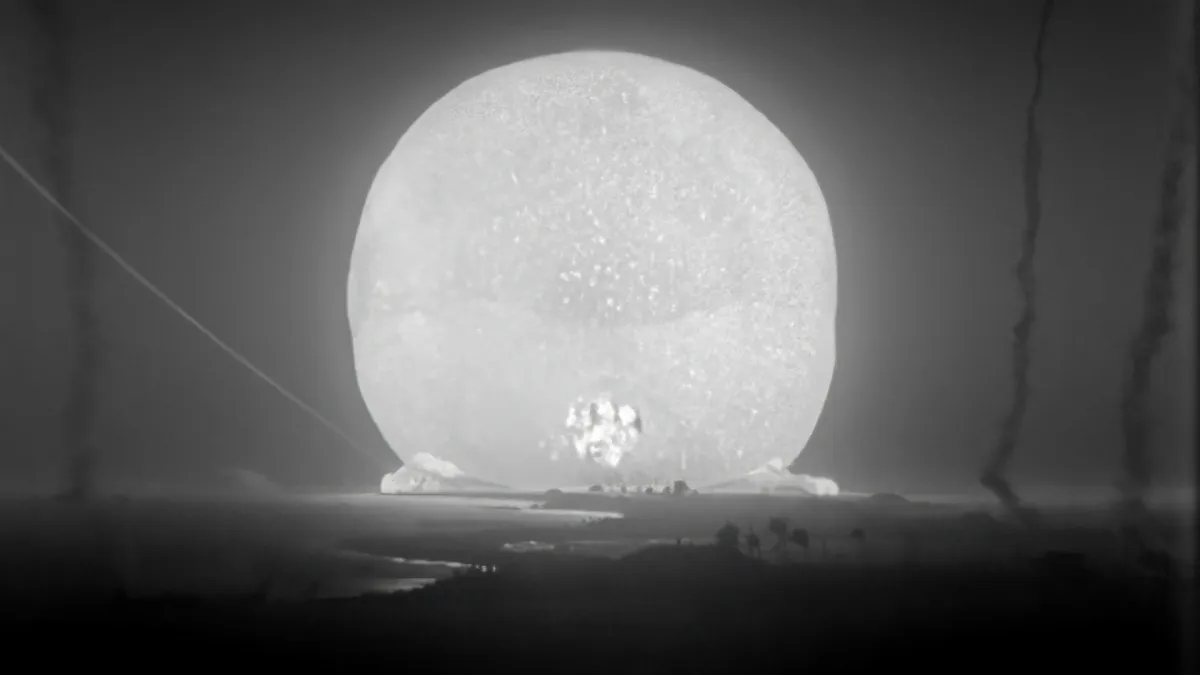
Perhaps this is why the greatest of these documentaries, The Journey, must necessarily present itself as political screed, eschew illusory realism, and clock in at an entire waking day. And perhaps this is also what David Lynch understood: that a mimesis of the mushroom cloud must transcend the real by drawing on artificial conventions like those of horror and the weird, of surrealism, absurdism, and the numinous. To experience the fabulous cosmic horror of the Bomb, look no further than the eighth episode of Lynch’s Twin Peaks: The Return, “Gotta Light?” A creation myth in disturbing black-and-white, the camera creeps into the dread of Trinity’s enveloping mushroom cloud. Against the visceral screech of Krzysztof Penderecki’s Threnody to the Victims of Hiroshima, the test spawns the series’ primary antagonist, Killer Bob, a malevolent entity that thrives on pain and sorrow.
And so, in the beginning was the Bomb.
This piece was first published in Documentary’s Winter 2026 issue.