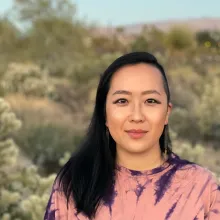
Sue Ding is a documentary filmmaker and artist based in Los Angeles. She directs and produces nonfiction projects for platforms including The New York Times and PBS. Her most recent film, The Claudia Kishi Club, was an official selection at SXSW and premiered on Netflix. Her work explores identity, storytelling, and visual culture. Sue also leads the XR media program at the Los Angeles Asian Pacific Film Festival, and consults on interactive, immersive, and multiplatform projects. She writes and lectures on documentary, participatory, and emerging media storytelling. Sue is an alumni of MIT’s
Latest Posts
We’re excited to announce a partnership with Argo, a new streaming platform and global curator of short films, starting this month exclusive to IDA members. With the goal of elevating shorts above the oceans of social media content, Argo provides a discovery home for filmmakers and film fans alike. Argo is building a community with all genres of short film curated into themed playlists by film festivals, filmmakers, and influencers. IDA will be joining a host of partners including Sundance Film Festival, The Guardian and Kickstarter. Yes, filmmakers do get paid! The platform works on a revenue
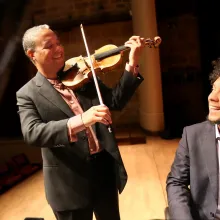
Aldo López-Gavilán and Ilmar Gavilán, the sibling protagonists at the heart of Marcia Jarmel and Ken Schneider’s Los Hermanos (The Brothers), are two Cuban-born virtuoso musicians, now in their 40s, whose lives have forever been at the mercy of ideological politics. While still in his early teens, elder brother Ilmar was sent to the former Soviet Union to perfect his string instrument talent—eventually ending up as a chamber violinist in the US, never to live in Cuba again. Meanwhile, kid brother Aldo stayed home to train with some of the most respected classical and jazz pianists on the
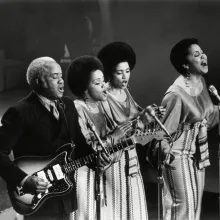
Screen Time is your curated weekly guide to excellent documentaries and nonfiction programs that you can watch at home. When the pandemic put a halt to our travel plans, little did we imagine that we’d find an unlikely travel guide in Orson Welles. Six extant episodes of the 25-part Around the World with Orson Welles are streaming on metrograph.com through June 20. Contrary to what the name suggests, this series takes us only around Europe, as Welles takes a break from the rigidity of his filmmaking form and presents us a more laid-back look at the cultures and people of the Basque country
Essential Doc Reads is our curated selection of recent features and important news items about the documentary form and its processes, from around the internet, as well as from the Documentary magazine archive. We hope you enjoy! Over at Immerse, Lauren Lee McCarthy, Tony Patrick, and Grace Lee talk about creating the 2021 Sundance New Frontier browser-based project Beyond the Breakdown—facilitated by a digital voice and on-screen text As we all suddenly moved to remote life this past year, we quickly adopted available tools—Zoom, Google Docs, Slack, Clubhouse—with little questioning of the

Like many of us struggling through the pandemic, Kizzy Corbett has turned to guided meditation to help manage her anxiety. But Corbett has more to worry about than most: The 35-year-old immunologist has spent the last year leading the National Institute of Health’s Vaccine Research Center team in partnering with Moderna to develop a vaccine. “When you give 30,000 people a vaccine or a placebo and allow them to go out into the world, you are really asking the world to give you the answer,” she says in an interview on her couch, the smoke from incense wafting around her. “There’s really nothing

When may a documentary producer record a telephone call or conversation? On January 2, 2021, former President Trump and his counsel called Georgia Secretary of State Brad Raffensperger to cajole, berate and threaten him to find votes and overturn his state’s election result. The Washington Post published the transcript and audio of the hour-long call the next day. Other journalists and publications followed suit and released the recording. Was it lawful for the Georgia Secretary of State to record the Trump telephone call? Was Raffensperger required to ask for consent or advise Trump and his

Richard Ray Perez succeeds Simon Kilmurry as the Executive Director of the International Documentary Association (IDA).

Documentary filmmaking, like other forms of investigative journalism, relies on sources and subjects who are willing to speak candidly and provide information—including in on- and off-camera interviews—sometimes at great risk to themselves. For that reason, especially for projects that tackle sensitive or dangerous subject matter, documentary filmmakers and other journalists often find themselves engaged in extensive, time-consuming efforts to build relationships of trust with their sources and subjects. The Federal Bureau of Investigation (FBI) has a long (and troubling) history of co-opting

Los Angeles, CA (May 10, 2021) - The International Documentary Association (IDA) and XRM Media announced the launch of a new international fund to support short vérité documentaries with an emphasis on emerging filmmakers. The IDA+XRM Media Incubator will provide three filmmakers with $25,000 each. In addition, each grantee will be paired with an award-winning director who will serve as a mentor. They are Academy award-nominated directors Skye Fitzgerald ( Hunger Ward) and Smriti Mundhra ( St. Louis Superman), and Emmy award-nominated director Nadia Hallgren ( Becoming). Applications for the