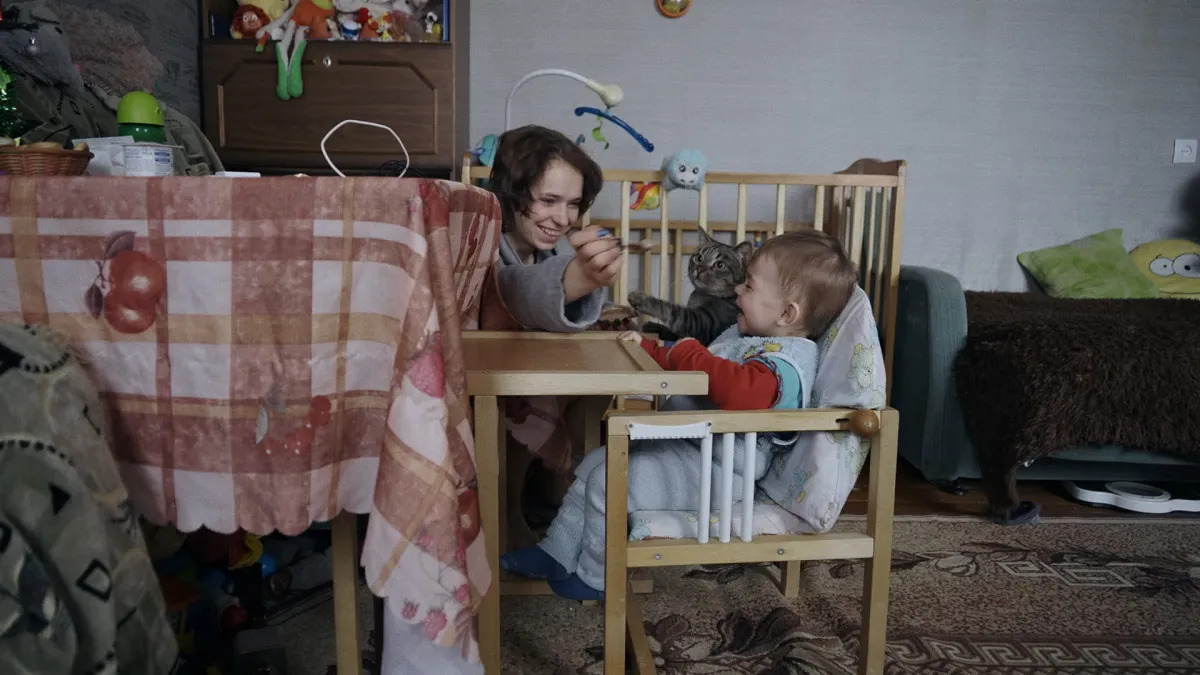
Welded Together. Image courtesy of Sheffield DocFest
“Always balance, everything in balance,” intones Raul Niño Zambrano, all smiles and relaxed on the last morning of his fourth year as creative director of Sheffield DocFest. It’s an aspirational mantra for a festival that seeks to elevate the documentary art of drawing meaning from chaos; in a capsizing world that needs independent media more than ever but would rather attack it, a confident and constructive place to rally is vital.
DocFest has fought its own battles in recent years, both external and internal. Two previous rounds of artistic directorship publicly quit or were forced out after short stints, both claiming a rift between programmers and the board of trustees, who were accused of parochial industrial biases. Zambrano was brought in as an interim creative director in 2022, and given the role permanently a year later. Meanwhile, Brexit cut off Creative Europe and Creative Media funding and visa-free visits from Europe, the pandemic hammered revenue and audience habits, and the UK remains in a deep industry recession with more than half its freelance workforce out of work and its once-mighty broadcasters on the back foot. It’s been a decade since the swagger of DocFest coach outings to Chatsworth House and the Peak District; the pop-up hub in Tudor Square and its free events vanished with the end of a three-year tie-up with the Wellcome Trust.
And yet the festival has steadied. Public ticket sales continued to climb, after the 2020-21 recess (when online viewing sales were commensurate): this year’s were up 20% to nearly 50,000, a third record year in a row. Industry delegate numbers were also up for a fifth consecutive year—from more countries (81) than ever—though they, talks and sessions, and MeetMarket presentations are still down on 2010s numbers. “Industry is being very picky now,” says Zambrano. “Six, eight years ago, people were going to every festival and market. Now they’re rethinking: do I definitely need to be there? Which is healthy—people don’t always need to travel. And the ones who are coming are much better prepared with their presentations and products and really paying attention, because there’s big competition out there.”
As for the public program, Zambrano seems to have laid to rest the aforementioned quarrels with his message of equanimity. “Something for everybody” is his further motto, meaning a full-spectrum festival offering from investigative journalism to “poetic or hybrid pieces and everything between.” He’s also adamant that DocFest’s strength is its amalgam identity straddling industry and public, international and Sheffield. (He splits his own time evenly between the city and his adopted Amsterdam.) You could argue a six-day smorgasbord of sundry nonfiction is spreading itself thin, but Zambrano’s aim of inclusive and accessible (one pass for all, he stresses) doesn’t mean comprehensive, and he seems happy to be a magpie.
This year DocFest launched a record 51 world premieres (including seven of the eight films in the international competition and all eight competing first features), among 116 films picked from a record 2,800 submissions. “The genre is doing amazingly in a really broad spectrum,” he says. “So if they want us to be their launch place, I think it’s worth giving them the shining space—a competition place—and let’s go on that journey together.”
As oft-noted at the festival, matters beyond were less reassuring. The world was “on fire”, said Prash Naik, introducing a talk titled “Too Hot to Handle?,” at which panellists discussed the chilling effects of far-right pressure on the free media, whether hostile Trump orders, Israeli bombs and lobby power, or Kremlin hitmen. The big streamers were no succour, everyone agreed: “Anything that is commercially or politically sensitive, they turn their back on,” Naik said. Three panelists shared their own tales of the rejection or repression of their political documentaries.
James Jones, the director and producer of last year’s Antidote, about the threats to Russian whistleblowers, said a corporate U.S. broadcaster had avoided his film for fear of security risks: “They generally were worried that it would make them them a target,” perhaps with Sony’s hacking experience after 2014’s The Interview in mind. Instead Antidote landed with PBS FRONTLINE, and Jones suggests his film shows the need for public service broadcasters: “They’re used to making enemies; this is their reason for being.”
Havana Marking’s Undercover: Exposing the Far Right, which goes undercover with the British antifascist campaigners Hope Not Hate, was dropped by last year’s BFI London Film Festival on grounds of staff safety after the UK’s extremist riots. The film reveals the funding of European racists by a Silicon Valley multimillionaire, and Marking posits that as the reason why it had not found U.S. distribution, even suggesting that “pissing off” the tech oligarchy might be a bigger fear for some corporations than standing up to Trump.
She had not found the BBC a safe harbor, though. Her team had been making Undercover, which includes a strand about the far-right agitator Tommy Robinson, notorious for his use of intimidation and misinformation, for the corporation’s Storyville strand until “layers of execs got involved” and she was told the film would only air if they interviewed Robinson. “Impartiality started becoming more important than the journalism. We kept saying: you can't be impartial about racism; that is not a negotiable thing.” Instead they went to Channel 4 who, assigning an “amazing legal team… rolled up their sleeves and wanted to make the strongest film they could make.”
Ben de Pear had even stronger words about making Gaza: Doctors Under Attack, which the BBC had been refusing to screen while it investigated a different film, Gaza: How to Survive a War Zone, accused of undisclosed partiality. He would later accuse the BBC of having tried to gag him during negotiations over the film’s fate, but at DocFest he was unfettered: whereas Channel 4 had been “an example to the rest of the broadcasters,” the BBC had “utterly failed” on Gaza, its journalists “stymied and silenced, made to use language they don’t recognize… and ashamed.” Bereaved Palestinian doctors had told him: “We don’t want to talk to the BBC because they won't show it.”
The next day, the BBC cited de Pear’s words as risking a “perception of partiality” as it announced it was relinquishing the rights to the film. Instead, within two weeks, Channel 4 screened it to great acclaim.
(Listening on during the June panel, the Dutch broadcaster VPRO’s international commissioner, Barbara Truyen, offered a continental perspective on the BBC’s chalice of impartiality: “We have a pluriform system where you show many sides, and the audience can decide what it thinks. I believe in integrity, I don’t believe in impartiality.”)
DocFest itself found ways to spotlight Palestine. The Tim Hetherington conflict-reporting strand included the world premiere of Hosam Abu Dan’s Gaza Sound Man, gathering the sounds of life and death under assault through the work of local sound engineer Mohammad Yaghi. (That strand’s award was given to a rare portrait of another global calamity, Hind Meddeb’s pained and soulful backward glance Sudan, Remember Us.) There was also a showcase of four films in progress from the Palestine Film Institute, and a standup-and-tell session, “Is it OK to Laugh? Behind the scenes of Palestine Comedy Club,” involving a performance by Jenin comedian Alaa Shehada and talk between Shehada and Charlotte Knowles.
Palestine Comedy Club is a film about Shehada and six fellow West Bank comedians’ collaboration since 2022. Shehada (also the director) and Knowles (producer) hoped comedy could counter the dehumanization of Palestinian people and open doors and eyes otherwise closed. “We’re trying to reach the world with our whole form, aspect, images,” said Shehada. “And we can’t keep moving with our lives otherwise.”
Knowles saw the war as the defining event of our times and the film as a way to show “the riches of Palestinian society and culture that we’re losing every day”; they didn’t wait around for funder approval but self-funded the shoot. “Institutions make you institutionalized. You can’t ask permission to make a film like this—no one will give you permission,” said Knowles.
DocFest did premiere a handful of soon-to-broadcast British TV titles, including two deep investigations of recent public tragedies, Tim Lawton’s 7:7 Homegrown Terror (now on Sky) and Olaide Sadiq’s Grenfell: Uncovered (Netflix), which won the audience award. The headline guests were Fenton Bailey and Randy Barbato, whose World of Wonder production company had scored subculture hits from The Adam and Joe Show to RuPaul’s Drag Race; Zambrano told me they also represented “a moment to rethink things,” to find “a win-win in the power of niche audiences and offering them things directly.”
Among other native titles was the opening film, Kim Hopkins’ follow-up to her filmmaking club hit A Bunch of Amateurs (2022), Still Pushing Pineapples. Its evocative and deftly judged study of northern working-class entertainment culture focuses on Dene Michael, the last standing member of 1980s novelty pop minstrels Black Lace, on the road from Blackpool to the Costa del Sol and back with his new partner and his aged mum. Down on the Kent coast, Jessi Gutch’s engaging Blue Has No Borders, in the first feature competition, took a more communal measure of cultural change in her adopted Folkestone through a portmanteau of characters “traditionally” English or otherwise, with herself as one of the more recent arrivals.
Meanwhile, the Ukraine war continued to generate new depictions—DocFest spotlit the spoils with a panel event titled “‘There are too many Ukrainian films’ - NO THERE ARE NOT.” (“I really hate it when people say that,” says Zambrano. “Are you kidding me?”) As well as UK debuts for Mstyslav Chernov’s 2000 Metres to Andriivka and Alisa Kovalenko’s My Dear Théo, from Sundance and CPH:DOX, there were three world premieres, two in competition. Mila Teshaieva and Marcus Lenz’s Shards of Light follows their When Spring Came to Bucha (2022), tracing the further efforts at rehabilitation and regeneration of that town’s inhabitants after brutal occupation in the war’s first months. Yegor Troyanovsky’s Cuba & Alaska is a girl-buddy portrait of two combat medics (one, Cuba, with an endearing earworm of a chuckle) whose gung-ho good cheer in military service takes an increasingly nihilistic determination as the horrors roll in, in keeping with the current tenor of grind and wear after three years of the fight. The third, Artem Ryzhykov and Juan Camilo Cruz’s stunning A Simple Soldier, entered in the Tim Hetherington strand, I’ll introduce below. But suffice to say, for many reasons, we can expect many more where these came from.
A Simple Soldier
Like Alisa Kovalenko’s My Dear Théo, Artem Ryzhykov and Juan Camilo Cruz’s A Simple Soldier is a portrait of the filmmaker (Artem Ryzhykov, an IDA-awarded cinematographer for 2015’s The Russian Woodpecker) as Ukrainian war volunteer; unlike Kovalenko’s, it’s obstinate in its determination to keep the camera running whenever. A DP by lifelong nurture, as home video shows us, Ryzhykov signed up in a belief shared by none of his comrades that he would be primarily filming the war. The film charts his transition from floppy-haired and chubby-faced camera obsessive to shorn, pumped, and haggard fighting machine as he is posted across the frontlines.
But he does keep filming (for the most part), and the film combines visceral combat footage, more variegated than that of 2000 Metres from Andriivka, with first-person character-led narrative. Ryzhykov’s upturned fate and inscrutable future are emblematic of his country’s. A friend couple also volunteering who he encounters at different posts also articulate the values in contest, while Ryzhykov’s filming is deeply descriptive of Ukraine’s landscapes simultaneously prized and sundered. Edited from over 900 hours of footage with a co-director communicating from a continent away (Ryzhykov and Cruz first met at DocFest), it’s a remarkable, powerful testament.
A Little Gray Wolf Will Come
Zhanna Agalakova was a renowned, state-honoured Russian TV news anchor turned foreign correspondent when she publicly resigned after Putin launched his full-scale invasion of Ukraine in 2022. This layered, pained, generous family diary film is structured, if not as a mea culpa for having served Putin’s propaganda machine too long, then certainly as an insight into the wrenching mix of motives she felt in the years beforehand. The central tension is between her persisting love of her Motherland—as hers and so many generations of Russians were taught to revere it—and her daughter Alice’s surly teenage scepticism. Not only is Alice a cosmopolitan, internationally schooled, information-rich modern girl but her father, Agalakova’s husband Giorgio, has inculcated in her habits of political protest quite foreign to her anxious mother. And yet, Agalakova is a child of perestroika who itched to leave her home city of Kazan and report on the world. Posted to New York, she describes her double life of feeling sometimes shocked by the city’s unconformities: “But I liked this life. People could be themselves.”
Directing and co-editing, Zhanna Agalakova weaves the story in effective collage style, including frank domestic scenes, but much of the film is made of footage from family trips to Kazan and across Russia between 2015 and 2019, offering fascinatingly telling and ambivalent glimpses of a great but broken country that Alice won’t relate to.
The Gas Station Attendant
Karla Murthy’s lovely, winding memento of her late father, an immigrant to the U.S. from Bangalore, won a special mention from DocFest’s international competition jury. It evokes the experience, common perhaps to many immigrants but not only, of simultaneously being always moving and never arriving, of searching and striving without finding settlement. A second, night job he takes in a gas station to make ends meet, his umpteenth in a life of slow downward mobility, is Murphy’s cue for exquisitely written and read voiceover reflections interwoven with rich family archive. She’s blessed he cued her passion for (home) movie-making, starting with the introspective, intimate phone calls they bonded through during his night shifts, and including long car journeys to next-big-hope sales shows.
The roving, associative storytelling is endlessly surprising, reaching back to Raj-era India and her dad’s restless childhood, his first flight from home at 10, and forward to her own adult life in relief to the anxieties his transience instilled in her. “I don’t know, I’ll keep going,” he says; “something will work out,” apparently unhopeful but undefeated, and widely connected. It’s a film of exquisite, tender ambivalence.
Welded Together
Like Monica Strømdahl’s recent CPH:DOX opener Flophouse America, the latest film from Belarus’s Anastasiya Miroshnichenko (Debut, 2017; Darkness Outside, 2020), which won DocFest’s main competition prize, confronts alcoholism with sombre frankness, though in this case there’s more air and classical dramatic shape. Indeed, its young adult protagonist, the rarely smiling Katya, carries the spare stoicism of an Aki Kaurismäki heroine as she pours herself into her daily labors, finding in them a degree of control and comradely respect that clearly compensate for a hollowed-out childhood after her widowed mother took to drink when Katya was six.
We first meet Katya working on a farm in Radost in midwinter, but she soon decamps to Brest for a fresh start with her mother and infant stepsister, Amina, and takes work as the lone woman in a welding factory. Miroshnichenko and her DP, Pavel Romanenya, shoot Katya’s satisfying if exhausting routines in carefully held verité style. The film shows that her mother is still drinking and her binges not only sabotage Katya’s working life, but also make her dread a similarly lost childhood for Amina. How much trust or faith can she afford to extend to her mother? What will she sacrifice for Amina? The weight she must shoulder, and the small flame of love she must tend under her carapace of icy determination, are quietly heartbreaking.
Nick Bradshaw is a film writer and critic who has written for numerous newspapers and film journals. He worked as an editor at Sight and Sound magazine, and before that at Time Out London.