

The main competition section at the 23rd CPH:DOX (March 19–30) consisted of 12 films that displayed a level of quality that more or less fits with those of its recent editions: one true work of art that ended up winning, four very strong and original films, a couple of questionable choices, and a few disappointments.
According to Artistic Director Niklas Engstrøm, selection is made based on the following criteria: While we have some of the other competitions, such as F:ACT, which is specifically for journalistic documentaries, or the NEW:VISION program for the films on the verge of visual art and documentary filmmaking[…], the main competition really should reflect the same diversity and the eclectic approach to documentary filmmaking that the festival tries to promote.
The festival’s opening film, Facing War by Norwegian director Tommy Gulliksen, caused divided reactions. Following the former NATO Secretary General Jens Stoltenberg’s last year in office as he balances opposing sides to get military assistance to Ukraine, its greatest value is behind-the-scenes access to the highest echelons of the organization. However, many observers noticed its failure to challenge the man who led the alliance in the years when it wreaked destruction and suffering in its subservience to U.S. interests.
But the timing was lucky for CPH:DOX. Between the selection of the film and its premiere, Trump started threatening to dismantle NATO and annex Greenland. From a Danish angle, the idea to open the festival with Facing War and bring Prime Minister Mette Fredriksen in for a discussion with Stoltenberg after the screening made sense.
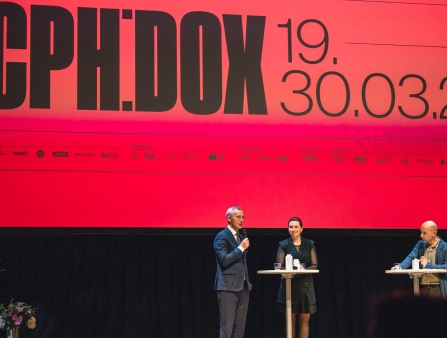
Jens Stoltenberg (L) and Danish Prime Minister Mette Frederiksen (R) in conversation. Image credit: Francesco Martello
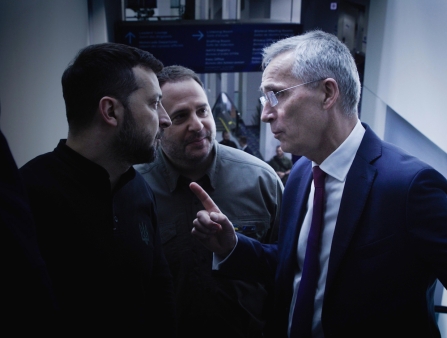
Facing War.
Two very different approaches to current affairs were seen in Alisa Kovalenko’s My Dear Theo and Irish director Gar O’Rourke’s feature-length debut, Sanatorium. Kovalenko’s film is a standout among the rising number of films made on the Ukrainian frontlines. Well-known for volunteering to serve in the war, Kovalenko frames the film as a letter to her young son, Theo, who is in Kyiv with his father. Video calls to her family alternate with scenes from the frontlines, where most of the time is spent waiting, punctured by occasional bursts of sudden combat activity that left many of her unit comrades dead.
Sanatorium, on the other hand, is a visually accomplished and light-footed account of the lives of staff and patients in a health retreat in Odesa. The war is in the background, and the 1970s brutalist building is the real hero of the film. The director often uses symmetry in the fixed-camera shots and music from the era in which it was built, creating a sort of time machine while focusing on a handful of lively protagonists.
Two documentaries shot on celluloid, Portuguese director Ico Costa’s Balane 3, and Agatha’s Almanac by Canadian filmmaker Amalie Atkins, are a feast for the senses, but with different results below the attractive surface. Agatha’s Almanac is a lovely, delicate portrait of a 90-year-old woman living alone on her ancestral farm without any modern technology. She grows her own food, preserving heirloom seeds, and the director’s old-fashioned, somewhat intentionally clumsy approach, fits the content perfectly, leaving the viewer with enjoyable nostalgia.
Balane 3, in the meantime, is a strange mix of poetic observation and chatty segments in which young inhabitants of the titular neighborhood in a Mozambican town mostly talk about sex. It is a charming community, but some scenes feel either overly staged or overly intrusive, especially when we have in mind that the director is a white European man.
A strong offering coming out of Kazakhstan, We Live Here by first-timer Zhanana Kurmasheva, follows three generations living in the desolate region of a former nuclear testing site. Many inhabitants here suffer from various radiation-related diseases, and as one of the heroes fights for compensation from the state, the director intersperses these investigative, dialogue-driven segments with views of barren land and snippets of short, fast-cut, nightmarish, symbolic images accompanied by disturbing sound design.
Conversely, experienced French filmmaker Thomas Balmès’ polished À demain sur la Lune (literally, “See you tomorrow on the moon”) delivers a creative and touching but also sober view of accepting death. In a palliative care unit in Calais, a therapy horse alleviates the suffering of four people with lethal diseases. The director doesn’t miss the opportunity provided by the oneiric view of a horse in white hospital corridors, but also uses the animal and its trainer in an imaginatively symbolic way. Among the patients, the 39-year-old key protagonist realizes she is actually happy as she has the time to herself and her children, while her husband refuses to accept her impending demise.
The recipient of special mention, Norwegian director Monica Strømdahl’s Flophouse America depicts a poor family as victims of the U.S. housing recession. The squalid setting with two alcoholic parents and a bored, angry son initially feels like another instance of misery porn. The film is saved to an extent by the love that exists within the family despite the odds, and some humor stemming from creative editing.
On the weakest end of the spectrum sit Danish director Christian Sønderby Jepsen’s transgressive Nordic family soap opera The Father, the Sons and the Holy Spirit, a wild and confusing ride that never reaches the finish line, and The Castle by Italy’s Danny Biancardi, Virginia Nardelli, and Stefano La Rosa, which follows three child protagonists who move into an abandoned kindergarten in Palermo. The kids are lovely, but the filmmakers’ attempt to create a magical world out of their imaginative play feels forced and tacked-on rather than organic.
Always.
Always
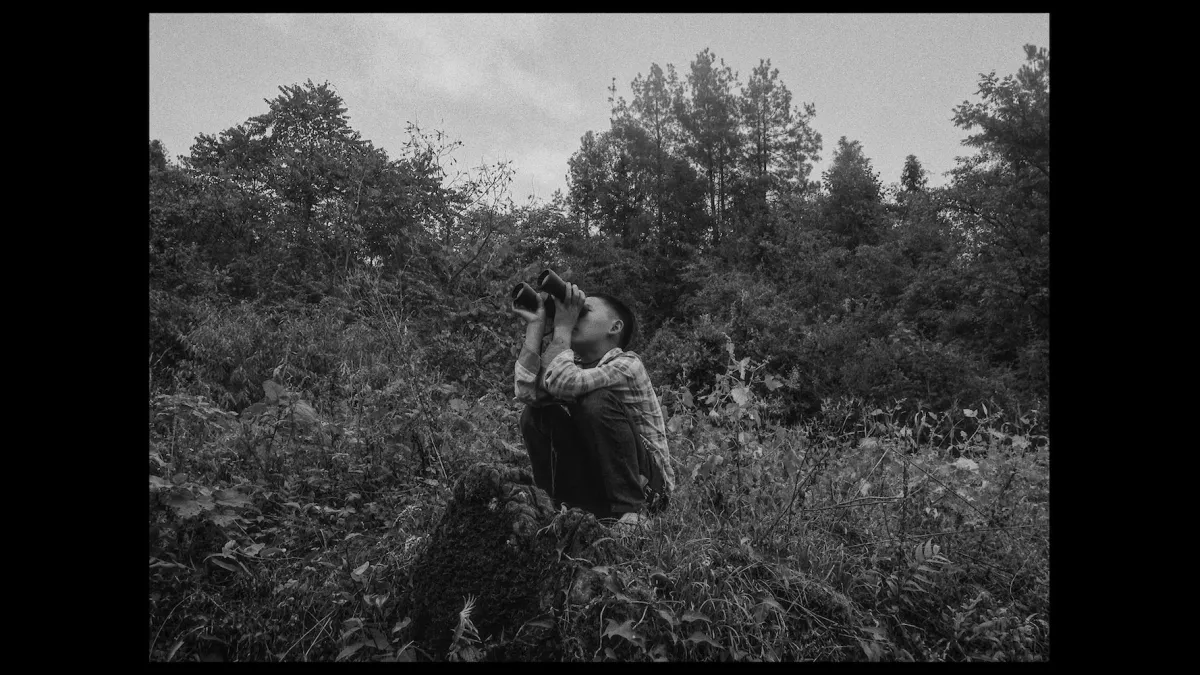
The winning film of the main competition at this year’s CPH:DOX, Always (an IDA grantee), comes from a little-known Chinese director, Deming Chen. His 2021 debut, Song of Shiratori, didn’t have wide exposure. But with this second feature supported by an all-star team and a strong production structure, the director makes a grand entrance onto the international scene.
Set in rural China, the documentary follows a young protagonist from Hunan province, Gong Youbin, who is nine years old when Chen picks up his story. He belongs to one of many poor rural families in a country where parents often leave villages to work in the cities and children are “left behind” to be cared for by grandparents. Gong’s situation is a little bit different, but it still reflects the reality of modern-day China beyond the shiny facade of the biggest economic growth of our era. Throughout the film, state propaganda blares from loudspeakers mounted on lamp posts, and in such instances, with the predominant black-and-white cinematography in Academy ratio, one wouldn’t be blamed for mistaking the setting for the 1950s.
When Gong was just three months old, his father lost his arm in a factory accident and was promptly left by his wife. He is not very well able to support his son, or himself, for that matter. But what we gather almost from the beginning is that Gong is emotionally quite isolated at home, with the family always in dire financial straits. A social worker drops by, prompted by the kid’s teacher, to see if they qualify for benefits, and it’s the overbearing grandmother who answers all his questions.
To this outside world, Chen brings in poetry written by the protagonist and his classmates in literature class as a crucial device for the film’s tone and themes. Tender, haiku-like snippets of fleeting moments and impressions are overlaid on the screen in Chinese characters, with small English translation in the bottom right corner, usually over shots of nature that linger, but never for too long. Editor I-Chu Lin keeps the film going at a steady pace that we feel is just right, artfully and confidently conveying a sense of time and groundedness that juxtaposes with the poetry in a lovely way. It also gives gravity to Chen’s own careful, patient cinematography, where the camera is almost always fixed. The compositions are flawless, often containing a complex mise-en-scene, completed by inspired work with natural lighting in the family’s simple home, where the inhabitants are at times just silhouettes in the semidark room.
The French-born, Taiwan-based artist Yannick Dauby transcends the borders of both sound art and musique concrète. His filigree work on sound design and music typically combines them beyond distinction between the two. Here, it is especially functional and creative in interweaving the protagonists’ connection to the land, with growing up and loss as the film’s key themes. Vast, dense forests of the mountainous region attain a spiritual quality with his subtle hums and drones, which contrast with the very present diegetic sounds that come with difficult field work. Wild animals appear in misty images accompanied by lightly whooshing sound effects; ants work their way through a dead moth to quiet clicking and shushing, derived from what sounds like static, and heavily processed human voices.
The final act switches to color and a 16:9 ratio, with the first shot in negative depicting an orange sky. Now, Gong is a teenager and is no longer writing poetry. Some remaining threads are resolved, some storylines end, and some are yet to begin. There is no need for answers—the whole film is a testament to growing up without a parent.
The Helsinki Effect.
The Helsinki Effect
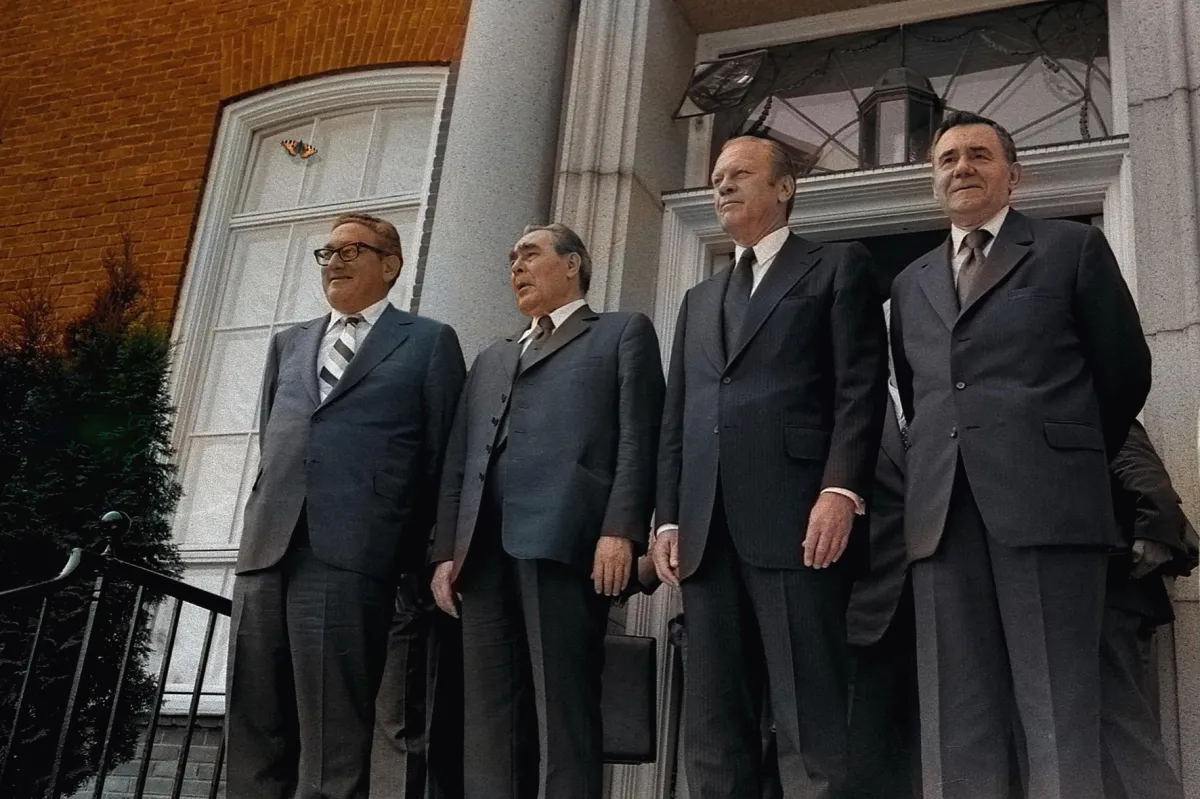
The 1975 Conference on Security and Co-operation in Europe (CSCE) gathered leaders of 35 European countries, the U.S., and Canada to sign what came to be known as the Helsinki Accords. It is a largely forgotten summit that had an outsized impact on the political developments at the end of the last century. From hundreds of hours of TV footage from the event, recently released transcripts including years of prior negotiations, and side conversations, Finnish director Arthur Franck made The Helsinki Effect, another standout from the main competition.
The transcripts became the real flesh of the documentary, leading the viewer through the story. Franck’s personal, spicy, and often self-deprecating voiceover, which reflects the best traditions of Finnish humor (repeatedly pointing out how tedious and boring the whole “shebang” was), provides a welcome, down-to-earth angle.
In Franck’s punchy language, the main characters are Henry Kissinger, then the U.S. national security advisor (“war criminal and major foreign policy nerd”); Soviet leader Leonid Brezhnev (“swimwear model,” pictured in bathing trunks); and Finland’s prime minister Urho Kekkonen (“supreme leader and all-around-God”), who was instrumental in getting the two sides to the table. Derided by some American media as a Soviet ally, Kekkonen knew what he was doing in securing peace for his nation, which had lost 42 wars to Russia throughout its history.
To make it all more dynamic, Franck uses AI to re-create the voices of Kissinger and Brezhnev, and comes up with the idea of himself calling them on the phone, asking questions in an increasingly convivial tone, as if they have become companions on this journey.
The many historians and contemporaries quoted in the film conclude that this nonbinding document inspired movements such as Solidarność in Poland or Chapter 77 in the Czech Republic, as well as the establishment of the Helsinki Human Rights Watch Groups. This, the film posits, gradually led to the dissolution of communist rule in Eastern Europe and the fall of the Berlin Wall. One could add that CSCE later became OSCE and what followed were such key agreements as Minsk 1 and 2, or the Budapest Summit, the consequences of which we see with Russia’s invasion of Ukraine—but a relatively well-informed viewer will easily come to their own conclusions.
Along with footage from the conference, interspersed with comically clumsy moments from TV studios around Europe and the U.S., the director uses stock footage of butterflies to refer to the title of the film and timelapse scenes of seedlings growing out of the earth to drive his point home. There are also black-and-white scenes of men playing basketball, whenever the three so-called “baskets” of proposals that the Accords consisted of are mentioned. Such literal illustrations break the monotony of footage of speeches and nicely add to the deadpan spirit of the film.
While his approach is playful and genuinely funny, if somewhat testing audiences’ patience before the film’s inspiring conclusion, Franck’s point is serious, nailing the zeitgeist as few films in recent times have. “Give me more boring speeches and conferences,” he says, “as the alternative is always much worse.”
As we watch the very idea of diplomacy being dismantled in the world of Trumps and Putins, The Helsinki Effect is a testament to a time when adversaries could find a common ground and actually keep the peace. Now we see how painfully we miss these basic tenets of international relations.
Walls – Akinni Inuk
Coming from the probably only internationally recognizable name from the small Greenlandic production scene, Emile Hertling Péronard and his Ánorâk Film, Walls – Akinni Inuk teams up Denmark’s Sofie Rørdam and Greenland’s Nina Paninnguaq Skydsbjerg. The first-time feature directors are experienced as a researcher and producer, respectively. After its world premiere at CPH:DOX, the film won the NORDIC:DOX Award.
The documentary opens with title cards that attempt to outline the complicated Greenlandic correctional system, which is what, according to press notes, Rørdam had initially set out to make a film about. The legal sector is still under Danish authority, which in 1954 designed the criminal law based on studies of traditional local culture. In the country with the world’s least dense population, the priority was to reintegrate offenders into society as quickly as possible. That’s why all the facilities are semi-open, which allowed the filmmakers to give small cameras to inmates of a women’s prison. This device, though, is only used at the very beginning of the film, giving it a raw quality that gradually softens.
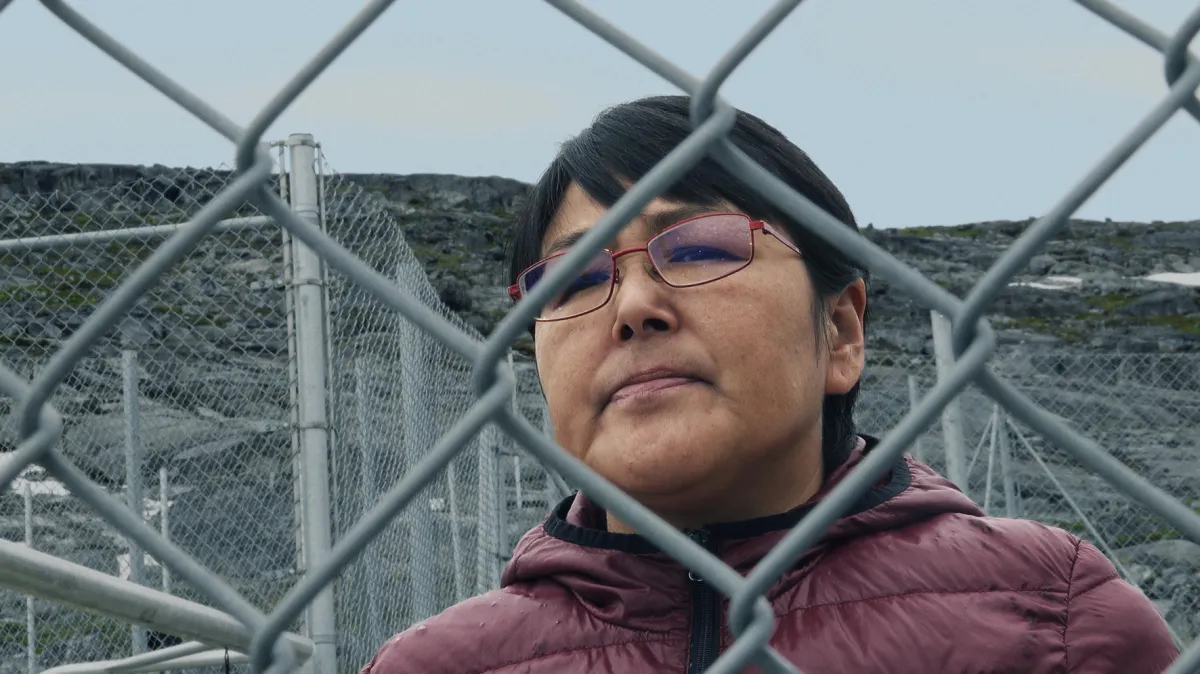
Danish law has a unique stipulation that was translated into the Greenlandic system: indefinite custody. After the film’s protagonist Ruth served five years for the killing of her rapist, she was then sentenced to indefinite custody for battery and assault of a man she believed was involved in her mother’s murder. Ruth’s story and its parallels to Paninnguaq Skydsbjerg’s own are narrated by the latter, who lays the pain bare for audiences to feel. Both had alcoholic mothers and both were sexually abused. Later, she gets pregnant, another thread that strengthens her connection to Ruth.
Their intimate conversations form the bulk of the film, and the camera gives them as much space as possible in the close quarters they talk in. It may look cozy as they share a cup of coffee, but such scenes are interspersed with magnificent vistas of the black crystalline-rock formations covered with snow and the innumerable colors of the ocean and the sky. Accompanied by the Greenlandic artist Tûtu’s guitar-driven score, they push the viewer to feel Ruth’s yearning for freedom. Her indefinite custody cuts her off from her children and grandchildren, her requests for leave are simply not answered though she has a legal right to them, and she is living with the unbearable uncertainty of when or whether at all she will be released. Eventually, it turns out that to get things moving in her case after 12 years, it takes a new lawyer—a Danish one.
The film never directly addresses racism or colorism, but much can be gathered from the unmissable disparity between Ruth and Paninnguaq Skydsbjerg, which is emphasized as they get closer emotionally on screen. Compared to a darker-skinned, short Ruth, Paninnguaq Skydsbjerg has lighter skin, is tall, and looks more stereotypically white Scandinavian. There is no exposition about it in the film, but when Ruth tells her that she can tell the co-director had the life of an educated person, even if she herself is not all that well-educated, the implication of their differing appearances on their lives is clear.
The Inuktun title of the film, Akinni Inuk, is translated as “The human on the other side.” Through their genuine and sincere interactions, the film shows how Ruth and Paninnguaq Skydsbjerg managed to cross the invisible border between those on the inside and outside of prison, and also their self-imposed limitations.
Walls – Akinni Inuk.
This piece was first published in Documentary’s Summer 2025 issue.