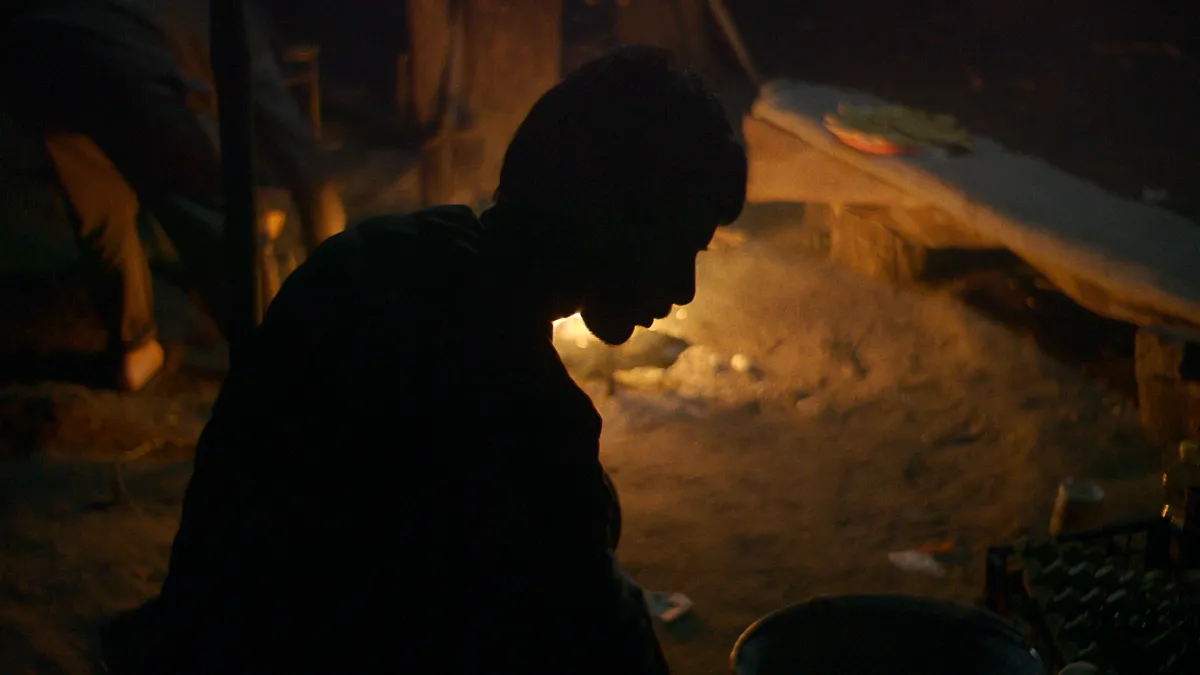


Waking Hours, in competition at the Venice Critics’ Week, immerses audiences in the hidden world along the Balkan borders, where human lives unfold under the cover of night. The documentary, produced by Stefano Centini and Serena Alfieri’s Volos Films with Roberto Minervini and Dario Zonta’s Cosma Film, is set at the edge of dense forests, where Afghan smugglers wait by fires while distant gunfire punctuates the darkness. Nearby, a wall of sharp metal marks the entrance to Europe, a physical and symbolic frontier.
Directors Federico Cammarata and Filippo Foscarini’s documentary is a nocturnal exploration of liminality, danger, and survival, where the camera follows its subjects with careful attention, privileging presence over commentary, and darkness over illumination.
Before embarking on Waking Hours, Cammarata and Foscarini began collaborating at the Centro Sperimentale di Cinematografia in Palermo on the 47-minute doc Tardo Agosto in 2020. Adopting a lean, fieldwork-based approach—Federico on visuals, Filippo on sound—their previous works have screened and won awards at DocLisboa, Popoli, Beldocs, and Yamagata.
In their conversation at the Lido with Documentary, the two directors talked about the inception of their project, the themes of survival, the nocturnal rhythm of life at the borders, and the way darkness shaped both their filming and the migrants’ experience. This interview has been edited.
DOCUMENTARY: First, how did you embark on the making of Waking Hours?
FILIPPO FOSCARINI: We began our research in the Balkan area thanks to an award we received at DocLisboa in 2022, which included an artistic residency at the Academy of Dramatic Arts in Zagreb. It was a one-month residency with complete freedom of movement: we weren’t required to stay in Zagreb, we could travel around. From there, a fascination with border areas developed, just as the war in Ukraine was starting.
We started exploring the borders between Croatia and Bosnia. These are areas with many villages, some completely abandoned due to previous conflicts. This is where we began our research and decided to develop the theme of war in the former Yugoslavia. This path led us to Brčko, in Bosnia, on the border with Serbia. During our visits, we discovered that in the Tiza River in Serbia, mayflies still survive—these insects were once common throughout the Danube basin but now persist only in certain areas due to pollution.
D: Initially, you were there for something completely different.
FF: Exactly. We wanted to find spots near the river to film the mayflies, a phenomenon that lasts very little—just three days. During excursions in the woods, we came across one of the local clans, who aren’t the protagonists of the film, but they made us aware of what was happening along the border fence between Serbia and Hungary.
D: How did you approach the clan?
FEDERICO CAMMARATA: As Filippo said, they stopped us while we were entering the forest. From that moment, we began researching the phenomenon, which is very vast: these forests host several clans from various Middle Eastern countries, and even from North Africa. The first clan we encountered was Moroccan. We approached them, but many groups were unfriendly.
D: They wanted to stay on their own.
FC: Exactly. They operate at the border and risk being stopped by the police, so caution is normal. We managed to make contact thanks to an NGO that helps migrants, No Name Kitchen. Our goal was to observe the camps and understand how people lived there. The NGO suggested following them and introduced us to a smaller, marginal clan composed of Afghans—they are the protagonists of the film. With them, a human connection was immediately established.
FF: The funny thing is, we were there just to film insects, so we were supposed to stay only a few days. We were already heading back to Italy when we received a call from one of them: Ramadan had just ended, they wanted to celebrate, had taken a goat from a shepherd, and invited us to eat it with them. That’s how we became familiar and ended up staying several weeks. It was curious because initially, we were returning to Zagreb, and there was a heated debate among us. Our work on insects was already done, and we had that initial idea in mind, but a completely different reality opened up. During the journey, we wondered whether to stay, and in the end, they themselves invited us to eat this “jungle kebab”—that’s how it all began.
We often don’t start with preconceptions: our approach is concrete, guided by what catches our attention. We don’t immediately define a narrative structure, but start with footage and research that become true memory catalogs, like the one on mayflies, which aren’t included in the film.
We asked ourselves whether to include them, but they would have broken the “nighttime device” we had chosen: the film is a large nocturnal void from start to finish, so we decided not to include them. However, since 2022, we have built a large archive, especially in Bosnia, which also includes material on mayflies, still unpublished.
D: There is a little bit of talking in this one, though, in your scenes with the architect Michele de Lucchi. How did you decide that what he said was important enough to include? How long was your interview with him?
VK: Yes, I will not normally use interviews, but I always film them, just in case. I spoke to about 100 architects, as well as scientists who are trying to find healthy replacements for cement, because 8% of CO2 emissions come from cement production. I didn’t plan to use the interview with Michele; I just wanted to talk to him so I could understand more. But when I saw the footage of him talking about his new idea of beauty, I thought, “Oof, maybe I have to use it.”
It’s 10 minutes, the entire conversation with him. I took it out and put it back in the film a few times—I took it out, I put it back, I took it out, I put it back. In the end, somehow I kept it in the film. And now I like that I kept it, because of how people react to it. He’s so beautiful, he’s like a prophet, and people will not forgive me if such a beautiful man never speaks. If you see a prophet and he doesn’t say a word, that would be a shame.
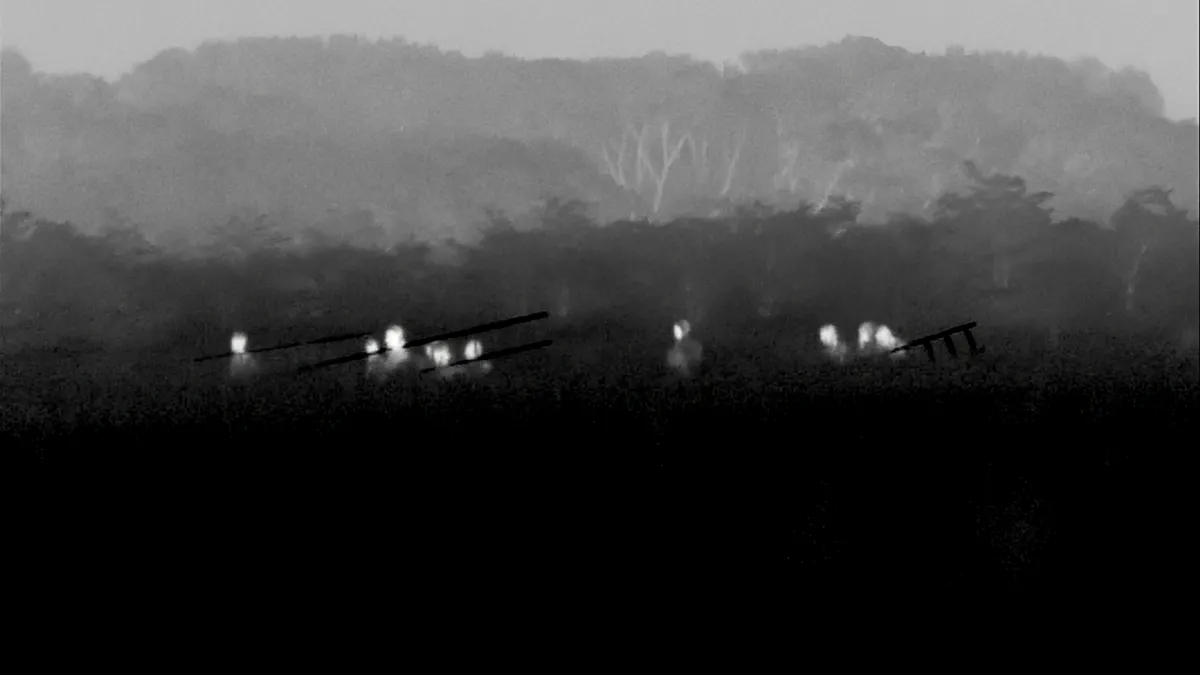
Waking Hours. Courtesy of the filmmakers
D: This brings me to your most radical aesthetic choice. The film is immersed in darkness: is this a result of the events or a deliberate artistic choice?
FC: The reasons are multiple. Initially, we were interested in filming the spaces, the temporary structures where these people live: tents and shelters in the forest. Then we met them in the evening, when they invited us to eat. Much of their life takes place at night: the clan we followed organizes passages and contacts, which mostly happen at night and via phone. The fire moment was fundamental: they carried out preparatory activities, and we could observe and record.
The night was also a time for storytelling: these people often don’t sleep, due to cold or constant vigilance, especially because of the police. Being with them at night allowed us to capture significant narrative moments.
Besides, night has a metaphorical value—it represents the limbo in which migrants often find themselves for years. Pragmatically, it was also the safest time for us. Police operations happen mostly during the day, so filming at night allowed us to capture more intimate moments without constantly living in fear.
FF: It’s paradoxical. By cliché, night is frightening. For us, too, darkness represented a sort of protective barrier, because police operations occurred during the day, when visibility was needed to enter these very dense forests, which seemed like jungles. Migrants and traffickers call the area “the jungle” for this reason. It’s important to highlight that the film didn’t start as an official project. It arose spontaneously, following the urgency of the moment.
D: So initially, there was no production involvement.
FF: Exactly. This exposed us to risks—NGOs advised us to limit movement in the woods as much as possible. Thanks to the relationship with the small clan, however, we felt the urgency to stay and filmed despite the dangers.
D: How long did you follow these people, and how much footage did you shoot?
FF: Only a few hours. We tend to shoot very little, even in digital. Shooting little is also a technical choice. It wasn’t “clandestine” footage, but the set was difficult to control. We shot very few hours, in two moments in 2023: first in spring to film the mayflies, and then again in October.
Moreover, between 2022 and 2023, the Balkan migration route, as well as the Mediterranean one, saw a significant increase in people, from 750 to 850 per week. This increased the presence of Frontex, the EU’s border police. Often, while filming in the woods, we saw drones monitoring the clans. A week after our departure, Frontex and the Serbian police practically cleared the area, and we lost track of our protagonists.
D: You don’t know what became of them.
FF: Exactly. These aren’t fictional characters, but real human beings. They probably managed to escape, but we have no certainty.
D: Were there particularly risky moments during filming?
FC: At the beginning, yes, because we didn’t know the territory or the dynamics between the clans. We tried to enter some areas without knowing the groups were in armed conflict. At Palić, near the lake, gunfire was often heard: sometimes Kalashnikovs from the Balkan wars, likely supplied by Albanian criminal networks. At night, immigrants guided by traffickers arrived. During the early hours, they crossed the forest hidden. We filmed these scenes while hiding, in fairly dangerous situations, and without legal cover.
FF: A producer, Luca Ricciardi, told us we would need a lawyer—the danger was not only physical but also legal. In this sense, the film raises important legal questions.
D: And there’s also a journalistic void… very little is known about these phenomena.
FF: Yes, they’re matters very difficult to document. It’s not just about smugglers; in some areas, migrants create real communities inside the forests. Living there is sometimes an act of resistance against a European model struggling to manage migration.
D: When did the project become an “official” production? And, what about post-production?
FC: After the Frontex operation, we began editing some footage. We participated in pitches and the first creative producer to join us was Dario Zonta. Filming lasted a few weeks, editing one full year. Later, we met Stefano Centini of Volos Films at the Bellaria Film Festival.
FF: From the editing point of view, the material was very difficult to handle. We didn’t know what they were saying, so everything had to be translated from start to finish. A huge job, often taking 5–6 hours a day.
D: What about Roberto Minervini? When was he involved?
FF: Roberto arrived very late. We had already done a rough cut and needed an external point of view. For months, very few people saw the edit. After 7–8 months, we decided to show it to selected people to test it. We asked for feedback for sound editor Benny Atria, and then Roberto came on board through Dario. Roberto is primarily an author. He either likes something or he doesn’t.
D: At least he’s got a clear head.
FF: Yes, indeed. We showed it to Roberto for feedback when it wasn’t yet the final cut. Thanks to his enthusiasm, we got to know him, and from that last rough cut to the final cut, he followed our work remotely.
D: One last question: compared to the time of filming, how has the phenomenon changed in your view, considering events, news, or contacts with NGOs and locals?
FC: That moment marked a turning point for the film. Until the end of 2023, Serbia was a highway, the main hotspot. It was relatively simple to arrive from the Middle East and obtain a temporary visa to start the journey. Later, the main routes were blocked: many people went to Bosnia, legal centers temporarily closed, camps dismantled. In Bulgaria, the situation is worsening. Numerically, there’s been a decrease in the last year and a half: institutions rejoice at the reduced entries, but this doesn’t mean people aren’t leaving or disappearing. They simply look for other routes, perhaps even riskier. The risk is that everything worsens due to both growing political instability and the climate crisis.