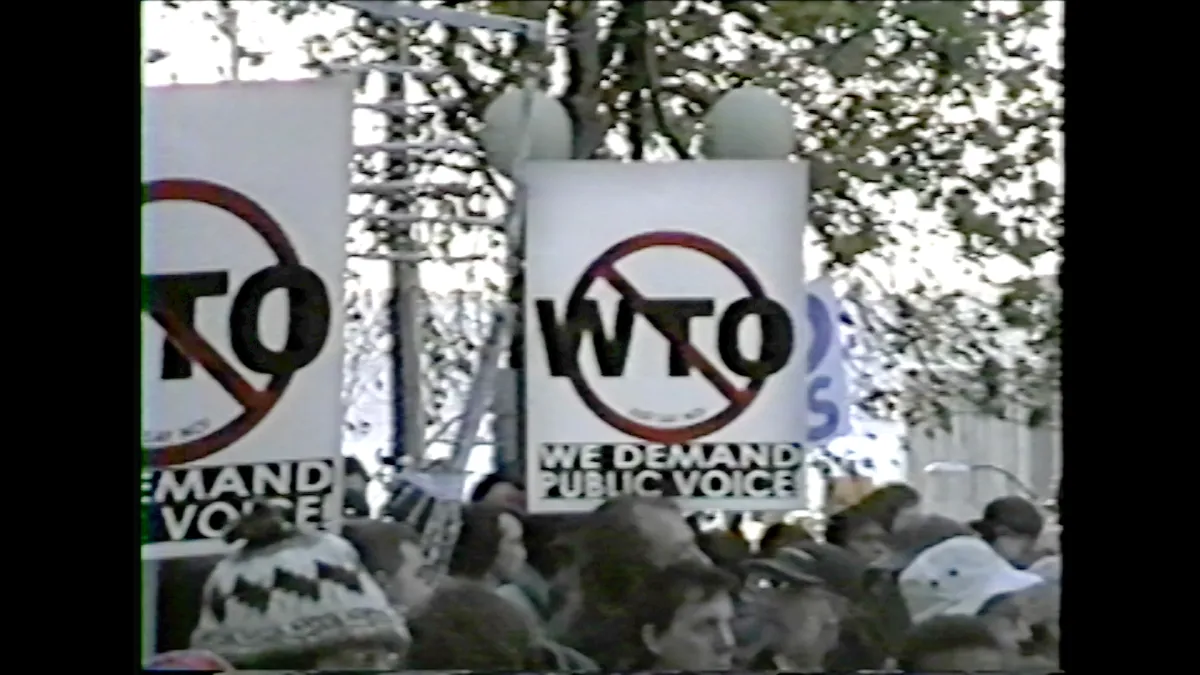


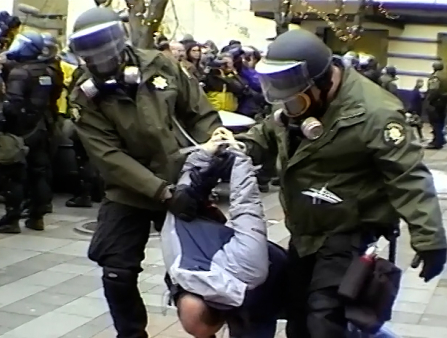
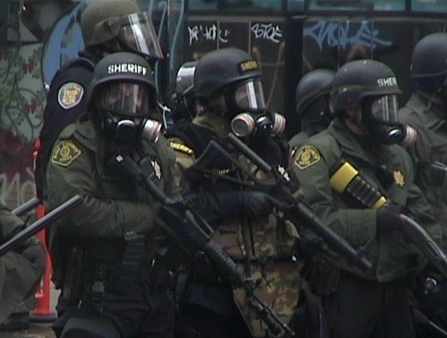
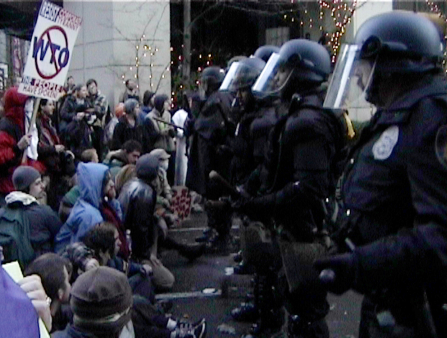
Even if, per William Faulkner, the past is never dead (nor even past), major historical flashpoints from the analog era often recede into the backdrop of the public commons. Such is the case with the demonstrations against the first-ever World Trade Organization ministerial, held in Seattle from November 29 to December 3rd, 1999, in which a mass mobilization of protesters (estimated by the Seattle Police Department as numbering at least 40,000) brought together factions ranging from longhair hippies to AFL-CIO trade unionists. While the thousands of demonstrators took direct action to prevent delegates from entering the summit by blocking routes of access to the Washington State Convention and Trade Center with sit-ins, marches, and by chaining themselves together, the protests gained overnight notoriety on account of the SPD’s repression. It hardly mattered that these tactics were nonviolent: the police eagerly broke out the tear gas, rubber bullets, pepper spray and batons, immediately escalating things and creating a bitter, convulsive standoff.
It’s a tired trope that documentaries raise “timely questions” and become “more relevant than ever,” but against this context it must be said Seattle filmmaker Ian Bell’s new documentary WTO/99 makes for bracing viewing. Edited by Bell and producer Alex Megaro, the film painstakingly reconstructs the events of those four protest days in chronological order, drawing from a reserve of archival footage the filmmakers estimate at over 1,000 hours. Images of vandalized Nike and Starbucks stores in downtown Seattle made for must-see TV; news broadcasts perpetuated the idea that the city had fallen into apocalyptic chaos as then-mayor Paul Schell imposed a curfew and declared a State of Emergency. Rather than applying voiceover narration, retrospective interviews or slick infographics, the filmmakers do their damndest to let this material, sourced from Seattle’s local news stations, independent journalists, and civilian protest attendees, speak for itself.
Cameos from Jello Biafra, Amy Goodman, George W. Bush and Michael Moore (among others) speak volumes about the debate around free trade as it stood at the turn of the millennium; beyond the brutal crackdown of the SPD, WTO/99 feels like watching a century’s worth of demands for labor protection and human rights yield to the almighty bottom line. A quarter-century later, the ugliest moments of the WTO protests look and feel more like a quaint foreshadowing of the steroidal militarized police clampdowns that would become commonplace during the Occupy Wall Street, Black Lives Matter or George Floyd uprisings to come.
Documentary spoke to Bell and Megaro as WTO/99, which was nominated for Best Editing at the 2025 IDA Awards, embarked on a directly distributed U.S. theatrical run. They cover the sourcing of the material, organizing the massive trove of material, and the film’s focus on the protestors’ critiques of transnational capitalism (or, as we used to call it, “globalization”) as millions of Americans try to make sense of the rising cost of living. This interview has been edited.
DOCUMENTARY: Talk about amassing the archival material for this doc: How many hours? How many sources?
IAN BELL: There’s an organization called MIPoPS, Moving Image Preservation of Puget Sound. They had been working on the digitization of about 400 hours of footage, which came from the independent Media Center, housed at the University of Washington. When we ran into them, they were about 200 hours in, and we asked if we could take a look at the material once they had digitized everything. They brought us hard drives with incredible stuff. Our archival producer Debra McClutchy found another 600 hours, with sources ranging from protesters’ shoeboxes to CNN, CBC, and the Seattle Police Department’s own footage and audio recordings of their radio communication from that week.
ALEX MEGARO: This is a project Ian and I had been discussing for about eight years. We approached MIPoPS after we found financing for the film. We had to build a block of clay before we could sculpt anything by watching it, then organizing it, drawing connections between different pieces of footage, and slowly creating an almost real-time [version] of the film, with full timelines that were chronological.
D: Were there any sources you chased unsuccessfully? Or things you couldn’t afford?
IB: This was an independent project. Some sources charged too much, so we’d have to pull a few seconds here and there.
AM: The CBC had a lot of great stuff we couldn’t afford to use, but the main thing was just that we couldn’t go crazy. Archival is never cheap. I want to add, though, that the news broadcasts you see in the film are only there because of a single person who recorded KIRO 7 to their VCR every night for the four nights this was happening. The actual news station doesn’t have records, because that requires money, space, and tapes. This is the only record of those broadcasts we know of.
Courtesy of Starseed Media Inc.
Courtesy of Rustin Thompson.
D: I can’t envision this as a single master timeline, but rather, four different bins of material that kept growing and growing.
AM: We were lucky in that some local news tapes included timestamps; in other cases, we had citizen journalists shouting out the time of the day on their tapes. But we had to sync everything by eye, and the only way to do that is to watch over and over and over, then you’re like, “Wait, I recognize that person raising their hand” and realize you could sync to that point. What we ended up doing was having material organized by street intersections, so you could go in and see exactly what happened and when.
D: Tell me about your workflow together. What’s the dynamic?
IB: Well, the “dress rehearsal” for WTO/99, if you like, is a doc called 187 Minutes (2023), about January 6th, that we made for VICE. It was part of a series we did for two seasons called Source Material, which relies entirely on reconstructing events with found footage and archival footage.
AM: No interviews, no voiceover, minimal text. Working so intensely in this style for so long, we developed a natural rapport. I know 1,000 hours of footage sounds daunting, but it didn’t seem as obscene as it might to a sane person. We know each other’s strengths. We know when one is losing steam in one timeline, and we can pass it off to the other. And we’ve noticed that if we pass a timeline back and forth, it always comes back better than it was previously.
D: It’s wildly different from a protest today, but also made me think of a conversation I had with a Leftist boomer during Occupy. It was about being wary of aligning the 2010s with the 1960s. One major discrepancy was, she said, “There wasn’t so much camera equipment everywhere.”
AM: It’s fascinating that each of us has a phone in their pocket today, but in 1999, the intention to film was just very different. The newest camcorder at the time was still bulky as hell. You had to lug it around with a finite amount of tape, so there’s just more intentionality in what gets filmed. Some of these people are amateurs, and for all we know, they’re shooting a crowd for the first time ever. You get the impression it was unprecedented for so many people on the ground to bring these bulky camcorders to a single, massive event.
We wanted this movie to work on multiple levels. The first is factual: we want people to watch it and come away understanding the facts of why this happened, what the arguments were between the different groups, and what happened on the ground. We also needed it to work on an experiential level: what it feels like on the ground, from a first-person perspective, in the heart of the melee. And that experiential level gives an emotional truth that enhances the factual and vice versa.
D: I appreciated the inclusion of a moment from one of the news broadcasts, where we see Starbucks CEO Howard Schultz, and he’s being interviewed about the protests on the night of November 30th, at a Sonics (RIP) game.
IB: Local audiences understand Schultz’s relationship to both globalization and the Sonics. Beyond that, though, the clip highlights the geography of the protests. We had a cut that was even more focused on geography because we wanted people to understand how small the area is that was shut down. The “chaos” Seattle was experiencing was a tiny sliver of the downtown area, just 20 blocks away from a packed basketball game at a huge stadium. The impression of the city in flames, you know, fogged over by a plume of tear gas, was pervasive, and still lives on in the memory of many people. That said, we’re also trying to delineate how broad the police action was, versus the specific sites protesters wanted to shut down. I’m not certain that comparison always comes across in the film, but it’s there.
Stills courtesy of Rustin Thompson.
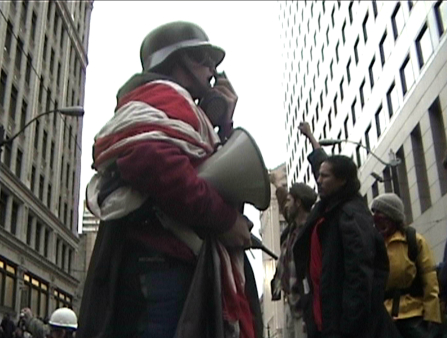
D: The controversy around the protests—and the police response—easily eclipsed everything else. You have protesters and activists talking about this. You have older demonstrators trying to stop people from vandalizing storefronts. I grew up in Shoreline, to the immediate north of Seattle, and even there, a 20-minute car ride away, people had the impression that the downtown area had descended into full chaos.
IB: That became the narrative due to the way it was covered in the legacy media. Firstly, Howard Schultz was talking about rioters destroying small, local, mom-and-pop businesses, but our research didn’t show one instance of that happening. The other thing is, why is a Nike store getting smashed, or a Starbucks, a bigger deal than chemical weapons being tested on American demonstrators?
D: The film also gives a strong impression that the protesters succeeded in their goal to shut down the ministerial. It also suggests that the anti-globalization movement was halted in its tracks after 9/11. There’s an immediate victory and a lingering doubt. How have these conversations influenced your political thinking around the film?
IB: Maybe it’s just because I was in college, but the turn-of-the-millennium era was a time of more hope, and optimism, about the future of the United States. The WTO protests added to that optimism. Examining this footage decades later, it’s really clear how the Democratic Party has abandoned the cause of labor over the last quarter-century. The protests brought together people from the far left, center-left, and far-right, which is fascinating. 40,000 people, the vast majority of whom are nonviolent, took direct action by trying to clog intersections and block people from getting to meetings.
AM: This is also why we included footage about Donald Trump’s exploratory committee for running for president in 2000. Just surreal to realize how long he’s been beating this drum.
IB: There’s a multiplicity of causes for what’s happening now, but it’s surreal to realize the people protesting the WTO in 1999 might have more in common with MAGA when it comes to trade issues. Trump tapped into the feeling of being ripped off in a way the Democrats have not been able to.
D: They’re still being ripped off, but they’ve been sold a different bill of goods.
IB: Right, I’m not saying I agree with Trump. I’m talking about the difference between Democratic leaders’ actions and their legislation, versus their words.
AM: After all, the crackdown happened under a hierarchy of Democrats, from Paul Schell (Seattle mayor) to Gary Locke (Washington governor) to Bill Clinton. For leftists, it really fuels the feeling of nobody is coming to save you.
D: It’s also melancholy to see this time capsule of Seattle. People ask me if the city has changed, and it’s kind of the same deal as San Francisco: the city has attracted a lot of business, and that’s pushed a lot of people out and radically altered the underlying class dynamics. Culturally, it remains quite liberal, but it’s also a tech hub, and the homelessness issue has exploded. The Space Needle is dwarfed by offices and towers that were not there in 1999, most of them done in a kind of storage-unit chic I find telltale and disgusting.
IB: I moved from New York back to Seattle during the pandemic. I wanted to be closer to family; my wife and I had just had a kid. But I felt very alienated from the town. This didn’t dawn on me before I started working on WTO/99, but the major companies that everybody was talking about at the time in the protests were primarily Northwest companies: Boeing, Amazon, Microsoft, Starbucks. There are eerie parallels between the way the WTO protests went south and what happened in 2020, with police action justified by anonymous reports of agitators infiltrating the protests. In some ways, it feels like the Seattle or the world everyone was trying to fight to avoid, is what Seattle ultimately became.