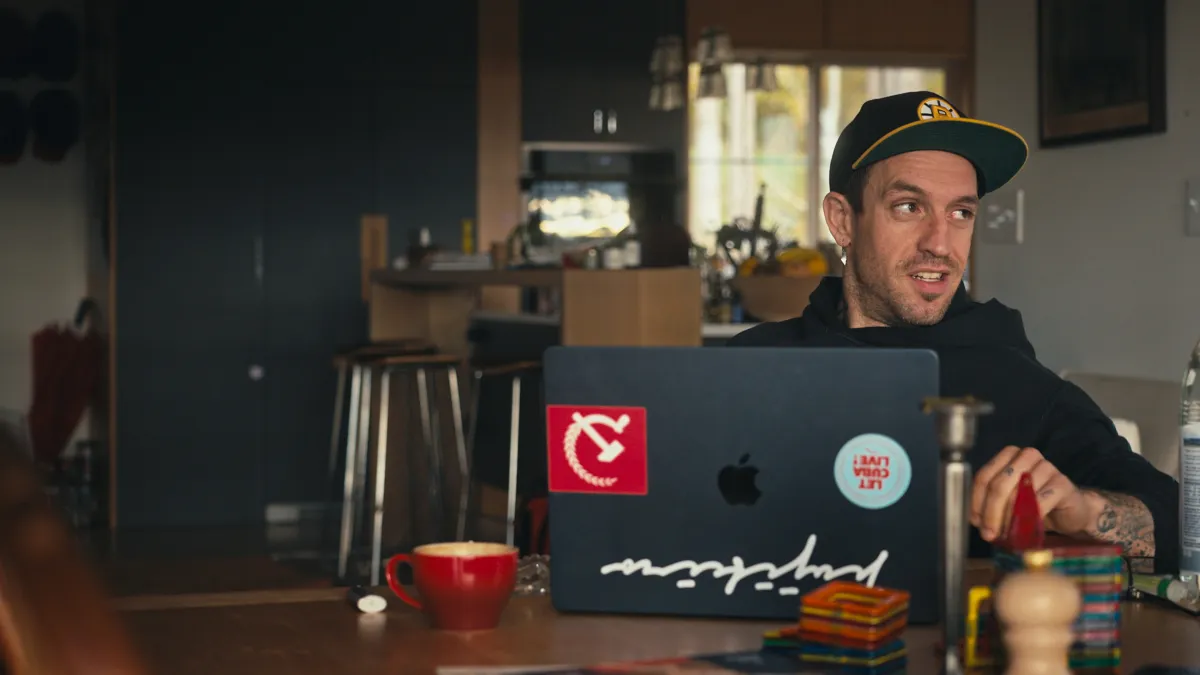


Sinéad O’Shea’s All About the Money follows the efforts of James Cox “Fergie” Chambers Jr., born into the multibillion-dollar Cox family, to sustain the communist-friendly Alford Family Farm in Massachusetts. Well, partly—because any story orbiting Fergie is eventually yanked along to wherever his make-stuff-happen impulses and volatile brew of beliefs take him. That includes an ambition for the farm to be a revolutionary training ground, aided by a communist-friendly gym; a direct action against an arms manufacturer supplying Israel; and a sudden move—perhaps not unrelated to arrests stemming from the direct action—to Tunisia, where he finances a soccer team, hangs out with his partner Stella and their child, and studies Islam.
O’Shea—whose last film was the rousing Blue Road: The Edna O’Brien Story (2024)—avoids turning Fergie’s hot-mess projects and biography into a voyeuristic spectacle (partly, it could be argued, by eliding other aspects of his personal life, amply covered in past journalistic profiles). Instead, the film’s intermittent multiyear chronicle presents a platter of contradictions as it traces the trajectories of Fergie and of Alford and its activist stewards living under his largesse. At the very least it’s a cautionary portrait of political action, or any endeavor, or a country, reliant on the generous whims of a billionaire, but O’Shea’s eye for portraiture also makes a meal of Fergie’s unfiltered pronouncements, a bewildering mix of black-sheep testimony about America’s class system, self-therapy, and the purely objectionable (regarding Hamas, Donbass, and perhaps best exemplified by his Stalin-Mao tattoo).
I spoke with O’Shea at Sundance, where All About the Money had its world premiere, about wrangling her wealthy subject for the film, the resonance of Alford’s project in American history and film, addressing Fergie’s controversial political views, and her own ultimate opinions on where the film lands. This interview has been edited.
DOCUMENTARY: Could we start with the timeline of making the film, just to get a sense of what happened when?
SINEAD O’SHEA: I’ll do my best to answer the questions. I think what has been a kind of governing principle for this film was that it wasn’t going to be an authored film.
D: What do you mean by that—that it would be for a network or something?
SOS: No... This is my fourth feature, and my second is a film called Pray for Our Sinners [2022], which is an account of resistance against the Catholic Church in my hometown in Ireland. But it’s edited alongside my recollections of growing up there, my perspectives on what it was to be an Irish child in the 1980s. For this, I wanted it to be much more observational, but I’ve misgivings about purely observational films. I don’t believe them a lot of the time. Just because I’ve filmed in so many situations. A camera is such a disruptive force; there is always a director there. It’s very difficult to achieve any kind of pure vérité. So I thought in this case, okay, we’ll acknowledge my presence. But ultimately, this isn’t a film about my opinions. This is a film about the people I’m documenting. I’m sorry, I feel like I’ve become incredibly pompous as I’m speaking.
D: Not at all. But did you have certain feelings by the end that you wanted to come across?
SOS: No, it’s not even that. It’s not a very black or white film—and I think that’s good—because that’s how I feel about it. I don’t think there are any heroes or villains within this film. I think it’s very difficult to make any sort of sweeping statements about it. It’s quite old-fashioned to make a documentary that’s not actually an opinion piece. This is just a piece of observation.
I think it’s very difficult to make any sort of sweeping statements about it. It’s quite old-fashioned to make a documentary that’s not actually an opinion piece. This is just a piece of observation.
— Sinéad O’Shea
D: More generally, a story of a billionaire with enormous sway over others is arguably a picture of America and its wealth gap right now.
SOS: I can’t really make that claim for myself. But it’s so much of an outsider’s perspective. I am an Irish person, and that probably did make things easier for me. It was more permissible for me to ask certain questions or be confused. That it’s all taking place for me in New England seemed so potent. It is such an interesting part of the United States; it’s where what we know as the United States began. And in this place in the Berkshires, I kept thinking of The New World [2005] by Terrence Malick, because it’s so lush and so beautiful. And there’s this idea of this new utopia being built, but it is always, always American.
D: And then you have this person who ostensibly wants to abandon his class, but there’s this question of class consciousness.
SOS: I think you’re right. He is a class traitor, and he is defying his class, and he is exposing their rituals. The thing I unequivocally admire about Fergie is that he doesn’t try to hide in discretion, as he says throughout the film, which is what rich people do all the time. It’s so rare to hear about these things because they have their lawyers and their “rituals,” and there is a kind of omerta there.
D: What sort of agreement did you have with Fergie in terms of what would be off limits?
SOS: There was none. I asked him if he had any questions. And he didn’t. He does a lot of interviews. Later in the film, he began doing these really big profiles with The Free Press, Rolling Stone, Vanity Fair. But there was no agreement. He just signed a release. In Ireland, we have very strict defamation laws, so I was always very conscious that everything had to be quite formalized. But there were no terms or conditions, which I think reflects very well on him.
D: How many hours of footage did you have in the end?
SOS: I don’t know off the top of my head, but not that much, actually. We were quite constrained. I was actually making the film about Edna O’Brien at the same time. And I had a very small baby. And Edna was obviously dying. So it was this weird nightmare project because there was no good reason to do it. It didn’t have funding. But I just thought it was so interesting. So I kept sneaking back to the U.S. to do it, but I could only come over for a few days at a time. I would shoot day and night, and then just not sleep and fly home again. But it was just so dynamic, because whenever we came back, these unbelievable ruptures would have taken place.
D: When did you first start shooting for this film?
SOS: I began developing it with Screen Ireland in late 2022. Then I began filming in June 2023. I only stopped filming in November 2025. That’s when the very final interview takes place. That was after it was accepted into Sundance.
D: So Sundance had seen it without that final interview?
SOS: Yeah. But they knew there was another scene coming.
D: By that point, Fergie has said and done a lot of things, and the Alford land project seems to be falling apart. How did you view how that scene works in the film?
SOS: I was texting him this morning because there was some interview I did with a Boston radio station, and I suppose they are framing the film as a kind of elegy for a lost dream, which I don’t think of it as at all. I just don’t think that’s what the trajectory of the film was. Fergie, such is his personality and wealth and resources, is an incredibly resilient person. I just thought he’s so sad and vulnerable in that scene in the hotel room at night when he talks about the traumas he experienced.
I think there is something quite Russian novel-esque about Fergie. There are so many complexities to that level of wealth and the aspiration to be good, to do good.
— Sinéad O’Shea
D: Sometimes I was thinking of the movie in almost literary terms of unreliable and reliable narrators...
SOS: I feel that too. My background is in literature, and there are a lot of books I was thinking of. I really love all of Edith Wharton’s writing. That was always in my mind, the rise and fall of the fortunes of New Englanders. But I was also thinking of books like The Idiot by Dostoevsky. I think there is something quite Russian novel-esque about Fergie. There are so many complexities to that level of wealth and the aspiration to be good, to do good.
D: Maybe we can address some of the complexity. I’m not sure how people will take some of his political positions about Hamas or Russia.
SOS: Oh, but that continues to be his fervent belief. He hasn’t softened those positions. In fact, at the end of the film, when I have the text saying he decided he didn’t want to proceed with this, it’s because he feels the politics in the film had been quite diluted. He feels, for example, that I didn’t speak enough about his work in Donbass. But that was because it predated when I was filming. He felt that that stuff wasn’t overt enough within the film, whereas I feel like it very much is, and people are not going to forget it. He really hates that phrase “agree to disagree,” but I just think we have to agree to disagree because I feel that his feelings about Hamas, about October 7, about Israel, are indelible for the viewer. And his support of Putin and Donbass, and what Russia is doing in Ukraine—there is no point in my debating this or pushing back.
I believe he will continue to fight for the causes he believes in. And there are a lot of people in the U.S. at this stage who will connect with his diagnosis of what’s been going wrong in the United States.
D: One pivotal point in the movie is the direct action against an arms manufacturer and the subsequent charges for Paige Belanger from the Alford farm and others. Was it important to you to include this in the film?
SOS: I thought it was really important to see the consequences of that action. I think Paige is so eloquent. She’d been in the film from the start. I have a lot of respect for everyone in the film. I suppose that might sound like a slightly saccharine thing to say, but I’m so aware that the film doesn’t exist without the participants, and they were very trusting. And in the edit, so much time was taken up with trying to convey the nuance of everything that was happening.
D: You also include in the film Fergie’s relationship with Stella Schnabel. It’s another side to the film, and she’s not a naive narrator by any means.
SOS: She’s definitely not. That was why I wanted her to be there at the end. I felt it was important to show that she had agency. That she owned her decisions. I thought her interview was amazing at the end. It was an hour long, and I would have happily just thrown an extra hour at the end.
D: Thinking about all of Fergie’s controversial viewpoints on things, how are you weighing these different things when creating the portrait?
SOS: We just were like, Okay, let’s just be chronological. That just takes an awful lot of the decision-making around the ethics and politics around it all. We’re just telling you what happened from when I started until the end. I really do believe it’s quite rare these days just to tell the truth in a documentary. Looking at this Brooklyn Beckham lunacy, it’s completely undermined those documentaries released about the Beckhams in the last couple of years. There are so many documentaries now that are vanity projects, and this was not that. This was actually an act of truth-telling. You could tell this story in quite a lot of different ways that could make it probably a lot more commercial, actually. You could make him into a demon. Or you could smooth all that kind of unpleasant political stuff. But instead, the decision was to be faithful to what happened.