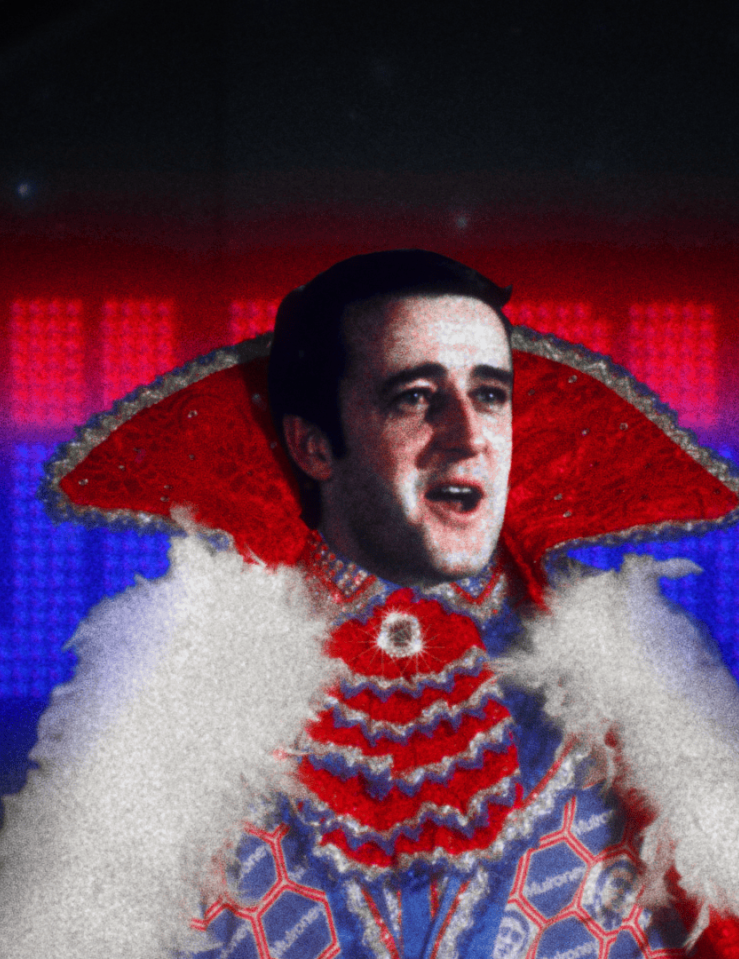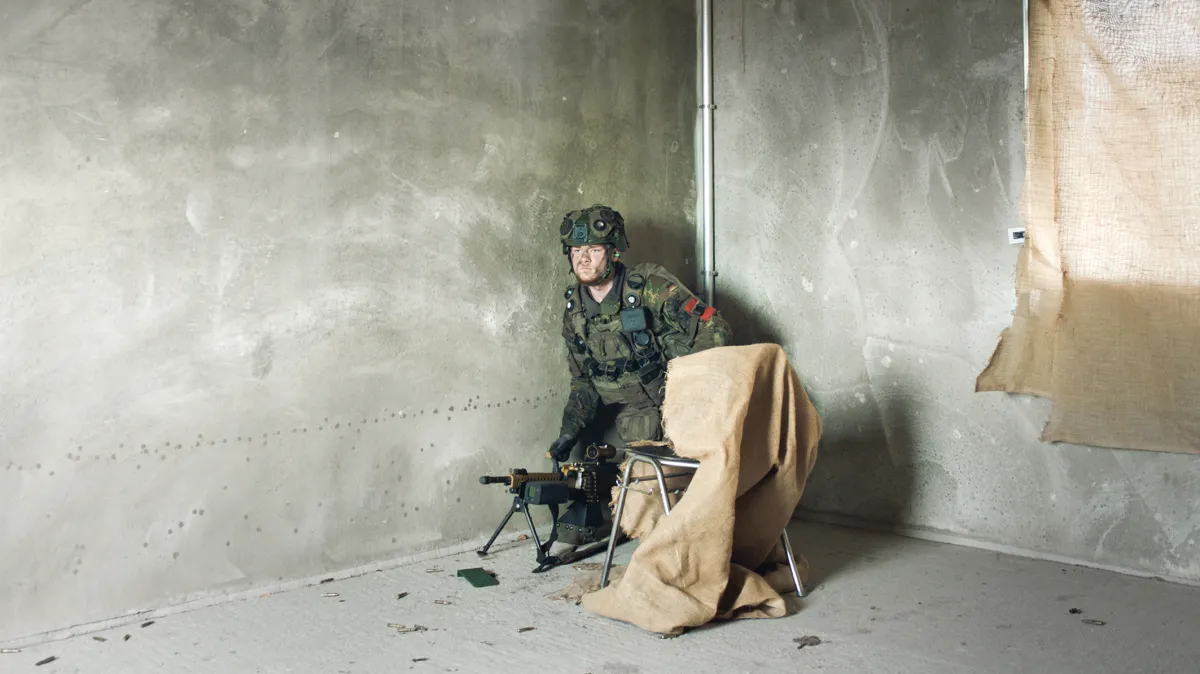


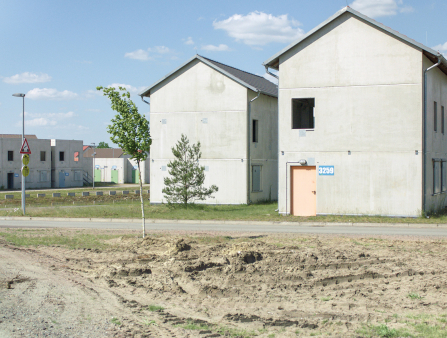
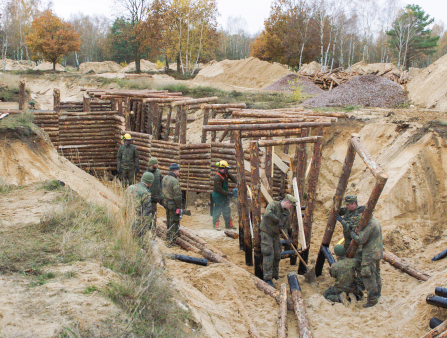
The opening sequence of Marie Wilke’s Scenario (2026) plunges us into the spectacle of warfare: a wounded female soldier sprawled on a field in front of a tank, is screaming her lungs out for medical help. Such mise-en-scène could be associated with a documentary from the Ukrainian frontline; however, this is far from real combat. We are in Germany’s Altmark region, home to Europe’s largest military model city of Schnöggersburg, where war is meticulously rehearsed and taught. Since the Russian invasion of Ukraine, the significance of this six-square-kilometre training ground has only intensified. As one commander explains to visiting civilians, the German Army has reached a turning point and is now doing its best to prevent and prepare for potential conflict.
The military training grounds of Altmark are thereby saturated with activity of different kinds: press briefings are conducted, enthusiastic recruits are sworn in, and civilians are instructed in weapons operations. But beneath the site’s theatrical atmosphere, darker historical layers begin to surface as Wilke reveals how that very same land once served as a testing ground for the Wehrmacht’s weaponry. The past inserts an unsettling layer of context into today’s rehearsal of future threats.
Wilke’s documentaries have consistently forged metonymic portraits of Germany through attentive observations within its institutions. Her debut feature Civil Servants (2015) followed young cadets through their rite of passage at a police academy, while Aggregate (2018) examined the entanglement of politics and media in a strained democratic landscape. Armed with her background in television, editing, journalism, and audiovisual art, Wilke brings a rigorously structured, analytically driven approach to Scenario, extending the observational trajectory of her previous work with striking precision.
While immersing the viewer in the rhetoric of state power, the film stretches beyond the national frame, ruthlessly interrogating deeply held beliefs about personal and national security. In light of the recent release of NATO wargame results predicting an effortless Russian takeover, Scenario emerges as an exceptionally timely work. I spoke with Marie Wilke ahead of the film’s world premiere in Berlinale Forum. This interview has been edited.
DOCUMENTARY: Let’s start by talking about your background. How did you develop such a committed directorial focus toward Germany’s institutions?
MARIE WILKE: I was drawn to film since I was a teenager, and not exclusively to nonfiction. When I started my education at the film school in Bolzano, Italy, is when I discovered documentaries. I cannot explain it, but I already knew this was a really interesting direction I am willing to take. My first teacher was the influential German cinema director Klaus Wildenhahn. To some extent, he was my inspirational departure for making my own documentaries. I have always been guided by doing what interests me. Over time, I realized I am particularly curious about how institutions work and how people interact with them. As a director, I have the unique privilege of observing their work from within while also learning from it.
D: Your debut feature, Civil Servants, is thematically the closest to Scenario. While back then you had a long preparation period and even pre-selected protagonists, I’m curious how you approached the project this time and the place itself.
MW: This military training ground was my departure point, which I actually first discovered while shooting Civil Servants. They are both located in Saxony-Anhalt. I was fascinated by the vast area of Schnöggersburg and beyond. I wanted to explore it, and see how I could use it as the centre of the film—maybe even trace Germany’s military past, present, and future. That is why it was also quite clear to me from the beginning that I didn’t want to follow individual protagonists and stories, but what happens in the Altmark military training area as a whole.
D: So you first approached this before the Russian invasion of Ukraine?
MW: It’s a bit strange, because the first time I visited this training ground was a long time ago, in 2015. I already had ideas and the desire to develop this project, but it didn’t materialize. At the time, nobody was interested in Germany or the Bundeswehr [armed forces of the Federal Republic of Germany], so I didn’t get funding. Everyone was saying that war was over and there was nothing to explore. But I never abandoned the idea. I returned to it around two years ago, in a completely different political climate, and eventually received funding.
D: Given the vast size of this territory and the variety of activities it offers, how did you decide what to shoot without getting lost?
MW: The convenient thing with those sorts of institutions is they have clear systems. They have a well-structured schedule. I simply studied the schedule of this military training ground, what they do all year long, and I was able to map out which kind of events we should definitely try to capture: the military exercises, occasions where the Bundeswehr is presenting itself, and how the civilians interact and react to that. Sometimes it worked rather intuitively; I thought something interesting might happen if we appeared with the camera, so we just went ahead and tried it.
D: How long was the shoot?
MW: There were a total of 38 shooting days, from December 2023 to December 2024.
D: In one of your past interviews, you stated that you prefer an observational mode, but dislike the invisible position of the “fly on the wall.” How did this work for you in Scenario?
MW: I simply don’t like that kind of attitude toward the observational position. There are three of us with a very large camera, and we are very much present. So, for me, there is no sense pretending to be invisible. I prefer to ensure that people are aware of our presence, and I try to communicate directorial intentions in advance. For me, they are equal participants in the whole filmmaking process; I’m not against them performing a little for the camera.
Through the influence of camera presence, an interaction arises between them and me, because we are doing something together. It becomes kind of a shared experience. That’s also why it’s important for me to ask people what they think, and whether they want something out of this film. So I’m not trying to present it as a pure reality; it’s a different kind of reality, and that genuinely fascinates me.
You see in Scenario that Germans are all grown up, thinking that nothing can ever happen, that war is in the past. But, of course, you always have Ukraine in the back of your mind while watching this film.
— Marie Wilke
D: There is a scene where young recruits are taught a rather idealistic moral lesson about the importance of questioning given orders, and the commanders draw parallels to Nazi Germany, which highlights the film’s emphasis on the country’s historical past. How did you arrive at this focus?
MW: That was my interest from the very beginning. I wanted to explore the relationship between Germany, war, and the past. I was particularly curious about how officers speak to German recruits who are just above 18 years old. Basically, soldiers who might go to a new war while carrying this German past inside their consciousness. How do you explain what was done in the past, and how do you move forward with that imprint into a potentially new war? I find it extremely compelling to observe how these questions are addressed within the military.
D: And this past is taught through artifacts from World War II. When the commander shows the soldiers ballistics from Sevastopol, from the lands of currently annexed Crimea, to essentially prepare them for a global war that could expand from that very same territory, it feels surreal.
MW: Yes, there’s a certain absurdity in those scenes for me as well. He is showing them shells and grenades from another war for educational purposes. But it’s quite surreal to speak about a past war while another, current war is unfolding in Europe, not far from this training base. It really confronts you with the phenomenon of war and makes you think about it more realistically, as something interconnected and repetitive.
D: What I appreciate in Scenario is how it manages to convey both the seriousness and the power of this institution as a symbol of modern Germany, while also containing bold irony from self-reassurance that war can be prevented at all costs. How did you work with that binary emotion?
MW: For me, that tension is always close by, and it’s very human, and so it was vivid inside that institution as well. Regarding what I called “absurdity” before, I want to clarify that I’m not saying, These people don’t know anything and it’s funny. Never. Because I include myself in this.
Maybe the irony arises because you can have a subject that is extremely serious, but then you act in a certain way, simply because you are not able to fully grasp it. Because how do you actually cope with it, right? You see in Scenario that Germans are all grown up, thinking that nothing can ever happen, that war is in the past. But, of course, you always have Ukraine in the back of your mind while watching this film.
D: Do you think that someone can prepare for the war?
MW: No. While shooting, I also kept thinking about how unprepared we were. But I guess you can not prepare for something like this, and thus, we are only repeating the statement that we should.