

At the end of 2027, the BBC’s Royal Charter, the constitutional agreement defining its mission and purposes, its governance, regulation, and funding, is due to expire. Since 1927, nine charters, with terms of five to 15 years, have authorized the corporation’s varied and developing outputs, as well as its more consistent objectives; negotiations with the UK government for a tenth are now underway. This process of charter review and renewal is when the contest over the BBC reaches its peak as its shape and scale, its ambitions, even its continued existence, come up for grabs. Can this enormous, unwieldy, beloved, infuriating institution be improved? Cut down to size? The government published its initial proposals – known as a ‘green paper’ – for public consultation last December, and is now digesting the submissions (including the BBC’s own). But therein lies the rub: the decision on the corporation’s future lies in the hands of the government of the day. A process that schedules regular rounds of uncertainty also leaves the BBC vulnerable to political swings and ideological antipathy.
The UK’s current political weather poses a new level of threat. Nigel Farage’s far-right political start-up, Reform UK, has led national polls for more than a year and has vowed to rip up the universal license fee that funds the BBC. Farage has pitched his enmity in neoliberal economic terms – a subsidized content producer should not be distorting a supposedly functioning market, and consumers should not endure a collectivist levy – but you might presume the BBC’s role as a bulwark of liberal democratic values, from interrogative reporting to diversity of provision, also drives his antipathy (however much he may presently benefit from its conscientious attentions). Like his fellow right-wing demagogues around the globe over the past decade, Farage has ridden the wave of post-truth new media that he vaunts as a vox-populi replacement for “elitist” traditional providers even as it amplifies misinformation, disinformation, and hate speech.
And, since the start of the second Trump administration, the owners of those new-media platforms have embraced the illiberal demagogues in common cause against regulatory impositions and restrictions (and for their lubricious ragebait). In finding itself potentially assailed by this joint threat to its independence and funding, the BBC is in good company among the world’s traditional news providers. At least, the abolition of its license fee would undermine the principle of universality by which the BBC seeks to broaden its relevance and knit the nation together.
Yet, among the many alternative proposals for the BBC’s next, at least one proposes to fortify the BBC’s independence by ending the merry-go-round of charter renewals, instead giving it the stability and confidence of a permanent charter with constitutional safeguards and funding guarantees. In “Our BBC: A Blueprint for a More Independent and Future-Proofed BBC” from the Demos think tank, the BBC is defined as more than just a news or media organization: it is “critical national infrastructure for our epistemic and democratic security.” Embracing the concept of information security as a prerequisite of democratic resilience, it warns that, “in an era of information warfare and global democratic backsliding, in which just 1 in 6 public media around the world are classified as independent, this Charter Renewal process must fundamentally strengthen the BBC’s independence from political interference while deepening its accountability to the public it serves.”
The report proposes four interconnected reforms: a permanent charter with a “public lock” to strengthen the corporation’s “constitutional foundations”; more independence governance, putting an end to the political appointments that have drawn increasing criticism and cynicism; a funding guarantee also independent of government intervention; and more citizen participation and deliberation in the BBC’s governance through citizen panels and assemblies.
Intriguingly, some of these suggestions seem to chime with noises the UK’s culture minister herself has been making: the green paper itself raises the question of a permanent charter, as enjoyed by the British Film Institute as well as the Bank of England. Famously, granting the latter political independence was the first move the UK’s previous Labour government made on its first day in power in 1997, a move designed to inspire market confidence in the country’s fiscal prudence. Relinquishing power over the BBC would mark a comparable commitment to the foundations of democratic discourse and knowledge, in the UK and internationally.
Sameer Padania, a Demos fellow and the lead author of the report, presented his findings at this spring’s CPH:DOX SUMMIT on media sovereignty, where he moderated a panel on building “new infrastructure for information ecosystems under siege.” I spoke to him about the mood of the times and changing understandings of public media, the concept of “epistemic security” as an organizing principle, and his hopes and fears for the charter-renewal process and the reception of his proposals. This interview has been edited for length and clarity.
DOCUMENTARY: The language in your report doesn’t pull its punches. You describe a “deliberate erosion of institutional norms” in an era of “technologies and infrastructure actively hostile to [the BBC’s] mission” during which it has had “starvation cycles” of funding imposed by unsupportive governments.
SAMEER PADANIA: It was important to be clear about the actually existing situation this is happening in. I looked at the language around previous charter renewals—in [the parliamentary record] Hansard and things like that—and the language is always… quite measured. But the nature of the challenge we face is now is so different that if you don’t acknowledge why this thing exists and why we spend between £3 and £5 billion [US$5-6.7 billion] on it; if you don’t go back to first principles and understand the broader information environment in which the BBC exists now, and the political and geopolitical forces bearing down on it, on Britain and “middle powers,” and on democracies and open societies generally, then you’re tinkering around the edges, rather than thinking fundamentally about the purpose of this kind of institution, and that money. It’s not just a nice-to-have, a cultural gilding around the edges. And it’s not about market failure. It’s about actively building something. That requires pretty forthright language. You can couch it in a lot of niceties, but the point is this is an institution that is farsighted, and in every era it’s had to be bold about how it articulates itself for the next era, and this may be the most existential moment it’s faced in decades.
Unless you understand the bigger picture—that there is a political, technological threat, melding the far right, evangelical Christians, and all these other forces with overlapping interests in controlling and shaping the information environment—then the rest is moot.
D: So to clarify your diagnosis: this is an era in which public-interest media faces overlapping threats from populists, oligopolists, and geopolitical enemies?
SP: At least! There’s also been short-termism and an abdication of responsibility by the market, which wants to have it both ways: it’s making money while claiming to be meeting public wants and needs, which is disingenuous. Look at Rupert Murdoch. We had [the former Australian prime minister] Malcolm Turnbull speaking at the Cambridge Disinformation Summit the other week about Murdoch’s “angertainment” in the context of the attack on discourse and democracy. So the roots of these challenges are long.
What has changed is that BBC funding used to be framed as a technical issue of competition and media plurality. The government and its treasury would approach the question through economics and other lenses and then say, “OK, plausibly we have a regulatory set of functions to do this. Of course, there are public-interest outcomes, but really it must not crimp the style of the commercial market, which is where things are really happening and we see ourselves growing.” Whereas this time, you see the issues framed in a much different way in the green paper. There was also a recent speech by [the science and technology minister] Liz Kendall about American AI and the threat to UK sovereignty.
So you can hear that the government is weighing the argument, but it takes time for that machine to metabolize that there is an international war on facts, evidence, science, human rights, women’s rights, multilateralism, anything collective: all these universal values that for a long time we assumed were understood to be in our mutual interest.
Now that [attack] is merging on a geopolitical level with the technology agenda, which is closely allied to the US foreign policy agenda. These are companies extending not just into information and communication but into all domains of human existence, cross-cutting defense, health… Look at the trade deals being done with African countries—Kenya, Zambia, others—that require incredibly extractive health data. You have to look at this in a global context, and we in the global north have not been used to seeing ourselves as part of a world under pressure. We’ve seen ourselves as separate, stable, secure: you know, We’re fine. Oh, that’s all really interesting, what’s happening to brown people. I can hopefully say that as a brown person myself. But [US corporate encroachment on public welfare] has been a curiosity. Now, these forces are present in and destabilizing our societies and the social contracts and assumptions we had about how we function.
That is the context in which arguments about public service media and public interest media more broadly—everything from fact-checking to what reality is and how you capture, understand, and convey it—have become the critical battleground since Trump returned to power. Even a year ago, people were trying to explain it away or say, Oh, he’ll get voted out or, He’ll become unpopular. I think that misunderstands the nature of the threat. I don’t know if circling the wagons is the right metaphor, but there needs to be common approaches in the industry, across public, private, community, and all these former competitors. There are faultlines in the industry, but the challenge is to see tech companies, AI, and those concentrations of power as a bigger threat than each other. Unless you understand the bigger picture—that there is a political, technological threat, melding the far right, evangelical Christians, and all these other forces with overlapping interests in controlling and shaping the information environment—then the rest is moot.
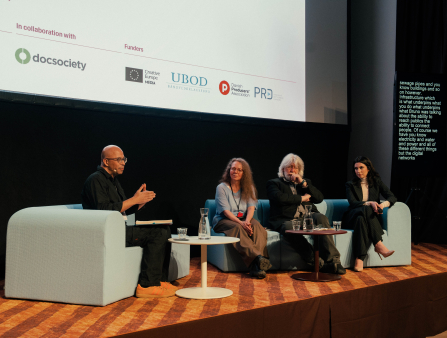
Sameer Padania moderates a panel at CPH:DOX SUMMIT with Bente Roalsvig, Bill Thompson, and Jad Abi-Khalil titled "The Act of Building: New Infrastructure For Information Ecosystems Under Siege." Photo credit: Charlottenborg Michael Kaack. Courtesy of CPH:DOX
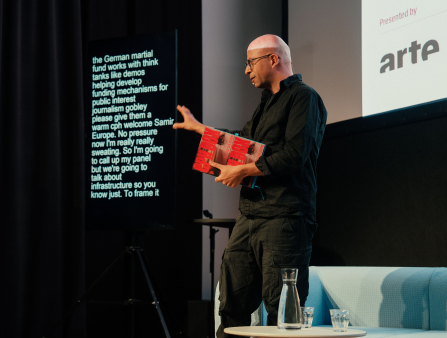
Sameer Padania at CPH:DOX SUMMIT 2026. Photo credit: Charlottenborg Michael Kaack. Courtesy of CPH:DOX
D: Are you hopeful that the political class is coming round to the argument for fortifying public broadcasting? And that the government will be bold enough to legislate for the long term and let go of its power over the BBC before that power could end up in the hands of its far-right opponents?
SP: We tried to look at instructive examples that already exist—policies or approaches that are close enough that allow you to say there is a policy menu; we’re not inventing incredible new things here. These are all already part of the policy agenda in different places, including in Britain itself. And that there are analogous approaches that can be adapted or at least serve as inspiration for the kind of unique reforms that will be needed in the media, information, and technology spaces. That was the impetus. That’s why it was super interesting to work with Demos on that.
I’ve worked across different parts of the media and information and technology space, from documentary to public-interest journalism to digital rights, big tech, and journalism funding. I’ve seen it from different angles. Each is almost always siloed from the others. They’re like, Yeah, of course we care about digital rights, but the really important thing is this, or, Documentary is the important thing, and we must develop policy that thinks from that.
For me, the interesting thing on an intellectual and a practical level, as an organizing principle, has been to contribute to and follow Demos’s work on epistemic security. You can explain that notion in different ways, but it essentially means how we know what we know as a society: how we can rely on knowledge, have a collective understanding, and debate issues. It used to be called “informed, inclusive debate,” but it brings together technology policy, politics, media, citizen literacy and involvement, the nature of democratic participation, broader knowledge institutions, and sectors like documentary. It provides a cross-cutting frame that shows why this is important and how it relates to their domain. It’s the big picture, the context that affects how we can operate as a democratic society, and how that affects the relationship between citizens and the state, citizens and power, citizens and information, citizens and their own rights. All of that is where we’ve been struggling to find an organizing principle.
“Epistemic security,” to me, is one of the most compelling ways to do that. Elizabeth Seger articulated the idea in a paper [“Tackling threats to informed decision-making in democratic societies”] for the Turing Institute in 2020. Then she moved to Demos in the aftermath of the US election to work more on that and show how it applies across many domains. Earlier this year, I became a Demos fellow, so I’ve seen how the concept has developed. Eighteen months ago, people would look at us and say, “I don’t even know how to pronounce that word,” and now it’s everywhere. [The previous BBC director general] Tim Davie used it in a speech a year ago. It’s a critical framework to understand the big picture and its applications: how to prepare, how to respond, how to collaborate, and who with. We used it a bit at the CPH:DOX SUMMIT as part of the framing of how we organized that day.
D: Should we be less surprised at finding ourselves in this position of epistemic vulnerability? Should we have strengthened the BBC’s independence before now? Why have we put up with charter renewals every ten years?
SP: There are others way better qualified to talk about the history of the BBC, but you can see people have raised issues of a permanent charter, BBC independence, citizen participation, many times.
Audience councils and things like that existed before, but they were led by trustees, organized by the BBC. The deliberative democracy field was embryonic at that point; whereas now, 10, 20 years later, you have an incredibly mature field with extremely well-codified ways of doing things, a ton of evidence. It’s not an experimental field anymore. [The UK media regulator] Ofcom did it online. We’ve had it in Wales, in Czechia; it’s happening in Germany, where these mini-publics are formed to try to understand what the public, as defined in deliberative terms, thinks about the relationship between media and democracy. It’s inarguable that those methods exist as a tool. It’s not controversial, and it’s different from internal, user, commercial, and market research done by organizations to understand the world, a product, or whatever. This is something qualitatively different about the nature and purpose of public consent and the public mind.
Things like that could have been done much earlier, sure, but I understand why they were put off. I’d be very disappointed if they were done by half measures this time. That’s what I fear more than anything, a “The BBC will run an experiment, and we’ll see how it goes” sort of thing.
There’s editorial chilling, decision-making within governance that doesn’t match what the BBC would do in a truly independent form if it weren’t worried about its own existence.
D: Can you elaborate on the virtues of a BBC with a permanent charter?
SP: There has been a change of governance with each charter renewal, and that is destabilizing. But this is why we tried with our proposal design to say that you need to create defenses around the BBC. Then, within that, say you have a permanent charter, everything else cascades from that, because the decision-making tree is very different than if you’re still having to sing for your supper every ten years, right? If you still have to persuade a government every ten years that you should exist, every twitch of every institutional component becomes a signal five years out: Oh my God, we’ve got to change this, we can’t upset anyone with that. These are known outcomes. There’s editorial chilling, decision-making within governance that doesn’t match what the BBC would do in a truly independent form if it weren’t worried about its own existence. It always has an eye to how this will play elsewhere. Even if it’s not [second-guessing itself], the perception is always there.
If you strip out that layer, you have freedom to experiment with forms of governance. You can say, We’re going to try this form; it may need to evolve, but we’ll do that as part of a strategic approach, not an external mandate. It’s not being done from the outside. The BBC should be in control, within the boundaries and accountabilities it has, and it can then evolve over time to meet the needs of the moment. Once the people who are part of the governance and deciding how it is funded are independent, you’re dissipating the current concentrations of power that distort how this institution argues for itself. But you need to create the primary defenses, which means that it can’t be dissolved without significant effort and public consent of some kind.
We talk in the report about [the 2010-16 Conservative chancellor] George Osbourne twice exerting his power over the BBC in problematic ways—distorting its funding, imposing cuts and burdens in exchange for its existence, in effect, and briefing the papers about it. That sort of chokehold is not good for the information environment, the creative economy, our national identity, or cultural output. You can’t expect an institution to maintain editorial freedom and consistency of output when it’s facing 30-40% cuts over 15 years, plus all this political instability and coercion.
In the last year, you can see the BBC has been emboldened by the signals from the government saying, Actually, think about what you need to be for the future. No guarantees, but what do you think is your role, your purpose as an institution? That can only come if you’re in an authentic situation where a government is willing to understand the long-term impacts of its decisions; that they’re not acting for short-term political opportunity or extracting political capital.
In the green paper, the government talked about these issues in quite an elegant way, and even brought a tear to my eye when it said, “This is not about market failure.” Mariana Mazzucato [a professor of the economics of innovation and public value at University College London] led an important research project on the BBC as a market shaper—what they termed “dynamic public value.” It’s how it anchors the creative economy, even bits of everyday democracy. And you see the BBC has been emboldened to talk about this a bit. That’s what happens when you have a government prepared to say, “Talk as if we want you to really be what you’re supposed to be.” Then you see momentum build.
So I hope they can genuinely give up the power and entrench the BBC’s independence because that’s the only safeguard that will work. If a parliament comes in, that’s sovereign, that has a majority: that’s how we work, you have to accept that.. You have to accept that. But they would have to go through the procedural friction to make sure there is public consent to [dismantling the BBC] and not just use political momentum to make changes for short-term gain. The institution deserves that protection.
My only worry then would be: What about its budget? If you’re looking at this institution through the frame of epistemic security, that it anchors and underpins so much of our creative economy, our knowledge ecosystems; we’re asking it to play a stronger role in relation to local media; it’s supposed to be commissioning and producing, in the UK and internationally, creative documentary, stuff that’s incredibly sensitive, to high standards of verification that drives international discussion and policy… all these things require resources.
There is, here and across Europe, an increasing desire to use technologies rooted in our laws, our values, our data protection, our boundaries.
D: What about the BBC’s traditional enemies on the national stage? Do you see any readiness there to defend the BBC in recognition of these arguments about market formation and international threat?
SP: I think you can look at public opinion. There’s polling about digital sovereignty. People understand the overweening power of the US tech companies. There is, here and across Europe, an increasing desire to use technologies rooted in our laws, our values, our data protection, our boundaries. There is an understanding of the instability and incoherence, but also of the US administration's priorities at the moment and how closely allied it is with big tech – as an economic prop but also as part of its broader agenda in the information environment.
Whether they express it through fears of misinformation and disinformation, declining institutional trust or faith, or a sense of instability and being unmoored in the information environment, people feel that something is not quite right. And there are people who try to exploit that politically, looking for division and telling people everything is broken. But what I see in the research is other people trying to ensure that people stay connected, trying to address polarisation and understand its roots, trying to address cost-of-living and community-organizing issues, and to find a sense of agency. I think the room to make those arguments is getting smaller. And part of that is due to the fact that people are linking this with the behavior of the US administration. It shows the value of good information and access to it.