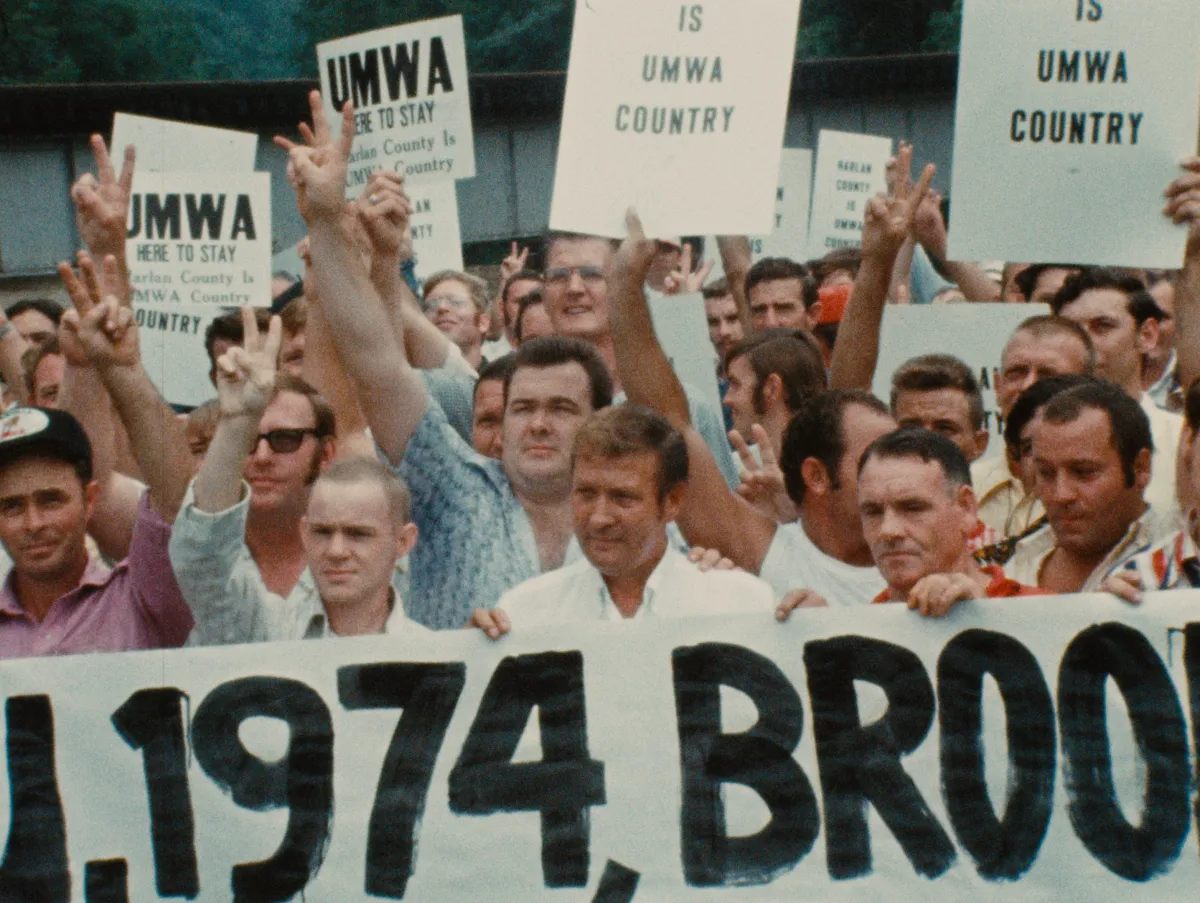


With Harlan County, USA (1976) and later still with American Dream (1990), documentary filmmaker Barbara Kopple established herself as fierce chronicler of labor organizing in the United States.
Her twinned portraits of long-running strikes, of coal miners in the 70s in Southeast Kentucky and of meatpacking workers in the 80s in Minnesota, remain resonant and timely. Just this past spring, digital restorations of both documentary classics were screened together in theaters across 22 cities in the U.S.
More than merely offering history lessons, they serve still as reminders of the power of collective unity. And, perhaps more pointedly, about the importance of chronicling such fights, no matter their eventual resolutions. The camera, as Kopple’s docs make clear, can and did serve as a helpful tool in these fights. But more importantly, perhaps, the intimacy and trust Kopple earned from those folks she chronicled is what makes these tales of labor organizing continue to feel vibrant and urgent in 2026.
With both of her films having arrived back in theaters this year, Documentary asked Steven Bognar, co-director of American Factory (2019), to talk with Kopple about those seminal labor docs and their storied histories. The two talked at length about what Kopple remembers of those two extended shoots, how she sees the labor movement changing in the 21st century, and what conversations these restorations have prompted at screenings all these decades later. This interview has been edited for length and clarity. —Manuel Betancourt
DOCUMENTARY: How are you doing?
BARBARA KOPPLE: Well. I’ve been doing this film on modern-day unionism for the last three years. It’s UPS and the Teamsters, and Amazon and the Teamsters, and the deliveristas—the people who ride the bikes and give you your soup or your medicine, or whatever, and they’re all undocumented. We haven’t been able to raise much money, but we’re doing it anyway. We did get a grant from Ford; it wasn’t very much, but it made us feel so good, like somebody cares out there about this. We’re in editing, and we’re close to finishing. It’s really hard weaving these stories together, but we’re doing it.
D: Your third huge labor film.
BK: Across generations. Fifty years, which is ridiculous. Fifty years!
D: You’re showing the restorations of both Harlan County and American Dream. What are audiences saying to you at those screenings?
BK: They love it. Even American Dream. That’s a tough one because they lose. I invited Ray Rogers [a then-freelance strike consultant who’s featured in the film], and he said, “It’s a darn good film, Barbara.” And Ray is still doing his corporate campaign stuff.
D: Are younger people coming up to you who had no knowledge of these stories?
BK: Yes, it’s mostly younger people who are coming and who are asking questions, and people who are in unions and want to know things. It’s good because I have union people up there with me, so they can say things.
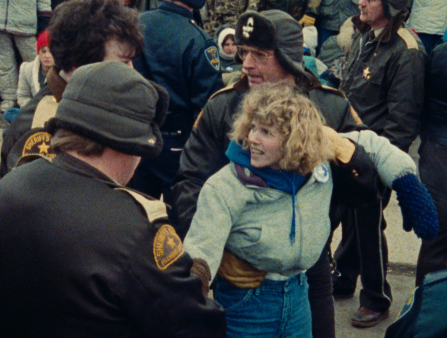
American Dream. Courtesy of Janus Films
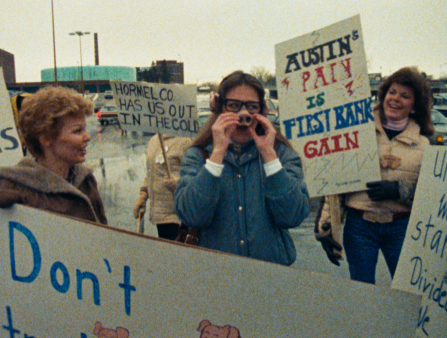
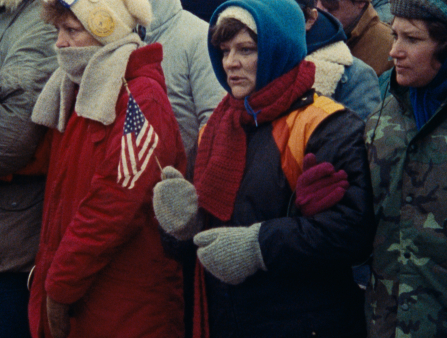
D: The militants that you chronicle, that you bore witness to, we need that now. When those coal miners are physically stopping those pickup trucks, the scabs trying to push through, they’re risking their lives.
BK: And one of them got killed, the company foreman. Well, the same with American Factory. What a phenomenal film that is. So much access. You got into everything, you really understood where everyone was coming from. What was the secret?
D: Studying American Dream. Your film was the secret. Because American Dream respects the divergent point of view of everybody. You put us in everyone’s shoes with an open heart and an unjudgmental point of view, which gives the film the Shakespearean depth it has. It’s like a great novel.
BK: Like American Factory. That’s exactly what you do.
D: One thing I learned from you is that you have to be comfortable with not knowing. You have to go along for the ride; you don’t know where it’s going or how long it’ll take, but you have to be present, loving, and non-judgmental.
BK: And live there. And be there.
D: —and highly observant, right?
BK: You have to know what everyone’s doing at every moment.
D: On the producing side, that is a huge part of the job that we don’t talk about very much. If you don’t keep in touch with everybody, you’re going to miss some big thing. Do memories come back to you of having to talk to everybody in Harlan County, or in Austin?
BK: Well, in Harlan County, everyone was there, so that was different, but if I left for two or three days to try to raise money, and have someone give us some film, or whatever, I’d call in all the time. But I lived there. I thought, Maybe I’ll never go back to New York again. Maybe these are my people. That’s how much I lived there.
American Dream was much harder, because it was the story of the international union, which had a different strategy than P-9, [the local union], and they just felt they had to bring everybody up to the same level, and the P-9 people saying, “My father worked here, my grandfather worked here. You gave us $10.69, and you’re taking it away, and people in the past have given you concessions, and this isn’t fair, and we’re gonna fight for safety,”—because the work that they do, standing shoulder to shoulder with these huge knives and everything, there are lots of accidents and loss of fingers, and just bad things. And then the P-10 people who went with Lewie Anderson, the union, and then the company. It was, Wow, what’s happening?
Being able to be there the day that the guys crossed the picket line was very big—seeing them in that room crying, and hearing that they can’t support their families. Minnesota guys are not the most open with their feelings. I went in the car with them. I got out before they went over, but I was down on the floor, and you could see the little top of my beanie or something doing sound, and the cameraman was in the back.
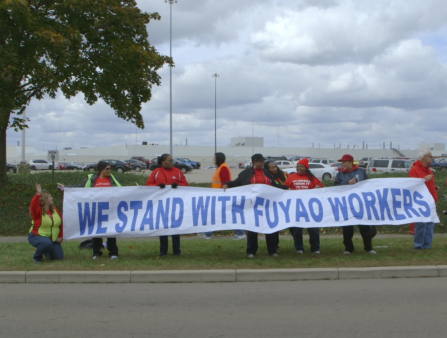
American Factory. Courtesy of Netflix
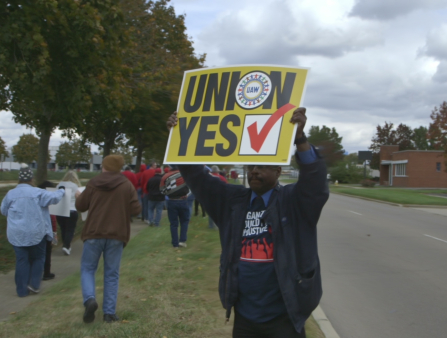
D: I’m so grateful for all your films. How do you walk around thinking about this body of work?
BK: I don’t. I go on to the next. If someone shows it, I’ll go, and I sit through it, because I want to know what people are thinking and feeling. I never leave. I sit there, no matter which film it is. It brings everything home to me, because I see who it influences now, or if it doesn’t, what they like, what they’re bored about, if they’re looking at their watch, whatever the feelings are.
D: You don’t walk around feeling like, Okay, I’ve made enough films, I’m good?
BK: Are you kidding? No! I have a wild sense of curiosity. I have tremendous energy. I love doing this. It’s so incredible to meet new people, to hear their stories, and then to be able to put it together and see how they feel about it.
D: You’ve worked with some of the great documentary DPs, like Tommy Hurwitz and Hart Perry. How do you build a rapport with your camera people? Are you whispering in their ear while you’re filming?
BK: I did sound for over 20 years. I also had wireless mics in Harlan County, because I put them on courtroom scenes. Duke Power, for example, said “Only camera or sound could come in,” and I’d already wired the women and the guys, so I said, “Okay, I understand, just camera can go in,” and I’m sitting there outside the room.
When I was doing sound, I’d have a headphone on [one ear]and then this [other] ear would be clear, and I could turn [my DP] around with their battery belt, right? And a circle [with my finger on their back] meant shoot, and a line on their back meant cut. Also, they’re all people I know really well, and who were great filmmakers on their own, so they know how to tell a story, and what’s important. And I always wear a Comtek, and they have to wear a Comtek.
D: So you can whisper to them?
BK: No, so I can hear everything that’s happening.
D: In your films, the dignity of the cutaway—of a human face listening and feeling something going on that will directly impact their lives, their children’s lives—you just have this understanding that listening and taking something in on a person has so much power.
BK: I just love people and care so much about them, and want to know everything that they’re going through. And if they’re not telling me, I want to try to open them up so that they will. Trust is the biggest thing that you can have. Trust and access.
D: I hear you ask very direct questions on the soundtracks of these films, and then you just give people space. We can learn so much from that simplicity.
As you’re making this third great labor film, have you seen the militants that we see in Kentucky or in Minnesota on the streets where you’ve been filming?
BK: Well, in the Amazon part, they did a strike for six days before Christmas, and two people were arrested. It wasn’t the violence of Harlan County; nobody had guns or anything like that, but lots of pulling and shoving and that kind of thing.
D: Do you think we need to be more militant if we’re fighting for a union now?
BK: We need to be militant, not violent, because there are too many excuses to hurt people, and we don’t want anybody to be hurt. We need strong thinking people out there doing things; so militant, yes; violent, no.
I just love people and care so much about them, and want to know everything that they’re going through. And if they’re not telling me, I want to try to open them up so that they will. Trust is the biggest thing that you can have. Trust and access.
—Barbara Kopple
D: You’ve been immersed in current labor struggles. How are you feeling about the state of the labor movement, and the lives of working people, their potential?
BK: They have so much passion and so much hope, and they’re not going to drop it. They’re not going to stop. They go through small down periods, but then they pick themselves right up and go back to it, so I have a lot of hope and a lot of good feelings about what’s happening. They’re fighting tremendous corporations on this industrial front.
D: Corporations are even more sophisticated now than they were back then. The Amazon Staten Island folks won a union, but Amazon’s yet to start contract negotiations; they’re just stalling.
BK: As one wise guy said, this guy Tony, who’s a teamster, “You don’t drink the champagne until you get a contract.” Just voting in a union doesn’t mean anything until you get the company to sit down with you.
But people change. People see that they can do something, and they become politicized, and they understand that life doesn’t have to be this way. The deliveristas in my film—Workers Justice Project, which is the company that I’m doing it under—they’ve won three victories already, and they’re this itsy bitsy little organization, and that gives me so much hope. And they have nothing. They have to buy their own equipment. They are independent contractors. They’re numbers. So are the Amazon workers: numbers. Nobody cares about them, and if they’re fired, even if it’s not their fault, there’s no one to talk to. But now, one of their victories is that they have a right to appeal, and they have 120 days before they can be dismissed, so good things are happening.
I started out filming American Dream in this town of Worthington, Minnesota, where an Armour plant was closing. One of the first days, I was shooting a husband and wife. The wife was saying, “I’m just so sad, I don’t want to leave my house, I don’t want to leave my friends,” and the husband said, “But honey, we’re going to another Armour plant, and we’ll be working, and you’ll make new friends, and you’ll keep your friends.” And the phone rang, and he went in and answered it, and he came out, and he burst into tears, and he said, “All the Armour plants are closing. There’s nowhere that we can go.”
It didn’t make the film. That was so depressing. I would come back from filming there and think, There’s just no hope here. People were loading up their trucks, and it was like The Grapes of Wrath, leaving to go to Texas and to go to other places. Then I heard on the radio, 90 miles away in Austin, Minnesota, “We’re not gonna take it anymore!” And boom, off I went.
D: It is never-ending, right? Coretta Scott King said, “Struggle is a never-ending process. Freedom is never really won, you earn it and win it in every generation.” The way capitalism just wants to push people around will never stop, and it’s up to us to fight back.
BK: Doing films, it’s up to us to let people know who these people are, so that they’re not anonymous or silent. And then people change, and if they hear your story and they see what you’re fighting for, maybe that helps them to turn around and to help out. I showed Harlan County a long time ago in Dallas, and this woman stood up, and she said, “I’ve been a Republican all my life, but this film, you’re making me think about it, and I may change my mind about unions.” That’s the reason why we do it. We do it so that their history will never be erased, and we do it to change people, or at least get people to think about what’s going on out there.
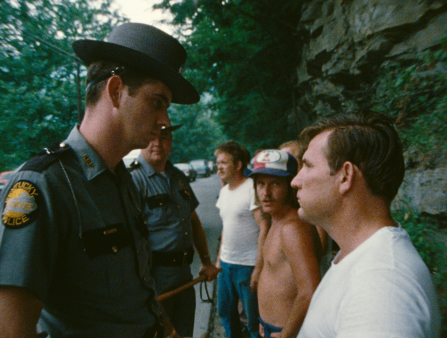
Harlan County, USA. Courtesy of Janus Films
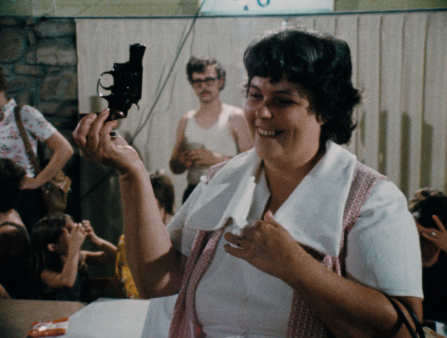
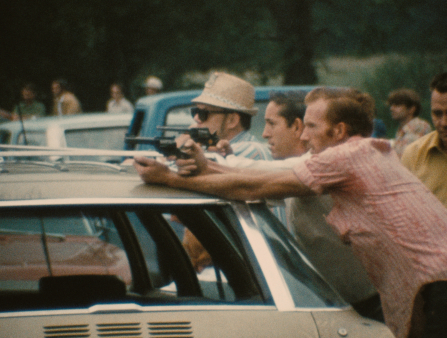
D: Do you ever think you will retire?
BK: No. Do you think you will?
D: No.
BK: Why? What would we do? No, of course not. I also love working with new young filmmakers who have so much spirit and hunger to do things. No. Never. As long as I can walk and talk and think.
D: Fred Wiseman was making films into his nineties.
BK: For me, he and [Albert and David] Maysles and [D. A.] Pennebaker were all mentors. I was going to school when [Wiseman] was doing Titicut Follies [1967], and it was censored everywhere, except for one theater in New York, Cinema Village. I took a train from Boston—I was at Northeastern University—to go to see the film, and it was just amazing to see what they do to people in institutions. I was studying clinical psychology at the time, so it was perfect. When I saw his film, I just knew that that was what I wanted to do.
The Maysles brothers, who I worked with for a long time as an intern, would have everybody come in for all their screenings, and every voice was counted, and it just gave you such confidence that one day you might be able to make stories like this.
Penny was incredible when I had a rough cut of Harlan County. I wanted to show it, and I didn’t want to show it, because I was scared. It was a double system, [picture and sound running on two separate reels]. That’s 16mm. I called him up and said, “May I use your projector and your screening room?” and he said, “Of course, come on up,” and he filled the room with filmmakers. Charlotte Zwerin, Susan Steinberg. So many people that I really looked up to at that time, and he was just so supportive and so amazing.
I have a photo here that Richard Avedon shot of me.
D: I know that photo! You, and Wiseman, and Penny, and Albert.
BK: And I’m squished to the end.
D: I love that photo. That’s like Mount Rushmore of documentary.
BK: I look at it and think these are the three people who really helped me and mentored me. I’m looking at it right now.
D: You navigate the labor world, the corporate world, coal miners, meat packers, and the documentary world. How did you face the maleness of both the worlds you’re filming and the documentary and film business?
BK: It’s easier to be a woman doing documentaries because people aren’t intimidated by you. When I was doing a film on Mike Tyson, I would talk to different boxers and journalists and whoever. A guy would have to really know all of his stuff, or he wasn’t a guy, but a woman; they consider that we don’t know anything. We could ask touchy-feely questions, or just rudimentary questions, and they open up, and they answer.
Unless they’re a sensitive new age guy like you.