

An estimated 80,000 people disappeared during Sri Lanka’s twenty-six-year civil war (1983-2009), fought between the Sinhalese-majority state and the separatist Liberation Tigers of Tamil Eelam (LTTE). The country’s minority Tamil population bore the overwhelming brunt of state violence and wartime atrocities. Sri Lankan filmmaker and artist Rajee Samarasinghe’s feature debut, Your Touch Makes Others Invisible, which premiered at the International Film Festival Rotterdam in 2025, is set in the country’s Northern Province, amid former LTTE strongholds now under the de facto occupation of the Sri Lankan military.
Blending interviews, fictional re-enactments, and surreal tableaux, and collaboratively enacted by members of the affected communities, Your Touch adopts a hybrid approach to capture a traumatic chapter in Sri Lanka’s history that successive governments have actively suppressed. The feature documentary builds upon a decade of short films exploring memories, rituals, and landscapes that continue to bear traces of the war, a body of work for which Samarasinghe was awarded a Guggenheim Fellowship just last year. Across these films, Samarasinghe has moved fluidly between staged performance, poetic observation, hand processed film portraits, and avant-garde experimentation, developing a distinctive cinematic language that persistently interrogates both the documentary impulse and the ethics of the ethnographic gaze.
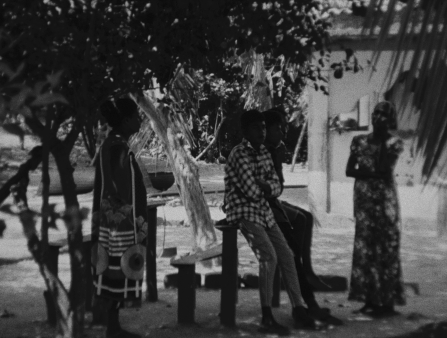
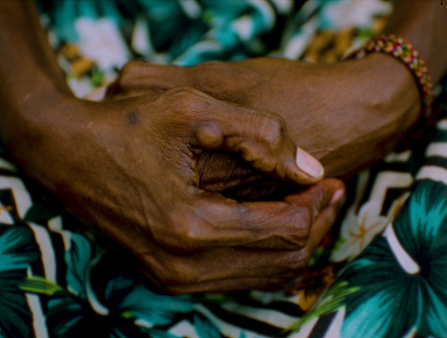
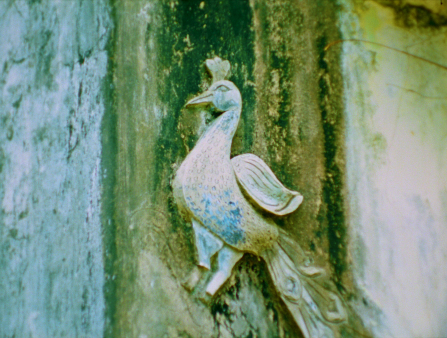
Samarasinghe’s latest short, A Flower Falling Back Into the Earth (2026), emerged from footage originally captured for Your Touch, and premiered in competition at this year’s Oberhausen Short Film Festival. Built around the testimony of a Tamil mother whose son vanished during the war, Flower eschews exposition in favor of a more elusive and self-reflexive approach: image and sound are often in dissonance; sequences unfold associatively rather than causally; and the testimony itself is rendered without sound.
Following a brief conversation with Samarasinghe at Oberhausen, I later spoke with him over Zoom for a more detailed discussion of Robert Gardner and Laleen Jayamanne’s impact on his work, how he’s navigated censorship and surveillance, and why he appreciates and insists on the imperfections of documentary form. This interview has been edited for length and clarity.
DOCUMENTARY: I thought we could start with the woman’s testimony. You’ve mentioned that there was something about this testimony that resisted you, and which you could not fit into your feature documentary.
RAJEE SAMARASINGHE: When I was editing, it became clear that this particular testimony was acutely drawing attention to the distance between me and the subject, and it was doing that in a powerful way. Every time I put it in the edit, it seemed to destroy all the other testimonies. This particular testimony was also quite emotional; she kept crying throughout. It spoke to a lot of the anxieties I was having during the shoot and the edit. About representation, and the gaze of a nonfiction filmmaker.
D: You also have these sequences, including B-roll footage, which keep circling around the testimony.
RS: The B-roll featured in the film was shot on the same day. I briefly spoke about this in Oberhausen, about the violence of the filmmaking act, especially when you’re capturing such sensitive material. When you actually reflect on what you’re doing, it’s almost like, Okay, we now have to take close-ups of this woman in anguish. The whole film is talking about the violence of the cinematic gesture.
What interests me is not documentary as a claim to truth but as a form always negotiating construction, presence, and failure. I suppose that’s why I lean into experimentation, because it’s a perpetual process of discovery and learning.
—Rajee Samarasinghe
D: Did the difficult shooting conditions for Your Touch also have something to do with the form of the film?
RS: The military essentially occupies that area even today, and in order to get access to shoot there I had to disguise what I was doing. The script I submitted was basically all the fictional elements in the feature without the documentary elements. It was an abstract film that didn’t make much sense. But they were always very suspicious of what we were doing. We had to shoot the testimonies secretly whenever we felt we weren’t being surveilled. The testimony in the short film was one of the more dangerous ones. It was in a village where literally every family had suffered a disappearance. But for me, that is almost less interesting than what the film is ultimately concerned with: this human act of confronting, of framing another human being and trying to represent their pain, which seems unimaginable, rather than the mechanics of filmmaking.
D: How did you become interested in nonfiction cinema?
RS: I started way back. I was thinking a lot about the colonial gaze and linking that to the gaze of the ethnographer. I made a few short films [If I Were Any Further Away I’d Be Closer to Home (2016); The Spectre Watches Over Her (2016); Exile (2018); The Eyes of Summer (2020); Misery Next Time (2021)] that addressed this, specifically in relation to South Asia. I’m drawn to documentary nonfiction because I think it’s an imperfect form that is constantly falling apart and failing at what it is supposed to do. I find that collapse very interesting.
D: Could you elaborate on that?
RS: What I mean is that documentary is always in a state of instability. The world is never fully available to the camera, nor is a person. A place, an event, or a testimony can’t really be held in place by a film without something being lost, distorted, or transformed. So the form is constantly collapsing under the weight of what it is trying to contain. What interests me is not documentary as a claim to truth but as a form always negotiating construction, presence, and failure. I suppose that’s why I lean into experimentation, because it’s a perpetual process of discovery and learning.
D: Across your films, I see a tendency for both lyrical observation and formal experimentation. How do those two impulses relate to one another?
RS: I don’t necessarily make a distinction. I think I’ve made films that are both lyrical and have a lot of formal experimentation, sometimes even within the same work. With Flower, I think it’s more useful to look at the film in the context of a formal documentary practice, where it gets a lot of interesting, even hostile reactions. The film is, in a sense, attacking the documentary tradition.
A Flower Falling Back Into the Earth.
D: What was the thought process behind removing sound from the woman’s testimony?
RS: That goes back to underlining the distance. I was hyper-conscious of the palpable distance between us in that moment. The silence had a real presence. I felt that including her words would make the encounter too available—too easily consumed and translated into explanation or evidence. I am instead asking the viewer to sit with the residue of the encounter: the absence, the rupture, the pain, and the fragility of the encounter. So it’s a kind of physical or corporeal approach to testimony, but there’s also a very human and spiritual aspect to it.
D: I recently watched one of Stephanie Spray’s films shot in Nepal, which also withholds access to its subjects by refusing the use of subtitles. Your use of silence seems to be attempting something similar.
RS: Even that other film from the Sensory Ethnography Lab, which is an entirely sonic piece, Ernst Karel’s Expedition Content (2020). You’re forced to reexamine and reorient your relationship to cinema as a spectator.
D: It also connects to Robert Gardner, who is a foundational figure in visual anthropology, and whose text you use as voiceover in the film. How did that come about?
RS: Lucien [Taylor] had come to CalArts while I was studying there, and he showed one of Gardner’s works from the archive. It was a short piece where Gardner films a woman dying. It was quite shocking, but it also fascinated me. The thing about Gardner was that he was a great filmmaker. There’s a paradox there, because I admire his work, but I’m also horrified by it. There’s one particular passage I pulled from his memoir, The Impulse to Preserve [2006], which seemed especially resonant to this particular film. Some of the images that I shot, right down to the butterflies, seemed to match—almost cosmically. Gardner is always someone I think about. But this is the first piece where I’m explicitly addressing him because I found that passage really brutal but also quite beautiful. There’s a kind of coldness to his words—and a beauty.
D: Also something violent…
RS: Extremely violent. In the way he talks about the camera and the filmmaking process. It’s quite unreal. I think he’ll always remain a fascinating figure to me.
D: Despite or precisely because of these anxieties, your films remain quite collaborative.
RS: Yes, they’ve been highly collaborative. I told the community members that I can’t tell their story the way a journalist would, but I have a certain power to bring this to audiences in a cinematic context. I think films become so much richer when you are open to collaboration, specifically in a documentary context.
A Flower Falling Back Into the Earth.
D: I was also wondering about South Asian influences. I couldn’t help but think of Laleen Jayamanne’s A Song of Ceylon (1985).
RS: I mean, that’s the one, right? That’s a film that’ll follow me all my life, probably to my death. I guess my film The Spectre Watches Over Her is a direct reaction to that work and that entire history. It’s a very important film. It’s just ever-present.
D: As a Sinhalese filmmaker making a film on the Sri Lankan Tamil community, were you constantly aware of the power dynamic?
RS: Always. In the feature, I opened the film by saying that this film is from my perspective; it’s inextricable from it. The feature is maybe less conscious of this, because I wanted the feature to be about the testimonies. Whereas the short is very much about the distance. When you’re actually on set, those barriers dissolve away, and you’re just human beings talking to each other. But you can never really get away from it, and that’s what the short is addressing.
D: I’d also like to touch upon festival censorship. I was programming for the International Film Festival of India when Your Touch was denied a censor exemption last year, and I don’t believe it has been screened anywhere in South Asia. As a nonfiction filmmaker working with politically sensitive material, how do you view such restrictions?
RS: It’s become very tricky. It has a lot to do with the politics of festivals and the shaping of a certain perception, what they want people to consume. Festivals are generally becoming more and more risk-averse. Even beyond politics, just with formally adventurous films. You don’t see too many of them at festivals anymore. Filmmakers also have a responsibility to fight this. It's one thing to finish a film, but the less talked about thing is that you also have to really push these difficult films out there, and promote these discourses all over the world.
D: Your films also seem deeply concerned with contemporary spectatorship and our everyday relationship to images.
RS: That’s true. Many of my films talk about anxieties around spectatorship, the failures of spectatorship, and of contemporary visual culture. It’s this extremely cold engagement with humanity. That’s also sometimes an issue I see within the experimental film circuit, an abundance of formal flourish and experimentation, oddly enough, even in progressive experimental spaces. Maybe even in Gardner’s work. It’s not how I like to do things. It goes back to failure and why I find the failure so interesting. The failure of the form.