

In 2026, “contraction” is the word du jour in the U.S. Over a billion dollars have been rescinded from the Corporation for Public Broadcasting; ITVS is working at reduced capacity; grants have been canceled at the National Endowments for the Humanities and the Arts; programs aiding marginalized groups have suffered major cutbacks due to DEI crackdowns; and local public sources of funding are shrinking to the point of collapse. In Europe, a rise in right-wing governments, all too eager to gnaw at the already flimsy edges of public funding, has set off a similar red alert. The core sentiment, however, is the same: it’s a farewell to the already brittle status quo.
When publicly funded pots dry up, and federal and state support disappears on the whims of unpredictable governments, it is the phones of well-endowed individuals that begin to ring off the hook. Honing in on the current status of private capital in the U.S., the numbers show the opposite of the feeling of scarcity that plagues the film industry. “Although government funding has been cut, there is also much more money coming in from individual donors and philanthropy,” notes renowned producer and Women Make Movies founder Debra Zimmerman.
“Most of these funds are not really accessible to most filmmakers, because they are based on personal relationships,” Zimmerman points out, noting how already wealthy creatives will continue to benefit from personal connections and families that often have foundations themselves. At a time when a healthy stock market pumps cash into expanding donor-advised funds (DAFs), teacher-turned-philanthropist Maida Lynn hits the nail on the head: “The contraction is in access; it’s not in financing.” Lynn has a rare vantage point as a donor working specifically in film, an experience she has recently turned into The Backlight, a newsletter that dissects the indie film industry through a nonprofit lens.
When individuals can no longer rely on governing bodies, institutions, and well-endowed donors, what pathways are there for financing meaningful work by those who are working-class or less well-connected? Earlier this year, during its biannual Get Real Conference, IDA hosted a panel that interrogated the collapse of traditional funding systems and the emerging alternatives on the scene. Titled “Follow the Money: New Economic Models,” the panel featured managing director of the Ujima Fund, Julia Parker, who spoke on behalf of an organization that has constantly sought to address some of the concerns regarding this ever-glaring power imbalance. While on stage at the conference, the exec described the Fund’s ethos with a “simple premise”: “The people most affected by economic decisions should have meaningful power over those decisions.”
Founded in 2017, the pioneering Boston Ujima Project is a member-run organization building cooperative economic infrastructure in Boston, with a clear mission to return wealth to working-class communities of color. In the early days of the organization, the BUP launched an investment pilot that crowdfunded $20,000 to be lent to five Black and immigrant-owned businesses in Boston. Five years later, they reached their $4.5MM deployment capital goal and subsequently launched the Boston Ujima Fund, which they tout as being the first-ever democratically run investment fund in the U.S.
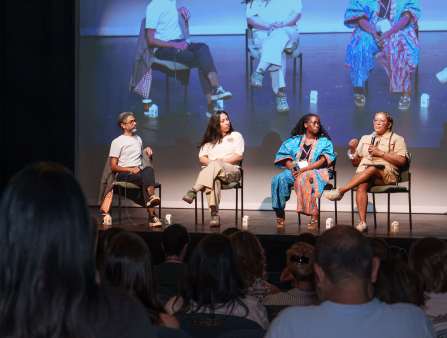
Sanjay Sharma, Grace Porras, Tiny Mungwe, and Julia Janai Parker in the “Follow the Money: New Economic Models” panel at GR’26. Photo credit: Urbanite LA.
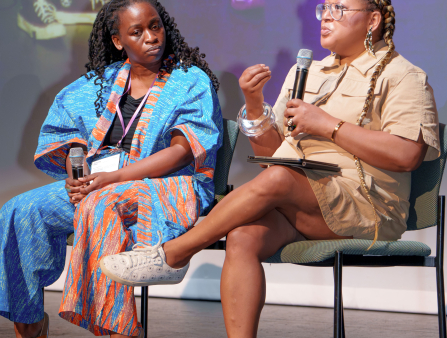
Filmmaker Tiny Mungwe and BUP's Julia Janai Parker in the “Follow the Money: New Economic Models” panel at GR’26. Photo credit: Urbanite LA.
The fund is structured by three pillars: investment democracy, equitable returns, and community economics. This means all investments undergo rigorous due diligence, with local assemblies evaluating prospective candidates and democratic voting processes choosing beneficiaries. The model is also pioneering in how it approaches equity through the lens of equivalence, prioritizing returns for working-class investors and supporting “reasonable” returns for wealthier investors who prioritize impact over profit. Finally, the fund takes a holistic approach to economics, focusing not only on direct cash grants but also on hands-on technical assistance, offering a wide portfolio of resources for growing local businesses.
In practice, the BUP model is similar to a credit union, where each voting member gets one vote—regardless of the size of their investment. Voting members are current and displaced working-class and/or BIPOC Boston residents, partner organizations, community business owners, and their employees. The voting members also elect the Community Standards Committee, responsible for setting investment criteria and monitoring the progress of all fund recipients.
Alongside its members, the Fund has a Community Standards Committee, Business Alliance, and Grassroots Partners, responsible for reviewing recommendations from assemblies and conducting due diligence. Their findings are then presented to voting members during assemblies, who can vet the proposals or request more information within a two-week window. Once feedback is presented to applying businesses, they have the chance to prepare a second presentation for the committee. Any investments must be approved by a majority vote of the duly constituted quorum of the voting members. Once that is reached, the proposal is sent to the BUP’s fiscal sponsor, the Center for Economic Democracy (CED), for final approval, which oversees fiduciary compliance and ensures all recipients align with the Fund’s mission.
BUP deputy director James Vamboi recalls how the organization felt like an opportunity to ensure “community members were not reliant on institutions or governments to fund their dreams and possibilities,” as well as a chance to “build a vehicle that, in partnership with other funding vehicles, could provide another avenue for capital.” Most pointedly, what the Ujima model could offer was a somewhat radical reversal of the thought process behind mechanisms like DAFs: a purposeful desire to not only be accessible to benefactors, but to work on a proximity that would allow the organization to gather a deep understanding of its members—and, subsequently, have a wider grasp of how to cater for their needs.
Vamboi notes that many other funding vehicles don’t have a community, let alone community knowledge. “They don’t have artists; they don’t have creativity in the ways they have cultivated relationships or told stories that people could resonate with.” While budding investors and creatives were systemically beholden to institutions with the final say over what they could build, the Ujima model takes the opposite approach, forgoing traditional credit scores and the burdensome bureaucracy of classic loans in favor of building an engine that runs counter to the “capitalist funding mechanism.” “We are building something that is collectively owned and distributed,” emphasizes Vamboi.
It’s important for us to understand cultural bearers as a distinct class of worker but not separate from how we speak about and think about the working class.
—Cierra Peters
Drilling down into the nitty-gritty of delivery, Parker notes similarities between the Ujima model and more traditional loan funds. Repayment is expected within the lifespan of the fund, a period of between six and ten years. If it’s an equity investment, however, the fund does not expect repayment above and beyond the initial principal. “We are not your typical venture capital firm that is looking for a ten-times return,” she underlines. “We are just looking to return the principal, and if there’s an upside, great. If there is not a liquidity event, it is what it is.”
The Ujima Fund was carefully structured to address the needs of its community, with an initial focus on small businesses and real estate. So what happens when members decide to invest outside of those constraints? Could the same model work within the somewhat flimsier world of film? Experimenting within the firm lines of due diligence would result in additional work and rounds of consultation. When it comes to funding artists, then, the Boston Ujima Project has shown the great advantage of malleability, potentialized by a natural inclination for trial and error—but it is still early days for any concrete verdict, given that the organization has only recently begun broaching how its model can be adapted to accommodate this new avenue.
In 2021, at the height of the COVID-19 pandemic, the BUP held its inaugural Ashé Ashé Cultural Assembly. The gathering and grant program provided space and financial support for local BIPOC artists, cultural workers, and organizers to nurture local creative ecosystems. The original assembly culminated in a collaborative grantmaking process supported by art-serving institutions and then led by community members, who voted on how to distribute $60,000 in grants to local artists. True to the ethos of the BUP, the now biannual process includes financial and political education workshops centered on specific aspects of cultural and economic practice, policy, and movement building.
Speaking to the thought process behind the creation of Ashé Ashé, Cierra Peters, the director of communications, culture, and enfranchisement at the Boston organization, notes that the event evolved from an understanding of “artists and culture bearers as economy builders and as central to the movements we are building.” As she tells Documentary, “It’s important for us to understand cultural bearers as a distinct class of worker but not separate from how we speak about and think about the working class.”
Vamboi reiterates how the Ujima Fund “exclusively supports businesses” at the moment, but the BUP has the “ability to stipend artists through our own general operating funds.” This is because the organization believes, as he insists, that “artists are economy builders and should be treated in the same way [as] other industries and professionals.”
We are thinking about how we can build a home for artists to receive consistent funding so they don’t have to apply every year. This sort of product-based funding is exhausting and doesn’t make sense.
—James Vamboi
A similar logic informed the Ford Foundation’s participation in Ava DuVernay’s 2023 biographical drama Origin. When the lauded American filmmaker exhausted traditional funding avenues for her biographical drama, her then-head of development at ARRAY, Regina Miller, went knocking on philanthropists’ doors. She first called Ford Foundation president Darren Walker, who connected her to Roy Swan, the head of Ford Foundation’s Mission Investments team. “He saw the beauty of the new model we wanted to create, a hybrid blend of philanthropic and social impact investing dollars,” said Miller to Forbes at the time. DuVernay’s film received an estimated $10 million from the Mission Investments pot, rather than going through Ford’s film-focused JustFilms platform.
In this scenario where increasingly malleable funding meets an urgent desire to see creatives as working professionals, we circle back to questions of access and the looming obsolescence of the grants model. Should we use this moment of disruption to transition away from the overbearing administrative load that underpins access to primarily small pots? Earlier this year, Ireland launched a groundbreaking scheme, the Basic Income for the Arts (BIA) initiative, providing €325 ($380) a week to 2,000 eligible artists in three-year cycles. Other European countries are flirting with similar models, with the livelihood of filmmakers taking center stage at major forums such as IDFA in recent years.
Stabilizing continued support in place of the precarity of the grants model is a priority for the BUP team. “We are thinking about how we can build a home for artists to receive consistent funding so they don’t have to apply every year,” relays Vamboi. “This sort of product-based funding is exhausting and doesn’t make sense.” Ujima executive director Nia Evans doubles down on this sentiment, reiterating the organization’s push to stretch what support to artists looks like: “In addition to funding businesses, in addition to thinking about decision-making with community members, I would say that’s a priority for us: developing systems of support for artists that are neither exploitative nor extractive.”
Organizations operating within these lines have a clear vision of the minutiae of their mechanisms, but those looking to both engage with their work and access their resources can’t quite put their finger on what tips the scales for each denomination. This is when knowledge sharing becomes crucial—if pioneering work happens in a silo, there is no chance of contagion.
In that sense, Ujima proves once again to be ahead of the curve. After years of being flooded with meeting requests from parties curious as to the organization’s structure and how to replicate it, the BUP launched the Ujima Translocal Membership Project. The action-oriented initiative is designed to “support like-minded organizations” across the U.S. in their “efforts to build sustainable, community-driven economic models.” The program, which operates on an invitation-only basis, has welcomed groups such as New York City’s Growhouse, Memphis’s Center for Transforming Communities, and Houston’s We Are the Ones.
There is definitely something very interesting happening around not using philanthropy as a band-aid to make up for all the market failure, but to address the root causes of that failure in the first place.
—Maida Lynn
Prodded about the most common questions directed at the BUP, Vamboi notes a recurring interest from both individuals and groups in learning the “technical infrastructure to build a fund that can be democratically governed to support businesses.” Frequent conversations revolve around the intricate details of how to build an investment vehicle, with Evans noting that the team often receives questions not just about the design of the fund but also about the process of setting up one like it.
Evans highlights a curiosity around working with investors, too. “Why do they invest? What are their expectations? We’re a membership-based organization, so we also get a fair amount of questions about how we’ve built our membership and got people interested in the project,” she adds, with Vamboi emphasizing that, alongside a thirst for technical knowledge, lies a genuine curiosity in how to best engage the local community. “A lot of people reach out to ask about building membership and getting people to support and participate in their efforts,” says the deputy director.
This piling up of curiosity and an increased desire to understand alternative community-led working models, without foregoing the potential for sustainability and longevity, speaks to a trend Lynn has noticed in her philanthropy circle. “There is definitely something very interesting happening around not using philanthropy as a band-aid to make up for all the market failure, but to address the root causes of that failure in the first place,” she says. “I do fantasize about a filmmaker-led financing mechanism that could have a say in what stories get told. It’s not even crowdfunding; it’s crowd-based filmmaking.”
One could argue that the reason Ujima’s approach to supporting artists is proving successful—at least for the present moment—is that it stems from a broader umbrella of business-based support. Instead of looking within its own bubble, filmmaking can perhaps learn from other business models also undergoing hardships in a time of generalized financial and political duress. While confusion still reigns at the crossroads of scarcity and innovation, there is also hope in knowing many are actively looking for a piece of the answer—and that answer, the BUP has shown, may very well lie in how we share our findings with our communities.
Reporting made with the valuable contributions of Ryan Harrington, Leah Natasha Thomas, Alison O’Daniel, Jessi Gutch, Reece Cargan, and Transform Finance.