

With their Sheffield DocFest premiering Time Machine Maidan (2026), co-directors Volodymyr Tykhyy and Roman Liubyi look back on both the major geopolitical event that shaped the fate of their country and the origin story that kickstarted their own lives in documentary filmmaking.
Among the protesters who filled Kyiv’s Maidan Square in November 2013, following the pro-Russian president Viktor Yanukovych’s refusal to sign the European Union Association Agreement, a small group of filmmakers from diverse backgrounds gathered with cameras in hand, convinced that documenting what was unfolding was as much their responsibility as protesting it. Filming the first days of protests, they quickly edited the footage, added English subtitles, and made their first anonymous upload on a YouTube channel. That two-and-a-half-minute film Prologue (2013) documents people’s testimonies and outrage; it served as a counter archive of what was happening, a correction to how the protests were being covered by media. As its video description states: “after the merciless beating of students on the EuroMaidan, patience of Ukrainians ended. Civil society, its protest, and cinema were born.” Prologue marked the birth of the documentary cinema collective known as Babylon’13.
Over the twelve and a half years that have followed, Babylon’13 kept filming history while making it, following the escalation from Maidan to the annexation of Crimea and conflict in Donbas, all leading into the ongoing war. Their body of work now includes more than 750 documentary shorts and over a dozen features, made by dozens of members rooted across many layers of Ukrainian society, witnessing and in many ways shaping the very evolution of Ukrainian war documentary. In that sense, Time Machine Maidan is aptly titled: the directors present the project as a literal time machine that transports us back to where it all began, offering a history of the collective and Ukraine’s resistance efforts in equal measure.
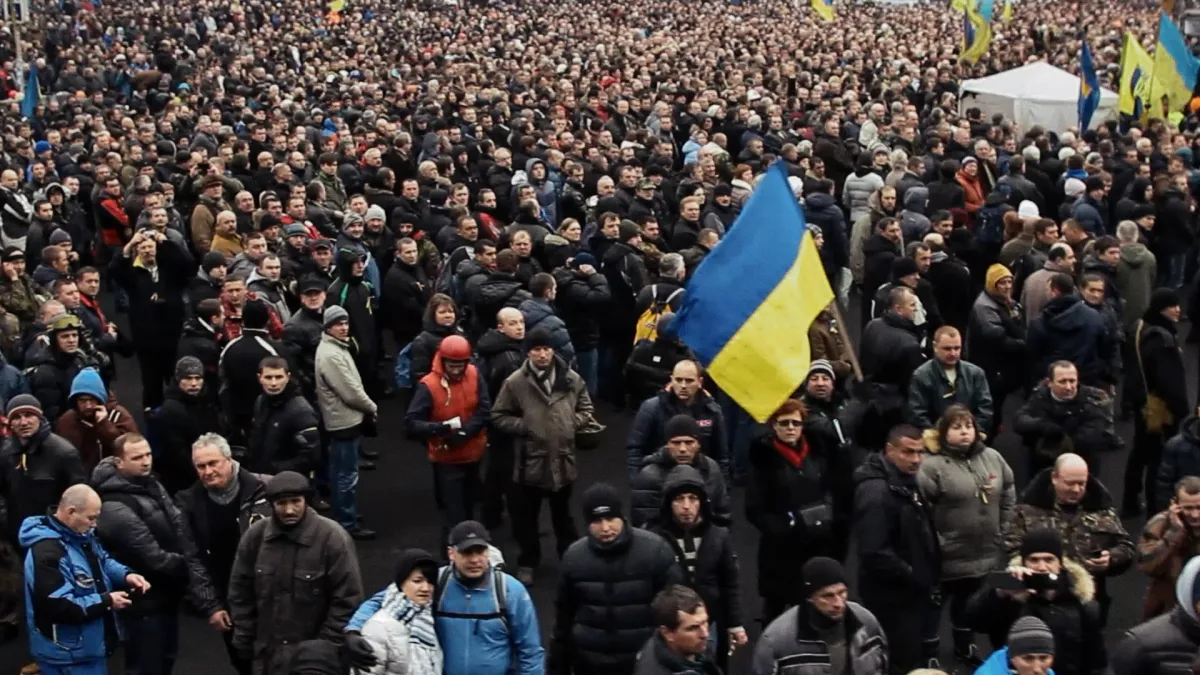
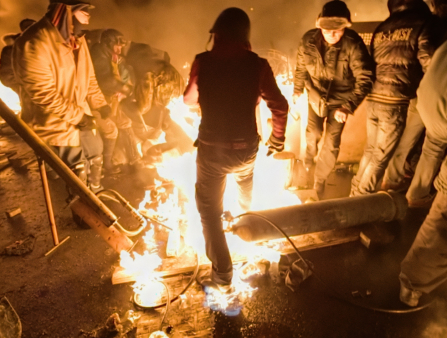
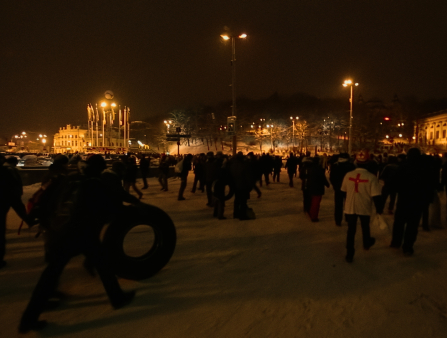
Told through the fictionalized consciousness of a young soldier wounded on the Donbas frontline in 2023, the film depicts how his uncertain passage between life and death plunges him a decade back in time, amidst protesters at the onset of the Revolution of Dignity. As if inside a video game, the hero drifts through fragments of archival footage, gradually learning the Revolution through the shifting gazes of documentarians. He passes from peaceful marches filmed within the crowd to protest tents where the handheld camera catches jokes traded over Molotov cocktail-making, then out to overwhelming wide shots of hundreds of thousands filling Maidan Square. At one moment, he arrives at a meeting point marked by a sign reading “For Those Who Got Lost,” prompting the wry remark: “Oh, that’s probably for me!”
Amid the crackling energy of the crowds on Maidan, his voice-over responds with irony, curiosity, and awe, as he reflects on Ukraine’s post-revolutionary generation and the independence he himself continues to defend at full scale.
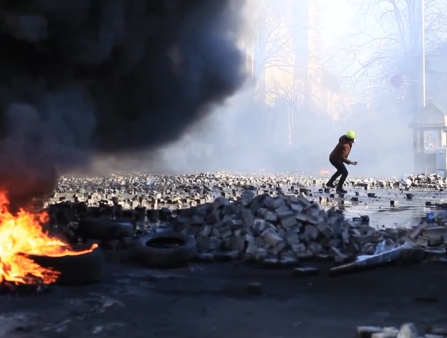
As the uprising radicalizes, cameras carry him into the burn, where their operators dodge bullets without ever losing command of the frame. Later, a sequence inadvertently recorded at fifty frames per second follows a camera rushing through the aftermath of a brutal street combat, its broken pace imbuing the closing images with an almost oneiric plasticity. Throughout the film, the recurring image of a Jenga tower becomes a metaphor for Babylon’13 itself. What initially appears to be an eclectic montage reveals the collective’s underlying harmony: a plurality of subjects, visual idioms, recording technologies, and degrees of participation, all held together without dissolving the individuality of the filmmaker behind each image.
Time Machine Maidan.
The formal distance between the raw immediacy of Prologue and the surreal and reflective core of Time Machine Maidan opens a striking perspective onto Babylon’13’s own evolution. Their latest project offers a perfect example of how an innately political film collective has evolved in its methods and aesthetics through its prolonged documentation of the war, with their work serving as an open rebuke against it yet, in turn, indebted to it. Time Machine Maidan not only reflects on Ukraine’s turbulent recent history but also serves as an institutional self-reconsideration. Revisiting its own archive, Babylon’13 takes stock of its cinematic legacy, reworking the footage once captured on Maidan through the formal language and aesthetic sensibility developed over twelve years of war.
While the complex schedules of Time Machine Maidan’s makers made it impossible to speak with them simultaneously, they all echoed each other in individual conversations, when explaining the motivation for creating this feature-length project. “We understood that we already have a proper distance to talk about and share this experience,” says producer Andrii Kotliar, whom I caught late at night before a trip to Sheffield he had managed to secure during military service. “It was time to make something more mature”, says co-director and editor Roman Liubyi, whom I caught during a week of leave from the front. Fellow director and co-founder of Babylon’13, Volodymyr Tykhyy, puts it plainly: it was time to create “a landmark film that would unite the experience of the Maidan and the work of the film collective that has been developing over the years.”
In the spirit of Time Machine Maidan’s own allegorical time travel, I invite Volodymyr to travel back to the collective’s founding days, the first spark of its formal and political rigor, and its expanding body of work based on that initial credo.
“We had a concrete goal,” he says, “to change the regime to a democratic one,” which began with the fundamental task of showing what was actually happening on the ground. As Volodymyr puts it, only one national broadcaster was covering the protests, while the rest “were making it look like nothing was happening”. Even international journalists arrived with, he continues, “either weird, often pro-Russian optics, or very little clarity. Above all, they were not telling about the people.” Out of the crowds, Babylon’13 wanted to individualize the experience of those witnessing what was happening.
While also aimed at an international audience, the collective discovered within weeks that they were watched most intensely, and most literally, by Maidan itself: “We became a medium that people needed, not because they did not know what was happening, but because they could see themselves and realize they were serving something larger than just being weird characters.” This, he says, was the gaining and granting of subjectivity, something that “hammering out daily actuality” (namely news media broadcasts) could not do.
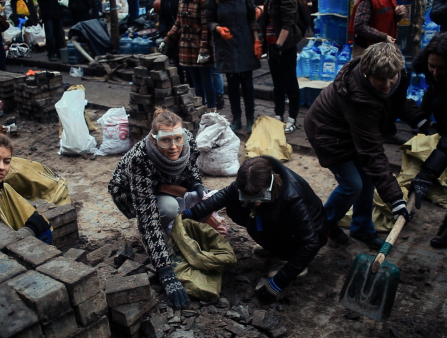
Brick by Brick.
Babylon’13’s credo of a “cinema of civil society” names the double duty of this democratic film collective: on one side, to bear witness to the moment, document state crimes, uphold the revolutionary spirit, and on the other, to bear that witness as filmmakers, each with a distinct cinematic sensibility of their own.
Volodymyr insists that “from the very beginning we were making cinema,” holding to a principle that captured both what unfolded in front of the camera and the cultural code and artistic gaze each filmmaker brought to the work, the two expanding both the scope and the versatility of what was documented. That dual approach had a magnetic pull. There were many who joined Babylon’13 who were compelled to witness, but just as many who arrived with little experience of cinema but a strong aspiration toward it. The work the collective created and distributed made room for both.
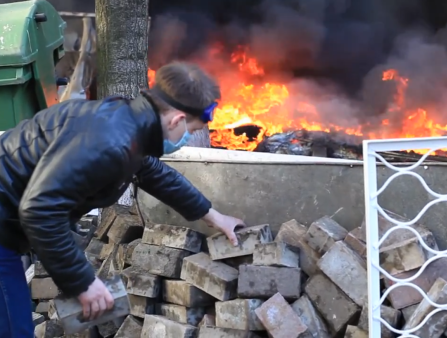
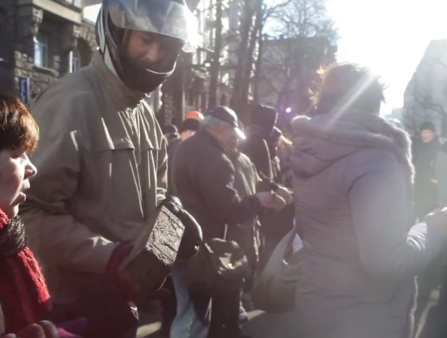
When police violently detained students, Andrii was among them. While in custody, he texted Volodymyr that he wanted to make films, and the very next day after his release, he was already making his debut Brick by Brick (2014), a detailed chronicle of people building the barricade. The short was edited by Roman, who by then already held the status of the collective’s editor and has since become one of Babylon’13’s “archival keepers.” For all three, revisiting Maidan carries a specific emotional weight. “While Volodymyr had approached Maidan with industry experience, sensing the need to institutionalize, there passed mine and Roman’s youth, and it was simply the best place to be,” Andrii says. It’s a place where they found love and friends and where they became filmmakers.
Since then, the revolutionary spirit has kept pace with the escalating war. The archive and the collective’s purpose have grown alongside it as they have taken on bigger fronts to reach, bigger events to record, bigger histories to keep. That expansion and evolution alongside escalation became part of Babylon’13’s DNA. From Maidan to the ongoing war, short-form documentaries covering a wide range of historical events and micro-level stories remind the world of the war by bringing a human perspective to dehumanized regions. Their gradually expanding output also bears witness to the ways war and camera technology co-evolved, inevitably bleeding into Babylon’13’s shifting formal register.
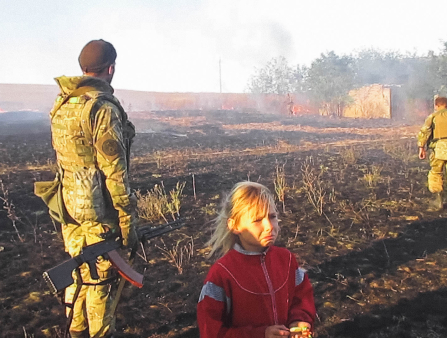
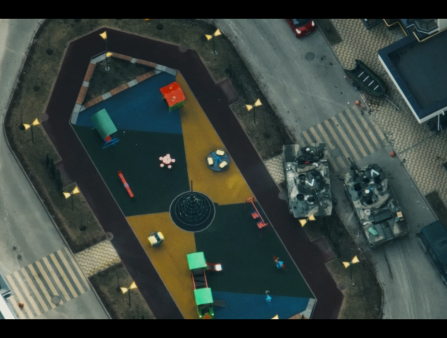
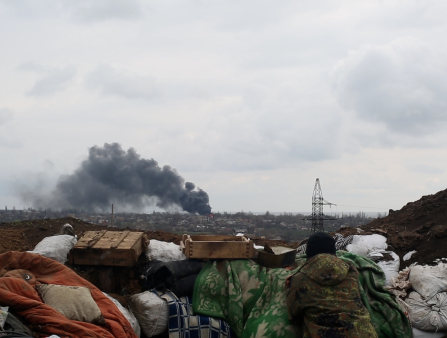
The collective’s feature-length works most vividly demonstrate the heterogeneity of its aesthetic and political practices, each film emerging from a distinct constellation of access, methodology, and archival engagement. Andrii and Volodymyr see Roman’s first feature, War Note (2020), as an early pride of the collective. The former calls this visceral montage-mosaic assembled from frontline soldiers’ footage “one of the most right and honest sayings about the war, made when, for many, the war still remained little more than background noise.” At the same time, the collective’s understanding and connections with the frontline, and simply having eyes all over the country, made possible such formally specific feature ideas as Volodymyr Tykhy’s One Day in Ukraine (2022) or Independence Day (2023), which each deploy a one-day-event concept with nearly a dozen DPs across various locations. The collective’s own prolific output is most felt in extra-durational character observations, such as Yuliia Hontaruk’s twelve-year-in-the-making To Die To Live (2026), which premieres at this year’s KVIFF—a radical case of what Volodymyr encourages from his fellows: to spend enough time with the heroes they document.
War Note.
One Day in Ukraine.
To Die to Live.
Asked about Babylon’13’s institutional and legal position today, and how the collective has changed ontologically through the expansion of its members, practices, and influence, Andrii calls it “a philosophically complex” question. “We always had a certain curiosity from our colleagues, which only enhanced with the beginning of the invasion, but with mobilization and given resources, we don’t have the capacity for numerous projects.” However, he reinforces that “Babylon’13 will always have a gene of the collective. We will never be a classical film production company with a linear structure.”
Legally, they operate in two registers: as a civic organization that runs the “non-commercial on purpose, grant-based projects, that are about impact and message,” and a still-developing film production line that releases the classical film projects. “We have around 30 filmmakers under our umbrella, who do not work with us exclusively but who can [develop and] realize their work with us”. The projects that are not about the money but are strongly aligned with the mission: “to help hold Russia accountable,” will always come first, Andrii adds.
The project that has, to date, most fully combined all three registers—commercial success, industry presence, and political impact—is Iron Butterflies (2023). Roman’s sophomore montagedocumentary on Russia’s downing of MH17 draws on multi-sourced archives and is laced with bold artistic decisions, including experimental dance performances and abstract reenactments. Andrii says its festival run, which included Sundance and Berlinale, among others, was “incredible.” The film is still traveling; last year, Deutsche Welle bought it, and new screenings at embassies are in the works.
Homing in on artistic decisions that transcend the conventional clarity of political documentaries, while still delivering political impact, became a modus operandi that shaped Time Machine Maidan. Demanding logistics, informed by war conditions and financial complexities, slowed its production pace, but what was initially intended as a documentary for Maidan’s tenth anniversary now arrives with a broader, multilayered symbolism than any round date could.
The crucial question for Roman was how to deploy “this colossal, splendid archive, in volumes and quality,” without falling back on overused expository forms or strict historical chronology. During this process, they also recognized the absence of a good fiction film about Maidan—and that gap worked in their favor. “What are the attributes of something clearly not a documentary?” Roman explains: “A plot. Science fiction, time travel.” This helped them land on what they alternatively frame as a “scripted reality” approach. Once they decided to treat their film as fiction, Time Machine Maidan finally found its formal register. The next task was to find a strategy that captured the kinetic movement of a time-travel narrative, something a simple jump cut doesn’t adequately convey.
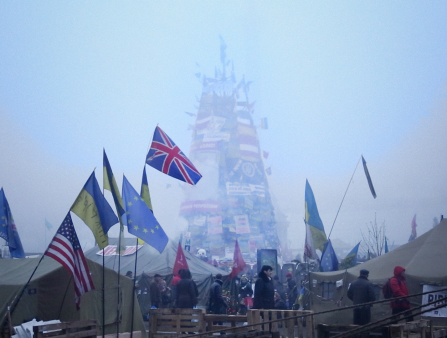
Time Machine Maidan.
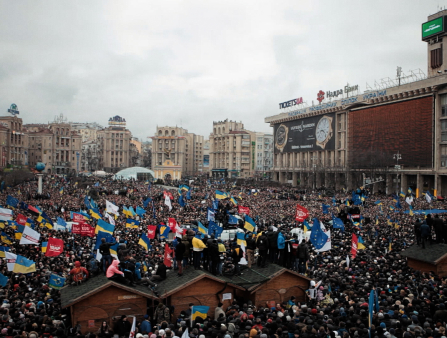
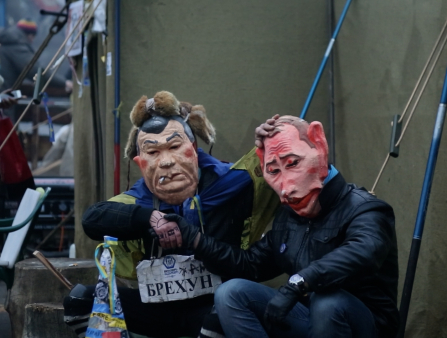
Volodymyr, who had already come to Maidan with experience in narrative-driven cinema, took great care with the storytelling, the creation of the hero, and the film’s reflectively humorous tone of voice. Meanwhile, Roman found an inventive way to literally jump a decade back, one that both suits the fictional arc and matches the collective’s high artistic standard. His search brought him to physics: “Time travel is, literally, about time and space, so there must be a certain discrepancy. Time freezes, but space keeps moving.” That sensation, he found, could best be captured by Gaussian Splatting: “A photogrammetry technique developed in the 2020s that generates a 3D space from a series of pictures or videos. So we are using a contemporary tool with material from ten years ago to recreate the space that no longer exists. Conceptually, it is already a time machine in itself.” Deploying it required specific footage, and, according to Roman’s estimate, roughly 3% of the archive met the technical requirements. Nonetheless, they purposefully used the unsuitable material. In their sometimes glitchy and incomplete rendering, these digitally processed images suitably capture a kind of in-betweenness, a literal gateway that connects disjointed epochs and splices together disparate places.
Those hauntingly surreal images reanimate the atomic energy of witnessing and filming the revolution before it crystallizes into the larger temporal and spatial formations, through which the collective came to understand itself. Precisely, their artistic approach makes this rendering of reality so genuine, as reality inadvertently kept bleeding into the filmmaking process. The theme of absence runs through the ephemeral imagery, which fuels the protagonist’s main quest to find an old friend Maksym Kryvtsov. This storied poet-soldier was meant to be the heart of this film, before his passing on the battlefield. Now, the unsuccessful search for this public figure in the crowd is mirrored by the way that Roman himself, who is intimately familiar with the Maidan archive, could not find his face in countless hours of footage.
Even if the team insists the film is primarily addressed to the new generation embodied in that hero, its very looseness with coherence, objectivity, and temporal clarity makes it land far more widely. The camera did not stop the war, but it preserved what it could, and proved a collective like this can do something just as crucial: (re)construct memory and trigger reflection. Babylon’13 itself emerges as the real hero of Time Machine Maidan.
With their introspective work, the collective has most astutely underscored how the political and the artful are inseparable, and how a film, a crowd, and a collective evolve through that inseparability. “To everyone next in line to fall to tyranny,” Andrii puts it directly, “organize your own Babylon’13. Institutions are stronger during tough times.”