

When Filipino filmmaker Baby Ruth Villarama first pitched Food Delivery: Fresh from the West Philippine Sea, it began as a look into the lives of those safeguarding the Philippines’ waters and ensuring the country’s food safety. The project was one of eight feature-length films given a P3 million peso seed grant (roughly US$52,000) by the CinePanalo Film Festival—a new cultural event funded by the supermarket giant Puregold. The funding enabled Villarama and her small team to follow two interwoven stories: that of naval officers delivering supplies to military outposts protecting the West Philippine Sea from other maritime militias and of fisherfolk in Masinloc, Zambales, who have long been terrorized by Chinese coast guards in local waters despite the Philippines’ landmark arbitration victory.
Villarama’s interest in the West Philippine Sea won’t shock those familiar with her oeuvre. In the past, she has used cinema to mine the social ills hindering ordinary Filipinos from living their dreams. Jazz in Love (2013) looked at queer couples yearning for same-sex marriage in a country dominated by conservative Catholics; Little Azkals (2014) focused on a soccer team pressured to win the World Cup despite little financial support; and in Sunday Beauty Queen (2016), she followed overseas Filipina workers (OFWs) who turn to pageantry to temporarily escape the burden of remitting money back home.
Through these inquiries, Villarama challenges the dominant beliefs held about Filipinos locally and internationally, influencing policy improvements and social support for her subjects.
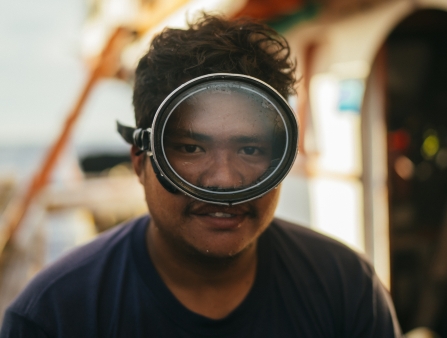
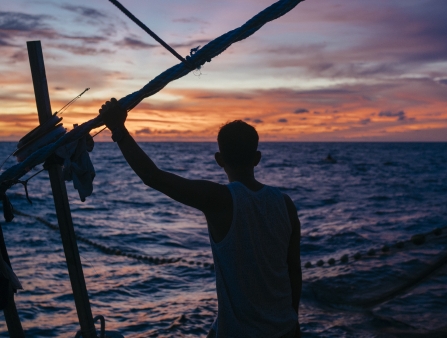
In Food Delivery, she uses food as a common ground for the abstract concepts of national security and maritime defense. Wide-angle aerial shots capture cargo being transported across the Pacific and motorboats searching for missing fishermen, while underwater cameras place us into the bountiful seas. By zooming in on the lives treated as chess pieces in securing maritime and food sovereignty, Villarama creates a portrait that is at once intimate and epic, clarifying who bears the brunt of broader miscommunications and examining why the deep inequities within Filipino waters still exist.
After completing the six-month production and receiving a PG rating from the Movie and Television Review and Classification Board (MTRCB), Food Delivery was ready for its world premiere. Then, just two days before its scheduled debut on March 14 at CinePanalo, the film was pulled from the festival’s lineup. In interviews, Villarama claimed unnamed “external factors” put the entire event “at risk of being cancelled” if Food Delivery remained in the program. The subtext was clear: Puregold, whose supermarket chain has close ties to Chinese suppliers and investors, sought to distance itself from a documentary critical of China’s maritime claims.
The decision sparked widespread backlash. The Directors’ Guild of the Philippines called the decision “a troubling trend in the suppression of artistic expression and the silencing of truth in our country.” Although the film had its new world premiere at New Zealand’s Doc Edge Festival—where it won the Tides of Change award—it continued to face pushback. On July 4, the Consulate-General of the People’s Republic of China in Auckland formally requested the film’s removal from Doc Edge, calling it “rife with disinformation and false propaganda.”
When the film reached limited Philippine screens after rights negotiations with lawyers and cinema operators, its homecoming proved dangerous. Within weeks of its local release in August, Villarama’s social media accounts were mass reported, locking her out of her immediate networks. Unidentified men began approaching members of the Masinloc fishing community, asking for the whereabouts of the film’s main subjects. Public screenings turned private. Q&As were scaled back or canceled entirely. These efforts appear aimed not just at silencing the film, but also the filmmakers and the people it seeks to uplift.
This interview, conducted two months before the film’s world premiere at Doc Edge, already bears traces of the tensions that would unfold in the months to come. Speaking in both Filipino and English, Villarama reflects on the complexities of the film’s birth, how filming obstacles shaped the stories that could be told, and the challenges of documenting resistance under surveillance. This conversation has been translated, condensed, and edited.
DOCUMENTARY: How did this project start, and what was the pre-production process like?
BABY RUTH VILLARAMA: We keep seeing it on the news: fishermen being chased and harassed by Chinese vessels in our own waters. At first, it felt distant because we live in the city center. But it was painful to watch. I kept asking myself: Is there anything we can do beyond expressing outrage and confusion on social media?
That curiosity about how survival, sovereignty, and food intersect became the seed. When CinePanalo opened their call for proposals for a P3 million grant, Chuck [Gutierrez, the film’s producer and editor] and I knew the scale of the story—traversing islands, speaking coast to coast with fisherfolk, soldiers, and coastguards—needed at least that budget.
Pre-production was tricky because the access and the security were never guaranteed. Food became our entry point. It’s universal and non-confrontational. Even after the Armed Forces of the Philippines (AFP) said yes, we needed to get approval from the Department of National Defense (DND), the National Maritime Council, and Malacañang. They didn’t really interfere, but the delays were their way of investigating what this project was really about.
The RORE [rotation and reprovision mission we were set to film] could happen anytime, so we were advised that we would need to leave within less than 24 to 48 hours. We had to talk to a lot of cinematographers and team members who were open to that. There were a handful of people who submitted [to be part of the team]. But when it was time to leave, they couldn’t because of existing commitments. It felt like fitting a camel through the eye of a needle..
D: You only had 48 hours notice?
BRV: It’s a secretive mission. China is always on their tail. A notification that there’s a ship delivering food to these islands will lead to another chase or harassment. They will find ways to discourage soldiers from being assigned in those places and delivering food. You’re in the middle of nowhere and you’re running out of food and supplies. You don’t know when you’ll receive your next batch of rice or canned goods. It’s like playing hide and seek in the middle of the ocean.
We had to submit all our CVs and all our company profiles. At some point, Chuck laughed and said it felt like we were applying for a job at the AFP.
D: What was your approach for filming at sea?
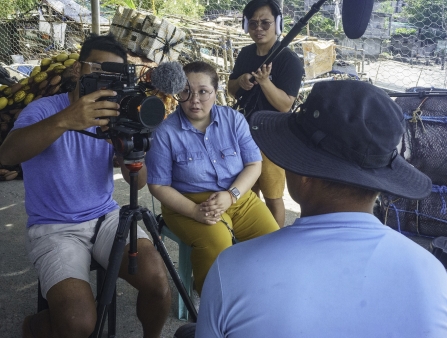
BRV: We used the most portable waterproof gear we could bring: an FX3, an iPhone 15 Pro in tight spaces shooting 4K, and Ray-Ban camera glasses as a last resort. The waves were high, the currents were strong. We had to hold on tight to the rig. For lenses, we used light ones. We wrapped equipment in thick plastic bags used by the fishermen because garbage bags weren’t effective. For the underwater shots, we needed an underwater camera. Luckily, Ivan Torres, one of our cinematographers, had experience as an underwater cinematographer and as a drone operator.
[On the ship, we deployed in three] units: two with three members each—the cinematographer, the sound, and an assistant—plus me and an assistant. The ship was big and we covered as much as possible within the limited time.
I felt like a basketball coach and player at the same time. Sometimes, it was a 24-hour cycle of events, so we’d take turns resting. The drone shots happened when everyone was asleep. We managed to capture brief footage of Chinese drones hovering around the ship. That doesn’t happen in the morning, and the captain often asked [us] to turn off all the lights.
We were careful. We couldn’t cluster together. I also assigned units to different fishing vessels during the rendezvous where the coast guard met fishermen looking for their missing companions. We only saw each other in the middle of the Scarborough Shoal. We came from Manila, they came from Subic.
D: What was the production timeline?
BRV: As soon as we got the first tranche, which I think was 500,000 pesos (US$8,600), we went to Subic, sat down with the fisherfolk, and really studied and observed them. How are they dealing with the situation? They were the priority of the story. There are a lot of reasons for us to be critical about the government because… Why did we even reach this situation in the first place?
With PHP3 million, we could afford 60 shooting days. We weren’t always full units. Sometimes, there would be trips where it would just be me and Nana [Buxani, cinematographer] driving to Subic just to find out what would happen in the next two weeks.
D: Communication emerges as a central theme—both the lack of telecommunications at sea and the rare moments when the coast guard and fisherfolk coordinate. How did this shape your narrative bookends?
BRV: It was recurring and deliberate. We wanted decision-makers to discuss these realities without spelling it out. How can you abandon soldiers in the middle of nowhere without a signal? Only the strongest of the strongest can stay there.
Radio communication between the coast guard and the fishermen is rare. The head of the coast guard teared up when we screened the film for them because sometimes they are unable to properly communicate. But for the first time, they united to search for missing fishermen and put the Philippine flag on Scarborough Shoal. It’s something [former President Rodrigo] Duterte was unable to do. When the fishermen told us they wanted to do it, we coordinated with the coast guard and made the fishermen’s case. More than 300 fisherfolk wanted to participate..
We want simple things. We’re not seeking full control of the South China Sea. We just want to be able to fish freely within our zone without harassment or fear of being monitored. We have to solve that issue within our generation because these issues can become more aggressive the more we allow them to be.
D: One of the magical moments in the film was a rare underwater view of Scarborough Shoal. Why include that footage?
BRV: The treasures of the sea are what we are fighting about here. External forces really want to control that area. We wanted to capture the treasure that we might be overlooking. Since people don’t know what they have, they allow others to take it because they think they’re just fishermen—they can always buy fish in the grocery store. But once we understand how beautiful this area is, and that it’s ours…
D: How did the grant structure affect your storytelling? Most grant-giving festivals in the Philippines are structured similarly.
BRV: If I had more time, I’d spend it getting to know the fisherfolk, Osman and Arnel. We’d hang out more. Witness how they build their boats. It would be more personal. In every documentary, time is an ally. With more time, you create more depth and reveal more truth. Because of the deadline, we had to maximize resources to tell the story of the West Philippine Sea in its entirety.
D: What happened when the film was pulled from the CinePanalo festival?
BRV: It was really disheartening. We followed every process. We were publicly announced as part of the lineup. Then came the silence. Backpedaling. Eventual removal without explanation. The Directors’ Guild of the Philippines called it censorship, and I agree. The film wasn’t even given a chance to be seen and to be judged accordingly. It was stopped because it was perceived as sensitive or politically dangerous.
That says a lot about our climate—self-censorship and allowing an external force to influence businesses. Who owns the country at this point? Who’s really controlling the Philippines?
Reclaiming the film’s rights wasn’t really easy. It meant standing our ground, consulting lawyers, risking future support, risking our name as filmmakers. We were worried that companies would be scared to hire us. But it also forced us to become even more intentional with our storytelling because we realized that the film needed to be free to breathe without fear. We went back to the editing room to create more space for the film to be truthful. It became less about compliance and more about courage.
We had to listen to our stakeholders and to people who will be affected by the situation. It was them who encouraged us: “They muzzled you, be brave.”
D: How has your relationship with the film changed after it was censored?
BRV: I used to see this as a documentary that would help create conversation. Now, I see it as a living document of resistance. The attempt to silence it gave the film a new soul. It reminded me that art has real power to unite people. It’s not just me and a couple of characters, but an entire country that I’m carrying. I hope I won’t be alone in standing up for this. It’s frightening. If they can silence a big company, what kind of chance do I have as a filmmaker?
D: What has become clearer about documenting resistance?
BRV: There are a lot of obscurities in this country that we have to make clear through our lens. But now we’re fighting a bigger force. It’s not just a government that’s not entirely working for us, but about trying to reclaim what’s ours from one of the world’s strongest entities. The entire region is affected. This film does not want to instigate war or expose people who are just out there confidently telling their story and sharing their world with us. We hope that this film can really uplift and unite us as a country. If we can make that happen, that would already be a triumph.
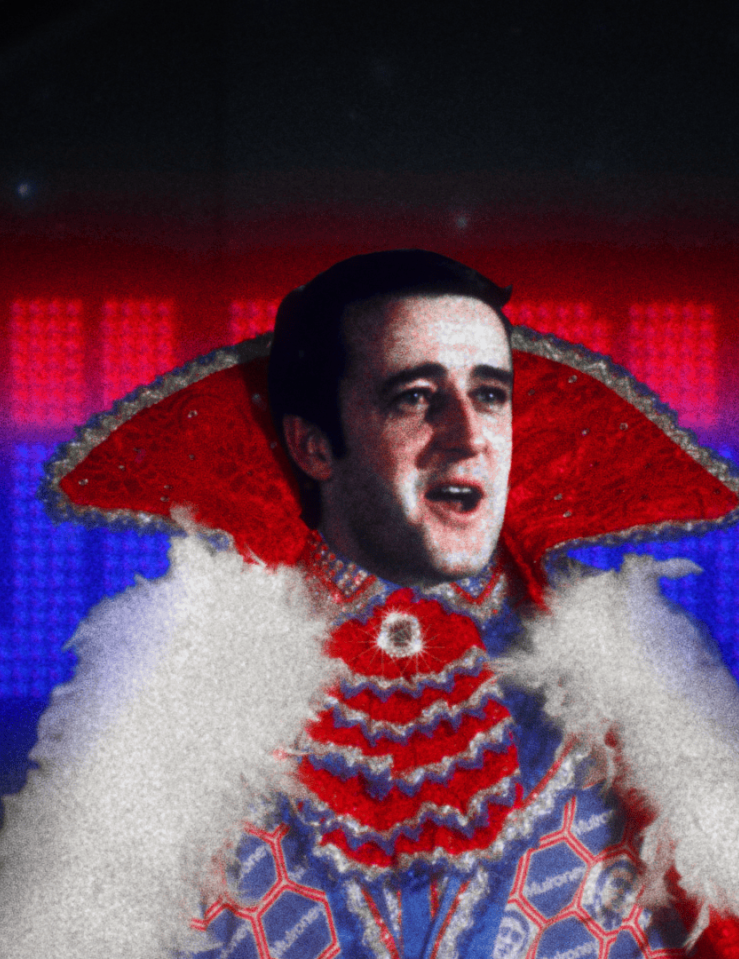
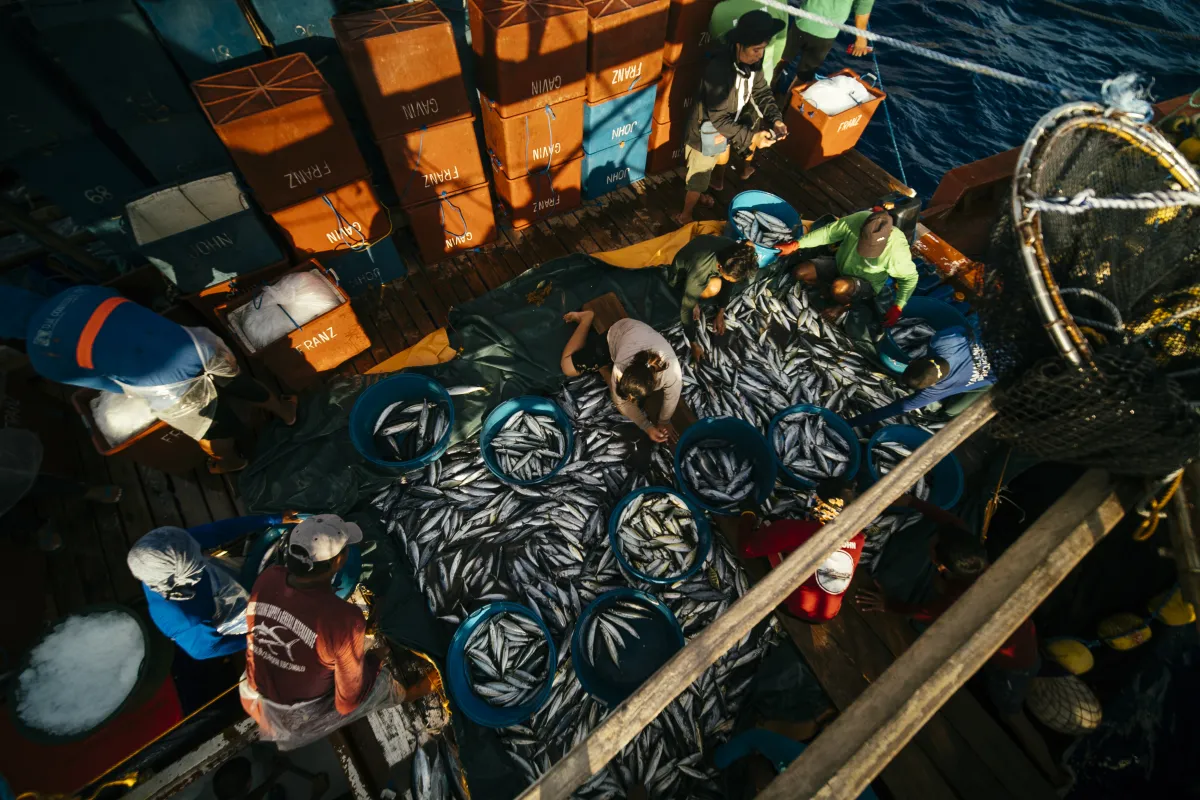
Food Delivery.
Food Delivery.
Baby Ruth Villarama (C) BTS.
Editor’s Note, October 2, 2025: This interview was updated with crew names and credits, and corrected the Philippines entity (to the coast guard) working with the fishermen.