
When Belarusians took to the streets in August 2020 against Alexander Lukashenko’s disputed reelection, his regime violently cracked down on the peaceful uprising. Andrei Kutsila first filmed its aftermath outside Okrestina prison in the short film Walls (2020). But once his own sister was detained, that project grew into When Flowers Are Not Silent (2021), an intimate portrait of Belarusian women navigating fear amid the disintegration of ordinary life. Its final turn from monochrome to color, meant to signal dignity overcoming that fear, lands bitterly five years on. Since then, the rights group Viasna has recorded over 100,000 acts of political persecution, while UN experts have documented routine torture, ill-treatment, and inhuman conditions for those held in Belarusian detention. All the while, Lukashenko’s support for Russia’s full-scale invasion of Ukraine has drawn Belarus into deeper political, economic, and military integration with Moscow.
Belarusian cinema has long borne the marks of the regime’s grip, its scarce institutional support and curtailed creative freedom making filmmaking an improbable path, as Kutsila knows well. A journalist by training, he found his way in through broadcaster Belsat, which Polish public television launched in 2007 as a Belarusian-language alternative to state propaganda. Its modest documentary strand helped Kutsila make more than a dozen films. Though he resists the label of “political filmmaker,” his earlier work reads as such in retrospect. Guests (2015) documents an unofficial shelter for the destitute while in Strip and War (2019), where a stripper shares a flat with his grandfather, an ex-Soviet officer, he captures a dignified Belarus absent from its Russified image.
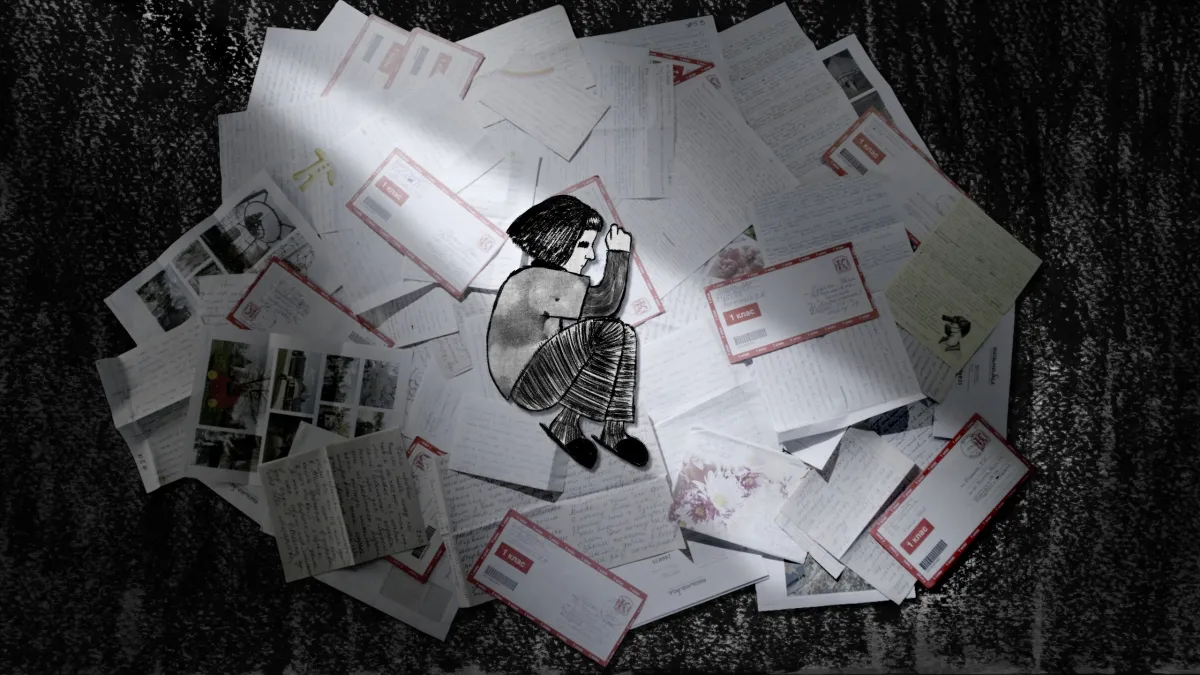
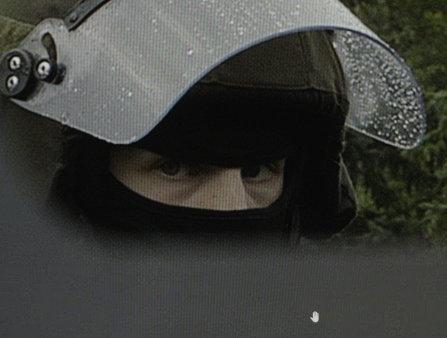
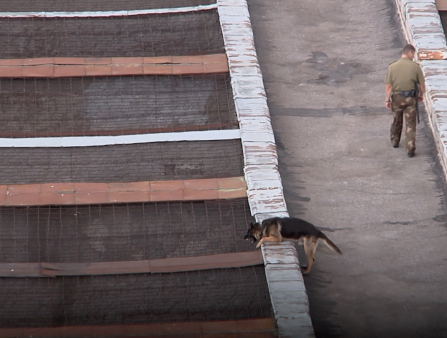
Exiled to Poland in 2021 and unwilling to watch Belarus recede from international attention, Kutsila spent the next five years making Letters From the Silenced Country, a spectral essay anchored in voiced-over correspondence between dissidents and the outside world. The film follows an anonymous man hiding from surveillance inside Belarus, a former criminal investigator living under threat abroad after breaking with the system, a young woman named Kasia writing and drawing in a women’s penal colony, and an imprisoned Belarusian political activist, Vitold Ashurak, writing and asking for pictures from loved ones before dying in custody. Lacking firsthand footage of his protagonists, Kutsila assembles the film from archival and guerrilla-shot footage, CCTV images from streets and prisons, online maps, and animation sequences—a visual grammar that not only answers the inaccessibility of Belarus but transmits the energy of that absence into the film’s emotional texture. Each story lays bare a different facet of oppression, yet together they add up to a story of loneliness and pain that reckons with the price of dissent.
Following the film’s Out-of-Competition premiere at Venice, Documentary spoke with Kutsila about his formation at Belsat, how anonymity and animation turned individual stories into a collective portrait, and his insistence on finding hope where there seems to be none. The following interview has been edited for length and clarity.
DOCUMENTARY: You studied journalism before entering cinema. How did you make that improbable transition in Belarus?
ANDREI KUTSILA: I applied for philosophy, but luckily fell one point short. I returned to Baranavichy, my hometown, enrolled in a pedagogical college, and a year later applied to the international journalism faculty at the Belarusian State University, which I had always dreamed of but had been afraid to apply for because of the high competition, but I got in. Soon, I realized general journalism wasn’t for me, as you cannot stay with one subject for a long time. While shooting classmates’ news segments and searching for visual language, I became interested in the camera. Then a grant for a student news studio gave us access to professional equipment—a treasure at the time. It sparked a deeper interest in cinema and pushed me toward self-education, watching classics, and reading books.
We have the Belarusian Academy of Arts, which has a Film and TV faculty but no separate film school, though it offers continuing-education courses. I took the two-year one while keeping a day job at the studio, and happily rushed to evening classes, where we studied film theory and history. That atmosphere of ideas and inspiration clarified that I wanted to make documentaries about real people and their stories.
With the short Focal Distance (2008), co-directed with Raman Ramashka, we premiered at the Krakow Film Festival, and discovered the international festival circuit and documentary itself. Despite watching many different docs, I still had a distorted idea of them as television content with interviews and archival footage. Focal Distance was a film of observation, of living alongside its subject. That is a standard thing now, but back then, it was a discovery that stories could be shown this way and be accepted.
D: Your career is inseparable from Belsat TV, a primarily journalistic channel. How did it root you in the documentary film industry?
AK: I entered the profession only thanks to its small documentary segment in journalism. I could have a small crew, and I could spend several months making a film, and the money was enough for a work trip—without Belsat, I’d hardly have survived in the profession.
That’s how I could also attend workshops in Poland, Kyiv, and IDFAcademy in Amsterdam. I knew I wanted to stay in the industry and felt I had the strength, desire, and subjects for a feature. After eight years of different films and stories, came a more serious production with Summa (2018), Polish Film Institute funding, and IDFA’s Best Mid-Length Documentary award.
But most importantly, under the authoritarian regime, Belsat TV let us keep working and shoot freely. Of course, we couldn’t access every location, yet we made many stories about Belarus, when things were less acute, and one could tell them through narratives of love and family. Then 2020 changed everything. I shelved old projects and took to the streets, not to film, as I didn’t want to shoot politics. I didn’t want to make a political film. But after two days of protests, when my sister was arrested, I couldn’t take it anymore. I took my camera with me into the streets.
D: With the upheaval pushing you both beyond an approach that had steered around politics and the country itself, what made you decide to take on a project as complex as Letters?
AK: After leaving, I wondered what to make about Belarus and became absorbed in prisoners’ letters—back then, they were massively posted on dedicated websites. With an abstract film idea, I dug deeper, seeking people who’d send their own or their relatives’ letters. I clung to this crucial literary foundation. But how do you make a film when you can’t return [to Belarus] and have only letters from people in prison? I didn’t know how to visualize it, but felt it was necessary. We’re tired of protest films built on archival footage, and it’s just essential to show post-protest Belarus, which remains unknown abroad. There are detention statistics and reports from human rights organizations, but those are mere numbers.
Collecting letters and drawings, I wanted to combine different stories told through different approaches, but how to bring that together without a hodgepodge stayed unclear for a long time, and at first, many people did not support the project. Then we sent an anonymous cinematographer to Belarus, and I edited the first 17 minutes. I also had long talks with an acquaintance in Belarus who evades surveillance, asking him to record his reflections, and, adding my own, felt a form and a kind of collective character emerging.
Each story gradually found its own visual form, even if it complicated the editing.
—Andrei Kutsila
D: His imposed anonymity makes this man’s story feel larger. Did that make space for broader reflections?
AK: About thirty percent of him is collective. I voice the narration myself, since I can’t use him directly, but the story of why he stayed, about his wife and children, is his alone. Alongside my own reflections on what I felt in Belarus a year after the protests, there are a few from an acquaintance of mine. But the story itself—and the emotion—are to some degree collectively familiar.
Through pitches and workshops, a team formed, and we proved the film had a right to exist and could work. But that’s only one of four stories. Animation is very expensive, so we first planned to use drawings alone, then realized animation could show this world from an entirely different perspective, and sought more partners and funding. Each story gradually found its own visual form, even if it complicated the editing.
D: How did Kasia’s drawings from the penal colony reach you?
AK: When it wasn’t yet so dangerous, Kasia’s friends set up an Instagram account with fragments of her drawings and letters. Deeply impressed, I contacted them, but they were afraid to send anything and vanished. But I waited two years for Kasia’s release, gave her time to adjust, and eventually we met in Europe, where she handed me huge bags of letters and drawings.
After that, we worked with a team of animators. To develop the style, we asked her to draw herself and her cellmates anew. She made many illustrations of the cell, and we merged her prison and post-release drawings into one style to animate. The paper drawings are her prison originals, shot live-action against a green screen, and including them in the film was essential.
D: In the episode where she likens her life to a tin can and then climbs out on a ladder, can you tell me how animation allows you to move beyond reconstruction?
AK: In one letter, she described climbing onto a cellmate’s bunk and not wanting to come down, because the cell looked entirely different from there. She immediately wanted to try every bunk, but then, she writes, what would she do for the rest of her sentence? So she took her time changing perspectives, to keep finding something new. That isn’t in the film, but it inspired that scene. Her writing guided my search for images to animate the drawing, and at times, these images speak instead of text, conveying her feelings.
This touches on a larger problem: the many strong texts we had to cut to keep the film watchable. Knowing Russian or Belarusian is one thing, but those who don’t know the language and rely on subtitles may miss all the imagery we worked so hard on. It was my first experience with animation, and it mattered that the images correlated with real life and stayed with the viewer.
When people say there’s no hope—for me, there is, just a different kind; neither sentimental nor grandiose. It comes from an inner feeling rather than any aim to make the film endlessly hopeless or to invent a happy ending.
—Andrei Kutsila
D: Watching the film, I was a little afraid of your ending. However wild it sounds, you don’t have the privilege of some political filmmakers to end on a bright note.
AK: I hope viewers won’t stay with a single emotion, as there are layers. Ultimately, you see that a person in prison can somehow find a form of existence and remain human, which is itself a form of survival, if not resistance.
I think of Ihar Karnei, a Radio Liberty journalist who went through so much in prison, recently released and now in the Azores. After such a brilliant career and education, he became a manual laborer, but what’s important is that he survived, is healthy, and has four daughters. When people say there’s no hope—for me, there is, just a different kind; neither sentimental nor grandiose. It comes from an inner feeling rather than any aim to make the film endlessly hopeless or to invent a happy ending.
D: I frame it this way because the film ends with Kasia confirming the protagonists’ fears of the correspondence rules tightening further.
AK: Yes. I don’t even write anymore. Before, you could hope a letter would get through, but now they are mostly destroyed, so why waste money and paper? You can write for the drawer, though, or photograph a letter before sending it. That’s how I wrote to a friend, who read my letter only after his release.
D: What also strikes me is that the film dispels romanticized ideas of revolution, showing the tough price of a lost protest, especially when so quickly forgotten. How do you answer the question of the price freedom?
AK: Freedom is a luxury—a key concept Europeans don’t grasp unless they’ve fought for it. Poles understand us better, having lived under the Polish People’s Republic, though their attitude toward Belarusians changed once Belarus sided with the aggressor. We are the same people, and it’s wild to be judged by your passport.
But I’m not complaining. Thank God we went through those protests, or we’d be treated far worse. Had the state carried out quiet repression in advance, preventing the protests altogether, we would face even bigger problems. We were lucky to take to the streets then, because today’s system makes that virtually impossible unless you want to rot in prison for fifteen years. The trouble is that outsiders read this as people not fighting hard enough. Ukrainian friends, before 2020, asked why we didn’t topple Lukashenko, while I envied and supported the Maidan, because, despite living amid terrible corruption, you go out and fight.
D: I strongly supported Belarus, but our conditions were completely different.
AK: Exactly, because how do you fight without weapons? If everyone were armed and resisted the same way, without the influence of Moscow—which can always roll in with tanks and which you must always account for in the region—we’d have sorted out our own country. A new generation will grow up that hasn’t been beaten. When a peaceful crowd takes to the streets, I’ll probably join them. I may know we’re doomed, but I’d find it hard to stay home.