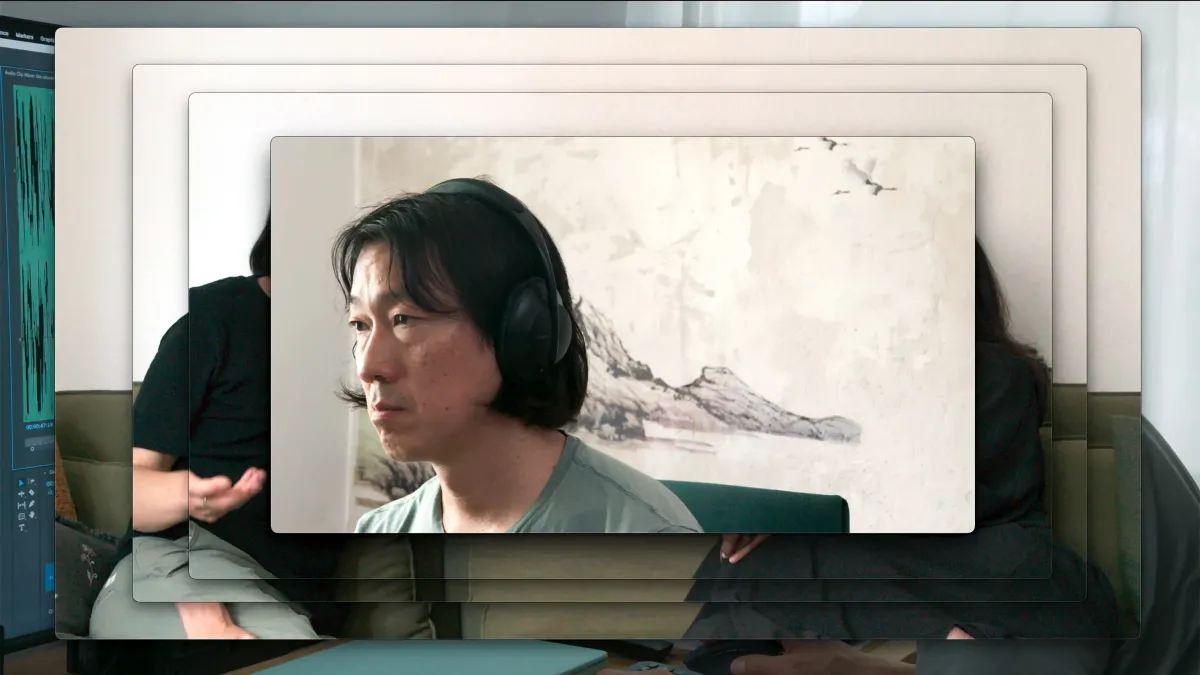


Critic, video essayist, and Professor for the Future of Cinema at the Locarno Film Festival, Kevin B. Lee is best associated with a specific subgenre of the video essay: the desktop documentary. In 2014 he debuted his short film Transformers: The Premake, a critical investigation of the global big-budget film industry using 355 YouTube videos. More than a decade later, the short is still shown at festivals and in classrooms as a concise and creative example of addressing the political economy of moving images through those same moving images. His feature debut, Afterlives, which world-premiered at Doclisboa and screened at the BFI London Film Festival, may be rooted in the form that first got him noticed, but it is also part critique of that very form.
The film is both an outgrowth and a continuation of Bottled Songs 1–4 (2021), a program of short documentaries dissecting ISIS videos framed as a correspondence between Lee and fellow filmmaker and film scholar, Lého Galibert-Laîne. The program hinged on their respective practices of viewing extremist propaganda. Afterlives begins where Bottled Songs left off, as Lee confronts the impossibility of watching certain violent images and reflects on what it means to consume and, in a way, domesticate them. Outside of the confines of his desktop, Lee travels to meet three women: artist Morehshin Allahyari, whose 3D-print reconstruction of a Medusa head, destroyed by ISIS, is central to the film; and two counter-extremism researchers, Nava Zarabian and Anne Speckhard.
The narrated self-reflection moments that run through the film, particularly when Lee is in front of the camera, gesture to what desktop documentaries cannot achieve within their formal confines. The film also found Lee working with a film crew for the first time. In conversation, he credits his DP, Ginan Seidel; his editor, Janina Herhoffer; and his producers, Carolyn Kirberg and Mareike Bernien, with helping him step outside the form he’s most well-known for.
Documentary caught up with Lee to talk about what he learned about that experience, why the politics of care are central to his feature, and why he remains skeptical of the potential of new technologies to help us see the world anew. This interview has been shortened and edited for clarity.
DOCUMENTARY: The context of a documentary—in terms of both production and issues raised—seems to me its most crucial aspect to consider. Desktop documentaries have a unique disposition to contextualize themselves. Thinking of Bottled Songs, what kind of context does a desktop documentary approach bring to its subject matter?
KEVIN B. LEE: When I first got involved in desktop documentary filmmaking, what was really exciting about it was that it offered a way of looking at the world and exploring certain topics that just really fit with how we live and how we experience life through our desktop screens and through the Internet. Lého Galibert-Laîné coined the term “netnographic cinema”: what does it mean to approach Internet spaces and Internet cultures through an ethnographic lens? In that way, Bottled Songs was a specific subset of desktop documentary. [With Bottled Songs Galibert-Laîné and I] were just really looking at how we operate as spectators in relation to these videos. But then this spectatorship itself needs to be unpacked. This is what I felt was an emerging limitation to desktop documentary itself, that it has the risk of being too self-enclosed.
D: But your most well-known desktop documentary, Transformers: The Premake, for example, does engage with the real world. It also includes footage you shot yourself, as Afterlives does.
KBL: Let me tell you an anecdote: at a screening of Bottled Songs, someone in the audience said something along the lines of: “Your analysis is impressive, but I gotta be honest with you, if I were one of these ISIS media makers, I would be flattered that you gave so much attention to my work.” That really troubled me, especially since my intention was to somehow diffuse or disarm the videos. So when in my search I found these three protagonists who all happen to be women—against the fact that ISIS videos are almost uniformly produced by men, presenting a toxic and violent masculinist view of the world—their creative viewership was inspiring to me, as were their strategies of transforming the videos against their original purpose.
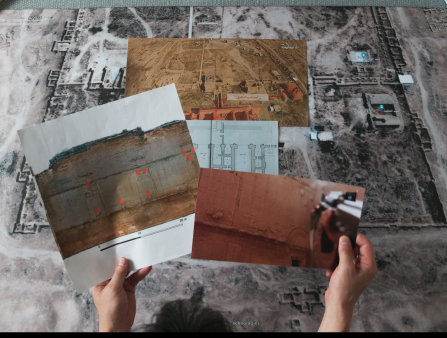
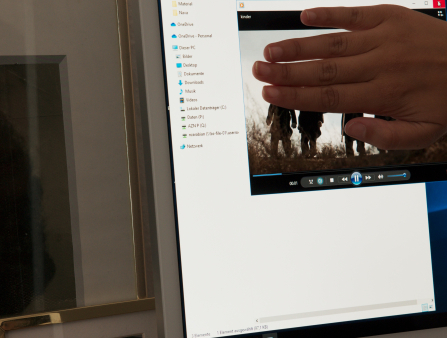
D: At one point in Afterlives, your monologues about Medusa end up addressing Medusa. Can you talk about crafting that particular storytelling device?
KBL: I originally intended the film to just be addressed to the Medusa. Almost as if in place of Lého, I now have this 3D printed replica of a destroyed historical relic…
D: An impossible conversation, almost.
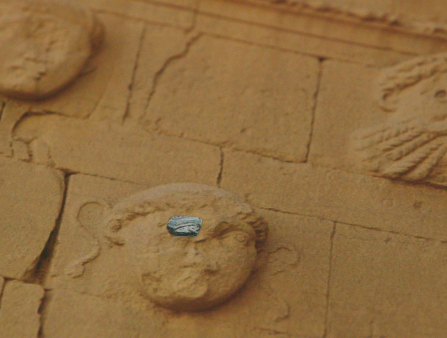
KBL: I didn’t know how to even address Medusa—it, she, they? The [figure of the] Medusa contains so much mythological significance, while this particular Medusa also has a technological significance because it’s also a hard drive of data about destroyed artifacts. There had to be a level of intimacy where I could start addressing Medusa as “you.” In other words, this intimacy must be earned within the space of the film, both for myself and for the audience.
D: Following your research, the film shows that Medusa has a non-binary, trans dimension as well.
KBL: It symbolizes the space I wanted to carve out around this subject matter: that there is a non-binary, queer, ambiguous, and open approach to this subject and all the contexts that are associated with it. We need to hold on to a certain openness and indeterminacy and not be fixed on particular assignations of who we are or what we stand for in a certain moment. I can also tie this into my background as an Asian American, which has also necessitated a constant process of negotiating my own identity and my position in relation to the contexts around me, even now when I’ve lived in Europe for the past nine years. I’d like to think that I’m bringing a degree of self-negotiation to this film and this topic.
D: That confrontation with something that is almost changing in front of your eyes is quite characteristic of the essayistic form. There are points in the film that form an alternative timeline, where you find yourself in a deadlock with the images or the film itself. Were there any particular challenges that opened things up for you?
KBL: I’ll confess that the difficulty for me was leaving the desktop. That meant leaving my own spectatorship behind. On a practical basis, [it involved] the challenge of working with a film crew for the first time. It’s in those physical filming situations where I had to negotiate my presence. I felt very exposed and vulnerable.
D: What is the biggest difference for you when using a camera set-up, instead of just using the tools on your laptop?
KBL: There’s a conflicted relationship with the authorial voice in Afterlives when perhaps the audience is expecting to be led by this narrator. What I wanted to convey was a sense of exhaustion with this authority. I’m critical of what it means to have an authoritative voice when the subject matter itself is so complex and multifaceted that you maybe shouldn’t trust one single author on it. In the first 15 minutes of the film, you see different figures, mostly men, who give their take on Medusa and on ISIS violence, with a continual need to contain, to control a narrative.
I’ll confess that the difficulty for me was leaving the desktop. That meant leaving my own spectatorship behind. On a practical basis, [it involved] the challenge of working with a film crew for the first time. It’s in those physical filming situations where I had to negotiate my presence. I felt very exposed and vulnerable.
— Kevin B. Lee
D: There’s that line: “I’ve been analyzing these men with their distancing approaches to this material, and all I get is distance. I’m looking for another way to care.” Can you elaborate on that notion of care?
KBL: Making Afterlives definitely made me more sensitive to the power relationships that are embedded within acts of care and attention. That searching for another way to care leads to, on the one hand, a different set of protagonists I meet in person, in their own domestic spaces, and to let go of my own authorial voice so that each of them can occupy the role of author. It leads to questions, like to what extent is the subject of the documentary also the author? What I wanted to get across was that meeting each of these three women also had an impact on my own authorship, including Medusa.
Even if I’m narrating the Medusa story, I feel like in some ways Medusa is speaking through me and the ending, which we don’t want to spoil, is really getting to this idea of who is speaking through whom, how stories get told. Morehshin Allahyari, whose work reconstructs artifacts destroyed by ISIS in 3D printed replicas, has this term “violent care,” which really resonated with me. Care is not neutral. Care is power, and power is political. And power has the capacity for violence. Not just physical violence, but cultural violence, institutional violence, extraction, exploitation, and inequality.
D: Afterlives is half desktop documentary and half a critique of the format, and often such hybrid forms can shed a different light on a context or a landscape that’s taken for granted. What were the transformations you noticed when it comes to your approach as a filmmaker and video-essayist?
KBL: I went from making video essays in a pretty laissez-faire approach— getting the movie clips off BitTorrent and such—to my first experience with film funding. Previously, I felt like I was entitled to make use of copyrighted materials because I would actually add value to them through my insights, and that speaks to my background as a video essayist and to the kind of relationship I had to media back then. Now, this project definitely made me more sensitive to the implications of the media I use in the first place, where it comes from, and the attachments it carries. For example, the only type of media with unrestricted use was the ISIS videos. Since ISIS is deemed a terrorist organization by European law, they have no claim on this media. However, in time it became clear that it was the content that I least wanted to incorporate in the film.
D: What did the process of making it reveal to you about the larger documentary ecosystem, if we start from the funding stage?
KBL: The film has a budget of around 160,000 EUR, which is definitely not a lot. But it’s not nothing either. It was pitched as a combination of desktop documentary and camera-based documentary. Since desktop recordings cost nothing, the camera-based parts had to be in the funding proposal, and the money was set for travel and location shooting—for the crew. A lot of film funding is there for the sake of maintaining a working, labor economy, and this should not be discounted. It’s analogous to the AI situation now because one of the biggest fears about AI isn’t what type of work it results in, but how many jobs it eliminates. Desktop documentary is not nearly as massive as AI, but it does raise similar questions: if one person can just record their screen to make a movie, what are the implications not just for film audiences or film art, but also for film labor? I don’t have any easy answers to that, but I became more sensitive to and appreciative of what it means to work with a film crew and the degrees of professionalism and teamwork I wasn’t as accountable to in the past when working alone.
But we couldn’t even find time for a wrap party because by the time the film was done, all of my collaborators had to move on to the next thing. Most of the people I worked closely with didn’t attend the premiere either in Lisbon or London. They’ve just got too many other gigs. It’s a weird situation where you can’t even reap the rewards of your labor and celebrate in a communal way after you’ve put in the hard work. Online, even if you’re not making money, at least you’re gaining social capital, likes, and followers. There’s something analogous here because if you’re not making a sustainable living with filmmaking, you should at least feel the bonds of connectedness, solidarity, and social fulfillment doing that. This project really exposed me to how tenuous and fragile the current situation is for the people making arthouse and experimental [documentary] films.
D: How was the process of editing this film different from your previous work, which was mostly created for the web?
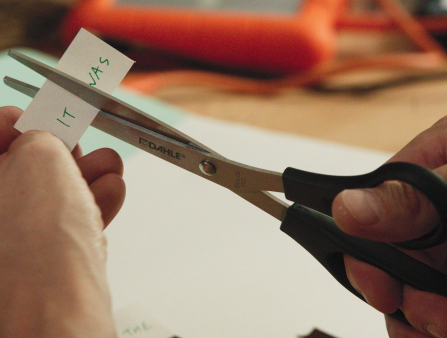
KBL: Let’s just say Internet time and real life time are definitely different. In the former, as a viewer, you don’t really get as much time to breathe. I really have to credit my editor, Janina Herhoffer, for just putting in more breathing space in Afterlives. We began with the camera-based scenes in physical spaces, then modified the desktop sequences so that they could work with the same kind of breath. We gave the viewer the same amount of time to process the desktop space, and this ‘oxygen principle’ was really helpful; when you’re immersed in information, there’s only so much you can take before you have to come up for air.
D: Since Afterlives is a critique of the form, what kind of place do you see it occupying in the desktop documentary landscape, if there is still a need for one?
KBL: Over the course of time, I got more and more interested in what’s beyond the screen. The same can apply to desktop documentaries. The desktop is a space, but it’s not the definitive one. To do desktop documentary justice, you have to perceive the boundaries and the limits of the desktop. You have to take a step out of it to access a much bigger space around it. That’s the direction my work will continue to go in, trying to discern those boundaries and what those boundaries can reveal.
D: In your work, you have been drawn to trying out the tools of the time (YouTube, Twitch, AI), and I feel that direction is similarly of this time. Being zoomed in on an interface can be navel-gazing. We shouldn’t allow ourselves that in the world we live in today.
KBL: For me, it used to be about the transformative and empowering potential of new technologies. Now, I have very little enthusiasm or confidence in them as a tool. I don’t see it as my salvation the way I used to with past technologies. My first impulse is to situate it and contextualize it and put an A-frame around it. It’s not about the tools anymore. It’s about seeing better. I used to think that these tools would allow me to see better. But now I want to see the tools better.