
Kamal Aljafari’s latest film picks up an archival thread that runs throughout his work, from Al Fidai (A Fidai Film, 2024) and its films and photos that were looted by the Israeli army from the Palestine Research Centre in Beirut to An Unusual Summer (2020) and his father’s home security footage. With Hasan in Gaza exists through a twist of personal serendipity: it’s composed of video from miniDV tapes from 2001 that he found in boxes at home, but had almost no recollection of making.
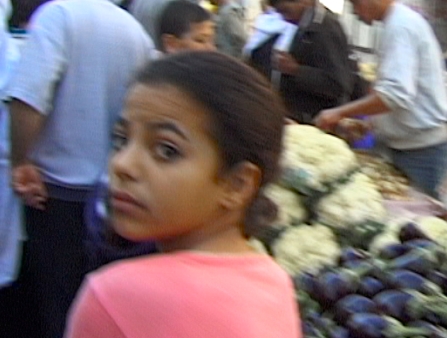
Most of the film resembles a scouting trip through neighborhoods and streets and among Palestinians who are making do: going to market, showing Aljafari Israeli bomb damage, huddling during mortar exchanges. Children ask, again and again, for attention, to be seen. The scenes of sometimes sparse alleys and ruins are unavoidably a little ghostly, like a walk through the past that occurs in a dream. Yet at the same time, there is the attuned, in-the-moment feel of a filmmaker exploring a potential subject, the editorial rhythms drawn out, rather than sharply punctuated and defined by violent events.
Here is a search throughout Gaza, but for what or for whom, is not fully revealed until a long explanation in the credits. Two and a half years deep into Israel’s ongoing massacres in Gaza, the timing of the film suggests that the tapes willed themselves into sight somehow, turning back the clock. With Hasan in Gaza would have been Aljafari’s first feature, but, as he explains to Documentary below, in a somewhat distanced tone, life took over. Perhaps that was because the search—for someone he remembered from a stint in prison in 1989, whose defiance toward a guard he couldn’t shake—only resulted in getting to know Hasan, his guide—who has since disappeared too, as far as Aljafari knows.
The full effect, melding the symbolic and the experiential, arrives almost in retrospect, in the sense of a search and a return that remains disorientingly out of reach. I sat down with Aljafari at the Locarno Film Festival, where With Hasan in Gaza had its world premiere in the international competition. This interview has been edited for length and clarity.
DOCUMENTARY: How did you rediscover these mini-DV tapes?
KAMAL ALJAFARI: In the beginning, I found just one tape that carried the caption “With Hasan in Gaza” in Arabic. I was looking at old tapes, mini-DVs, that I have because I wanted to digitize them, and they were already 20 years old. By chance, I saw one with this caption there in a box.
D: This was at your home?
KA: Yeah, at my place in Berlin. And I really did not know what it was. At the beginning, I thought that someone must have given this to me to watch. I used to teach in the past, and sometimes students give you tapes or something to watch that you end up not ever watching. I went to a place where I could play the tape because I didn’t have the player. It got stuck in the player, and I had to return the following day because it needed to be fixed.
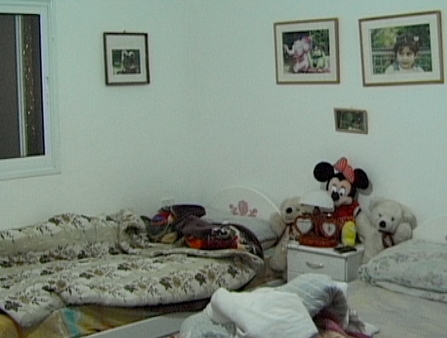
I’m watching it, and I still did not remember, did not know what it was, until a moment where I saw myself, and then slowly, I started remembering that I went there. In fact, the only scene that I do remember having filmed, after watching the material, was the one at Hasan’s home at night. Because I really remember clearly that he wanted to watch the [basketball] game, and I stayed in his children’s room. So I remembered that, but actually, everything else, to this day, I don’t remember that I filmed it. It’s really quite mysterious how memory functions. I think one explanation could be that I never watched the rushes. I filmed and I took the tapes with me to Cologne. In the end, there were three tapes. The one with “With Hasan in Gaza” written on it, and then two more tapes with no writing on them.
D: What happened? At the time, did you start on a different project?
KA: Yeah, I was studying there and I started a new life. And then time passes, you do other things, you have another life. But these tapes were with me all these years. Many places, many countries.
D: They traveled with you.
KA: They were with me and they never got lost!
All images courtesy of Kamal Aljafari Productions
D: How do you think of the tapes and the movie now? Do you view it as a kind of reconstructed memory?
KA: It’s very difficult for me to define, because I’m still processing this film. But very quickly, when I discovered the material and started watching, I realized that this is a film that is ready-made. It was almost like a found object. And there was no editing in the classical sense involved in the making of this film. Everything you see in the film is in the same order.
D: The same sequence time-wise?
KA: Exactly as it was shot. I did remove a couple of scenes, because in terms of the pacing, somehow they were not helping. In total we had two hours and 35 minutes, and the film is one hour and 46 minutes. We ended up using most of it, but really, the order is the same as I found it on the tapes.
D: That’s very interesting because I was going to ask about the philosophy behind the editing.
KA: Yeah, it is a travelogue, you know. This is the way I wanted it to stay, and I think in some way it is made in the old documentary travelogue style: you go to a place. Travelogues were the first documentaries, and it was always about going somewhere far away to film.
D: Or a king visits and you film that.
KA: Exactly, exactly—there was an event. This material was something quite special in that sense, because it was a documentation of a visit that I did. The tape had the date of the shooting, and that’s how I knew what year, because I really do not remember exactly. It was the 1st and 2nd of November, 2001.
D: That’s a heavy time globally, just because of the September 11th attacks, and other events were yet to come. What was your reason for starting filming on that date?
KA: I don’t remember the exact reason why. I think I was already living in Cologne, and I went back to visit my family [in Palestine] and I took a camera with me. So I filmed, I took these tapes with me, and I totally forgot about them.
D: When did you start working with the tapes, and what precipitated that?
KA: I discovered them in August 2024, and I started working with them just last September [2024]. And when I look at the footage today, it has a kind of inner logic that is difficult for me to explain—all the things that happen along the way: taking so many cars, meeting people, and being led by Hasan. I consider him today as my first guide in making films, because he would talk to me about being patient and how to film. He liked zooming, and you can see the difference with what I did. I was more observational, not moving the camera much. And he was...
D: Getting in there.
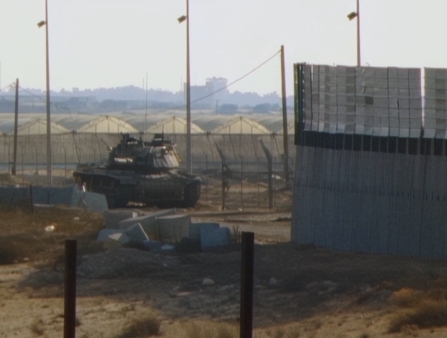
KA: Exactly, getting closer to the subject. At some point in the film, he’s telling me zoom in to the [Israeli] tank, right?
D: And there’s an element of danger you feel throughout, because the camera is viewed as a weapon. We hear that warning in the car sequences, to keep the camera out of sight from Israeli soldiers.
KA: At Hasan’s place, I was sometimes a bit worried because you could see that there was shelling and gunshots. Even when we weren’t at the site that was being attacked by the army, this question came up. Then there’s this one scene where I’m filming the kid and then you hear the shots. And the kid is, you know, jumping. It’s impossible to explain, because everything that you want to understand about today, you can see in this, you know? Where we come from, and how we arrived at this moment of catastrophe, total catastrophe.
D: As I watched, I was writing down place names that I was hearing. Looking them up, I’d find destroyed, destroyed, destroyed. Like the Shajayia refugee camp.
KA: This was another aspect, because Hasan would tell me then, “Ah this is this place, that place,” all these places we know from the media today, and it was about some massacre, some destruction.
D: There’s no voiceover in the film, and you just have occasional lines of on-screen text along the way. What was behind that decision for you, not to have your voice on it?
KA: I think these narrations somehow work more gently when they are written on the screen. And there’s already a lot of talk in the film. So I thought, okay, this is another layer that you are able to separate from the film itself.
D: The songs add another layer of emotion. Sometimes it sounded as if they were playing in the car.
KA: Some of it was playing in the car. And others are choices that I made. Like the love song when we are driving to the highest point of Rafah, if you remember, with the sunset?
D: The song with the line “Your smile is like the warmth of the kerosene lamp”?
KA: Ah, this one exactly!
D: Finally, we have not really talked about the reason for the film’s being, really: this search for the person you met in prison. Does that still feel like the seed of the film, this memory of his defiance?
KA: It’s so many years later, and sometimes it feels like I’m talking about another person, you know? Still, no, it’s me, of course. But it’s kind of history. When I did the journey, the search became something else.