
Viktor Kossakovsky’s new film Architecton lays three narrative tracks. In one, we see the process by which part of a mountain is blasted away, the rocks are crushed into gravel, the gravel is ground into dust, and the dust is melted into cement. In another, the camera surveys ruins around the world, from recent remnants of the War in Ukraine or the aftermath of an earthquake in Turkey to ancient sites in Lebanon. We see the distinction between modern architecture that’s designed to be built quickly and efficiently and older methods that have let buildings last hundreds or thousands of years. Tying these two strands together are parts of a conversation with Italian architect Michele de Lucchi. After making a name for himself in industrial design, he’s pursuing ideas to put humans more in harmony with nature.
The film’s emphasis on nonhuman subjects—rocks, geological features, buildings, ruins—is of a piece with Kossakovsky’s interests in many of his works. Aquarela (2018) observes various bodies of water and ice around the Earth in stunning 96-frame-per-second clarity. Gunda (2020) follows the daily life of a pig on a farm, inviting identification with something we’re encouraged to think of as an agricultural commodity. Architecton seeks to make stones, which we typically imagine as the setting or background of our lives, active elements.
With Architecton in theaters, we sat down with Kossakovsky over Zoom to discuss the film, creating empathy for rocks, and the “age of cement and sugar.” This conversation has been edited and condensed for time and clarity.
DOCUMENTARY: You’ve made multiple films now about these elemental forces of nature. How did that become your focus?
VIKTOR KOSSAKOVSKY: When I started making Vivan las Antipodas! (2011), the idea was very simple. I was in Argentina and saw a man fishing. His reflection was so clear that I saw the fishing line go down through to his opposite, like the line became longer. I thought, “What if I continue this line? What will be on the opposite side of the world?” And on the other side of the world was Shanghai. It was already an interesting combination.
But there aren’t many land-to-land antipodes, because most of the planet is covered by water. All of America goes to the ocean except Hawaii, which is opposite Botswana. When I was filming in a village in Botswana, suddenly an elephant came into the frame, so close that I only saw its skin. And then I thought that the cooled lava from volcanoes in Hawaii looks like the skin of an elephant. In New Zealand, I saw people trying to bury a whale on the coast, so big that they could not move it. And on the opposite side of the world, in Spain, we found a rock the size and shape of a whale. I thought, “What is happening there? What is nature telling me?”
We traveled to film people, but suddenly the elephant is important, the whale is important, the rock is important. I realized that these things are all as important as we are. Then slowly, I think, “Oh, maybe we are not so important.” So I started to make films without words, without people. And I love it. My next film, Trillion, has no words. I love that my films do not talk with words but with images.
D: There is a little bit of talking in this one, though, in your scenes with the architect Michele de Lucchi. How did you decide that what he said was important enough to include? How long was your interview with him?
VK: Yes, I will not normally use interviews, but I always film them, just in case. I spoke to about 100 architects, as well as scientists who are trying to find healthy replacements for cement, because 8% of CO2 emissions come from cement production. I didn’t plan to use the interview with Michele; I just wanted to talk to him so I could understand more. But when I saw the footage of him talking about his new idea of beauty, I thought, “Oof, maybe I have to use it.”
It’s 10 minutes, the entire conversation with him. I took it out and put it back in the film a few times—I took it out, I put it back, I took it out, I put it back. In the end, somehow I kept it in the film. And now I like that I kept it, because of how people react to it. He’s so beautiful, he’s like a prophet, and people will not forgive me if such a beautiful man never speaks. If you see a prophet and he doesn’t say a word, that would be a shame.
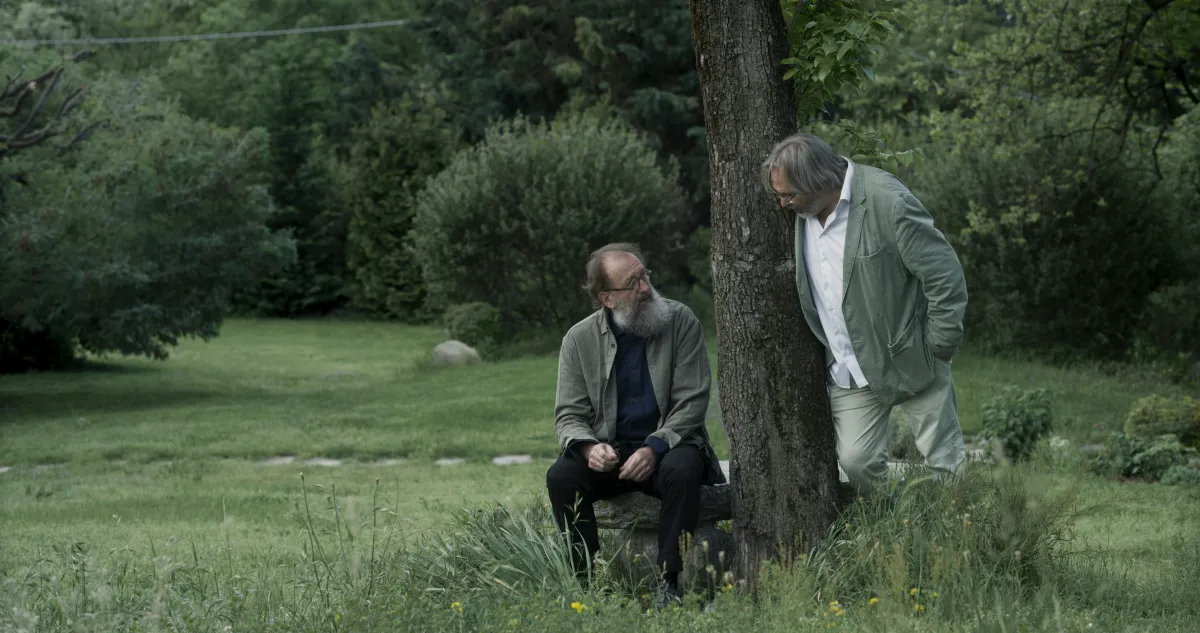
Michele de Lucchi (L) and Viktor Kossakovsky (R) in Architecton. Courtesy of A24
D: There’s a great sense of monumentality and scale to many of your images in this film. Not just when looking at mountains or ruins, but in making gravel seem huge. What kind of sensibility shaped how you approached these subjects and then put them together?
VK: I discovered the locations and topics on my own, and based on that, I had ideas about what would be interesting to see. If we show rock becoming cement, we can see the whole life of the rock. That would mean starting with a mountain, and then people blast it with dynamite and it becomes rocks. Then those rocks are broken into stones that go into a machine. And that machine is like the gate to Hell, you know? The stones are crushed into powder, then they go into fire—1,400 degrees Celsius—to become cement. That process is like the last minutes of the life of the stones.
It was interesting to try to make people feel empathy toward rocks. I said, “No one’s seen rocks dancing, so why not make them dance?” When people are moving, it's interesting to film. When animals are moving, it’s very interesting to film. But rocks are not moving; we consider them like death, right? That makes it a challenge, to film something that is not moving and make people feel empathy and interest for it. I like a challenge.
D: In previous films, like Gunda or Aquarela, you have subjects that move on their own, and you tend to capture them from a stationary position. Here, it’s often the opposite, where many of your subjects are stationary and you move around them. There are so many different techniques—the drone footage, the extreme close-ups, the high-frame-rate slow motion.
VK: My team, we love to do difficult things. Every morning, we are sitting and drawing what we can do that’s technically innovative, what’s interesting, and never done before. We’re trying to challenge. If we find an easy solution, something everyone else can do, most of the time, I say no, we don’t do it. I believe in cinema, in documentary as an art form. I really respect the image by itself.
We have a writer who was part of Russian culture and then became part of American culture, Nabokov. He said, “I want my readers becoming my viewers.” And if I continue his idea, I would say I want my viewers becoming philosophers. When someone starts to talk, my brain starts working. But if I show you something and don’t tell you anything, maybe it goes somewhere else, not to the rational part of your brain. You feel it, and then maybe it goes to your brain. But maybe not, maybe it stays in your soul, which is more interesting for me. If you start a film with a voiceover, a conversation, or an interview, then the rational part of the brain starts to dominate. The audience will just say, “Okay, I have to understand this information.” It’s hard to go back to the soul, to the heart. I’d rather do the opposite; I’d rather touch your heart, your soul, and maybe later it goes to your mind. Or maybe not. That’s not important.
D: You’re contrasting this “life cycle” of rocks being “born” from the mountains before “dying” by being turned into concrete with these scenes of the result of similar processes throughout history—all this footage of different ruins.
VK: I guess it’s a question of responsibility. If I make a movie to be seen for one weekend, no one will think about it again after that. If you make buildings to last 40 years only, that’s one responsibility, but if you make buildings from stones or megaliths, you might think, “Oh, it will live longer than myself. That means it should be a little bit beautiful, at least.” Imagine if you make something with a megalith, and then forever people say, “Oh, he was a bad architect.” But if you make something from concrete and you know that in 40 years it'll be demolished, it doesn't matter how you build.
D: Were these issues around concrete production and construction something you learned about through making this film?
VK: Yes, I was not aware before. We were filming in a medium-sized cement factory, and they run 24/7 because the fire needs to always burn, and that needs coal. When you have two stones and you put cement between them to help them connect, it’s okay. But now we build whole buildings from cement. China now produces more cement in a few years than the United States did in the entire 20th century.
Talking to all these scientists and architects, I noticed that they’re not aware of the scale of the problem. The big architects do a few projects that show up in magazines, the buildings everyone knows. But 90% of their work is concrete rectangles: office centers, supermarkets, fitness centers. They don’t pay attention to this. If you look at the Pritzkers, most of the time, they give prizes for cement bunkers. They’re not aware that in one year, we produce enough cement to build a wall 1,000 meters tall and one meter thick around the equator. And when I talked to them about the problem, they’d say, “Oh, you're right.”
It’s a kind of way we think. We can produce a car that runs 50 years, but manufacturers would rather make a car that runs 10 years so you have to buy a new one. We can make timeless movies, but the studios and theaters need a new one, a new one, a new one, another new one.
D: Celluloid can last over 100 years if preserved properly, but digital formats have to be continually updated. They’re very temporary.
VK: Yeah, exactly. I think that in 1,000 years, if someone looks back to this time, they’ll say it was an age of cement and sugar, our two main poisons. Sugar is nice in small doses, and cement is nice in small doses, but the problem is how much we love it.