Interview

The 23rd edition of CPH:DOX wrapped last month, with record-breaking attendance and satisfied delegates at the festival’s market, but individual events at the industry conference revealed ruptures in the front of documentary unity against political threats. Filmmaker Omar Shargawi issued one of the most visible criticisms, reading a statement contrasting the festival’s support of Ukrainian filmmakers to a lack of “solidarity with the Palestinians” at an industry talk. At the closing ceremony, Artistic Director Niklas Engstrøm and Executive Director Katrine Kilgaard said their aim was “pluralism” and “to make room for a multitude of opinions and ideas, including those that challenge our own perspective as a festival.” Documentary reached out to Engstrøm for further comment via email after the festival ended.
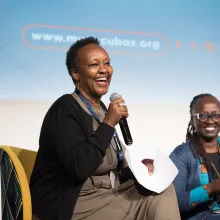
One of the foremost critical thinkers of the international documentary ecosystem, Leonard Cortana was tapped by EURODOC program head Nora Philippe in 2023 to manage the inclusion program and strategic partnerships. The resulting program, BIPOC EURODOC, hosts bi-monthly member meetings and monthly public webinars with outside experts to support the ongoing education of its members. The task force also conducts focus groups to inform white papers like this recent study on film festival delegations, in partnership with the #Docsafe initiative. Speaking on Zoom from Mexico City, Cortana spoke with Documentary about the goals of BIPOC EURODOC, the politics of film festival delegations, and why post-screening Q&As are “an extremely unsafe space.”
With The Encampments, directors Kei Pritsker and Michael Workman forge a counter-narrative to the mainstream media. Embedded with the encampment at Columbia University, which became a particular focal point in this controversy, they let the students speak for themselves. The Encampments pulled in the largest single-theater opening ever for a documentary (it was also the second-highest opening PTA) before expanding to over 50 markets last weekend. Amid the film’s early theatrical success, we sat down with Pritsker over Zoom to discuss the making of the film, its context in current political events, and adjusting the distribution timetable.
Shot over three years, Flophouse America is the unflinching debut feature by Norwegian photographer-turned-filmmaker Monica Strømdahl. The documentary offers an intimate, often harrowing portrait of Mikal, a boy growing up in a crumbling motel alongside his parents, Jason and Tonya, both trapped in cycles of addiction and poverty. In her conversation with Documentary Magazine, Strømdahl reflects on the ethical challenges of filming such vulnerable subjects over an extended period, the responsibility she felt toward Mikal and his family, and how her background in photography shaped the film’s aesthetic. With Flophouse America, she not only delivers a powerful creative statement but also raises urgent questions about systemic neglect, resilience, and the role of the documentary filmmaker as both witness and storyteller.
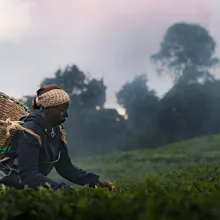
In 2024, 7 million livestock died in Mongolia due to what some say was the country’s harshest winter on record. Australian filmmaker Kasimir Burgess witnessed the disaster firsthand while making his third feature documentary, Iron Winter. The film documents two young herders, Batbold and Tsagaanaa, upholding a rural Mongolian tradition of winter herding—protecting horses from severe dzud and wolves by amassing them by the thousands and migrating for several months in search of better pastures. Ahead of its world premiere, over a video call Burgess shared with Documentary the appeal of the winter herding story, the challenges involved in telling it, and his hopes for what audiences take away from the film.
In 2003, a group of eight artists covertly built a living space in an unused part of the parking structure for Providence, Rhode Island’s gargantuan Providence Place shopping mall. Upon the apartment’s discovery in 2007, it became a brief local news sensation, before the story was largely forgotten. Jeremy Workman has brought the group back together to tell the tale in his documentary Secret Mall Apartment. We sat down with Workman for a call to discuss the unusual art project, the footage his subjects captured, and how he gained their trust to make the documentary after they’d denied other filmmakers for years.
No summary could ever do justice to what Belgian filmmaker Johan Grimonprez has created through his audiovisual-textual collage Soundtrack to a Coup d’État (2024). The year 1960, famously called the “Year of Africa,” serves as the political, social, and cultural matrix on which Grimonprez builds his manifold narrative—moving back and forth in time and space, layering sound, image, and text with texture and depth. Now an Oscar nominee, the documentarian comes well-prepared, armed with the quintessential skills of an avid researcher and a seasoned orator, opening new tabs in our minds with each question while anticipating potential criticisms with humility and curiosity. Documentary magazine sat down with Grimonprez to discuss Soundtrack to a Coup d’État in his format of choice: a dialogue.
Makarenko, a public school in the Parisian suburb of Ivry-sur-Seine, is the subject of Elementary , the latest vérité study from renowned French
APA members Debra McClutchy and Eugen Bräunig are eager to discuss the comprehensive new guidelines they’ve co-authored, “Working with Archival Producers.” From breaking down their roles during various stages of production to ideal onboarding scenarios, the document is, first and foremost, a means to advocate for a tangible job description and reasonable workloads. Despite the desire to establish concrete parameters for this work, there is also ample room for adjustment. In our conversation below, McClutchy and Bräunig discuss how they came to co-author this new guideline, how it complements the APA’s previous document on GenAI best practices, and member feedback.
Oleksiy Radynski is one of the most fascinating figures in contemporary Ukrainian cinema. Since his early shorts, Radynski has worked in observational documentary and archival footage. In films like his feature-length debut Infinity According to Florian (2022), he explores culture, historical memory, and community, particularly within Kyiv’s urban landscapes. The full-scale invasion shifted Radynski’s focus more decisively towards found footage, as he became increasingly engaged in the recovery of previously forgotten Ukrainian cinema. Ahead of its world premiere, Documentary spoke with Radynski about Special Operation’s challenging production, the semiotics of surveillance cameras, and the depiction of imperialism through landscapes.