Archival Storytelling

'Our Nixon' premieres in theaters August 30 through Cinedigm.
In this interview, Mary Stephen reflects on decades spent shaping other filmmakers’ narratives before turning to her own family in Palimpsest: The
In this interview on Under the Flags, the Sun, Paraguayan director Juanjo Pereira discusses completing his archival excavation of former President
In this interview, Iranian filmmaker Maryam Tafakory discusses how she abstracts and rewrites post-revolutionary Iranian cinema to reveal the queer
Close to the start of her hypnotic documentary The Memory of Butterflies, director Tatiana Fuentes Sadowski describes the moment that inspired the film. While looking through a selection of propaganda images taken by a company operating in the Amazon during the late 19th-century rubber boom, Sadowski came across a posed portrait of two young Indigenous men. In the image, the pair stands hand in hand dressed in Western clothes, stiff suits and ties, gazing at the camera with solemn, unreadable expressions: Omarino and Aredomi. Documentary spoke to Sadowski shortly after the film’s premiere at the Berlinale, where the documentary jury awarded the film a special mention, about the ethics of colonial archive, cinematic speculation, and sound as a threshold. This interview has been edited for length and clarity.
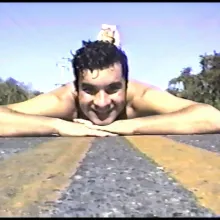
On January 14th,1996—his 21st birthday—Ricardo López started videotaping himself laying out his plot to attack the Icelandic popstar Björk. In this initial tape, López said Björk was a symbol of purity and innocence to him, an image which he said she destroyed by having relationships with two different black musicians, previously with Massive Attack’s Tricky and, at the time of his recordings, English music producer Goldie. Filmmaker Heather Landsman seriously considers López’s footage in her new film The Best of Me, which condenses the 20-some hours of tapes López produced into a hauntingly candid look into a deeply unwell and alienated individual. The Best of Me is being independently distributed by Landsman through the Film-Makers’ Cooperative, touring microcinemas.
Now a quarter-century old, the Museum of Modern Art’s Doc Fortnight has developed into one of the most sharply curated showcases for nonfiction film in the United States. In a climate of festivals fixated on acquiring flashy premieres, MoMA’s programmers instead focus on finding the new and recent titles that interest them most to give New York a taste of the international doc scene. This year, many of Doc Fortnight’s picks significantly repurpose existing media to new ends: Eight Postcards From Utopia, B.F. Skinner Plays Himself, John Lilly and the Earth Coincidence Control Office, Give it Back: Stage Theory, Henry Fonda for President, and An Unfinished Film.
In 2003, a group of eight artists covertly built a living space in an unused part of the parking structure for Providence, Rhode Island’s gargantuan Providence Place shopping mall. Upon the apartment’s discovery in 2007, it became a brief local news sensation, before the story was largely forgotten. Jeremy Workman has brought the group back together to tell the tale in his documentary Secret Mall Apartment. We sat down with Workman for a call to discuss the unusual art project, the footage his subjects captured, and how he gained their trust to make the documentary after they’d denied other filmmakers for years.
No summary could ever do justice to what Belgian filmmaker Johan Grimonprez has created through his audiovisual-textual collage Soundtrack to a Coup d’État (2024). The year 1960, famously called the “Year of Africa,” serves as the political, social, and cultural matrix on which Grimonprez builds his manifold narrative—moving back and forth in time and space, layering sound, image, and text with texture and depth. Now an Oscar nominee, the documentarian comes well-prepared, armed with the quintessential skills of an avid researcher and a seasoned orator, opening new tabs in our minds with each question while anticipating potential criticisms with humility and curiosity. Documentary magazine sat down with Grimonprez to discuss Soundtrack to a Coup d’État in his format of choice: a dialogue.