

Low-key but not low-energy, the 38th edition of IDFA opened with approximately 250 films under the leadership of a new artistic director, Isabel Arrate Fernandez, a veteran exec at the institution who stepped into the shoes of Orwa Nyrabia (a current board member of IDA, which publishes Documentary). So far, the respected festival has preserved the sections, competitions, and bustling nerve center of Vondelpark that were forged by Nyrabia, but it’s probably too early to single out the imprint of Fernandez’s brand-new tenure, considering that Nyrabia’s term only officially wrapped over the summer.
My focus was on world premieres, but as usual, the festival (which intriguingly opened with a program of protest-themed shorts) also offered the chance to catch up with the latest work by the likes of Laura Poitras, Gianfranco Rosi, Raoul Peck, Claire Simon, Julia Loktev, and Mstyslav Chernov, and feted Susana de Sousa Dias as its Guest of Honor. The audience award went to Cutting Through Rocks, Sara Khaki and Mohammadreza Eyni’s portrait of a steely-nerved motorbike-riding woman taking charge of municipal duties in an Iranian village while battling ugly local and state persecution, a nice bit of appreciation after its overlooked Sundance premiere. The jury awards tended to dovetail with the very titles that had filled my schedule.
The top prize in the international competition went to A Fox Under a Pink Moon, from leading Iranian documentarian Mehrdad Oskouei, a regular at IDFA for over 20 years (as he gleefully demonstrated during our interview by brandishing his past IDFA badges). Outwardly, it belongs to the annual crop of migration sagas that tag along, sometimes clandestinely, with grueling journeys toward and through Europe, usually enduring betrayal by smugglers, abuse at the border, and exposure to the elements. What distinguishes Oskouei’s effort is its teenage subject, who receives a co-director credit: Soraya Akhalaghi, a sculptor and painter whose defiant, playful, and confessional qualities fuel a raw artistic talent. An Afghan who works cleaning homes in Tehran, she is trying to emigrate via Turkey to Germany and escape her abusive husband and grim economic prospects. After finding Soraya making art in a friend’s studio (not shown in the film), Oskouei remotely directed and advised her own shooting—before, during, and between her attempts to leave, which include a harrowing night trip by boat.
It could all seem almost too much for one film to contain, between the violence and hopelessness of her marriage, and the physical and mental toll of the often last-minute emigration attempts. Without creating a false sense of escapism, Soraya’s unstoppable art-making allows her to transcend her immediate circumstances, as she crafts sculptures out of clay-like wet cartons and colorful paintings inspired by Frida Kahlo. What could sound like a documentarian’s opportunistic use of an artist subject who’s in dire straits instead upholds an emotional integrity through Soraya’s self-fashioning. The chronicles do not shy away from Soraya filming her own bruises from abuse. (The one scene that some might feel a tad precious in its romanticism was in fact a very late addition, riffing on the title: an Instagram-like composite of Soraya playing guitar next to an animated fox and moon.) Building on Oskouei’s established knack for portraying the struggles of his young subjects, and the talents of editor Amir Adibparvar, the episodic structure deftly compresses several years of life. The results suggest that remote collaboration is a matter of successfully syncing up on many levels, not just technical but also artistic.
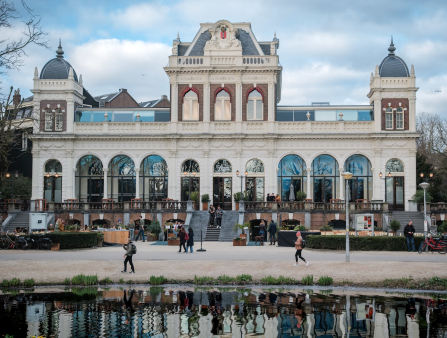
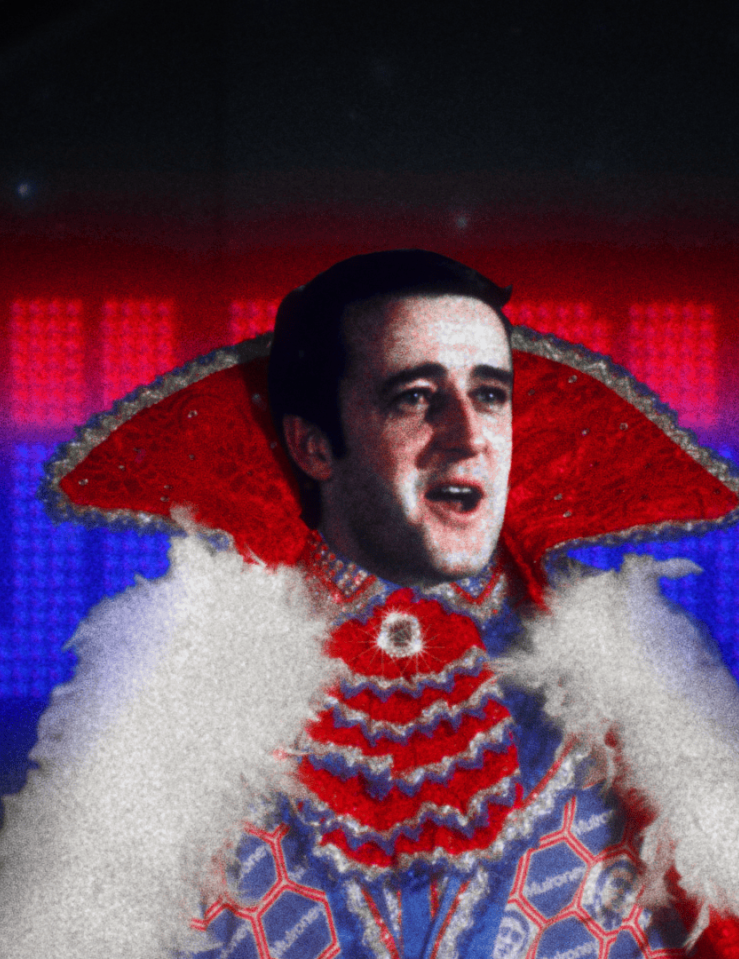
Het Documentaire Paviljoen. Photo credit: Bernard Kalu
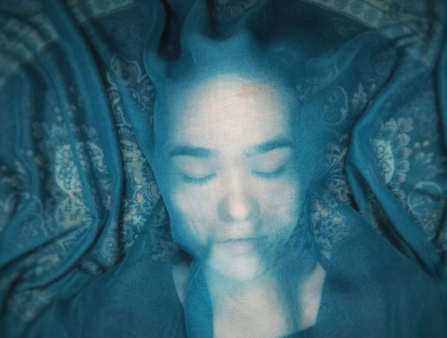
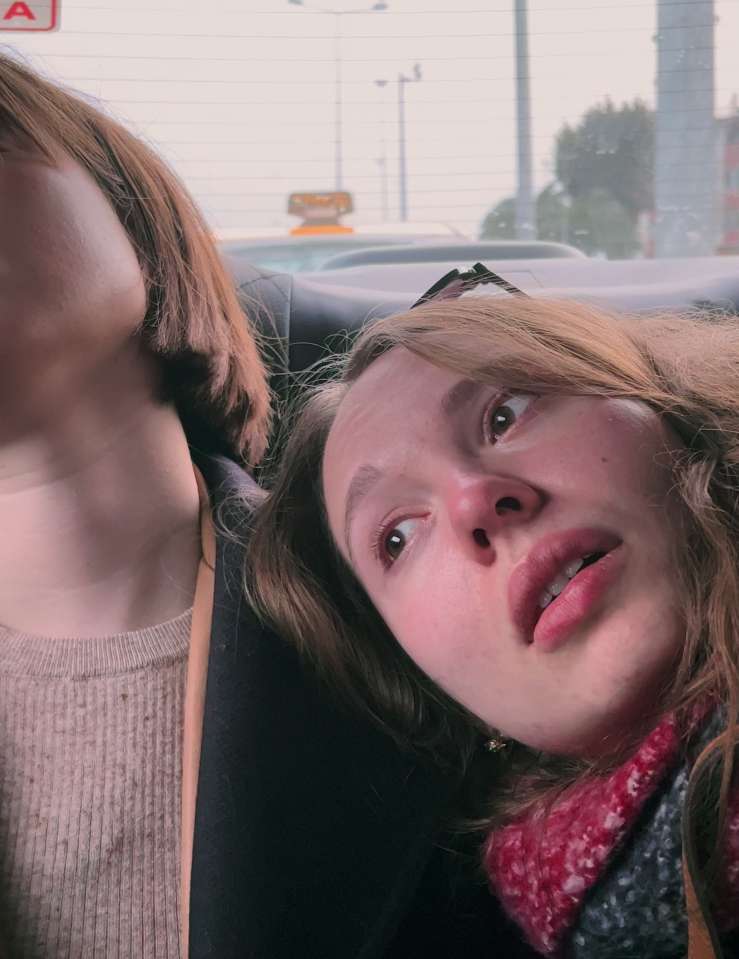
A Fox Under a Pink Moon.
Two films at this year’s edition complemented each other well in their treatment of sexual assault survivors dealing with the emotional and legal aftermath. First, Sien Versteyhe’s The Sessions follows a Dutch woman in her twenties through EMDR-aided therapy sessions as she works through her lingering trauma and feelings of disgust after someone she trusted raped her. The film’s understated technique, filming her at an angle from behind to conceal her identity but not render her an anonymous blur, respects the labor of recovery as she’s guided in revisiting her memories and monitoring her reactions. Versteyhe, in a post-screening Q&A, says she’d initially intended to chart across several cases before deciding to devote the film to this one, which allows for a deep investment in her journey.
What we see outside the therapist’s office are the protagonist’s calls with a polite but infuriating court bureaucracy, as her legal complaints—first about the original case and then about subsequent incidents of harassment—are steadily ground down by the machinery of a system that appears unable to hold the perpetrator accountable. The film’s innocuous interstitial moments (e.g. watching TV shows on her laptop at home) still radiate the weight of the burdens she carries. While she appears to make some progress with her caring therapist, the film harbors no illusions about the Sisyphean nature of recovery.
María Silvia Esteve’s international competition title Mailin covers similar sensitive territory. The film follows Mailin Gobbo, an Argentine woman abused as a child by a Catholic priest who victimized at least 120 others. Gobbo revisits her trauma through two parallel tracks: her court battles to hold the priest to account, and her reflections in voiceover alongside home video—both footage of her childhood at family events where the priest was a fixture, and current footage of her own daughters growing up.
Esteve centers Gobbo but buffers the film with dreamy interludes that bear some resemblance, in their grounding and centering effects, to the EMDR therapy in The Sessions. The experiences that Gobbo had buried for so long now preoccupy her on multiple fronts. Her unwillingness to turn away is expressed in Esteve’s inclusion of closed court proceedings, playing their audio under a shot of Gobbo staring silently into the camera. Esteve (who, credits reveal, handled editing, camera, animation, and music) cycles through Mailin’s meditations with a kind of aching repetition, until the trial winds to an awful close: the priest’s release. Mailin (and the film) breaks composure and lets loose with anger, supported by family and members of a tireless women’s collective. A text caption quickly explains that the priest was eventually convicted, then fled justice—underlining how Mailin and others are left to struggle with the aftermath without closure.

The Sessions.
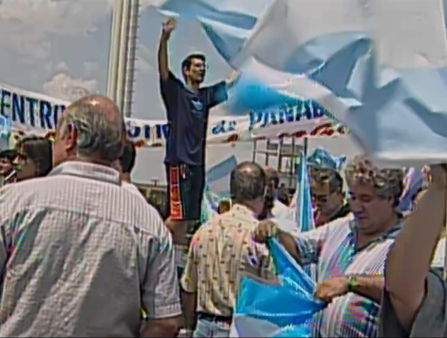
December.
Another strong film from Argentina, and the IDFA prize-winner for Best Editing, was December, Lucas Gallo’s in-the-moment found-footage history of the country’s 2001 financial meltdown. Composed of TV news coverage, minus the presenters and other framing (or distancing) devices, the gripping account moves through presidential politics, protests, and street unrest with the immediacy of vérité. When the government froze bank deposits amid a foreign debt crisis and recession, the decision threw the nation and its people into disarray. Gallo viscerally conveys this sense of freefall through military crackdowns and looting, but also through the palpable stress in the faces and bodies of Argentinians on screen. A comedic element emerges in the revolving-door turnover of politicians facing (or avoiding) this manmade catastrophe. At the same time, the insulation enjoyed by the ruling classes compared to those in the streets is unmistakable.
At times, the scale of the events recalls the Patricio Guzmán classic The Battle of Chile (1975), while the expert narrative use of footage recalls another recent skillful assemblage of video from a critical moment in Argentine history, The Trial (2023, dir. Ulises de la Orden). Almost as a spiritual reprieve from the galling government incompetence, Gallo (who previously directed 1982) includes an extended sequence at a much-anticipated soccer match. At a free-wheeling Q&A after one public screening, he said his long-suffering producer had urged him to cut it. Gallo also noted that funding for this account of Argentine history came from Uruguayan sources, after the Milei administration hobbled state funding in Argentina.
Watching December was especially intriguing during the latest bout of dubious American investment in Argentina, as were the festival’s migration narratives during the latest xenophobic tantrums by the current American presidency. That brings us to another pair of films at IDFA, which depicted smaller, isolated communities trying to carve out an existence amid much larger forces. Silent Flood depicts a religious community in Ukraine along the Dniester River. The members resemble the Amish in their traditional life and rejection of 20th-century technology. In 2015, a Kviv Post article claimed that the group refused to be photographed, but director Dmytro Sukholytkyy-Sobchuk gives them the full idyllic treatment, showing them going about their chores, wrangling horses in lakes or round a grain mill, baking bread in large loaves, and milling about outside in groups.
In voiceover, old-timers recap the area’s brushes with war dating back to the Austro-Hungarian Empire, but the camera tours their labor without showing much else about how the residents live their lives or manage the community. When this stuck-in-time hamlet faces the Russian invasion, the film abruptly shifts to focus on a Ukrainian troop bivouacked in one of the houses. As they eat bread made by “the old believers,” whilst lit like Old Masters paintings, the soldiers trade factoids about the community with respect and a hint of mixed feelings about their pacifism. Edited with scattered shots of damaged houses, it feels as if the entire population has suddenly vanished, like a lost civilization—a sense heightened when we next follow bomb detectors sweeping over the deserted farm landscapes. It’s a poignant effect, but one can’t help wanting to learn a bit more about and from the community.
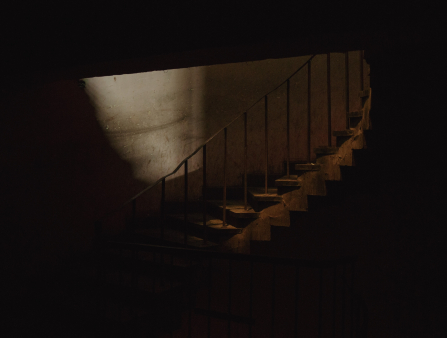
By contrast, The Kartli Kingdom (dir. Tamar Kalandadze and Julien Pebrel) rolls up its sleeves and essentially hangs out with the residents of a former sanatorium in Georgia, home to refugees from the disputed region of Abkhazia after the 1993 war. The building bears the scars of time—specifically, a massive widening crack that threatens its stability—and so this curious community is shown lobbying local authorities for re-housing guarantees. The solidarity of the politically active contingent, who are almost all women, and their acumen are apparent, likely the result of having to fend for themselves for decades.
Since the film barely leaves the building, the relaxed daily rhythms in its box-like rooms and grey corridors take hold, with residents kibitzing, napping, going to an apartment set up as a (free) store, or having a smoke on the roof. Waiting is the prevailing activity for this community, ensconced in both a familiar haven that they will be sad to leave and a place of limbo. The passage of time is hauntingly illustrated through intermittent, murky video clips of a wedding, in which one can recognize the now middle-aged participants. Behind the bonhomie and quiet resignation must lie a bone-deep desperation for some: the movie opens with a funeral for a man who committed suicide by jumping off the building, as if the wait had been unbearable.
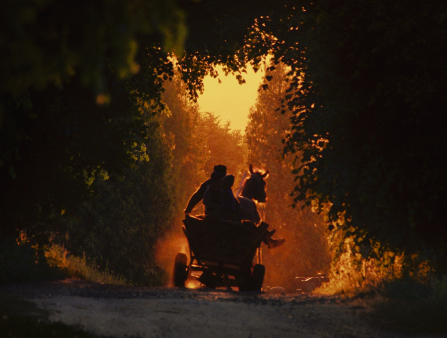
Silent Flood.
The Kartli Kingdom.
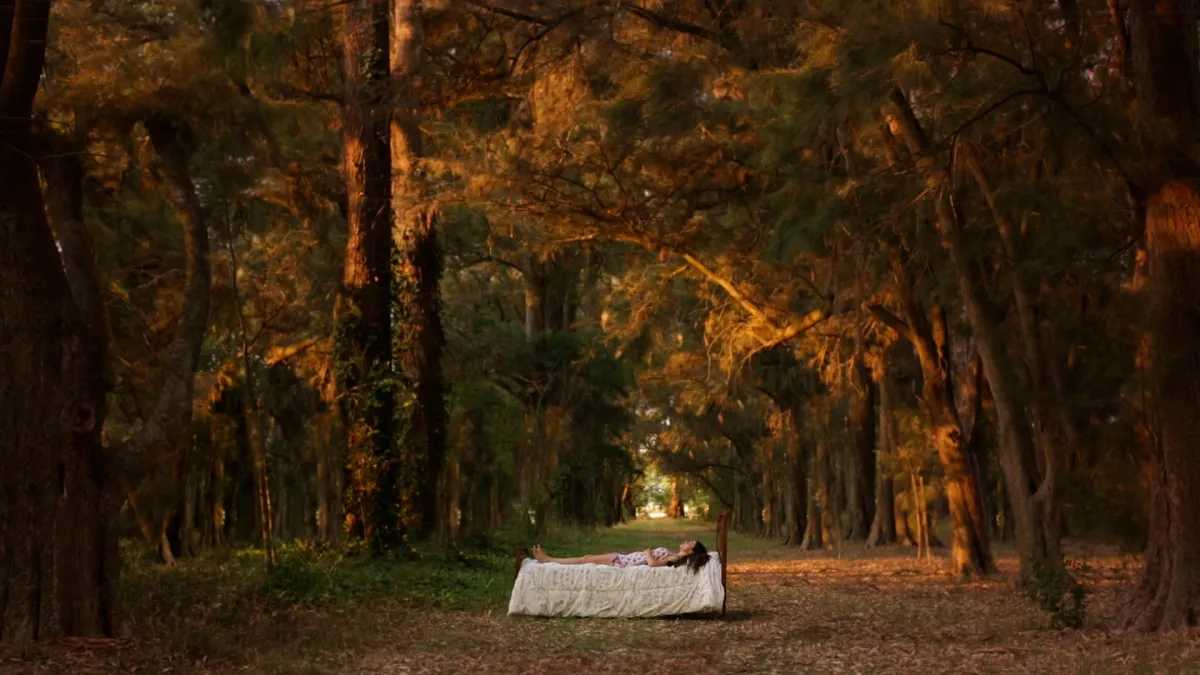
Trillion.
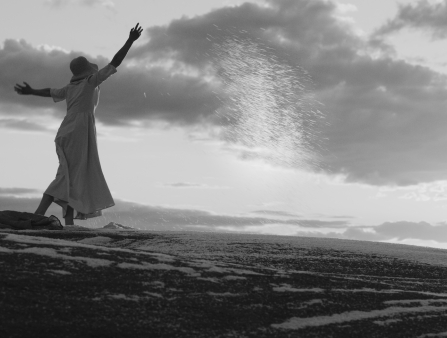
IDFA also presented a world premiere of the latest formal experiment from regular guest Victor Kossakovsky. A minimalist enigma until its credits, the black-and-white Trillion scans a desolate expanse of a sloping rocky island that suggests either outtakes from Man of Aran (1934) or electron microscopy, set to fretting cascades of classical music (later identified as “The Book of Grief and Joy” by Nastasia Khrushcheva). Kossakovsky’s camera follows one cloche-hatted perpetual stranger as she bustles across the uninhabited rocks, strewing what looks like grain or salt from a sack. Deprived of any explanation or identification, we are left to watch a ritual that frustratingly approaches abstraction. Is it some form of land art a la Andy Goldsworthy or Christo? Is it a record of a repetitive human activity rendered with stark beauty, like Sharon Lockhart’s clam-diggers? Or is this an homage to the sensual natural textures of early silent documentary, such as Joris Ivens’s Rain? Or is this perhaps the document of an obscure Guinness World Record?
Those were my charitable interpretations until late, extreme close-ups of fish scales further confused me, knowing the sleight-of-hand with which Kossakovsky creates even simple shots such as the close-ups of churning rock in Architecton. Trillion might make many throw up their hands at its stringent yet sadly monotonous art, well before a closing credit identifies the woman as the pseudonymous artist K49814, who works with fish scales and other natural materials, and dedicates the film to the trillion-plus fish taken from global waters daily. The decision to withhold any identifying information until the end feels bafflingly counterproductive to both the film’s political and artistic aims.
Finally, the IDFA program featured a retrospective about institutions, which included a canny pairing of Abbas Kiarostami’s Fellow Citizen, a 1983 telephoto montage of negotiations with a traffic official at a busy intersection in Tehran, and Donald Brittain’s 1979 satire of bureaucracy Paperland, which is wildly overdetermined and dated, but still amusing. One final mention goes to a deserving multiple-prize-winner that found me late in the game: Afghan-Dutch artist-filmmaker Dawood Hilmandi’s Paikar, a dazzling orchestration of sound and image (also edited by Fox’s Adibparvar, with echoes of Claire Denis) that traces the filmmaker’s attempts to reconcile with his gruff, remorseless father. The alternately tense and tender encounters between the two are punctuated by mesmerizing stretches of Hilmandi’s wanderings, overlaid with a huskily poetic voiceover and shot at subtly displaced angles and, especially in mobile moments, from hard-to-place positions. Like the best films at IDFA 2025, Paikar examined a familiar problem with restless energy and a bracing technique, allowing us to feel and understand the experiences on screen.