

Once Upon A Time in Harlem opens with a handwritten note from William Greaves:
In an effort of co-creation, I propose to create a series of great films on great people, all of whom are metaphors, creations of the Godhead.
This objective, this thesis, would be fulfilled by Greaves in his lifetime. A son of Harlem himself, to call him a pioneer in filmmaking would not be hyperbole. Alongside his lifelong partner and collaborator, Louise Archimbault Greaves, they set out to do just what he proposed: make great films on great people. Greaves’s filmography is teeming with films about Black cultural figures and history, putting on record their insurmountable contributions to the artistic landscape across time. A handful of selections include titles such as The First World Festival of Negro Arts (1966), Nationtime (1972) , and Ida B. Wells: A Passion for Justice (1989). He also shifted American independent film with his masterwork, Symbiopsychotaxiplasm (1968), which was added to the National Film Registry in 2015.
In addition to his prolific work as a documentarian (receiving an IDA Career Achievement Award in 2005), Greaves was also a groundbreaking journalist with the television program Black Journal, which, under his tenure, won an Emmy Award. The show’s objective was to showcase stories by Black Americans, for Black Americans, which made it not only an important historical document in the midst of the Black Arts and Black Power movements, but also an incubator of Black filmmakers like St. Clair Bourne.
The Black filmmakers who cut their teeth with Greaves include his son David Greaves, who worked diligently alongside his father over the decades. In the voiceover of William Greaves’s voice reading his note at the beginning of Once Upon a Time, we hear him address his son directly: “use that reading, David.” It’s a poetic gesture to the familial collaboration that seems integral to his filmmaking practice. It’s a tradition that continues in this film, a posthumous release premiering at this last Sundance in Park City. Once Upon a Time in Harlem is conceived by William Greaves and directed by David Greaves, who also worked with his daughter Liani Greaves, who produced the film with Anne de Mare.
Shot in 1972, this exploration of the Harlem Renaissance takes place over one evening. Luminaries of the then–recent past descend upon the apartment of Duke Ellington to reunite for a cocktail party, and discuss their involvement and remembrance of the Harlem Renaissance. Now, it’s almost hard to fathom that the Harlem Renaissance was a century ago. Its artists, writers, and thinkers' influence has been long felt. The Renaissance immediately calls to mind folks like Langston Hughes and Zora Neale Hurston, both of whom had since passed upon the creation of this documentary, but whose spirits loom large in the room, and in the arts and letters. More so in recent years with posthumous releases and books interrogating their friendship. However, this is merely one facet of the Renaissance, a movement that had been building in the years prior to the twenties.
The circumstances leading to the Renaissance are also familiar to our current century. The NAACP’s Silent Protest of 1917, the Red Summer of 1919, the first wave of the Great Migration, and Spanish flu all occurred in succession opening the door to shape the minds and hearts of those who would come to Harlem in search of avenues to assert and express themselves both politically and artistically. As Thomas Harvey puts it at the end of the film,
...I think we kind of touched on all the different philosophies that were espoused during that period and I think it all had to do with the struggle of the Negro, the rise of the Negro. And most of these activities were not coordinated. I think all of them were aiming at the same thing but we were traveling different roads.
Nonetheless, their paths converged, and would again some 50 years later at the behest of William Greaves, with the help of librarians Regina Andrews and Jean Blackwell Hutson, themselves figures of the Renaissance.
These legends arrive in their Sunday Best: tan suits, teal ties, flowery dresses, and ornate jewelry. They’ve gathered to remember and to discuss and litigate the arts and cultural movement they ushered in five decades prior. Voices overlap, people shout the name of folks who didn’t make it to the convening (like influential sculptor and educator Augusta Savage, or political leader and UNIA founder Marcus Garvey) to ensure their legacies aren’t left out. I love the shots of hands jutting out in excitement at a memory or a counterpoint to be made; disagreements still abound. Ida Mae Cullen reminds us not to forget her husband Countee Cullen’s contributions. Split screen is employed to showcase the reactions around the room at various points of the party. The film also incorporates individual interviews with the likes of composer Eubie Blake, painter and queer pioneer Richard Bruce Nugent (described by another attendee as “the Boy Wonder of the Renaissance”), and journalist Gerri Major. I’m most struck by Leigh Whipper, an actor born during Reconstruction and, at age 96, one of the older people in the room. He recites from memory a poem dedicated to him by Paul Laurence Dunbar, a friend and fishing partner.
What’s striking is how the film makes clear the importance of an ecosystem. Each person, down to the historians and the theorists, all comprise a crucial piece of what’s necessary to create a renaissance. It’s not lost on me that this reunion is also happening in the midst of what would then be another period of upheaval and artistic creation as the Black Arts Movement is still in full swing in Harlem, images of folks on the streets sporting afros, a marquee at the Apollo advertising a blaxploitation film. Some fifty years on, we finally have this film.
Once Upon a Time in Harlem feels like a gift, a monument, and, as Liani Greaves so adequately puts it during our conversation, “a recipe.” Within this masterpiece, we can find the ingredients necessary to create our contemporary Renaissance, learning and building upon the path that was illuminated by our geniuses. In fact, that is precisely what they wanted! The spirit of the Harlem Renaissance has never ceased. Our conversation traverses the film’s genesis, why it took another fifty years to complete, and what the future holds as David and Liani Greaves ensure and preserve William Greaves’s artistic legacy. The film premieres later today at Sundance. This interview has been edited.
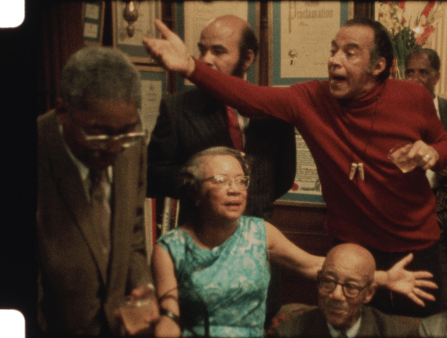
Aaron Douglas, Jean Blackwell Hutson, Nathan Huggins, Richard Bruce Nugent, Eubie Blake, and Irwin C. Miller appear in Once Upon A Time In Harlem. Image credit: William Greaves Production
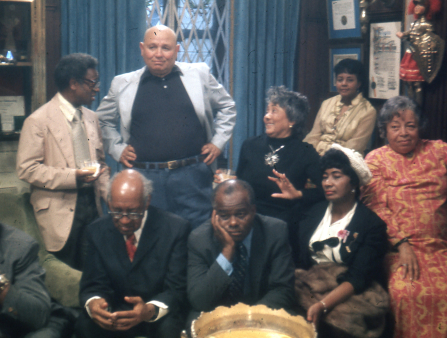
Thomas Harvey, Ernest Crichlow, William Patterson, Romare Bearden, John Henrick Clarke, Ida Mae Cullen and Louise Patterson appear in Once Upon A Time In Harlem. Image credit: William Greaves Production
DOCUMENTARY: The film starts with a title card that says the objective is to make great films about great people, which we know that your father and your grandfather have a legacy of doing. Can you talk about the genesis of this film at the time that it was being made?
DAVID GREAVES: It was inspired by a book by David Levering Lewis. I’m sure dad read it; he was steeped in those people and that time. I imagine it frankly grew out of there. We were funded to do a film about the Harlem Renaissance. He shot From These Roots [1974], a black-and-white archival distillation of the Renaissance.
The live action party had to be put on hold until because he was working on other projects, and did not have any funds to do this second film.
LIANI GREAVES: So much of this project is about this idea of co-creation and collaboration. Even that [1981] book by David Levering Lewis, it’s called When Harlem Was in Vogue, is part of that kind of collaboration. My grandfather was reading that book and was inspired and said, “I’m going to bring together these people into this party and create this party and film it.”
D: David, I know you were a cameraman on this project. Can you talk about what you remember about the approach to filming a dinner party, or having them all in one space and talking?
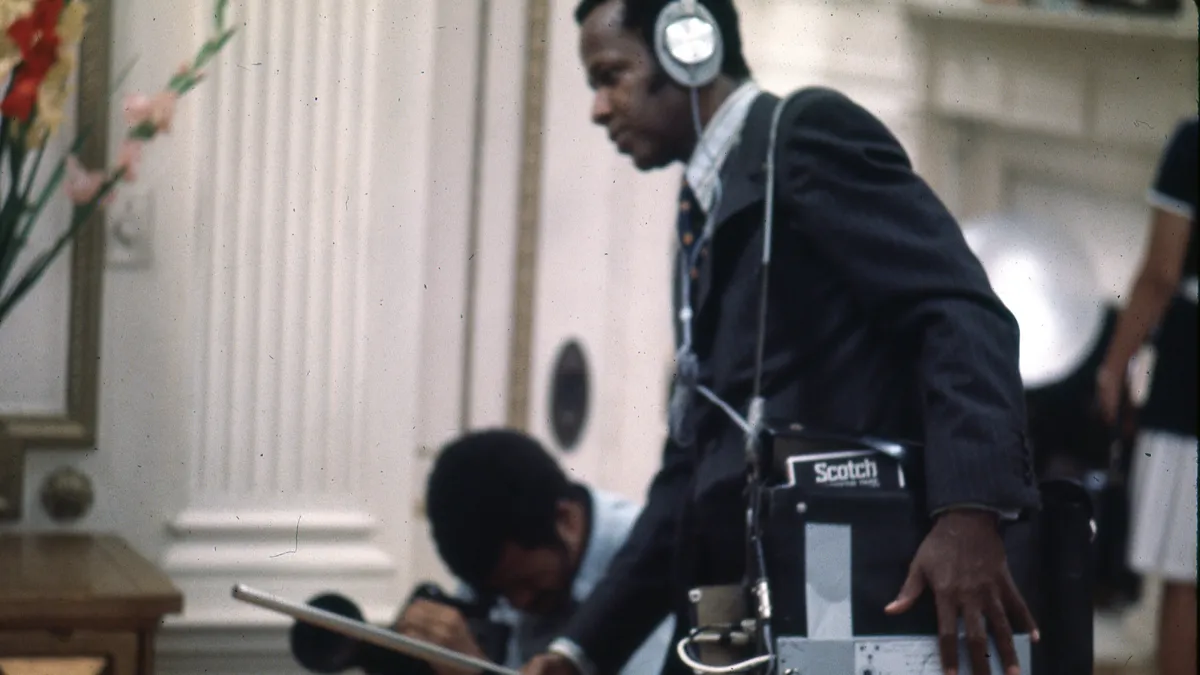
DG: Sure. Well, dad had four camera people, four cameras, and two sound people. And so we worked in two teams, like flies on the wall, capturing conversations at the beginning. As I’m sure you see all the various conversations that are taking place. We were able to have usually two cameras on each of them. And then, in the discussion, he was directing the action by raising questions. Our job was to capture those reactions.
D: Was that your first time collaborating with your father in a filmmaking capacity?
DG: No, I worked with my father for 15 years on films and as his assistant. We had a long relationship in terms of working on films. And the predecessor to this film, From These Roots [1974], helped shape it.
D: Did he collaborate with Duke Ellington at all, seeing as the party takes place at his house?
DG: No. He collaborated with the librarians at the Schomburg, both Jean Hutson and Regina Andrews. They were the contacts between Dad and the Renaissance luminaries.
D: Can you tell me about the genesis of what we see now, Once Upon a Time in Harlem? What drove you both to say, “Okay, it’s time to finish this. It’s time to get this out into the world”?
LG: We were probably going to say the same thing: Louise Greaves.
DG: Yes.
LG: My grandmother [Louise Greaves] was my grandfather’s producer for his entire career; his collaborator. And they had been working on the film before my grandfather passed away. They had been working on trying to find a way to finish this film. And they were shooting a lot of new footage of cultural events and that kind of thing, and couldn’t really figure out how to make it work together. At the time of her death, she had been working on the film.
She’d gotten a grant from the Ford Foundation to restore and preserve the footage. It was shot on 16mm film. That was a year-and-a-half project that started around 2020. So it started out as, Well, someone’s gotta do it. And Louise Greaves said, “You two are going to do it.”
But it wasn’t just the two of us. Anne de Mare, who’s a producer on the film, was working with Louise on the restoration part of that.
D: That’s about a 50-year gap from when it was shot. What was David and your grandfather William Greaves’s relationship to the material prior to 2020?
DG: When he [William Greaves] started to get back into the footage, there was a lot of uncertainty in terms of exactly how they wanted to put other things into this project. Then Dad became very ill. And so it was up to Louise to make it happen. Without her tenacity, it would not be here.
D: So you mentioned there were shoots after, but this film is predominantly archival footage from the party. And you also have contextual footage and things of that nature. Can you talk about the creative decisions once you both came on board to make this film?
DG: First of all, creatively, you go through the footage. It’s amazing. And selecting the most emotional parts that really are exciting, are historically important. I was thinking about what folks should know about. They should know about Theodore Roosevelt being hissed. They should know about JT Gibson loaning another Black man $5,000. They should know that Essie [Eslanda Robeson] was the one who went to a lot of libraries to study up for Robeson. So a lot of those decisions were made one at a time.
LG: I was really curious about those relationships and those moments of collaboration that created the Harlem Renaissance. It was all collaboration. It was intergenerational. It was the painter sitting for the sculptor. And the sculptor reading the poetry for the poet. That was exciting for me.
I was really curious about those relationships and those moments of collaboration that created the Harlem Renaissance. It was all collaboration. It was intergenerational. It was the painter sitting for the sculptor. And the sculptor reading the poetry for the poet.
— Liani Greaves
D: When I was watching it, I was thinking about how Leigh Whipper was born during Reconstruction, and a lot of the things that we are dealing with in this country right now feel reminiscent of that era, when he was talking about his father being on the legislature and them not wanting to uphold that decision and things of that nature. It’s very apparent that, in a lot of ways, the more things change, the more things stay the same.
LG: What I love about the film is that there’s so much to learn from what was preserved. We can go back, see this footage, and learn from those experiences and really learn about, “Oh, collaboration is important.” This is a way that we can create things and pay attention to the people that are around us, the other artists, the other creatives.
D: I think even the format of the film—of it being a party—speaks to the origins of the Renaissance, which a lot of it was done through socializing and partying.
LG: Yes.
D: You can make a movement at a party.
LG: That’s right.
D: Can you talk to me a little bit about some of the formal decisions that were made? I really love the split screens and the use of voiceover. What was that process like?
DG: That kind of thing grew out of Symbiopsychotaxiplasm [1968], which was all split screens and people moving around. That gave us the license to have him on camera and also to use as much of the material. Whenever we could, we tried to put in the split screen.
LG: So much of this film mirrors Symbiopsychotaxiplasm. He did this film after that, and this idea of, I wonder what would happen if I put all these people together and put a bunch of cameras on them? That curiosity is where the magic happens.
DG: He was absolutely correct. The energy from seeing each other after so long—a lot of times they hadn’t seen each other in 50 years—he knew they would be able to express it in some way because that’s who they were. They were, as he says, metaphors of the divine.
D: Can you talk about the audio at the end of the film? I love being in the party, but the ending montage is so powerful because you have these images of children—you’re clearly gesturing towards this intergenerational aspect. When I was watching it, one of those kids on the stoop could be my parent, and now I’m talking to you. Could talk about the use of his voice at the end of the film and piecing together the ending montage?
LG: That poem is at the end of another film that my grandfather made. And that film, Wealth of a Nation [1966], is about creative expression. He ends it with this poem that he wrote. I love that poem so much. And yes, there’s that intergenerational piece. One of the kids in there is me, actually, and I’m pointing at my dad at the time. So it’s kind of this weird moment that happens. I love the ending of the film as well. And that music by Tamar-kali.
DG: As I think about that, the montage grew out of what it is that they had in there originally.
LG: Our goal with this film was to enliven my grandfather’s legacy and his impact. He had not planned on inserting his writing and all of that. That is what brings him back into the film. And also, it shares for the first time his ideas around creative expression and personal expression with the public. I love that because it’s the final word about his work and what he was really thinking about, which was our right and our ability to express ourselves.
As they say in the film, the younger generations should really pay attention to what happened before.
— David Greaves
D: How was the editing process overall? I actually saw some of this at the Flaherty last year. And I know there was also a screening at the Met the year before that. How did these screenings help shape the process of making the film?
DG: We had some wonderful advisors look at it, and they definitely contributed. Particularly at the beginning of the film, we had a lot of other historical material, and people said, “No, let’s get to the party.” And so a lot of that historical background ended up inside of the poem, “The Negro Speaks of Rivers,” which is just the history, then the middle passage, and then here in the States.
D: There’s a lot of intergenerational tension in the room in this film. 50 years have passed since it was recorded. What do you hope newer generations take from seeing this now?
DG: The importance of the history that we come from. As they say in the film, the younger generations should really pay attention to what happened before.
LG: I see this film as sort of a recipe for a Renaissance, or an awakening, as George Schuyler calls it. What we noticed is that, 50 years later, as they reflect, they say, “The Renaissance didn’t die.” This idea of awakening doesn’t die. And so I want people to notice that they are in the midst of their own Renaissance. That there are journalists like yourself, like we are: this is what it is.
And to pay attention to the time because you don’t realize sometimes what we’re doing right now. This is an awakening. What are we creating here? I think that’s one of my grandfather’s driving questions: What are we bringing forward at this moment?
D: I wanted to ask you about legacy. I think it’s so beautiful how you have all kept working within the family and are spearheading the preservation of your legacy. Can you talk more about what that’s like and the beauty of that culminating in this film?
DG: I’m joyful about it, frankly. We believe that Dad and Louise are both joyful about it, too. The whole thing about this is the energy that Louise put into it. Liani has a very funny photograph of Louise toward the end of her life in the hospital, with a computer in front, with a telephone there, and the papers, because that’s the kind of person she was. She was focused on this thing. And so we have a responsibility to honor that as well as my father’s work. So yeah, it’s a family affair.
LG: It was awesome to be able to work with my dad on a project so intimately. It's been a real honor.
D: Wonderful. As a duo, are you working on anything else?
LG: We’ve got other projects around William Greaves Productions that we want to be thinking about. And then, as far as this project, there’s another part of it. Dad calls this film a trailer for the archives from the footage. It was 60,000 feet of film that was shot. There’s a lot that couldn’t make it.
So we are also creating a public-facing archive that folks will be able to watch and listen to the rest of the interviews and be able to access. Our mission is to really share this project as widely as possible and have people experience it.